Bubbles, Bars and Big Fish

Monday 29th April 2019

It’s a rather blustery morning with dark clouds rushing across the sky, but with the early light playing spectacularly on the hills, I am enjoying a few moments of quiet, in our calm anchorage in Privateer Bay, to catch up on my blog.

Hills of Tortola in the morning light

Last Tuesday morning we sailed to one of our old favourites, Diamond Cay and opted to drop the anchor in the slightly deeper water at the centre of the bay to escape the crowds. It is a beautiful spot with the shallowing sea providing every shade of turquoise imaginable with, in the distance, Sandy Spit. Sandy Spit with its Robinson Crusoe look of white sand with a solitary palm tree had often acted as the poster boy for the BVI, sadly, post Irma, the tree has gone but the sand island still acted as a good focus to paddle out to in the kayak, as did the bar on the opposite shore. Our kids were using every moment of their holiday to the full.

The walk through the mangroves to the ‘bubbly pool’ has also been stripped bare, the dead trees cast aside leaving open beach. However the view here where the mighty Atlantic is halted in a froth, by a wide reef, to produce a tranquil lagoon is still great, as is the clamber up the hill to the cliffs.

Mangroves stripped bare but the Atlantic forces its way into the lagoon just the same.

After a short 15min walk you are brought to the main attraction, a small bay where the same power of the ocean is squeezed, this time, through a gap in the rocks, each wave turning the calm pool into a seething mass of bubbles.

Having fun at the Bubbly Pool, Diamond Cay

After a couple of days we pushed on to visit two of the ‘must dos’ bars here in the BVI; the Soggy Dollar Bar and Foxy’s Bar. Both were full to the brim, in fact Josh Van Dyke Island, at least as far as the tourist dollar is concerned, appears to be very much business as usual.

Sopers hole on the other hand looks to be using the devastation to rebuild bigger and better, the whole place is currently one large building site, with nothing open we moved on to Norman Bight.

And finally we found some good snorkelling not just on the edge of the bay but around the corner to an area known as the Caves. While the younger crew opted to investigate another beach bar, Rick and I took the dingy out to explore. The water was beautifully clear and right on the southern point of the bay we found turtles. They were quietly relaxing on the rocks just under the surface, they were so close we could almost touch them. Surprisingly unbothered by our presence, they just sat there, rarely have we had such a good photo opportunity. Unbelievably, and probably for the first time ever, we had forgotten the camera!

In the morning we took Raya around to the Privateer Bay just beyond the caves and we all snorkelled most of the day intent on getting that perfect turtle shot. Typically there were none to be had, but there were plenty of things to enjoy instead.

The local big fish here are tarpons. They can grow to be 6 or 7 ft long and we have seen them, attracted to the light at the back of the boat, most evenings since Antigua. They are easily identified not just by their size but by their startlingly, shiny, silver scales that reflect in the spotlight. Yesterday we saw them as we swam along the cliffs, lurking in the blue of the deeper water their size was slightly intimidating despite knowing that they are harmless. In the shallows were smaller but more colourful specimens, from the crowds of sergeant major fish that Matt and Robyn fed with old bread to large parrot fish, elegant french angel fish, bright queen triggers and peculiar looking file fish.

A queen trigger fish snapped by Matt and a perfect Parrot fish caught by Rick

As the name suggests the cliffs here are full of small caves, the light playing on the water as you enter is magical and for those less frightened than me, the dark interiors fascinating. As everyone investigated I was excitedly floating above a large spotted eagle ray and later in the afternoon Rachael and Andy even found a nurse shark for company.

No turtles today but nobody was complaining.

Back to the BVI

Tuesday 23rd April 2019

With the wind behind us and a bright moon above us, it was a lovely night sail from St Barts to the British Virgin Islands. We sailed excitedly through the outer islands into the Francis Drake Channel as the first signs of light appeared in the Eastern sky. It was in the BVI , over a few charter holidays, that the seeds for this trip were sown and, as such, is a good place to have our final tropical fling before we set off back across the Atlantic to cooler climes.

Unfortunately our happy memories were immediately soured by the check in process. The anchorage in Road Town was small and very choppy in the brisk wind. The dingy dock for customs required us to squeeze between a ferry and the rocks. Once inside the custom office the procedure had about seven ill defined steps, each one requiring either form filling or payment and the receiving of numerous stamps. We have occasionally seen worse bureaucracy but nothing like the bad attitude of the officers here, they were incredibly rude, arguing with us and each other and being purposely unhelpful.

So it was two tired and rather cross sailors that docked a few hours later in Nanny Cay marina, to spend a couple of days on the normal marina jobs. Hose down the boat, laundry, cooking gas refil, provisioning…… It has to be said that it took us a few days to find the Caribbean vibe that a stay in the BVI normally brings

Every where has a not quite familiar feel to it. Of course not only has it been about 7 years since our last visit but during that time the country has suffered the effects of a devastating hurricane. On the 6th September 2017 Cat 5 Hurricane Irma passed directly over the islands. Producing wind speeds in excess of 180mph, it was the strongest open sea Atlantic storm on record and nothing much survived its fury. Eighty five percent of the housing stock in Tortola was distroyed or damaged, Island infrastructure was mostly wiped out and the charter yacht fleets, a major source of income for the area, were decimated. Miraculously due to the effective early warning systems in place only four people lost their lives.

The Islands after a huge effort have mostly recovered but signs of wreckage are still in evidence. Particularly poignant for us were the yachts that Irma left high and dry and that still line the beach at Trellis Bay, their typically jaunty nautical names, ‘The Good Life’, ‘Chillin”, ‘Starry nights’, now seeming cruelly incongruous.

Wrecks still litter Trellis Bay

We were however there for a happier event, Trellis Bay is five minutes from the airport and Rachael, Mathew and their partners Andy and Robyn arrived Saturday on the evening flight. Despite the fading light they couldn’t resist an immediate swim, in fact they have hardly been out of the water since.

Readying to snorkel around Monkey Point
We have been nicely surprised by the lack of crowds, of course we return with a lot more experience and are, where possible, anchoring, instead of being squeezed tight in the mooring fields. And there are so many protected anchorages here it’s easy to just hop from one to another each day as the conditions dictate.

Not so good is the lack of life in the sea, we remember the BVI for it’s good snorkelling but it seems Irma has taken her toll under the water as well as on land. Monkey Point always one of our favourite spots was teeming with baby fish but with very little coral the reef fish were missing.

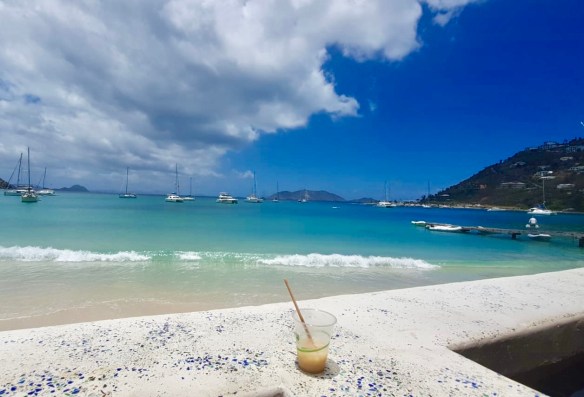
The sea is still a remarkable blue, the beaches are of soft sand and the green hills of the islands still make for a stunning back drop.

Cane Garden Bay

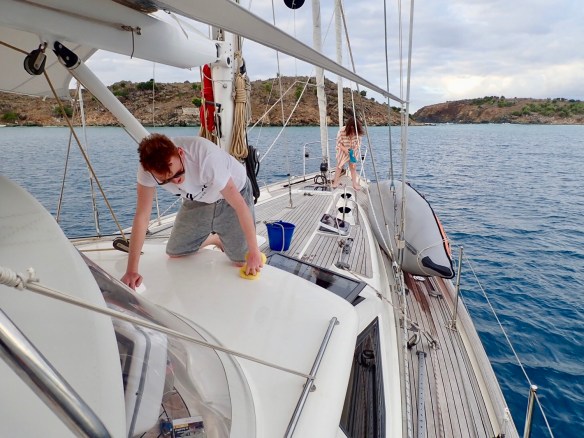
Having six people onboard has rather embarrassingly shown exactly how much we have spread out over the past four years, emptying lockers and clearing bunks took us a couple of days but by Saturday there was plenty of room for everyone. The cooking and washing up is a bit of a mission, the beer seems to somehow be disappearing and the rails are permanently full of damp towels. However the conversation is good, the laughter is loud and trips ashore frequent, I think everyone is having fun, despite the captain dishing out cleaning tasks.

Crew earning their keep

Money, Money, Money

Monday 15th April 2019

On Wednesday we left the superyachts of Antigua, for, if possible, the even more opulent world of St Barts. In the immortal words of ABBA, it certainly is, at least around here, a rich mans world.

We are anchored off the west coast of St Barts, it is windy and the fetch combined with a bit of a swell is making things rather uncomfortable. The conditions are not improved by the continuous wake of large fast tenders racing back and forth from their luxuriant motherships.

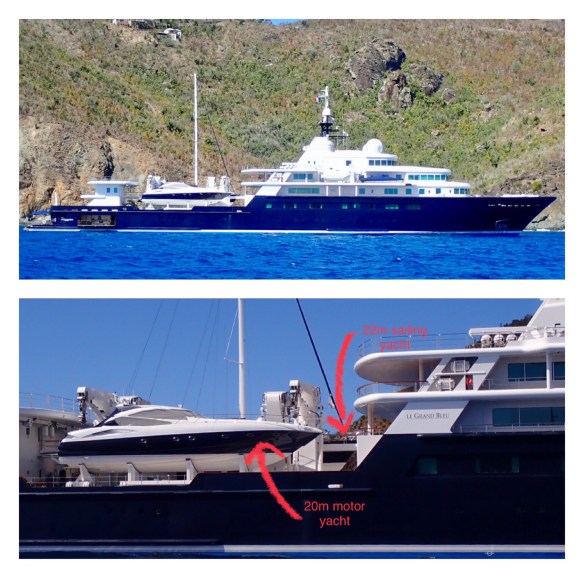
The most luxurious of all is Le Grand Bleu, who at 113m long is one of the largest private yachts in the world and on her deck has, indulgently, a 22m sailing yacht (that’s 5m longer than Raya) and a 20m motor yacht. If Wikipedia is to be believed it was exchanged in payment for a lost bet between two Russian oligarchs.

Just plain greedy

Despite all this and the rocky anchorage outside Gustavia’s harbour, we are loving it here. From the efficient customs check in, to the restaurant staff, to the well stocked supermarket everything has been friendly and very french and unlike some of the French islands we have been to everyone is happy to speak English. Despite the superyachts in the harbour, the multi million pound villas that sit above us in the hills and the designer shops that line the Main Street, prices are unexpectidly reasonable. We decided to stay a while.

Not having local Sims for mobile data, we have been forced to spend time over long lazy lunches using the restaurants free and fast WiFi services. Not much beats eating fantastic food, with a cooling breeze and nice views.

Lunch time view

In fact overall St Barts has a very different vibe to the other Caribbean Islands we have visited, I decided to look into its history. Named by Christopher Columbus after his brother Bartomoleo. Little more than nine square miles of rugged rock, for years nobody paid much interest in it, even the local Caribs it appears only visited on occasional fishing trips. However in the 17C as the Europeans battled for dominance of the area, the French claimed the island and an increasing number of settlers began to live on its steep hills. In 1784 the French gave the islands to Sweden in exchange for trading rights in Gothenburg. As the only Swedish interest in the Caribbean they spent time and money modernising the island, building roads, forts and with no flat areas for plantations, they instead took advantage of it protected harbour to create a freeport, naming the capital Gustavia after the Swedish King. This in tun attracted more trade, legal and not so legal, and the island began to prosper. Eventually after a hundred years, with the population still mainly descendants from the original French occupation, Sweden returned the island to France and St Barts today is an ‘independent overseas collectivity’ and part of the French West Indies.

Pretty streets in Gustavia

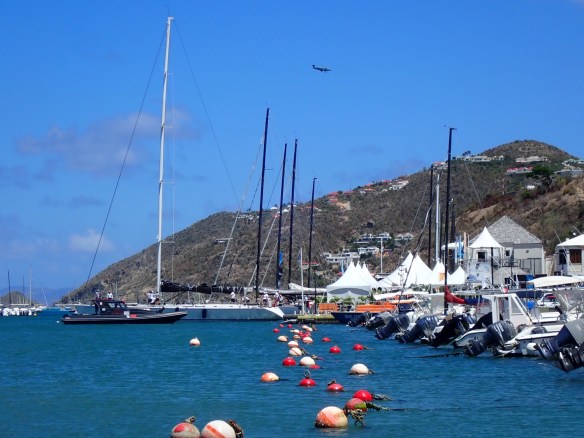
Its main focus is now tourism, with many hotels and upmarket holiday villas. It restricts the number of large cruise boat visits and instead encourages cultural and sporting events. Including, another reason for us lingering here, the Voiles St Barts yacht regatta. For the past week amazing sleek racing yachts have been arriving and we have been enjoying watching the action as they prepare for first race today.

Racing Yacht Sorcha setting out for a sail

To escape the turbulence of the outer harbour anchorage we sailed around the corner to Colombier Bay. The water around St Barts is exceptionally clear and we had an enjoyable snorkel along the its rocky sides. As with the rest of the Caribbean there was little coral and few fish but an enjoyable swim never the less. The bay was still busy, escaping the large motor yachts seems impossible here and so when the next day a wind shift bought fierce gusts into the anchorage, we moved back to Gustavia to make ready for the overnight sail to the British Virgin Islands we plan for this evening.

Nautical Giants

Sunday 7th April 2019

The stunning 200ft schooner Athos joins us in Hermitage Bay.

Torrential rain beats down on the hatches, I’m up to my elbows in laundry, which, if the rain doesn’t stop soon, I’ll have nowhere to dry and Rick has his head over the innards of a broken toilet. The cruising life is not all sand, sun and sailing. Luckily, in compensation, we have had our fair share of each of these over the past few days.

English Harbour, a quick walk from our anchorage in Falmouth Harbour, is home to Antigua’s premier historical sight, Nelsons Dockyard. The bay was recognised during the 18th Century as large and sheltered enough to protect the Royal Navy’s Caribbean fleet from hurricanes. It quickly grew into a working dockyard repairing ships that otherwise would have had to have made the long and arduous trip back to England. In the 1780’s Horatio Nelson, then a Captain, was stationed here for three years and when the dockyard was restored in the 1950’s it was named in his honour. Now full of restaurants and gift shops it still retains its marine links with numerous yacht services based in its old buildings and docking for large yachts around its edge.

The old dockyard buildings although converted to commercial use still overlook large sailing boats
Last week the dockside was gradually filling with Oysters, the participants of the World Rally arriving for the official completion of their circumnavigation and boats gearing up for the Oyster Regatta that starts tomorrow. Oyster engineers were, as always at these events, on hand to help check over the boats and happily extended their advice to us and any other Oyster yachts anchored near by.

It was great to link up with old faces, one family that we met sailing their Oyster across the Atlantic with us nearly four years ago, were also on the dock. However, they have turned to the dark side, swapping their sails for a 72ft motor cruiser. They kindly gave us the tour, the engine room alone seemed nearly as big as Raya, a lot of pipes, connections, filters etc. to look after but all comfortably at eye level. The living quarters were as luxurious as expected but the thing that caught our eye was that chairs sat unfixed to the floor and picture frames adorned the shelves, having stabilisers makes life at sea much more comfortable.

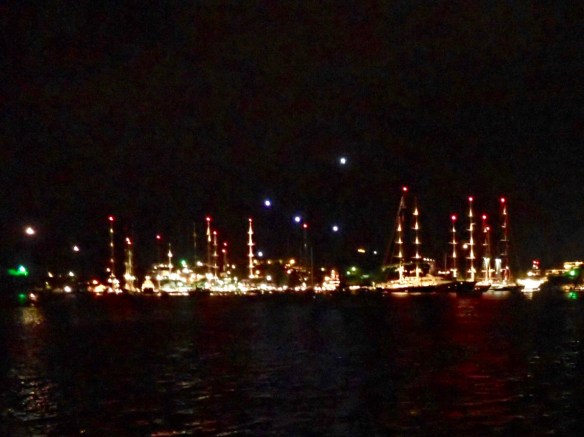
Back across the headland in Falmouth Harbour there were plenty more nautical wonders to admire, megayachts filled the marina and they were quite a sight, at night, their tall masts fully lit,the scene was reminiscent of a huge oil refinery..

Nightscape created by dozens of mega yachts.
Near the entrance of Falmouth Harbour is Pigeon Bay with its pretty beach. Monday we took the dingy over to investigate and nestling, almost hidden, in the trees, we found Catherine’s Place a lovely barefoot beach restaurant. With great food, exceptional cocktails and friendly service, all a few steps from a cooling swim, we couldn’t resist and retuned the next day to do it all again.

Wanting to explore Antigua a bit further, for Phil and Julia’s final trip we set off around the coast. The first planned anchorage was very full, the second, although pretty was gusty and noisy from building works. Eventually we found Hermitage Bay, it was still a bit windy but there were few boats and the holding was good. We enjoyed a quiet couple of days at anchor, even finding an empty beach, our first in the Caribbean. It took a wet and bouncy trip in the dingy around a small headland to get there but was well worth the effort.

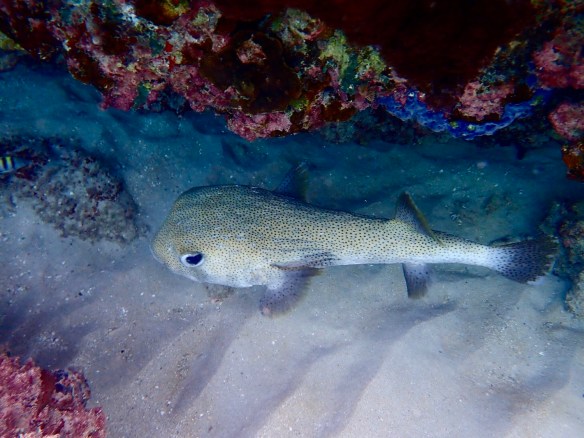
First impressions of the reef that ran the length of the beach was rather disappointing, but the more you looked the more you saw. Soft corals swayed in the current and amongst the scattering of small fish a few giants lurked, including, at three foot long, the largest porcupine fish we’ve ever seen.

Large spotted porcupine fish

We are now tied up in the Jolly Harbour marina, our friends have left, the large supermarket has been raided and the normal list of jobs actioned. Tuesday or Wednesday we head off for the British Virgin Islands, where Rachael, Mathew and partners join us for one last tropical fling.

As I begin to plot our trip back across the Atlantic it seems impossible that our journey is almost finished, last week as I sunk my toes into soft white sand, my feet bathed by the warm Caribbean Sea, it felt impossible to imagine giving all this up. However today as we contemplated another set of custom officers, tried and failed to get our cooking gas canister refilled, decided the water on the dock tastes too musty to fill our tanks, while the washing machine decides to lock up full of now precious water and a very soggy set of clothes, moving on to our next adventure, whatever that might be has its appeal.

Island Hopping to Antigua

Sunday 31st March 2019

It was with relief that we entered, past the Pillars of Hercules, from the choppy beam sea off the south coast of Antigua, into the still waters of English harbour. Unfortunately anchoring is tight here and we were forced back out and around the corner to the larger but thankfully equally protected Falmouth Harbour. Over the last few days we have been making our way north, day sailing the 200nm from St Lucia.

The journey passes three large islands, Martinique, Dominica and Guadeloupe and again involves some interesting sailing. Luckily the trades had veered slightly to the SE keeping the winds mostly behind the beam. Still, the 40nm passage between St Lucia and our first stop Grand Anse was quite lively, throwing our poor guests in at the deep end. Luckily we had taken the precaution of dosing up on seasick pills and had pre-made lunch, everyone survived unscathed..

Grand Anse turned out to be a bit disappointing and feeling rather tied we were not pleased to discover that the customs check-in was no longer in this bay and required a walk over the hill. We fled back to the boat deciding to check in the next day in St Pierre our next stop in the north of Martinique.

The French ports, rather conveniently, have computers placed in restaurants and small shops to allow easy check in. L’Alsace Kay served us cold beer and wine while we filled out the required forms and then lunch in their first floor restaurant overlooking the bay. The menu was in French, the boys took the easy route and ordered the dish of the day, chicken curry but Julia I opted to tackle the translation. I ordered ham with potato salad and Julia an onion tart from the vegetarian selection, or so we thought. What arrived was a little different, Julia was presented with a giant chicken vol-a-vent and I, a whole knuckle of ham. Luckily Julia does eat meat and decided it was too difficult to complain, the leftovers from my plate fed all four of us that evening!

We made an early start the next day and with a little less wind we had a fantastic sail across to Dominica, once in the lea of the island the wind dropped completely and we had a smooth motor up to Portsmouth near the top of the island. The boat boys, who in their small motor boats, scream out to meet you as soon as you appear around the headland were thankfully very organised. Anthony found us a mooring, took Rick to customs, relieved us of our rubbish and the next morning led us on a tour up the Indian river.

Beautiful Indian River

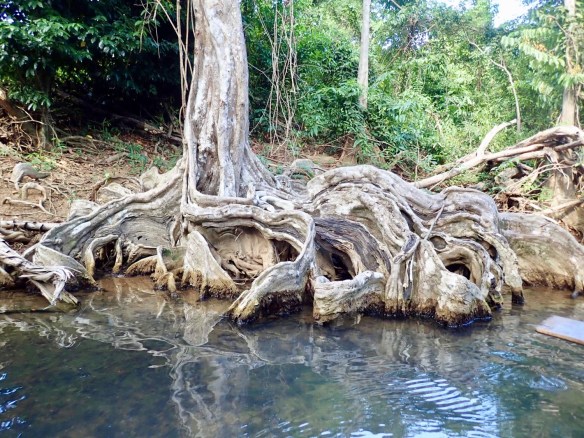
Named after the few final native Indians that took refuge here as the British and French battled over the island in the 17 century, the Indian river tour takes you a mile into the forest. Motors aren’t allowed so the tranquillity of the still green water, lined by large mangrove trees, with amazing gnarly buttress roots, is undisturbed.

Amazing roots of the Mangrove trees

The rainforest river scene from the Pirates of the Caribbean was filmed here, but Calypso’s, hut has been mostly destroyed, along with, unfortunately, many of the large trees. Hurricane Maria devastated the island 18months ago and the people, some of whom lost everything, have only just got back on their feet.

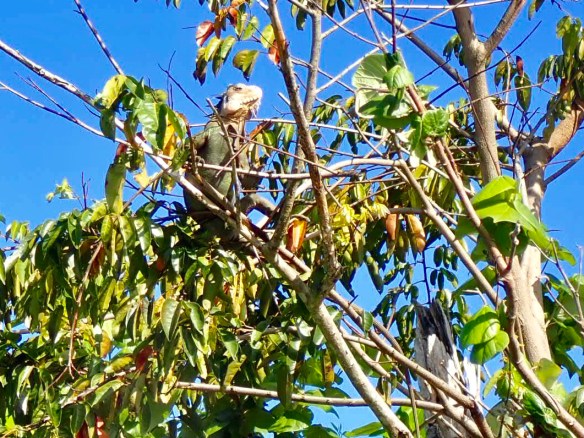
Faster to recover has been the river and it’s surrounding rain forest and they are home to, amongst other things, 20 varieties of crab, large shoals of mullet, juvenile barracuda, blue herons, snakes, humming birds and Iguana’s.

Iguana sunning himself in the early morning warmth.

We saw a good selection of these occupants as we glided serenely through the water, before taking a stroll amongst a plantation of fruit trees, the visit ended at a fruit and rum bar for refreshments. An enjoyable few hours that is well recommended.

Keen to get to Antigua before the wind returned to the North East, with the resultant rougher passage, we forewent the Saints Islands and took off for Deshaies, in the north of Guadeloupe.

We arrived mid afternoon to a very choppy anchorage and, despite the pretty town ashore, decided to stay onboard avoiding having to check in and a soaking from what was going to be a very wet dingy ride. Instead, as we had every evening in these west coast bays, we enjoyed a lovely sunset from the cockpit, watched 4ft long tarpons glinting in the light off the stern and prepared for an early start the next morning and the 40nm to Antigua.

Pretty Town of Desharies

The English and neighbouring harbour Falmouth are the Superyacht centres of the Caribbean, we are looking forward to a bit of nautical voyeurism.