Birthdays and Blisters

Sunday 30th October 2016

Normally on arrival at a new place we take a couple of slow days to rest and acclimatise before tackling any tasks that need doing, the problems with the engine, however, have meant this time we found ourselves immediately embroiled in boat maintainance. We have had little time to reflect on our return to civilisation, forced to enjoy and cope with the dramatic changes to our life style while we work busily to get things sorted out. As the New Zealanders get excited about the signs of the summer about to begin, we are shocked at how chilly we feel. As we take delight in the quality and variety of food, we grapple with the concept of using credit cards and phones again. We are in constant surprise at the ease of communication and the amount of services around us, while having to hobble from one workshop to another. After nearly a year of freedom our poor feet are struggling to cope with being contained, they are covered in blisters and even with copious use of plasters it is a choice between cold toes or pain.

After Bruce and his guys got the engine cleaned and restarted, the dirty job of emptying and cleaning the contaminated fuel tank began. Up came the table and floorboards of the salon and for hours a continuous train of full smelly jerry cans were carried up the companionway and out of the boat. Time for me to escape, nowhere glamorous unfortunately, just to the quiet of the laundrette and another task completed.

In the meantime Rick had found a North Sail loft that would valet our sails and replace the degraded UV strips that protect the edge when furled. We decided with the facilities so close by we might as well get them sorted out straight away and we were pleased to hear that with the protection in place and a bit of stitching the sails should be good for another 20,000nm. While the sails are off the boat, we have checked, washed and repaired all the running rigging and the outhaul car for the mainsail is at the stainless steel shop being refabricated. Rick has serviced the generator and we have cleaned and dried out the leaky forward cabin that had taken a bit of a bashing on the sail down.
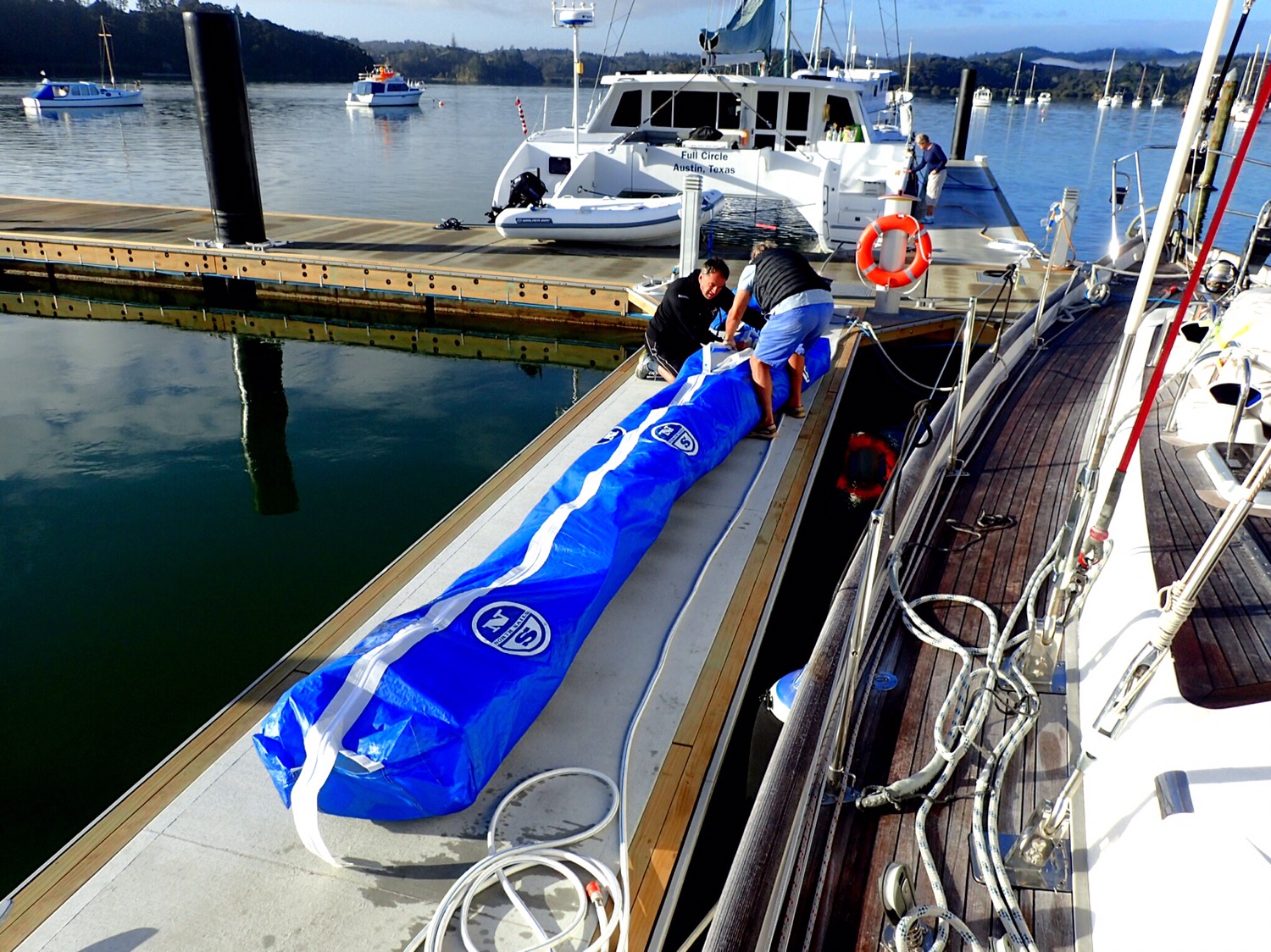
Sending off the Genoa


It’s not been all work and no play however, the marina is surrounded by gentle rolling hills and winding water ways. It has a very pleasant cafe that does brilliant breakfasts, especially a delicious eggs benedict and the Opua yacht club has a terrace to sit and appreciate the view. They are both gathering places for all the yachties and we have been bumping into familiar faces as everyone gradually trickles out of the tropics, like us arriving in New Zealand to escape the cyclone season.

View from our berth at Opua Marina


Wednesday we were kindly taken by locals and Island Cruising Club managers Mike and Lyn, the five miles into the nearby town of Paihia. A pretty tourist town where the ferries and tours leave to explore the Bay of Islands. The sights from the car and the sea front are lovely but our attention was focussed on the long awaited trip to the supermarket. Walking in the door the choice and quality of the products was almost too much, it turned out to be nearly as hard to buy a complete meal as it had from the empty shelves of Tonga. We came away with six bags of unrelated but scrumptous items from asparagus and advocados to blue cheese and sausages to fresh milk and bottles of local Riesling.

And on Friday it was Rick’s birthday, to celebrate we got a taxi back into Paihia for dinner. After a year of early tropical sunsets we are really enjoying the light evenings and spent an delightful hour drinking at the wharf overlooking the bay. Then despite what we thought was a burning desire to eat somewhere sophisticated, we ended up being tempted by a Indian/Thai restaurant, Greens, it turned out to be an extremely good choice, the food was fantastic. 
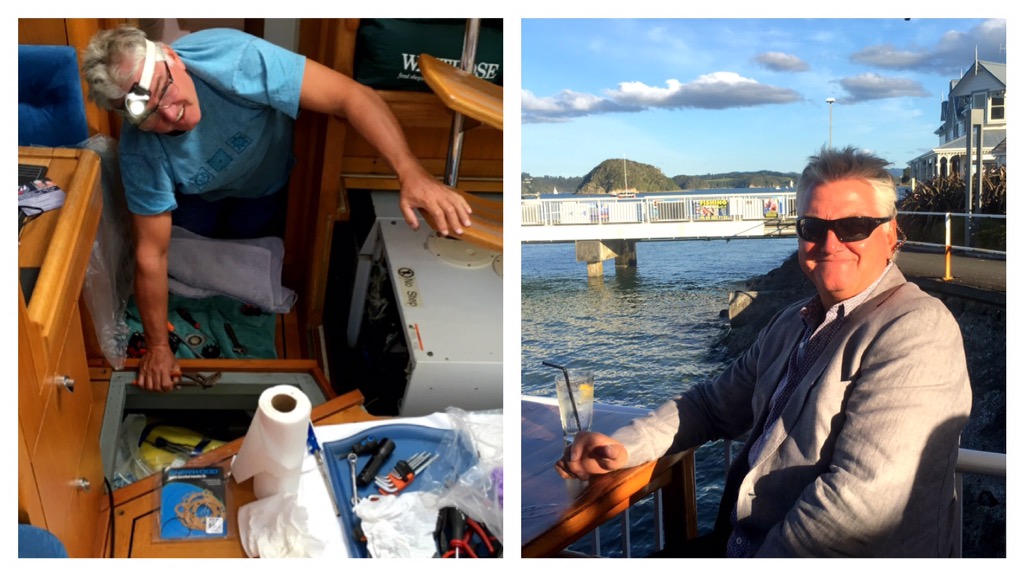
Celebrating his 60th Birthday


We plan to stay in Opua for another week before sailing down to just North of Auckland, Gulf Harbour, where we will base the boat while we return to the UK, tour the South Island and lift out to redo the antifoul. So with our feet on the mend and jobs on the boat in hand we are hoping to try and have some time here to be tourists before we leave.
Alternative arrival to New Zealand

Tuesday 25th October 2016

Monday lunch time, after a week at sea, we tied up to the customs dock at Opua Marina. Unfortunately this was not the arrival in New Zealand we had imagined, for we arrived curtesy of  the local coastguard. A real trip of extremes, we had calms so still it was difficult to believe we were at sea, a blast from Antartica that bought cold strong winds and then an engine failure just as we thought we were home and dry.

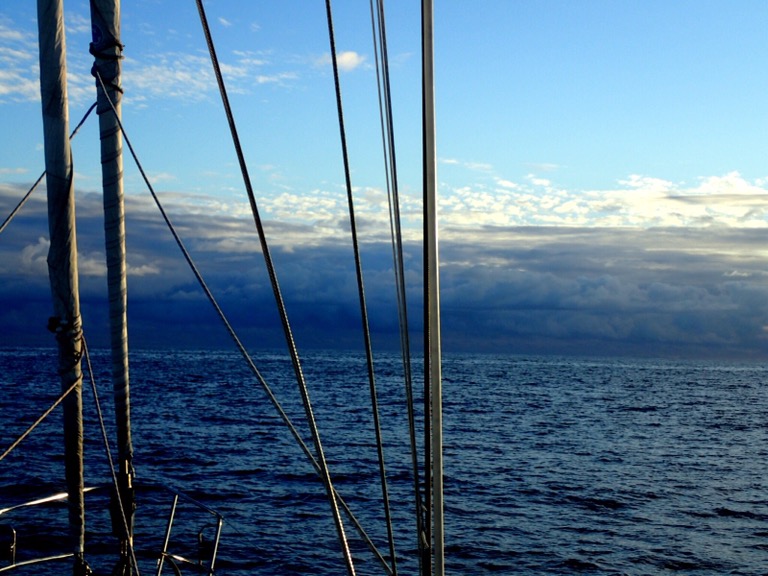
After the two windless days we saw building, on the horizon, a long grey smudge. As we got closer it gradually became more and more ominous, this was the front that we had been expecting, a dramatic and sudden change from the bright sunny weather to a line of cloud bearing heavy rain. The rain didn’t last long but the weather behind the cloud was in complete contrast to the past few days, the wind turned to the south and grew in strength. At first it was a relief to turn off the engine and we turned west as planned to ride out the weather. The winds and the sea gradually built and within a few hours things were uncomfortable, the wind veered to the SW making it impossible to sail even vaguely towards our destination. So back on came the engine, to help us sail as close to the wind as possible.

Ominous front on the horizon


We were both well dosed with seasick pills, a pre-prepared meal sat on the cooker and we hunkered down, every bit of warm clothing we owned layered under our jackets, telling ourselves it was only for 24 hrs. It was a long 24 hrs however, especially the hours of cold night watches and rather depressing to see our VMG (velocity made good – the speed at which we were going towards out final destination) at only 0.7kts. The sea was never really huge just messy, rocking Raya unpredictably as she slammed into the oncoming swell, the chilly wind whipping around the corners of the sprayhood.

Chilly in the cockpit


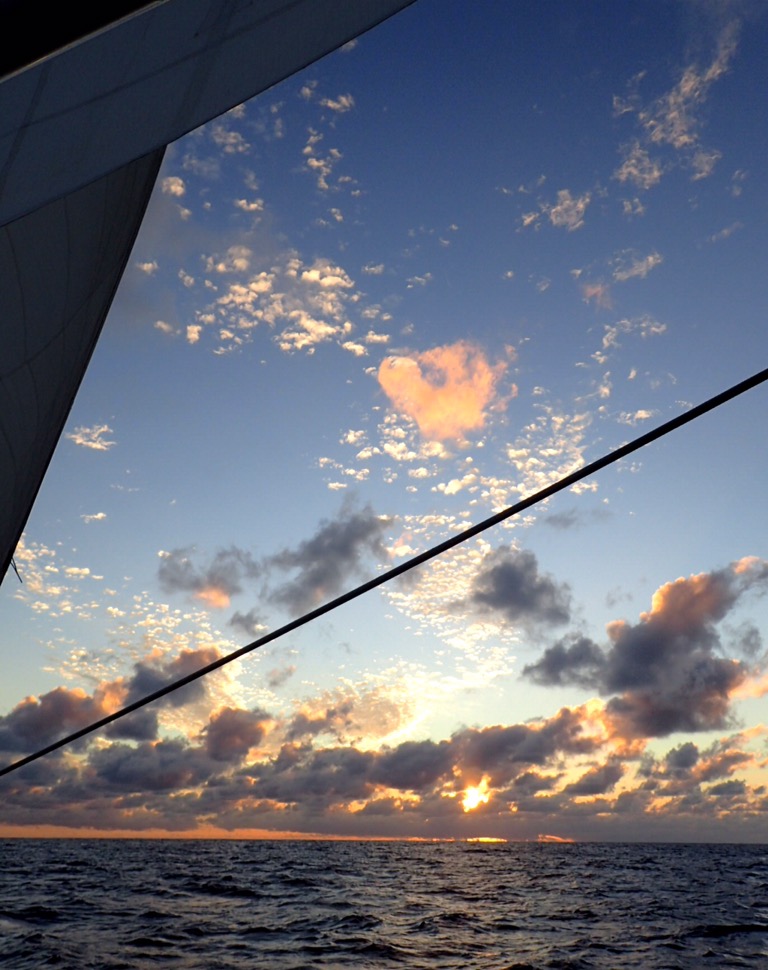
Gradually through Sunday the wind decreased and the sea calmed and although chilly we began to enjoy the trip once again. We spotted our first albatross, their huge wingspan disproportionately long for their bodies, seemingly never moving as they swooped past the boat and low over the waves. We got out the cruising guides and started to read about the entry into Opua, we even shared a beer sitting out at the back of the boat watching the sun set.

In the early hours of Monday morning with the wind dropping yet again, our engine which had been doing such a sterling job for us on this difficult to sail passage, suddenly stopped. We knew the fuel we had picked up in Tonga was dirty, Rick had been emptying and changing filters for the whole trip. This time however there was also oil leaking from the turbo charger, he began to think maybe it wasn’t a fuel problem, he worked through the night while I managed to get us sailing in the light winds. Finally the engine restarted , we left it running at very low revs to see if it would keep going, no such luck it stopped again after an hour. We sailed slowly onwards until a few miles out from the rocky shore of the Bay of Islands the wind completely died. This far from the coast we were in no danger, but we thought it prudent, with no knowledge of the tides and currents, not to try and enter the Bay until there was a steady enough wind to give us steerage. The wind dropped further, the dial read 2kts, Rick tried a few more things, questions fill our heads, there was some fuel coming through the system but how much fuel was enough fuel, had problems with the turbo shut down the engine as a precaution, if we got the engine running would it fail again in a more enclosed and dangerous space?

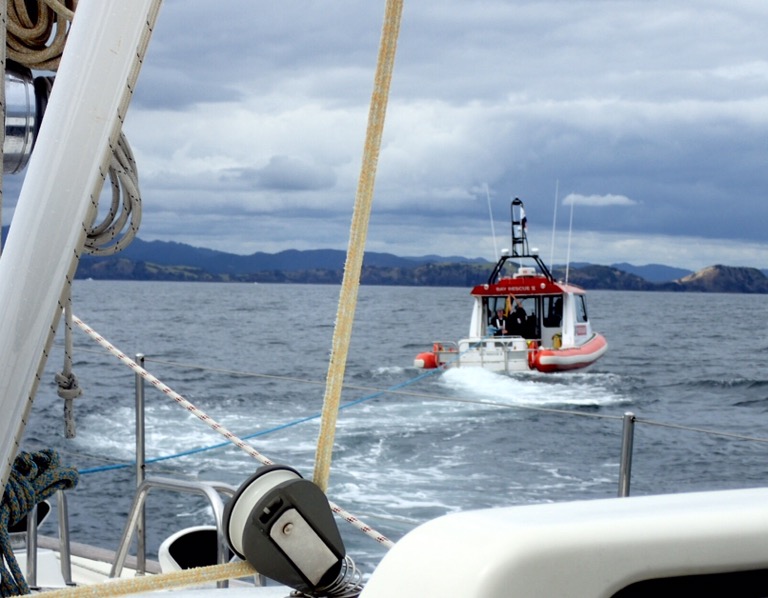
We had a cup of tea to consider our options and at eight in the morning we called the marina to see if they could arrange for some help for us. Typically, it turned out this was a bank holiday in New Zealand and no commercial help was available, an all stations radio call was put out for assistance to no avail, finally it was suggested that they contact the coastguard. So it was we found ourselves being towed at great cost, the coastguard here, unlike in the UK charge for their services, through the Bay and the channel towards the marina.

Preparing to Tow


They dropped us at the customs dock to check in, we thanked them and they rushed off to help someone else. The customs official was waiting for us and the entry procedures started. This includes the requirement to pass a Biosecurity Inspection. You are not allowed to bring in any meat, vegetables, fruit, seeds or dairy into the country, so the contents of our fridge, freezers and many cupboards were thrown into black rubbish sacks. The process was conducted efficiently and with a smile and before long with the help of Bruce from Seapower, a marine engineering company, we were safely tied up in our berth. Finally we toasted ourselves with the traditional ‘ got here beer’, too tired to venture out for food and with little else available, we opened a tin of beans, had a glass of wine and slept for twelve solid hours. 


In the morning Bruce was back with his engineers, the Tongan fuel was the culprit, every filter and pipe was clogged and the injectors blocked, it took a few hours but they got the engine running again. It was a relief that we didn’t have to replace the expensive turbo charger, frustrating that the fuel providers in Tonga could get away with selling such a filthy product but mostly thankful that the engine failed when it did, our situation could have been far worse.

OK, New Zealand here we are, what have you got to offer us for the next few months?

Halfway Around the World

Early this morning we crossed the dateline, we have sailed halfway around the world. Unlike at the equator, however, there was no dramatic 00 00.000 moment on the position read out. Longitude 180 doesn’t really exist so the read out just flipped from 179 59.999 W to 179 59.999 E. We have already lost our day as we entered Tonga, who bend the line to keep themselves at the same time as New Zealand, so it’s only practical significance is that we need to remember to start taking away instead of adding to our longitude as we travel west.

Goodbye Tonga


Monday Raya flew out of Tonga on strong SSE winds, travelling slightly east of the normal doglegged SW course, on Bob the weather mans advice. The sea was lumpy and skies grey but we were happy with the high speeds because we were trying to out run a low pressure system coming down from Fiji. Having achieved that, yesterday we had a perfect days sailing but today having reached the centre of a high pressure all is calm and we have only 4kts of wind so have the motor. Low winds have their upside however, the sea is a huge empty flat disc of blue and the sun shines in a cloudless sky, nothing else anywhere just a few birds and a couple of flying fish. In the whole four days the only boat we have seen has been a single AIS target of a cargo ship over 60nm away. Yesterday we did spot some dolphins, the first pod since Huahini in French Polynesia, disappointedly they didn’t come over to check us out, unlike a whale, which made us jump as he suddenly surfaced with a huge blow just meters away, before, obviously not taken by Raya’s womanly charms, sunk down and disappeared.


The sea and air temperature are decreasing surprisingly quickly and night watches have become rather chilly. Socks, jumpers and jackets that have not seen the light of day since we left NW Portugal a year and a half ago, are being pulled, musty, from beneath berths and wardrobes. The life jacket straps have had to be released to fit over all the clothing.

The early miles going south means accidentally, and as seems to be Raya’s way, we find ourselves on the rhumb line directly into Opua, with just under 500nm to go, that would normally give us an arrival time around Sunday lunch time. Unfortunately we have a front crossing New Zealand, bringing southerly winds to contend with, this will force us to sail west for a day, it will be fairly uncomfortable upwind sailing and add twelve or so hours to our eta, which in turn will mean slowing up so as not to arrive during Sunday night. We are also assuming that the south winds will cause a further drop in temperature and probably bring showers- is that the wet weather gear locker I can here rustling?

So this evening we are trying to enjoy the last of today’s calm sunshine, congratulate ourselves on reaching this far and look forward to the prize of arriving in New Zealand, hopefully Monday morning.

Meteorology at Mama’s

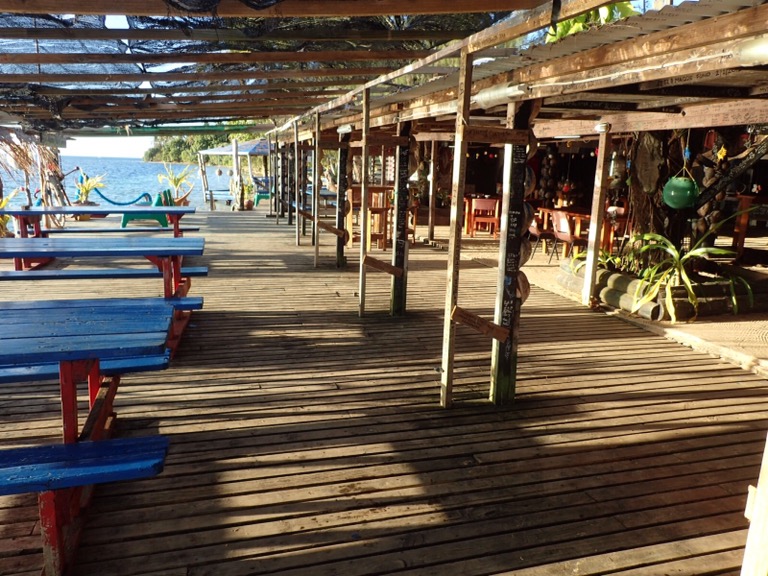
This morning I opened our last pack of Englsh tea bags, what surer sign could there be that it’s time to return to civilisation for a while. Our passports have been stamped, Raya is full of fuel, five passage meals sit in the freezer, it’s now just down to the weather. Tonight there is going to be a BBQ at Big Mama’s Yacht Club for all the waiting cruisers, as if collectively we can will the weather to suit our plans.

Veranda at Big Mama’s Yacht Club


After a year of relatively stable trade wind sailing, we are venturing back out into less predictable weather. The weather systems that cross over Australia and New Zealand from the Southern Ocean to just below the tropics are on the face of it simple, a high pressure system follows a low pressure system, follows a high pressure, follows a low pressure etc. etc. all travelling west to east. The reality is of course much more complex, firstly we must remember that each system rotates in the opposite direction to those of the northern hemisphere, so for the best departure we wait for the top of a high pressure to bring us SE-E-NE winds to whisk us south west from Tonga. Then the timing becomes crucial because between the high we are using and the following low there is often a trough of high winds and if the systems squash up or travels too quickly you face south winds straight on the nose as you approach your destination. The general advice is to sail a dog leg, going well west of the rhumb line before turning south, the magic waypoint being around 30S 173E. The skill is to know when in the system to leave and then exactly how far west to sail. Add to all that the seemingly infinite other vagaries that affect the weather and the fact that our ‘at sea’ weather forecast app is having a crisis about spanning the dateline, we have decided for the first time, to use the help of a weather router. Bob McDavitt is a weather guru located in New Zealand, he looks at your particular passage requirements – destination, boat type, average passage speed, etc. and with his years of experience analysing the weather patterns he suggests a departure date, best route and updates as necessary along the way. At the moment it is firming up for us to leave on Monday, heading for Opua in Northern New Zealand.

Needless to say the weather is the main topic of conversation in the bar at Big Mama’s Yacht Club, everybody anchored at Pangaimotu, the main stopping off point to take off for New Zealand, is on more or less the same track. However it wasn’t just passage weather that has been the topic of interest, the forecasted low pressure screamed through Tonga last Monday night with gusts in the high thirties and lashings of rain. With plenty of warning everybody had time to prepare and we all sat tight as it past over. 

Stormy morning


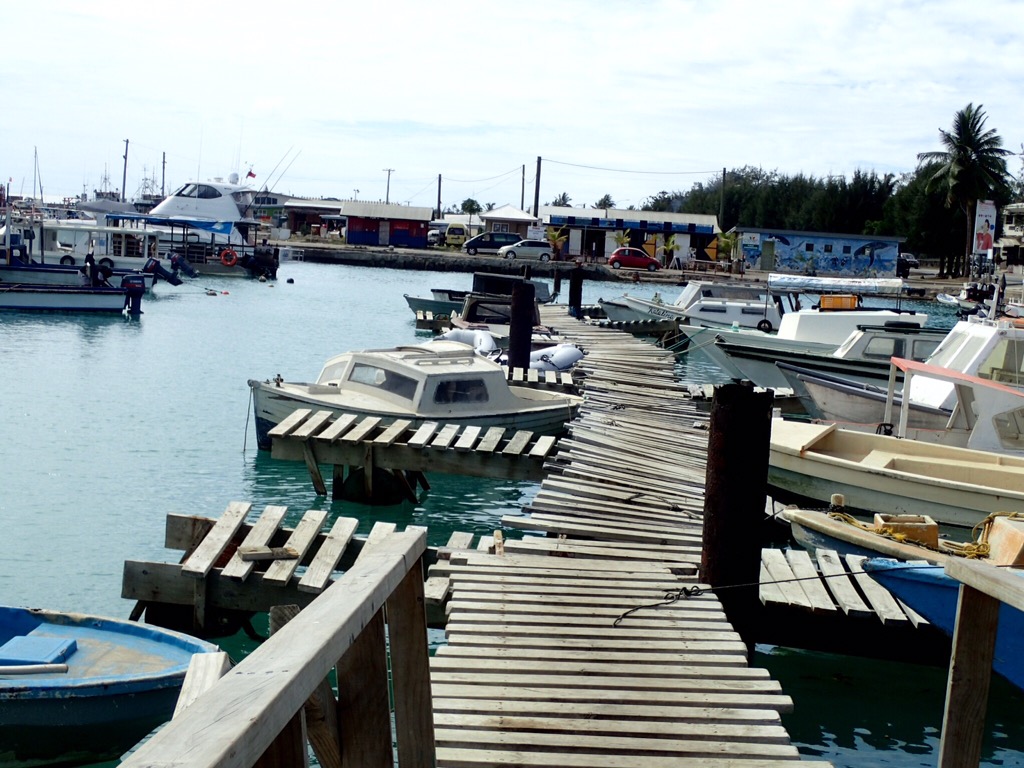
By Wednesday all was calm and we could venture out to prepare for our exit. The small boat harbour unfortunately hadn’t weathered the storm as well, the dodgy dock had become completely detached from its link to shore and had lost large sections of its length, the attached small boats sinking and floating out to sea. Getting on to dry land was precarious to say the least. In the heat we then spent 3hrs traipsing between, Nuku’alofa Port Authority, the Customs shed and other official offices in a seemingly random order, filling in numerous forms and collecting countless stamps as we went. The system for checking out has another fundamental problem, to get duty free fuel you need to have custom clearance, to get custom clearance you need a departure time within the next 24hrs. Unfortunately it takes a day to organise the fuel, a day to get it onboard, there is no fuel or custom service at the weekend and the weather windows change almost hourly. We took the decision to check out early and sit hopefully inconspicuously at anchor. 

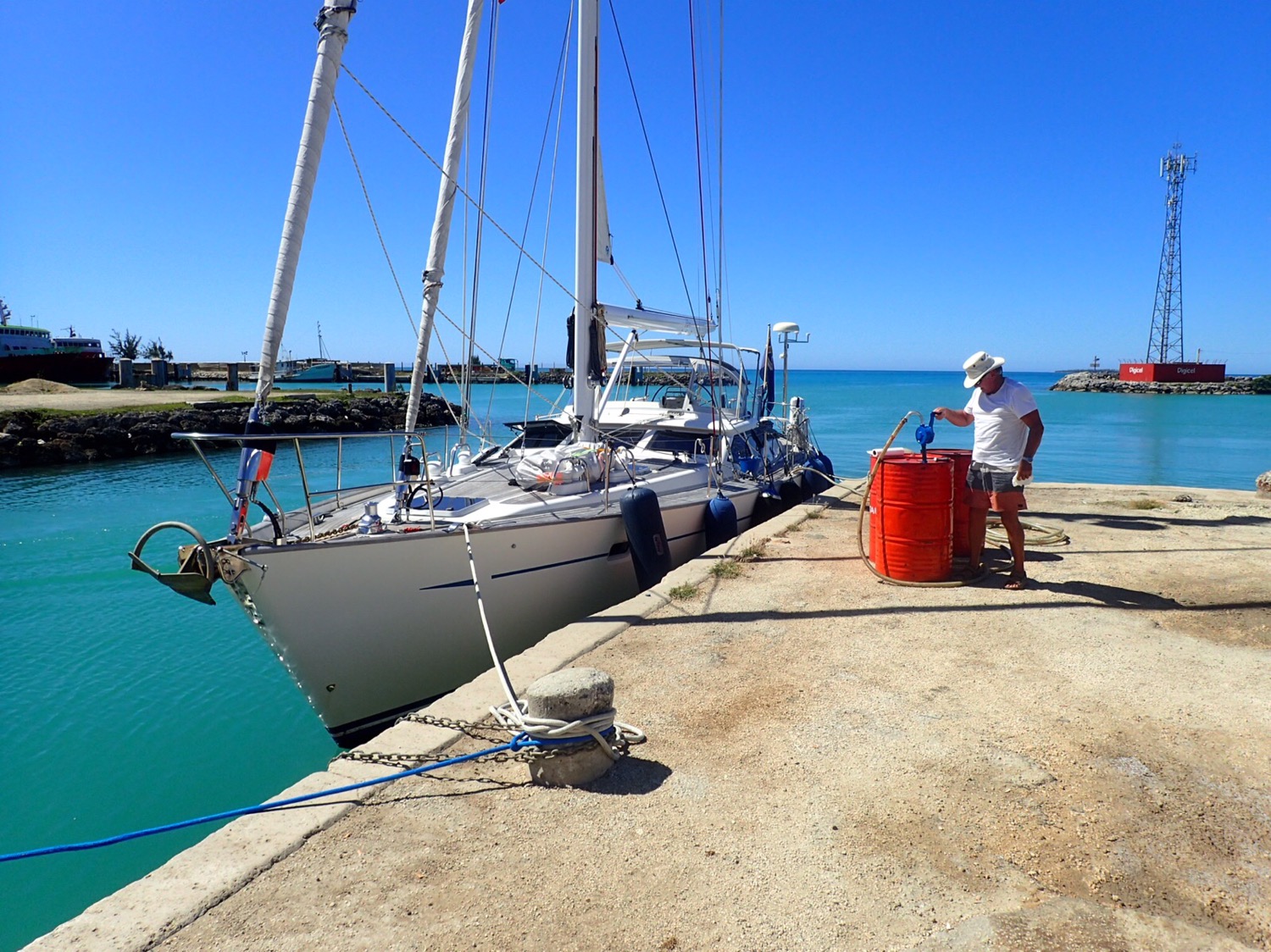
We were quite pleased we did, it took us all day Thursday to fill the fuel tanks. Firstly it took Rick and Russ, from A Train and also filling up, three trips in the dingy over to the harbour to clear a space at the wharf big enough to fit us on. We then had to wait for the tide to come in a little to give us enough depth, while we waited the delivery truck arrived and finding us not there, left and had to be called back, finally we had to pump 600l of diesel from three large drums into our tank by hand, all in the scorching afternoon sun.


It was an exhausting and frustrating couple of days but now we are prepared and looking forward to casting off. New Zealand here we come, please warm up a bit for us, the current Spring temperature in Opua of 18 degrees is going to seem very cold!

United States Naval Ship Pililaau

Sunday 9th October 2016

Yesterday, we spent an amazing couple of hours aboard the enormous US military support vessel USNS Pililaau. The night before we happened to be spending the evening with Russ and Gwen on board their yacht A-Train, when three of the slightly inebriated US crew whom Russ had befriended the night before, came by to invite them to have a look around. Rather surprised to be invited on a military vessel and with a three mile dingy ride across open choppy seas we nearly declined. We were so glad we decided to go. It was a completely, in the original sense of the word, awesome experience, the whole environment was totally alien to us in almost every way, but for the occasional feature that reminded us this was a ship that had to moor up, anchor, navigate and stay safely afloat just like us.

USNS Piliaau

USNS Pililaau is 950ft long and 106ft wide, the deck stands about 100ft above the water. She is run by a civilian crew of thirty and Mike our friendly and enthusiastic host is the First Mate. Her task in life is to keep the US military flexible, by being one of 18 supply ships that are held in constant operational readiness around the world. Currently she has 40 Marines onboard that are involved in training exercises with local military units throughout the Pacific Islands.

We arrived at a landing pontoon on her port side, the dingies minute against her massive black hull and climbed a long steep ladder to a gate in the rail high above us. We stepped onto a clear area of her enormous deck, the helipads for two helicopters, the rest of the deck was jammed packed with containers and equipment required in the logistics of disembarking and loading all the military cargo she carries in her massive hold.

View from the bridge

We went through a small door in the superstructure, entering into a maze of corridors and steep steps. Here is housed the bridge, offices, hospital, cafeteria, and living quarters. Mike’s cabin was surprisingly large, the Marines however were crammed twelve to a small room containing just bunks and lockers. The bridge was huge, with large windows giving a clear view of the deck below and the surrounding area,  but was surprisingly un-hightech. She was controlled with just two throttles, two bow thrusters and a tiny wheel. What the rest of the switches, knobs and lights that filled the 50 ft control panel did was a mystery but the chart plotter was just a larger version of ours with a route plotted between waypoints exactly as we would do.  

The five floors of cargo holds run the length and breadth of the ship. Mike took us through two of them and the scale of the operation became clear. Talk about boys toys, they were jam packed with military vericles, armour plated jeeps, bomb proof troop carriers, cranes, diggers and much more, at the far end were about fifty containers of just ammunition. The whole space felt like the set of a Hollywood movie. We resurfaced at the bows where two mighty anchors had been deployed on massive chains each individual link being about two foot long. The scale of everything on the ship was mind blowing, the industrial surroundings severe and the noise in some areas deafening, a stark but fascinating contrast to our other recent exploits.

Giant cranes dominate the deck

Our tour ended on a light note as Mike proudly led us the nearly quarter of a mile back to the stern to show us the ‘swimming pool’. Tucked in a corner was a cut down container Mike had purloined, lined with fibreglass and painted blue, it was complete with steps to a raised deck and homemade sun loungers.

Back on Raya we are sitting out a low pressure system, bringing rain and high winds to Tonga, busily preparing for the trip down to New Zealand. We have taken a few trips into town, much bigger and more crowded than Neiafu but equally lacking in any town planning. A few areas have been modernised and a lot of building is taking place, as far as we can see totally under the control of the Chinese. The supermarkets and shops were as empty and uninspiring as we have come to expect, the bank as chaotic but we did have an extremely good lunch at the Friends Cafe. 

And exiting the dingy, tied up in the small boat harbour, we immediately realised we have another candidate to add to our growing list of dodgy docks.

Nuku’alofa, small boats harbour

Reefs and Wrecks

Tuesday 4th October 2016

The sea was much calmer for our return visit to Ha’afeva, we planned to stay overnight on Saturday to break the thirty five mile trip down to Nomuku Iki. We were pleased to find the bouncy anchorage of just a week ago was now pleasantly smooth. At low tide, revealed on the reef to the west, is the wreck of the Korean fishing boat Eikiaki. It is marked on our guide as a good snorkelling spot, so we decided to dingy across and investigate..

It turned out to be the best snorkelling we had done in Tonga, not just the spectacle of a boat being gradually claimed by the sea but the coral that has been so poor elsewhere, here was very much alive, multi-coloured and multi-structured.

Flurishing coral at Ha’afeva

The rusting hulk of the Eikiaki sat on the sea floor, its small amount of remaining superstructure poking out of the water. We tied the dingy to a crumbling rail and snorkelled a meter or so above its deck. Fish swam in and out of the hatches and openings into the hold, coral flourished on every surface and old cables wound through the chaos of metalwork. 

Snorkeling above the Eikiaki

The next morning we moved on to Nomuku Iki, or small Nomuku. A channel runs between the large and small island and winds around extensive reefs. On one side the busy village with ferries and fishing boats dashing in and out, on the other where we were anchored yet another deserted pristine white beach. And, we were surprised to find, another wrecked fishing boat. This one sat high up on the sand looking rather like a huge stranded bath tub.

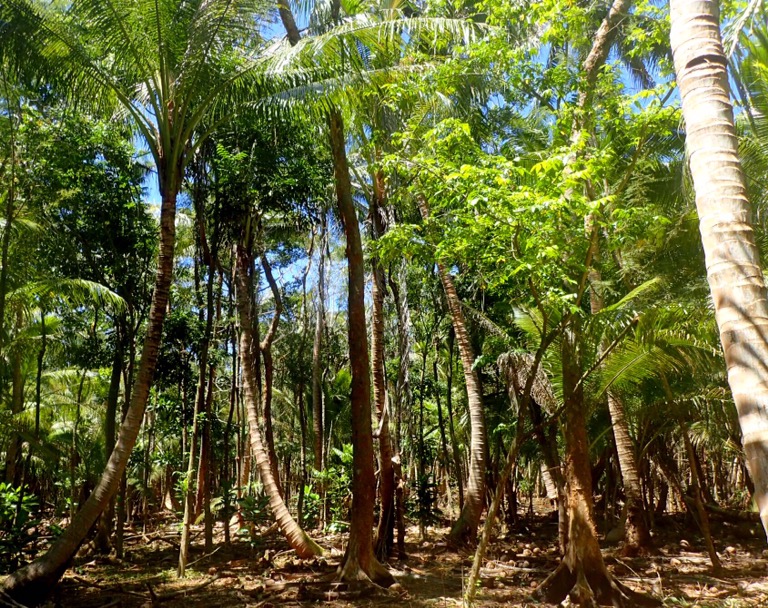
Just behind it through a break in the trees was a clearing, a shack, some copra drying racks and fishing nets. Nobody was at home except a huge sow who frightened the life out of us as it appeared suddenly through the thick jungle of trees. We ventured further in, admiring the long straight trunks of the palms and soaking up the cathedral like atmosphere, until, after just a few hundred meters, all traces of a path disappeared, the floor a mass of coconut husks and the way forward a tangle of undergrowth. Having left the machete at home we turned back.

The interior of Nomuku Iki Island

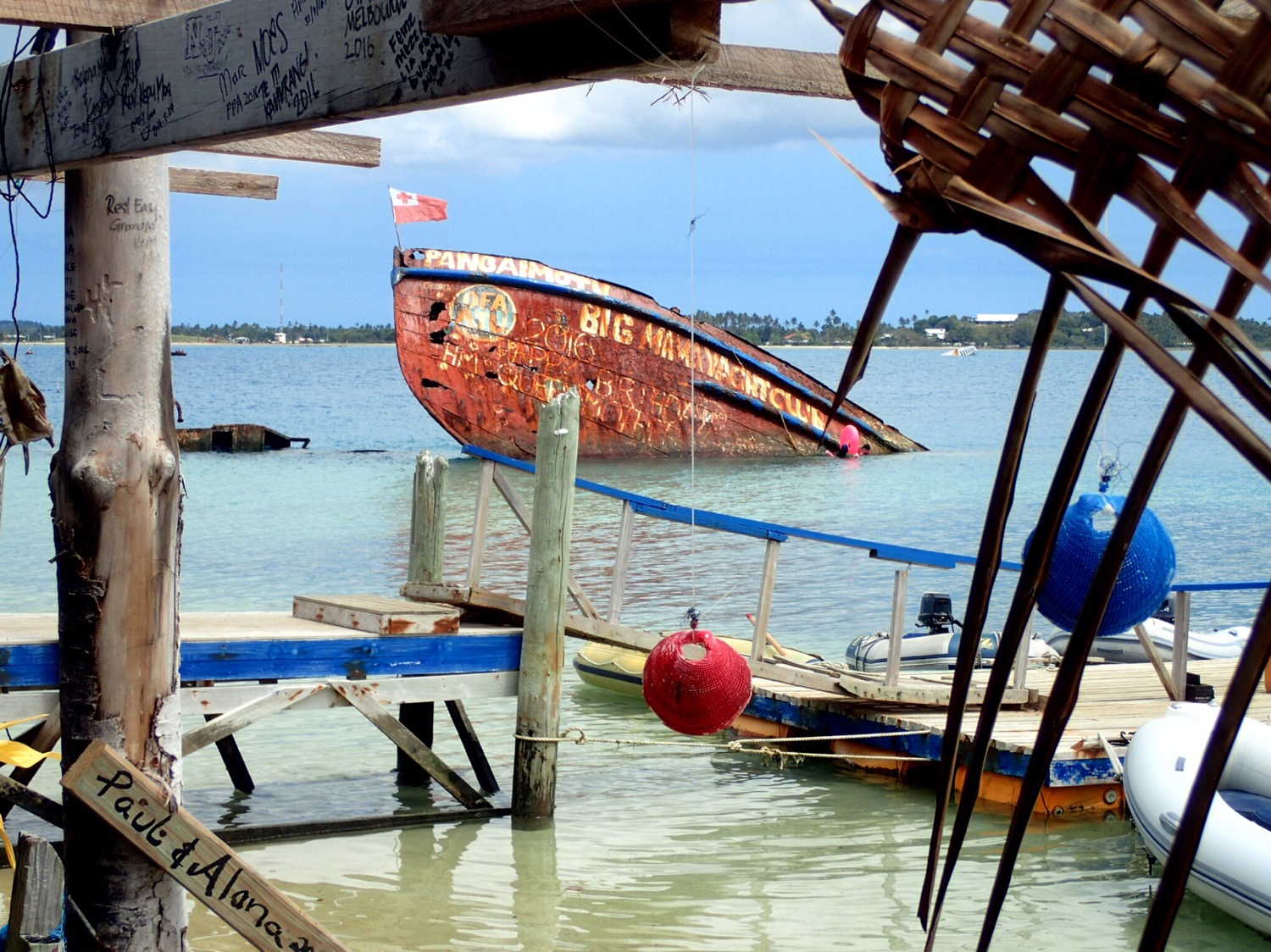
Nomuku Iki was our last desert island for this year as we have now reached Nuku’alofa where we shall prepare for our sail down to New Zealand. It was not however our last wreck, not wanting to quite leave tropical islands behind instead of mooring off the town quay we have anchored, a mile NE off of Pangaimotu and Big Mamas Yacht club. No normal sign above the door here. It seems to have been a week of wrecks.

Wreck off Pangaimotu

Highlights and Hazards in Ha’apai 

Saturday 1st October 2016

Early Friday morning I wrote sitting anchored off two picture perfect islands, we were the only yacht for miles around. There was no wind and as I waited for the sun to rise higher in the sky, a misty damp haze hung low and thick in the stillness. The sea was very calm, a slight swell undulated across its glassy surface and with no breeze to hold her, Raya drifted beam on and rocked to and fro. Seven meters below us the sea floor was so clear I could easily see the bright yellow and black angel fish swimming around a patch of coral.

I was distracted by the sound of splashing, a dozen small silver fish that leapt from the water quickly followed by four or five eighteen inch tuna. I put out a fishing hook, more in hope than expectation, our rod and lure are designed for ocean trawling. As I returned to the cockpit I hear a whale blow, I grab the camera but no close encounters or acrobatics today, he just cruises by about 200m away. When I finally return to my scribbling the moment I described above had gone. The sun was beginning to burn off the mist, the smallest breeze was rippling the water, it was going to be a fine day.

In this beautifully settled weather Ha’apai is turning out to be the South Pacific we dreamed of before we left, clear azure seas, white beaches and palm trees but paradise is not without its challenges. Each anchorage has, as always, to be assessed for protection from the wind for the length of our stay, entry and exit must be timed to coincide with a high sun, preferably behind you and in a cloudless sky.

Last Sunday we arrived in Ha’afeva to discover a rather uncomfortable anchorage, the island had been described as a good place to sit out west winds and the main attraction was the village ashore. We have discovered that we are naturalists rather than anthropologists, we are much more interested in the wildlife and the geology of the islands than the human inhabitants, another Tongan village didn’t overly excite us. We decided to back track, the anchorage at Luangahu was calmer and equally protected from the westerlies and with the wind now on the beam gave us the added bonus of a great sail. Again there were whales all around, one of which, made us jump as he appeared to check us out just twenty meters away. 

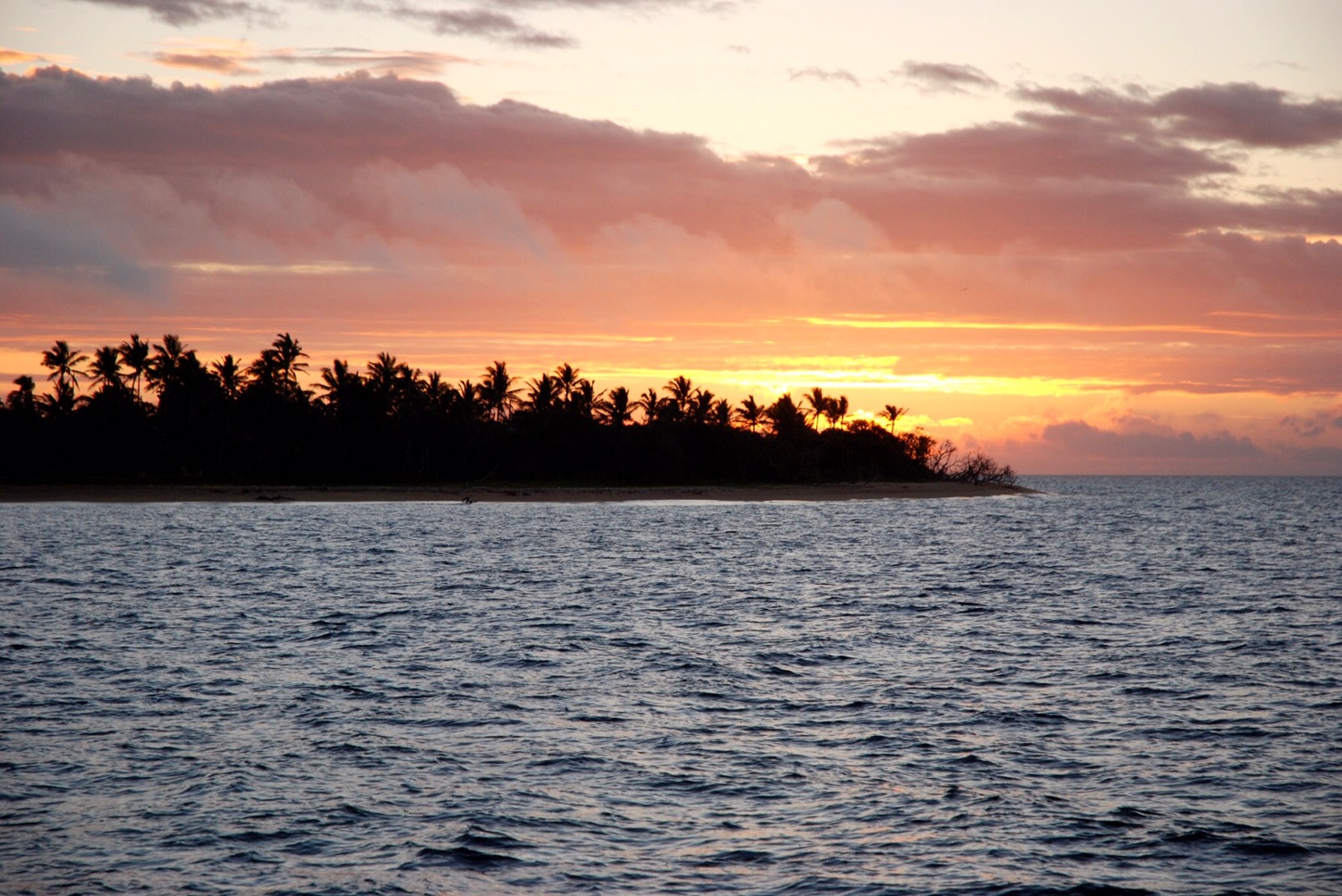
Sun set behind Luangahu

Luangahu is an amazingly beautiful spot and it was easy to while away the time until the wind returned to the east and we could move on to our next spot. Leaving the island however turned out to be as difficult as our original arrival. The first task was to unwind our anchor chain that had with the 180 degree change in wind direction wound itself around a small coral bommie. We very slowly eased around it and the anchor came up fine, but as we threaded our way out to deeper. water the engine stuttered  and choked, we took our eyes off the road and instantly clunk we had banged into some coral. We returned to the anchorage, Rick check the fuel filters and dived in to check the keel, all seemed well. With the engine running normally we slowly, very slowly tried again. 

Not what you want to see when you check the anchor chain

Just as we breathed a sigh of relief at clearing the shallows, in front of us we spotted two sleeping whales, a small boat sat on the  reef, it took no notice of us, we assumed he was fishing,  until a moment later when we spotted just in time there were swimmers in with the whales. We turned north, another whale appeared in front of us, we turned south, finally with nerves by now rather frayed, we extracted ourselves from Luangahu’s grip and set off for the twin islands of Uonukuhahaki and Uonukuhihifo, or Lobster Island East and Lobster Island West.

After our thankfully straight forward arrival, we went to explore ashore. The two pretty islands are long and thin and linked by a bar of white coral sand, on the far side is a rocky lagoon which is where the lobsters can be found. A brief search produced no signs, luckily, as after an equally brief discussion we realise we have no clue how to catch one, we have visions of large snapping claws and lost fingers.

Stunning sand bar linking the two lobster islands

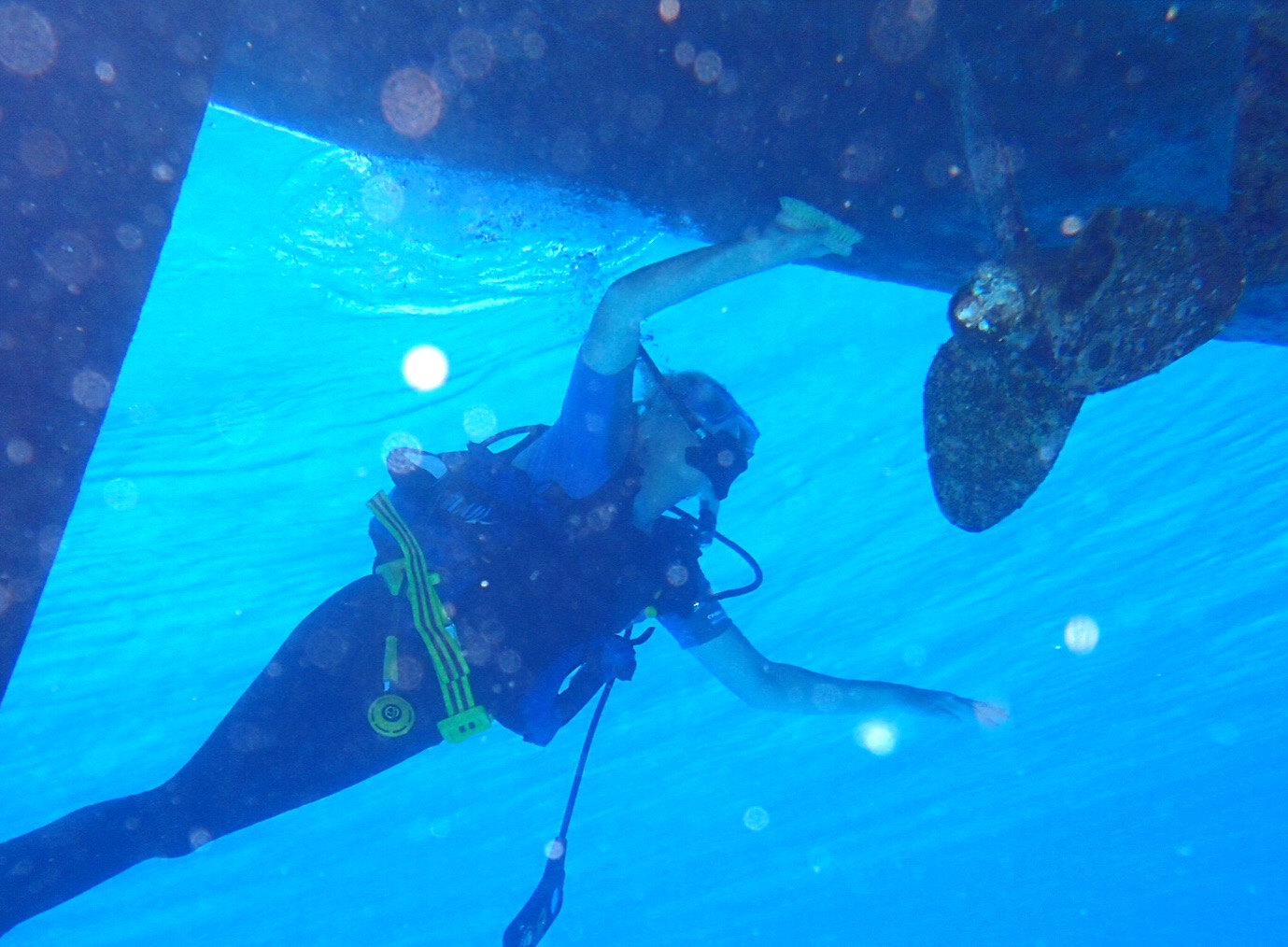
The early misty morning did turn into a spectacular day. We decided to take advantage of the calm water to put on our scuba gear and clean the hull fittings and propeller. We need a clean hull to enter New Zealand, hopefully we can find a diver to give it a good going over in Nuku’alofa as we didn’t have enough air in our tanks to do more than the essentials. We have to admit we did waste some air by diving a small bommie just off the boat. Yesterday I had snorkelled the area to check the anchor and the depth of the coral patches close by. I came accross one bommie that was just delightful but a little deep to appreciate from the surface. It was great to be back down at eye level with the fish, it’s been a while since we have dived. This small clump of coral just twenty foot in diameter was bursting with fish of all shape and sizes. The bright sun light shone through the clear, shallow water catching a rainbow of colours as the fish ducked and dived around the contours of the corals and made for perfect conditions for Rick, with our underwater camera that seems to be having a new lease of life, to capture a great video.

Diving under the boat for a bit of a clean


We move on again today back to spend a night at Ha’afeva the halfway point to our next and final island Numuka Iki.

N.B. I have just updated the last post with some pictures.