Waiting on Weather Windows

Wednesday 9th January 2019

We sit in the very industrial, noisy and rather rickety Port Elizabeth marina, not quite as far towards Cape Town and the start point of our South Atlantic Crossing as we’d like. But sailing here in South Africa is all about weather windows and despite this being the best time to round the Cape, they are still short in duration and numbers.

We were disappointed to find on our return to Raya, after the Christmas break in the UK, that the work the riggers had been promising to do since our arrival in November still hadn’t been completed. Worse still they had started job leaving the boat unable to sail, any thoughts of getting away promptly with a weather window that was opening on the Thursday were quickly dismissed, as finally the riggers got on with the job.

Finally all hands on deck, but too late for a quick get away.

With our potential time in Cape Town becoming shorter and shorter, we spent the next few days doing as much of the preparation for the long passage between South Africa and the Caribbean as was possible while still in Durban. Filling the freezer with meat, the lockers with non-perishables and cleaning products and doing routine boat checks above and below decks.

With the next break in the weather pointing towards the possibility of an early morning get away on Monday, we crossed our fingers and Friday morning went through the protracted process of checking out of Durban before the offices closed for the weekend.

When leaving or arriving in South African ports you are required to file a ‘flight plan’, a four or five page document, describing the yacht and your sailing route, sign and stamped by all the authorities. We understand the theory behind the need for this information, which has safety benefits for yachts as well as protecting South Africa’s borders from drug and frequent people smuggling. However, in practice, for yacht crews, that having already gone through the procedure to enter and leave Richards Bay and again on arrival in Durban, it just turns into a three hour, hot and frustrating exercise in paper pushing.

Ten am saw Rick standing in the hour long queue at the bank paying our port fees, the Port Authority bizarrely taking neither cash nor cards in person. In the mean time, the marina office and I did battle with the card machine that was refusing to take payment for everyone’s marina fees. After a call to their banks technical support team, at last, my card was excepted and the first box on our flight plan was stamped. Then it was on to the Port Authority office, about a km away, to submit our bank receipt. Here the gentleman also explained our next moves, including a return to his office, which he informed us would shut for lunch at 1pm, just thirty five minutes away. So at a run in 30C of heat we went to the building next door, here the immigration office inspected our passports and stamped their box in the flight plan. Next, in the same building but back out into the heat and around the corner through a different door, it was on to the customs office, where we submitted their outbound form. Interestingly this is exactly the same as the inbound form we had filled a few weeks ago, except for the circling of outbound instead of inbound, we collected another stamp. At two minutes to one we dashed back to the Port Authority office where with a flourish he gave us the final stamp. Relieved, if rather sweaty, we returned to the Marina office so they could add it to their files. The one flimsy bit of paper I was left with felt wholly inadequate for the amount of effort exerted.

Luckily we had the weekend to recover and our weather window stayed open. At five am Monday we squeezed out of the spot Raya had called home for the past two months and headed out of the harbour. With little wind we motored offshore to pick up the benefits of the Agulhas current and within a few hours, with sun shining and a pod of about a hundred dolphins entertaining us, we were travelling south at eleven knots.

A large pod of dolphins joined us and gave a fine display of leaping their antics

Gradually the wind increased and the sails came out. As the wind waves met the southern ocean swell it produced a lumpy sea, but with the wind in the north travelling in the same direction as the current, the fearsome Agulhas waves were kept at bay. The current increased and for a time was running at 6 or even 7kts, it felt odd as we gently sailed downwind to see our speed over the ground reading 13kts.

A very odd set of readings as we sped along in 5.5kts of current.

As Raya got into her stride we were seeing unheard of speeds, for a moment the gauge read 17kts!

We felt confident that we could make it a fair way towards Cape Town, reaching one of the picturesque bays on the south coast before the next set of strong SW winds arrived. Unfortunately this wasn’t to be, we have been taking advice from a South African sailor who, for free, helps foreign boats with his wealth of local knowledge of the weather and sea states on this coast. Early Tuesday morning we received an email, he advised us that a large swell was now forecast for the rest of the week and although the bays looked protected the swell tended to creep around the headlands making the anchorages very uncomfortable especially as we wold be there for 4 or 5days.

So having had our fastest day run ever, we put on the breaks, turned out of the current and towards Port Elizabeth. As we crept along with reefed sails at only 5kts, in contrast to the previous 24hrs, we probably produced our slowest 12 but as always we were keen not to arrive until first light.

Luckily what appears to be the one large enough pontoon for Raya’s 56ft was available and by six am we were tied up and happily munching on a bacon sandwich.

We have some very large neighbours.
Traditional Christmas

Monday 1st January 2019

As the taxi whisks us along the empty, early morning motorway from the airport back to the marina on he Durban waterfront, evidence of the previous nights revelling lines the route. Although it was by now 6am a surprisingly large number of party goers were still celebrating, chatting and even dancing near the city beaches.

We had seen in the New Year high above Central Africa trying our best to find a comfortable enough position to sleep in our aircraft seats. We have done so much celebrating with our friends and family over the past couple of weeks, that missing this final night of festivities was almost a relief.

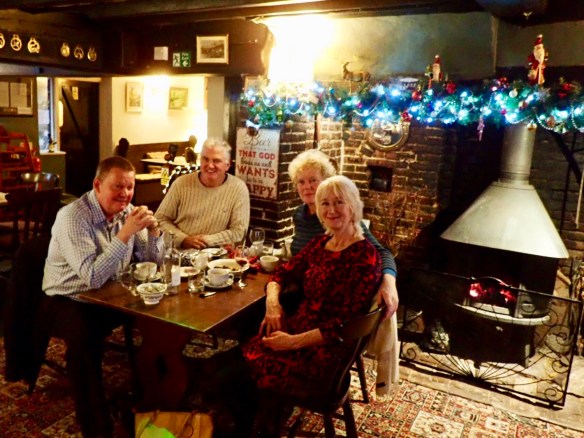
After the first week in the UK we gradually, with the help of a few extra winter wollies, began to acclimatise to the cooler temperatures, enjoying traditional pub lunches, bracing country walks and an over abundance of food and drink laid on by our ever generous friends.

Traditional pub lunch with Tony and Gilly
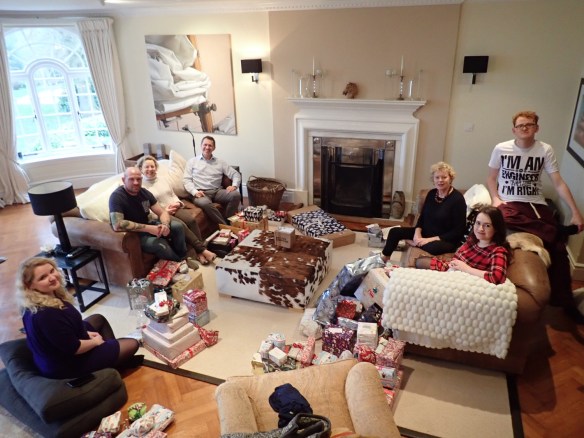
Christmas itself was spent in Buckinghamshire. As we did two years ago, we took over the lovely house of our friends while they skied in the Alps. Having not been home for 18 months it was fantastic to get the family together to celebrate and to indulge in all the family Christmas traditions. From early morning Christmas stocking opening, piles of presents and a dinner of Roast turkey.

An abundance of presents

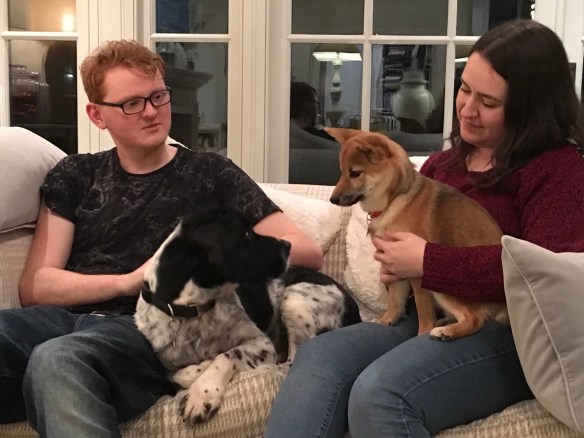
Augmenting the eight adults, this year, we had the pleasure of sharing Christmas with two lovely dogs, Dash whose house we had invaded and Stormi, Matt and Robyn’s new puppy. After a few nervous moments establishing doggy terms when they first met, they luckily became firm friends and were no trouble at all.

Dash and Stormi

Everybody around our Christmas dinner table will be joining us, at one time or another in the Caribbean while we are there in the spring and there was much enthusiastic chatter about sailing, snorkelling and rum. However with the end of our adventure looming a lot of conversation has also focussed on the small matter of what we plan to do next. But as we batted around all our exciting ideas and the seemingly endless possibilities, the thought that by next Christmas we would be firmly back on dry land is so far from our current watery existence that it’s quite difficult to imagine it actually being real.

And there is of course also the small matter of the more than 9000 sea miles we need to cover between Durban and our return to Europe. The most difficult of which could be our next leg around the Cape of Good Hope to Cape Town. For the last few days in the UK we have been looking for one of the elusive weather windows to escape Durban. Firmly reminding ourselves that with time a bit tight for our arrival in the Caribbean, it’s important to resist the temptation to leave in the wrong conditions.

It’s Cold Outside

Saturday 15th December 2018

The bitter wind whipped off the sea, freezing our ears and creeping down the gaps around the neck of our coats. We had gone down to Ramsgate harbour to view the Christmas lights that decorate the yachts each year and couldn’t believe that it could really be this cold. This was not the Ramsgate that lies about 75nm south of Durban, this was Ramsgate, England. We have arrived back home to spend Christmas with family and friends and although, as always, our welcome has been generous and warm, after two years of perpetual summer we are suffering in the cold temperatures that have taken hold in the UK this week.

Before we left Durban we had enjoyed a day on a warmer coast, we’d driven 20 mins north from the city to the beach at Umhlanga Rocks. The beach stretches into the distance in both directions, the waves crashing over the large smooth boulders that give the town its name.

Umhlanga Rocks beach and lighthouse.

The unusual ‘whale bone’ pier that stands at the centre of the beach has won scores of awards, it’s curving structure framing a marvellous view out over the Indian Ocean. A favourite spot for tourists and locals, my fellow visitors included a honeymooning couple, three teenage boys caps pulled down low over their faces, an old gentleman catching his breadth and a couple attentively clinging to their two young children. Looking around me I noticed that this was a rather happy spot, although a disparate group, old, young, black, white, as the wind caught our hair and the spray from the crashing waves beneath our feet filled the air, none of us could stop broad smiles from forming .

Umhlanga Pier

Amongst the new hotels and apartment blocks overlooking the beach sits the Oyster Box Hotel, built in the 1950’s it revels in its colonial grandeur. We had a fantastic lunch sitting on the terrace enjoying the views, before, like good tourists, we visited the art and craft shops, where we topped up on Christmas presents and fell in love with a sculptured giraffe. At about 4ft tall he was much too big for our suitcases and so will have to sail back to Europe with us, although where to store him onboard is a problem yet to be solved.

We flew into the UK on Sunday afternoon, straight into the political turmoil of Brexit, we have been watching from afar the twists and turns of the process, feeling gladly detached. This week as events seem to be tumbling further out of control, we have been avidly catching up on the radio and tv, aghast at the seeming chaos. The rest of the UK, on the other hand, who have been bombarded by it for a couple of years now, are completely fed up by it all, if you ask for an opinion they despairingly just hold their heads in their hands.

Perhaps to hide from reality, everyone is immersing themselves in Christmas, trees and decorations cheering up all the houses, shopping centres blast out cheery Christmas songs and supermarket shelves are filled with festive goodies. As always we have been treated to fabulous food and far too much drink and as we shiver in the chill emanating from Westminster and the wintery weather outside, the hospitality we are enjoying is very welcome.

It’s cold outside!

Right Now, perhaps

Tuesday 4th December 2018

Taking a reflective moment in the cockpit, late afternoon in Durban Marina

We are fast learning that getting things done here is not as easy as it first seemed. The progress we made with the easier jobs when we first arrived, has not continued for the more difficult tasks. Since our return from Safari it’s been very much a matter of one step forward, one step back, half a step forward, if we’re lucky.

When we arrived we were jokingly warned about the translation of words and the South African perception of timescales. Unfortunately we took less notice of this than we should have. We are beginning to discover that the word ‘now’ turns out to mean ‘maybe later’, ‘just now’ means eventually and ‘now now’ while better than ‘now’ still doesn’t mean ‘right now’ which is the best you can hope for and means you have a chance of something actually happening that day, perhaps.

To add to the frustration transferring money from the UK to South Africa turns out to be a lengthy process and full of pitfalls. So having finally got someone to do the work, if they don’t take credit cards, we have to ATM crawl until we have coaxed enough machines to pay out sufficient cash. This is made more difficult by the warnings from everyone to be careful to only draw out money in a secure place.

Despite these and all the other words of caution we have been given, we haven’t ever actually felt threatened here, walking through the run down area near us, does produce quite a few stares but whether these are malicious or just shock at seeing a European face amongst the crowd is unclear. The crime rate is high here and the perception of danger, real or not, is ever present. Barbed wire tops every fence and gate and security alarm notices warn of a ‘fast armed response’.

Barbed wire at the yacht club parking gate.

Despite delays from outside help, we have been working hard and getting things done. Rick has been busy replacing, fixing and servicing, while I amongst other things have been having a well needed clear out of some of the lockers. Anyone who has spent anytime on Raya knows of the stash of emergency food in the front cabin. Hoarded for times of serious starvation, the tins of Fray Bentos Steak and Kidney pies have become infamous as food of last resort. Luckily we have managed to avoid being stranded at sea and even the remotest islands have had provisions adequate for our needs. The stores mostly bought way back in Europe, have been shaken and bounced across three oceans and most items are now more than two years past their use by date, it is time for stocks to be refreshed.

Goodbye to the steak and kidney pies.

We head back to the UK for a quick visit on Sunday and despite the pressure that is putting us under to get people to get on with things, excitement is building. A very full couple of weeks has been planned with military precision, Christmas presents have been bought or ordered and winter clothes have been aired and washed of boat mustiness. The water maker is pickled, the freezer and fridge are almost empty and the suitcases dug out from under the bed. We are nearly ready!

Have to dash somebody has just told Rick they are coming right now, perhaps!

South African Safari

Monday 26th November 2018

Nambiti Game Reserve, in the incredible dawn light

As is often the case we were holding on tight as we lurched and bounced forward, but unusually the wind rushing past us was dry and full of dust, all around were greens and browns instead of our normal blues and the dark grey animals close by were elephants not whales. We have had a weekend away from the boat, enjoying a safari in the Nambiti Game Reserve, staying at the rather lovely Nambiti Hills Safari Lodge.

The lodge had a fabulous pool and terrace area

At only 22,000 acres the reserve is relatively small but is rich in biodiversity containing grasslands, savannah, rivers and dammed waterholes, woodland and thornveld (grassland rich in thorny acacia bushes). This variety of habitats means the park can support over 40 different species including the Big 5. The big 5 aren’t actually the five biggest animals in Africa, the title originates from the days of hunting when five animals stood out as the most dangerous to hunt on foot. Now thankfully most people only hunt with cameras and we were lucky enough to get shots of four of them, lions, elephants, rhinoceros and cape buffalo. The fifth of the big five is the leopard, which our friendly and knowledgable guide Siya informed us, finds you rather than you finding them, sightings are rare.

The park cuts down the rhino’s horns to make them worthless to the poachers

Siya was extremely good at spotting the animals at a distance and expertly manoeuvring the open truck up, down and around the rough tracks of the park to get us as close as possible to the animals. And at times we got very close, the game pretty much ignoring us as they grazed, or strolled pass.

Highlights were many and included in the distance, a female cheetah streaking across the hill capturing an impala for herself and two nearly grown cubs and one evening, right next to us, another female striding along with us marking her territory. A group of lions, suddenly rousing from their slumbers, startled us as they ran past the truck. A male letting out a roar just meters away, leaving us in no doubt about who is king of this jungle.

Up close and personal with the lions

A young bull elephant, ostracised from a herd we had seen the day before, angrily crossed in front of us, a herd of cape buffalos content in cropping the grass at one point completely surrounded us and magnificent giraffes strolled stately past.

A real privilege to be so near to these mighty beasts

On a smaller scale, one evening as dusk darkened to night, Siya caught a genet cat in his spotlight, being nocturnal they aren’t often seen. About the size of a domestic cat they have a striking appearance, their bodies are of white fur spotted with black and their long busy tails black and white stripes.

Not to be out done, colourful land and water birds were in abundance, a few having some very curious features. The prize for most ridiculous bird must go to the long tailed widowbirds. A medium sized bird, the males during the mating season have tail feathers that are about half a meter long, these may make them attractive to the females but make flying clumsily difficult.

We also saw two large secretarybirds with an appearance that is part eagle, part crane. With feathers extending half way down their long legs, they look as if they are wearing a pair of long furry shorts. The odd name originates from the crest of feathers that the adults have on the back of their heads, these were thought to resemble the quills that 19th century clerks stuck in their wigs.

A young secretarybird takes flight

To increase sightings the game drives took place in the surprisingly chilly mornings at five after a 4.30am wake up call and in the afternoon at four as the hot temperatures of the day decreased. They were punctuated by stops for coffee and tea in the morning and gin and tonics in the afternoon. In fact the food and refreshments at the lodge were all delicious and almost too plentiful. Between drives we indulged in some spa treatments and enjoyed our rooms large bath that looked out over the bush. We read, slept and revelled in the luxury. Today we return to Raya and the ever long to do list.

Enjoying the quiet of the Bush with a gin and tonic
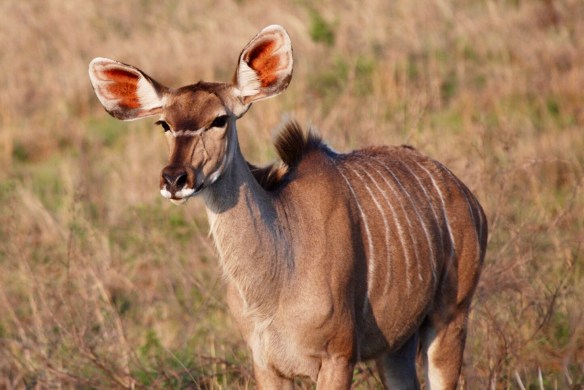
It was so difficult to know where to stop with the photos and I couldn’t resist adding a few more below.

Amazing ears of the female Kudu

And the curly horns of the males

Delightful legs of the African Wattled Plovers
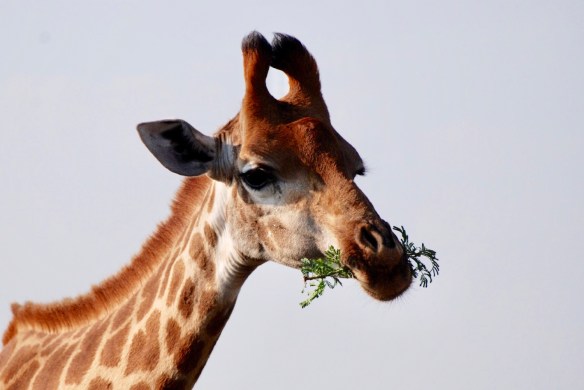
And the priceless expressions on the faces of the giraffes

Finally Durban

Reunion to Durban – part 3

Whales everywhere between Madagascar and Durban
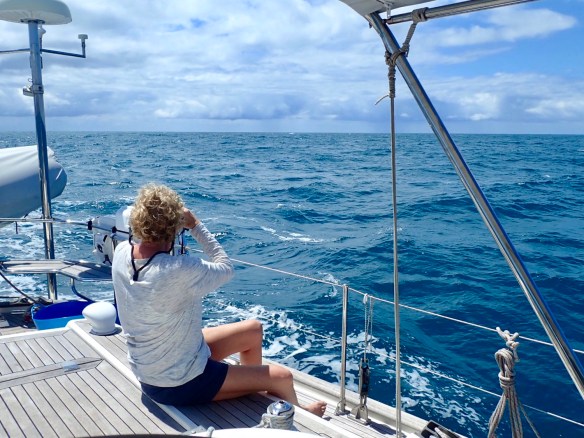
Thursday 15th November 2018

At 3am last Friday, near the top of the tide, we left the dock in Richards Bay and with a good forecast we headed finally for Durban. The multitude of lights within the busy harbour, an incoming cruise liner and 50 or so anchored tankers that were overloading our AIS system, made for a stressful exit. But by first light we had turned south and were being whisked along with help of the Agulhas current, the light winds were directly behind us as we motor sailed, in sunshine and calm seas.

Ever since we arrived off the coast of Madagascar we have seen numerous pods of whales and this trip proved to be no exception. However many times you encounter them, when they are up close to you, it is still shocking how huge they actually are. One surprised us, surfacing just a few hundred meters off our beam, another pod entertained us, breaching and fin slapping as we sailed by.

Whale watching off Madagascar

By 4pm we were tied up on the International dock in Durban Marina. We are a bit close to the noise of the city, with its continuous traffic, a rail track and crowds of people. And the water in this corner of the marina is depressingly strewn with rubbish. We are however more than ready to enjoy having no anchor alarms to worry about, no walls to contend with as the tide rises and falls and an endless supply of power and water.

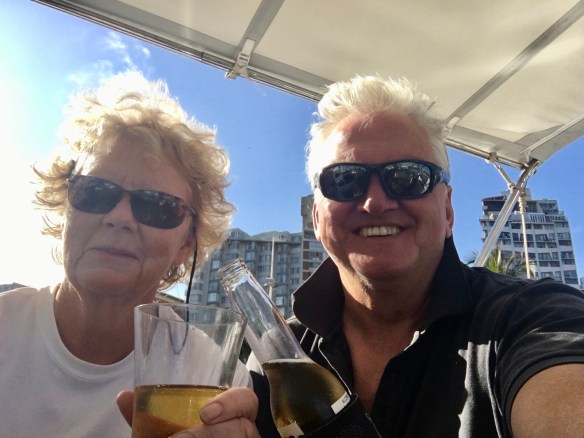
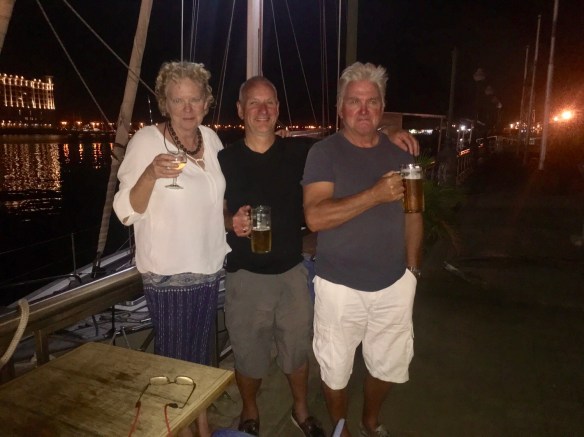
Durban ‘got here’ beers

Just across from us is the Royal Natal Yacht Club, the oldest yacht club in Africa. It’s a well frequented venue and everyone has given generously of their time and local knowledge. Sunday’s they served a carvery so we enjoyed our first roast lunch in 18 months, we have sampled the fine South African wine and been entertained by live music on their lawn. A few hundred meters in the other direction is the Point Yacht Club, who serve a knock out breakfast and have a Thursday night B B Q. Termed Braai here, as well as delicious chicken kebabs, we tried spicy boerewors, a tasty beef sausage and rather tough biltong, a thick cut beef jerky. There are a couple of Oyster rally boats still in the marina, as well as a few other boats we know, so we have plenty of company and as for once Sterling is strong here, to make things even better, everything is extremely cheap.

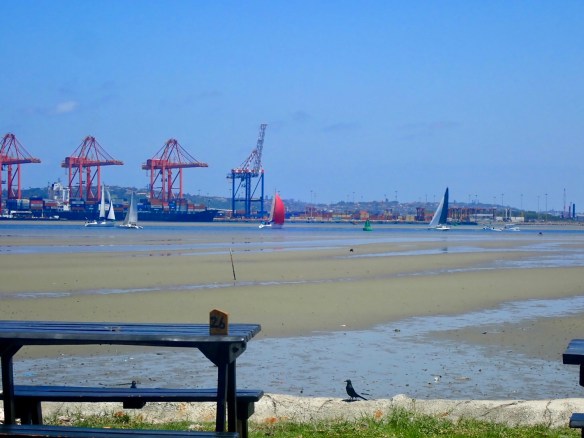
View from the yacht club lawn across Durban Harbour at spring low tide
We do however have lots of work to get through during the next few weeks, a long list of jobs sits staring at us from the table. Luckily with labour cheap and plenty of marine trades around, finding help has been relatively easy so far.

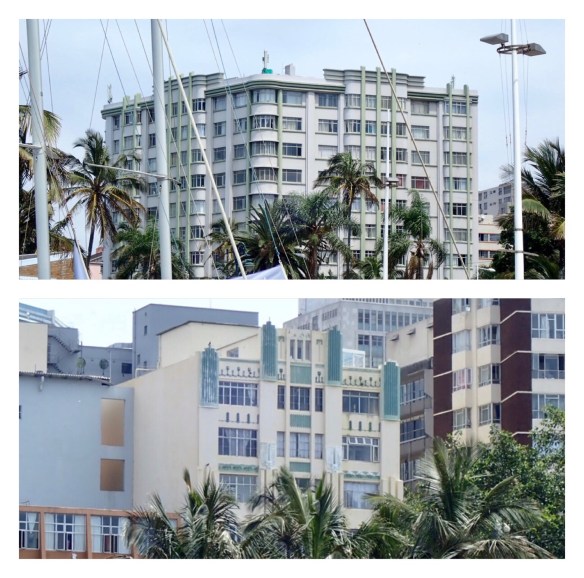
Which is a good job because moving about is a bit of a challenge, the crime level in Durban is high and exploring further than the marina precinct by foot, we are told, is ill advised. Our immediate surroundings, in the worst days of apartheid, was a whites only neighbourhood, upmarket new apartment blocks sat between majestic examples of Art Deco architecture. As politics changed, the wealthy residents moved out of the city centre and now many of the buildings stand empty and derelict, the whole area has become dismally run down and petty crime is rife. Consequently taxis are the order of the day and next week, having ticked off some of our tasks, we will hire a car to explore further a field.

Art Deco architecture overlooking the harbour

Landfall South Africa

Reunion to Durban – part two

Wednesday 7th November 2018

It was with a mixture of relief and disappointment that we managed with difficulty to tie up to the wall in the large port of Richards Bay about 85nm north of Durban. The arrival fantasies, in my tired state, of a safe, easy, marina pontoon, where we could close our eyes and sleep for a week, were not to be.

Richards Bay is full, the marina gearing up for the arrival of the World ARC and the Small Craft Harbour has foreign boats rafted two by two to the wall. The only spot we could fit into was nestled in amongst the large tug boats that operate in the port. Getting on and off the boat is difficult and in the gale force SW winds that have blown for the past two days and with spring tides, sometimes impossible. We are within the tug boat security area and so have to be let in and out by a security guard, we have no power and water only after Rick managed to temporarily connect us to the over sized pipes designed for commercial vessels. The rough wall is playing havoc with our lines as we rise and fall in the 2m tide and we haven’t dared look at what the barnacle encrusted sides are doing to our fenders.

Tied up with Vella in Richards Bay small craft harbour.

We have arrived in South Africa however and the ‘got here’ beers that we drank in a nearby bar, have rarely tasted so sweet. To cap things off, on the bar TV, a bit of home welcomed us, the England rugby team were playing the Springboks at Twickenham, we cheered quietly, amongst a sea of green shirts, as England kicked the winning penalty.

It was a five day passage from Madagascar to Richards Bay, from a sailing point of view it was straight forward, we had one night of higher winds brought by squalls of torrential rain but mainly there was light winds and the engine was on. We decided early on to make the slightly shorter run into Richards Bay, in doing so, avoiding a night entry, in high winds into Durban Harbour. However, psychologically the passage was quite stressful, timing was every thing, not just to avoid the worst of a squally front but importantly to arrive at the Agulhas current in the right conditions and our weather window was quite tight. Estimating our speed was complicated by continually changing eddies of current that swung from 2kts with us to 1kt against, the days of motoring gave, me at least, range anxiety and news from some of the over boats was not good.

The fleet had split at the south east corner of Madagascar, while we sat things out in Fort Dauphin others pushed on. Some, risking the run straight in, sailed through bad weather but after a day or so waiting at sea for the wind to change, successfully made it ahead of the pack. Other boats decided to wait things out on the west coast of Madagascar, but a terrifying incident, where Atem the Blue Swan was approached by an armed gang, who were only deterred by a strong squall from boarding the yacht, sent everyone scurrying to hide out off the coast of Mozambique. Atem reported the incident to the American, British, French and any other authority that have navy boats in the region, apparently the potential pirates were apprehended. Atem arrived in Richards Bay a few days after us understandably very shaken. Thankfully we had no such problems and with help from our weather man, Chris Tibbs, when we reached the infamous Agulhas current all was calm, a sleeping monster beneath our keel.

Crossing the Agulhas Current

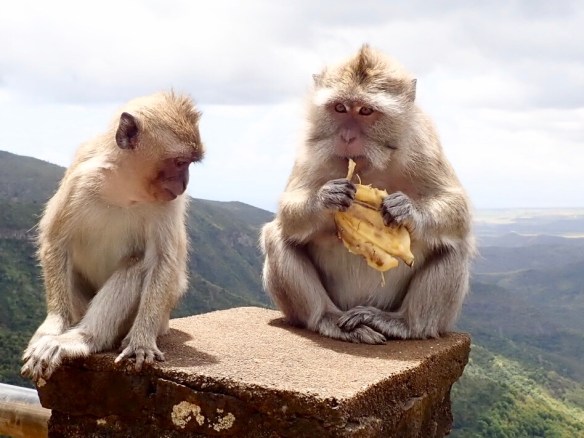
In the few days we have been here, Richards Bay has thrown everything at us, scorching decks, violent thunder storms, torrential rain and gale force winds. We have been invaded by a swarm of May Flies, that promptly died and covered the decks and visited by a troop of monkeys that we had to shoo from the boom.

Lightening was a bit close for comfort

Many hours have been spent dealing with immigration and customs, in South Africa you have to fully check in and out as you arrive at and leave each port, this involves getting the correct stamps, from the correct offices, in the correct order. Luckily we have had a knowledgable and helpful taxi driver to chauffeur us around and the company of the folks on Vela another Oyster that has been rafted up to us. Not only did we jointly do battle with the authorities, we have all dodged extremely close lightening, eaten out, drank on each other’s boats and done a half day river safari together.

The St Lucia river an hour of so north from here is home to 800 hippos and 1000 crocodiles. Our tourist boat slowly meandered up the brown muddy shallows bordered by reeds and mangroves. We passed sleeping and swimming crocs, bright yellow weaver birds creating their perfect round nests on the reed stems and families of wallowing hippos. Further up the river through the trees we spotted an antelope and a group of at least thirty sleeping hippos. Appetites wetted we have booked a three day safari for the end of the month.

Occupants of the St Lucia River

With the weather easing and hopefully all paperwork completed, we plan to start the short sail south in the early hours tomorrow, with an arrival, finally, at Durban marina in time for supper.

An Unexpected stop in Madagascar

A ring tailed lemur

Reunion to Durban – Part 1

Tuesday 30th October 2018

The Indian Ocean continues to challenge us. The exit from Reunion, last Wednesday, was even more lively than expected, with high winds and horribly rough sea. In our rather rushed departure I had forgotten to take a seasick pill and I rapidly became unwell. Even my trusty tablets that I put under my top lip couldn’t stop the waves of dreadful nausea.

Having been told we couldn’t stay in the marina we had decided to leave quickly so that we could sail with the Oyster Rally boats who had very kindly invited us, and Atem the Blue Swan, to join their SSB radio net. With such a tricky crossing in front of us there is comfort in numbers and the pooling of knowledge means we would be very well informed.

Thankfully during the first night things calmed down and my queasiness gradually wore off. The wind dropped right back and on came our engine. Unfortunately, looking forward a week, with the help of our weather router, conditions for our arrival in Durban, still looked difficult. As the forecasts firmed up, it became clear to us that a stop in Madagascar to wait for things to improve might be the solution. So it was therefore that just 3 days into our journey we found ourselves anchored, with four other Oysters that made the same call, in Fort Dauphin on the SE corner of Madagascar.

Madagascar had never even been on our radar, we knew very little about it. Whales breaching and fin slapping greeted us at the entrance to the bay, which we were surprised to find, with its backdrop of mountains and several European influenced villas above the beach, looked from a distance, a bit like an Alpine lake resort.

Fort Dauphin

The view from the deck proved to be deceptive, ashore, the smells, the slightly beaten up buildings, the rutted roads, the lovely wooden canoes and the smiling faces of the people, were all very African. We were met at the beach by an excited gang of youngsters and a few adults, all keen to help bring the dingy up the beach and look after it for us. The women and children persistently offered cheap jewellery for sale, the men waved taxi keys or offered to be our guide. The throng was a bit intense but all very friendly.

Local wooden canoes

We were shown the way to the immigration office where much filling of forms and enthusiastic stamping took place before a fee of over £100 was demanded. There was slight suspicion amongst the crews that this amount was fairly arbitrary and set to fit how much they thought we would pay. Barring Galapagos, with its National Park fees, I think it must be the highest amount we have paid to enter any country, but we were stuck here, we had to pay up.

A few trips to the ATM were in order and after a data sim was purchased we returned to Raya to rest, and, what else, to study the weather forecasts. We assured ourselves we had made the best decision, we would be here a couple of days. Heck, we were in Madagascar, time to find the lemurs.

Our taxi drivers car, a bright blue, tiny ancient Renault, was only just big enough for us and our guide, who, reassuringly, wore a sign saying ‘Official Guide’ in big letters around his neck. They told us they would take us to a private reserve where we could get close to the lemurs, but to be honest they could have been taking us anywhere, our normal careful research not done, we were in their hands. We wound our way through the crowded, narrow streets and through the bustling market area, stopping at yet another ATM to get more tens of thousands of Madagascan Rand, even after our time in Indonesia, we were struggling to get our head around all those zeros.

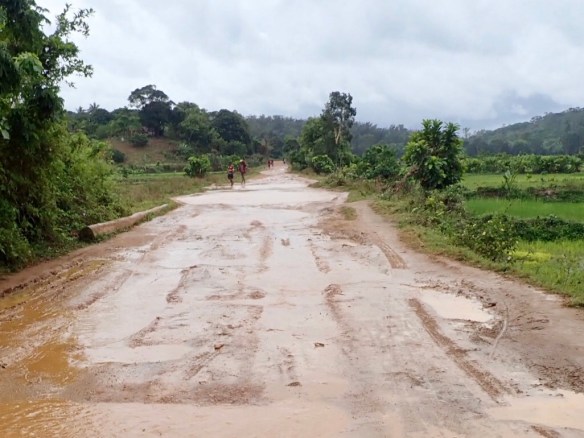
Leaving the town behind we turned onto a smooth wide dual carriage way, rice paddies and other crops filling the narrow strip of land between the mountains and the coast. Our comfort and speed was, however, short lived, as within minutes we took an unmade road towards the mountains. It had rained heavily all night and our driver was quickly confronted by deep puddles that filled the bumpy track.

Overnight rain made the roads almost impassable.

He’d obviously tackled this before as he torturously wound his way between them, his little car manfully battling on. Villages lay every few miles, consisting of collections of huts constructed totally from the bamboo that grows everywhere here, the walls from the stiff stems, the roofs from the fronds. We passed a gash in the mountain, shockingly rock was being hewn from its sides by hand, carried to the nearest village and made into square bricks.

Yes that’s a duck wandering past stone bricks, hand made straight from the mountain

A continuous stream of people walked between the villages, mostly carrying goods either strung from bamboo sticks, or in the case of the women in baskets miraculously balanced on their heads. A man driving four head of cattle squeezed to the side of the road to let us pass, we stared out of the window wide eyed, this truly was, another place, a world away from our comfortable European lives.

Everyone uses the one road through the villages

Eventually we reached the reserve and found our lemurs. They are really lovely creatures with expressive human like faces, their bodies covered in lush soft hair and their long bushy tails used skilfully, almost like an extra limb. We saw tiny Bamboo lemurs sat high amongst the shade of the dense foliage at the top of 30ft bamboo clumps, brown lemurs athletically leaping from impossibly spindly branches in the very tops of the trees and ring tailed lemurs that peered at us from crooks in the tree trunks.

Ring tailed lemurs

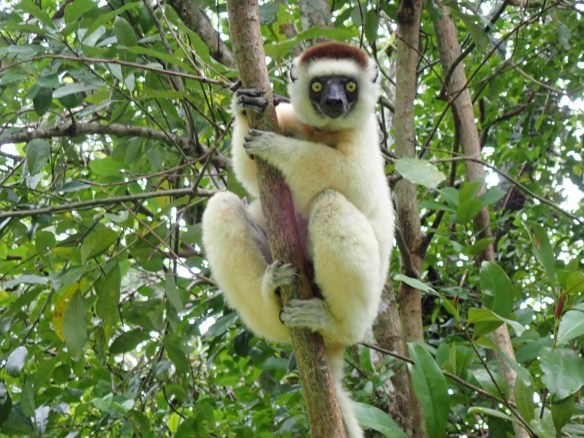
But the friendliest were the white lemurs, nick named dancing lemurs they nimbly swang from branch to branch, ran up and down the tree trunks and came right up to us looking for food.

White lemur

What an amazing morning. Praying for no more rain we followed the rough road back to the bay, ran the gauntlet of locals on the beach and returned to the boat. The days weather report had arrived, it was time to move on, our unscheduled stop had turned out to be so much more than a safe place to wait for the weather systems to get in line. Despite our fears this little corner of Madagascar, at least, is delightful.

Reunion Island

Wednesday 24th October 2018

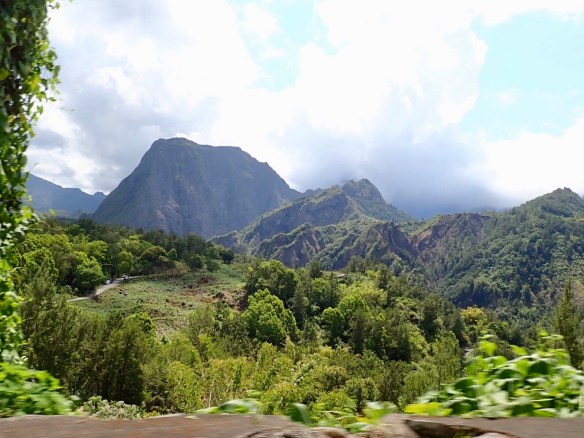
Magnificent landscape around Reunion Island

As I swap the current charts on the table for those of the Madagascan and South African coast, the wind howls into the cockpit and the boat rocks on the fetch building in the dock here at Le Port on Reunion Island. We are rafted to a lovely 62ft Swan with a blue hull, luckily the winds are from the SW and pushing us both, off each other and off the wall.

Raya rafted in Le Port, the Oyster fleet behind us, all waiting for a weather window

The weather here is very variable, the normally reliable SE trades being affected by a continuous procession of high and low pressures. The 8-9 day crossing from here to Durban is unlikely to be straight forward, the forecast changing from day to day. On top of which the last day into Durban we will cross the infamous Agulhas Current. Running south down the South African coast it is not a place to be if the winds turn to the SW, which in unsettled weather they, suddenly, often do..

Finding a good weather window to make the crossing is difficult, the Oyster World Rally Fleet that should have left last week are still firmly tired to the wall. A few months ago we decided to ask weather guru Chris Tibbs to help route us for the passage. He confirms that once this front has past over, tomorrow there is a window opening up, so we are preparing to leave.

If we had known how nice Reunion Island was we might have planned a longer stay. High volcanos, one of which is still active, form the base of the island. Lush with tropical rain forest, near vertical cliffs, formed from numerous rivers, cut through the landscape. It was as if we were driving through a geography lesson on V shaped valleys.We followed the steep road around tight hair pinned bends admiring the views. The sides of the hills were streaked with waterfalls.

Waterfalls streaked the hillside

While we had the car we also went down to the beach for a late afternoon paddle and sundowners overlooking the surf crashing onto the reef a few hundred meters off the coast at La Saline la Bain. The lagoon inside the reef is one of the few safe places to swim in Reunion, as well as being famous for its magnificent interior it has a less favourable reputation for having the highest number of shark attacks per head of population in the World. Most marinas have no swimming signs posted around the dock, but we’ve never before seen them say no swimming : beware of sharks.

Nice spot to watch the sun go down

With brilliant French supermarkets the freezer is full of not just passage meals but pastries and bread, the fridge has soft cheese, ham and salami. Raya is shipshape, Richard who accompanied us from Cocos Keeling, has been safely waved off at the airport, and customs officers are due in the morning to stamp our departure papers. Africa here we come…..

Or do we? Tuesday night suddenly the weather doesn’t look so good, the last few days into Durban are now looking difficult. This means we either need to make a stop after three days in Madagascar or slow our speed down perhaps even heaving to (stopping mid ocean) to wait for an improvement in conditions before we cross the current. The Oyster fleet already a week behind schedule decide they will leave, we on the other hand have no time pressures and conclude that perhaps we should enjoy Reunion a bit longer.

Unfortunately, this morning the Marina has different ideas, with the arrival of the World ARC boats due in the next few days they refuse to let us stay. This is very unusual, normally a port would make every effort to accommodate you, realising the weather is our ruler. However it seems in the Indian Ocean the rallies are King, individual boats having to fit in were and when they can.

Back to plan A, a departure in a couple of hours, we’ll have to work things out as we go.

Angel trumpet shrubs brighten the mountain villages
Monkeying around in Mauritius

Wednesday 17th October 2018

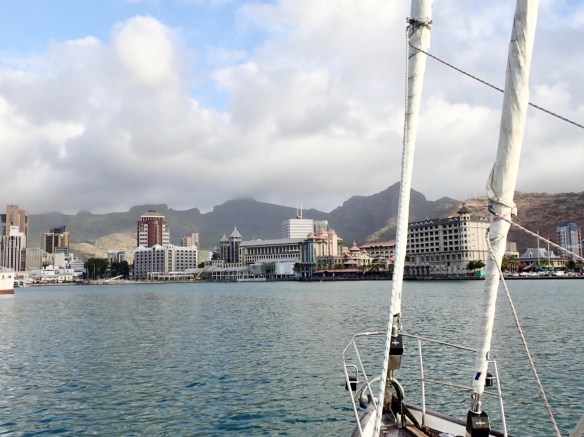
After so many weeks either at sea or on quiet islands, emerging into the bustling town of Port Louis was completely disorientating. A cacophony of noise from the huge building works on the Waterfront assaulted my ears. People and more people, cars and bikes blocked my every move and the mishmash of roads that looked nothing like the grid layout on my map , hid my destination. Finally locating the supermarket, dazed I fought my way through the crowds. Doing my best to translate the French labels, I scrabbled together enough items to get us through the next few days.

Sailing into Port Louis

Luckily it didn’t take long to adjust and on Mauritius’s plus side, we have found nice cheese and baguettes, an ATM that gives us money on our first attempt and in the restaurants the food has been good and the wine served in thin stemmed glasses, a real luxury.

At the weekend we hired a car to explore a bit further and visit some of the tourist attractions. Escaping the traffic and chaos of the town’s took a while, Mauritius turns out to be much more built up than we expected. The busy roads, crowded pavements and ramshackle buildings of much of Port Louis and the towns of the interior are a world away from the serenity of the expensive resorts that line the rest of the coast, our previous experience of the Island. The real Mauritius is a truly multicultural society. Christian churches sit next to ornate Hindu temples, while pray call from the mosques fills the air. Over half of the population is of Indian decent, but there are also a large contingent of Africans and Chinese all muddling along together.

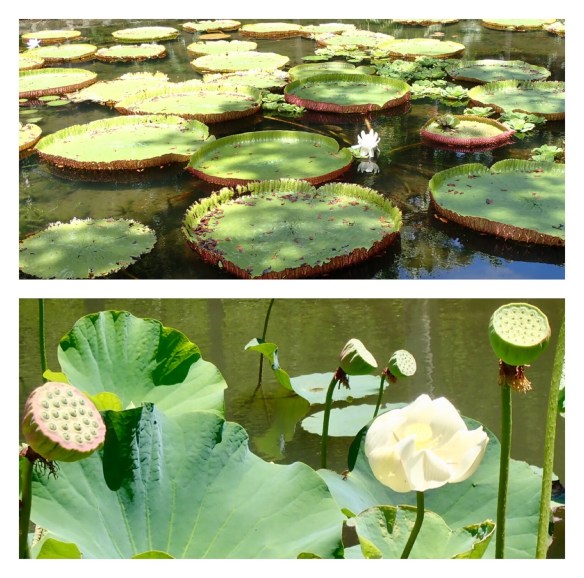
We first travelled north to the Botanic gardens, famous for its pond of Giant Amazonian Lilies and 80 varieties of palm trees. Created over 260yrs ago, avenues of mature trees link the formal lilly pond to the more naturalistic ponds of lotus flowers.

Victoria Amazonia Lilies and Lotus flowers and seed pods.
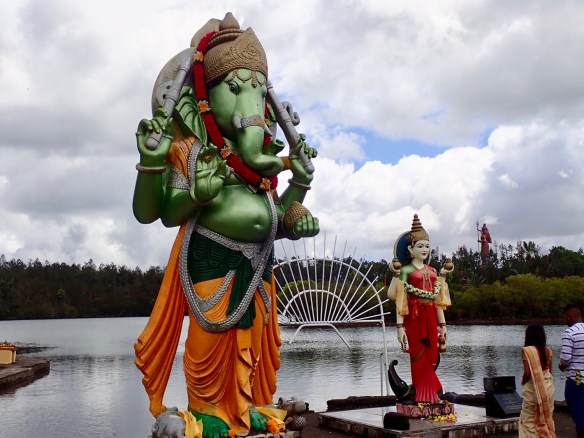
Sunday we headed South to explore the mountains of the Black River National Park. First stop was the sacred lake at Grand Bassin, mythically linked with the Ganges it is one of the most important Hindu pilgrimage sites outside of India. The proof of its popularity are the huge car parks and walkways that lead to it. The air was thick with the scent of incense and although nobody seemed to mind us wandering amongst them taking photos, we felt rather like intruders. Dressed in their colourful Sunday best, families had come to be blessed in the holy waters, making offerings of fruit, vegetables and flowers and then visiting the temple and praying to the brightly decorated deities that sit at the waters edge.

Ganesh the elephant deity

We drove further into the park stopping at view points and waterfalls. Unfortunately the dry season had turned the waterfalls into trickles and with cloudy skies the no doubt often spectacular views to the south coast were misty and flat. Troops of monkeys that had collected to scavenge from the tourists leftovers became the main attraction.

Monkeys high up in the Black River National Park

Descending through sharp hairpins the mountain road led us down to Chamarel and it’s peculiar dunes, La Terre de Sept Couleurs. The seven colours have been created from basalt rock rich in Iron and Aluminium. Ferrous oxides giving the reds and browns, aluminium oxides producing blues and purples.

The Seven Coloured Earth

Back onboard Raya we spent a couple of days in limbo, waiting for the ok on a spot in the marina in Reunion Island, our next stop and where Richard leaves us to fly back to the UK. The Oyster Rally a week ahead of us is occupying most of the space, but with the arrival of the World Rally boats to Port Louis, things are getting pretty tight here too. Berths for individual yachts such as ourselves are becoming few and far between. And with the weather not looking good for a departure to South Africa any time soon there is becoming a bit of a yacht bottle neck.

Thankfully yesterday Regine the Oyster Rally coordinator kindly negotiated us a spot tied up with the Oyster fleet, we leave for Reunion this afternoon.

Turbulent Indian Ocean

Finally Internet, see two blogs below

Friday 5th October 2018

We have just reached the halfway mark of our sail from Cocos Keeling to Mauritius. The Indian Ocean continues to be lumpy and uncomfortable, tossing Raya back and forth as she speeds onward. Bigger waves roll in every ten minutes or so, looming over us then picking us up, when we reach the crest for a moment we sit perched high above the ocean, before with much spray and noise, we surf downwards to await the next ride.

Waves up to five meters high persisted for most of the passage.
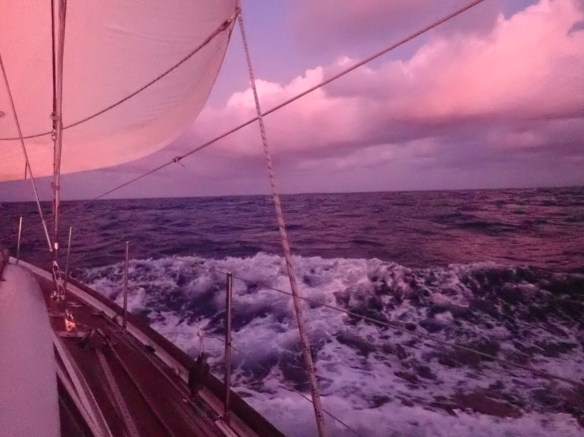
Our friend Richard who joined us in Cocos Keeling has fitted in well with our routines and so we are now all getting a bit more sleep, even with the rolly conditions. The half moon however that lit our way for the first few nights, has waned and with quite a bit of cloud obscuring the stars our night watches are very dark. Sunrise is as always welcome.

A pink sunrise

We have seen very few other ships, a few tankers have passed us but most only spotted on the chart plotter as AIS targets, just a couple pass close enough to spot on the horizon. Even the dolphins have been keeping their distance it is unusual to be at sea for this long without spotting at least a few.

In contrast there have been plenty of flying fish, one morning Richard cleared 26 that had accumulated on the deck over night. During the day we watched them skimming the waves all around us. On one wave, right next to us, about 50 small fish all took to the air at once. Catching the sun as they leapt, fins beating rapidly, for one magical moment they looked just like a band of fairies appearing from the deep.

So each day goes on, we eat, catch up on sleep, read and gather for the 4pm crossword. We’ve had good winds and we are sailing fast, there is much debate as to whether we can maintain these high speeds and make it to Port Louis the afternoon before our estimated arrival on Friday 12th. The next few days, with a forecast drop in the wind and possible drop in speed, will be the deciding factor. Unfortunately if we lose pace then we will have to slow up for the rest of the voyage to avoid a night time arrival.

——————————————————————————————————————————————–

Thursday 11th October 2018

On day eight calmer weather did arrive, the sea settled, the sun shone and the fishing rod came out. Luckily we still had a reasonable breeze and could keep our speed up. The fish however were disappointedly not biting. A fish supper would not only have been delicious but would have helped our dwindling fresh food supplies. Almost everything I bought in Cocos Keeling has not lasted well, the fridge is looking extremely bare. We have all been fantasising about our first meal ashore, with chips of course and a large glass of wine.

Boys putting out the fishing rod, no bites this trip sadly.

The Indian Ocean hadn’t finished with us yet however, two days out from Mauritius and the winds built again along with the swell. It was back to bracing against the tipping from the waves, each task taking twice as long as it should. We have found this Ocean particularly fickle, winds often gusting from 18 to over 30kts every few minutes and the sea state varying, seemingly randomly, from slight to rough.

For the second half of the passage we saw many more tankers and cargo boats, all thankfully happy, on request on VHF, to let us maintain our course. About 200nm out we began to cross the shipping lane for boats coming up from the Cape of Good Hope heading towards East Asia. A sharp lookout was required.

And then the squalls came. Ominous black clouds would appear on the horizon, the wind would drop and back. The arrival of a downpour would be accompanied by a blast of high winds that only gradually returned to their presquall direction and strength. Each squall required us to reef the sails and frequently change direction, the cockpit and crew were frequently soaked, sleeping off watch almost impossible, if we hadn’t laughed we would have cried.

Squalls rolling in over the Indian Ocean

To add to our woes, a seam on our Genoa started to split, the sails have, like us, done a lot of miles. Luckily they are very strong and held together with a network of spectra, miraculously the sail maintained its integrity and didn’t appear to effect our performance.

A split in the Genoa

But we made it, in more or less one piece and are now tied up to the wall near the customs office in the capital of Mauritius, Port Louis. Although not our favourite crossing it has been our fastest, arriving 12hrs earlier that expected and averaging 7.8kts. The usual ‘ got here beer’ was delayed slightly by the extremely efficient check in procedure. An hour of form filling later, it was three very weary and slightly wobbly sailors that clambered over the railings to the restaurants conveniently located right next to us.

Second ‘got here beer’

Cocos Keeling

Thursday 27th September 2018

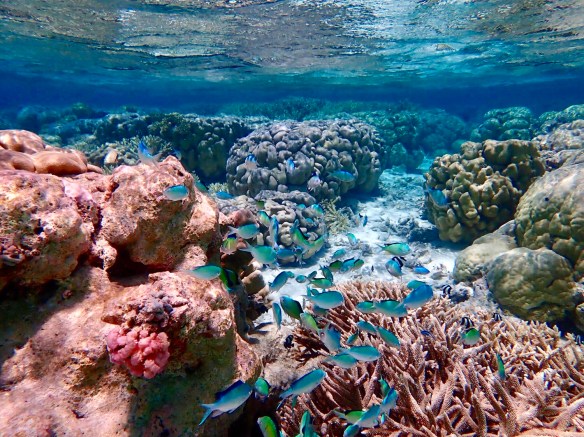
Coral garden Cocos Keeling

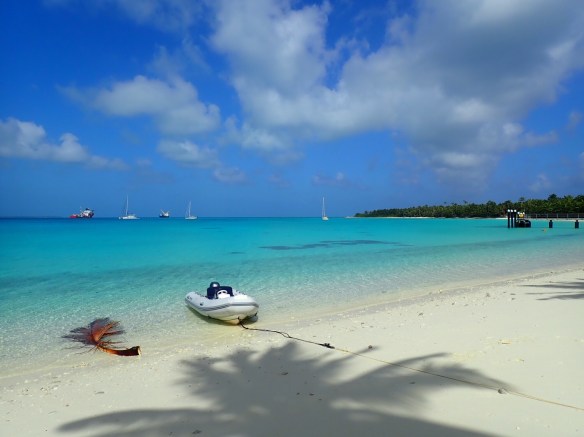
Sitting atop a sea mount rising from the sea bed 5000m below, Cocos Keeling is 600nm SE of Java and over thousand miles NW of Australia, it is the very definition of the middle of nowhere. Two stunning coral atolls comprising of 27 white sand islands, topped with palm trees and of course surrounded by turquoise seas.

The anchorage off Direction Island

For such a remote spot we have discovered it has a lively history. The inside of the Southern Atoll has provided, in the aptly named Refuge Bay, protection for passing ships for centuries and we in that long tradition are anchored in its lagoon off Direction Island. It was first put on the map by a whaler from the Scottish Clunies-Ross family, who in the early 19th century settled here, bringing in hundreds of Malay workers with whom he set up a successful coconut plantation.

At the beginning of the 20th century things began to change. As telegraph communications become more important, in 1901 a cable was laid from Perth in Australia to a repeater station on Direction Island and then on to Singapore and Mauritius providing a link from Australia to London. With the coming of the World Wars the islands strategic position became even more clear to the Australian government and in the 1950s, it would appear rather underhandedly, the Governor of the the time John Clunies-Ross was accused of practicing slavery, shamed and bankrupted. Cocos Keeling became part of Australia.

Oceana House the grand family home still stands on Home Island. After years of neglect it was bought by an Australian couple Avril and Lloyd and just in time its expansive teak panelling, wooden floors and ornate terraces are beginning to be restored.

Home island, a very wet 2nm dingy ride away from the anchorage, has that sleepy island feel that we have found in many isolated ocean islands. It is home to the majority of the Muslim Malay population and with only short distances to travel in their small town they get around slightly incongruously in golf buggies. There is a small museum, a supermarket, island administrative buildings and a brand new cyclone shelter. But our destination is almost always, the pavilion, here overlooking the beach and lagoon is an internet hotspot, every couple of days we sit, dripping from the journey, catching up with our emails and downloading the weather.

Connecting with the rest of the world

West Island, that forms a large part of the western lagoon edge, houses most of the Australian residents, a further supermarket, a cafe and the airport. Saturday our friend Richard was flying in from the UK to join us on the leg to Mauritius and Reunion. With the demise of our Bimini and sprayhood earlier in the year, we also had a large box of replacement canvas work, very efficiently supplied by Dolphin sails in the U.K. to pick up. Add on the fact that fresh groceries had arrived on the island that day, which I with seemingly the rest of the population, rushed to snap up before stocks dwindled, meant it was three very ladened sailors that made the convoluted trek back to Raya. First step was to take a shuttle bus from the town to the ferry dock, then it required two ferry crossings from West Island to Home Island, one for people and one for cargo and then being too loaded down for the dingy, we had to arrange a water taxi back to the boat. It took a while but we made it and Richard is unpacked, the new sprayhood up and the fridge full.

As we wait for the rather windy weather to calm down before we head off on the two week passage to Mauritius, we have been enjoying this rather special place. As well as learning about the islands history we have been following trails through land thick with palm trees, socialising with the World ARC boats that have gradually being filling the anchorage and snorkelling ‘The Rip’.

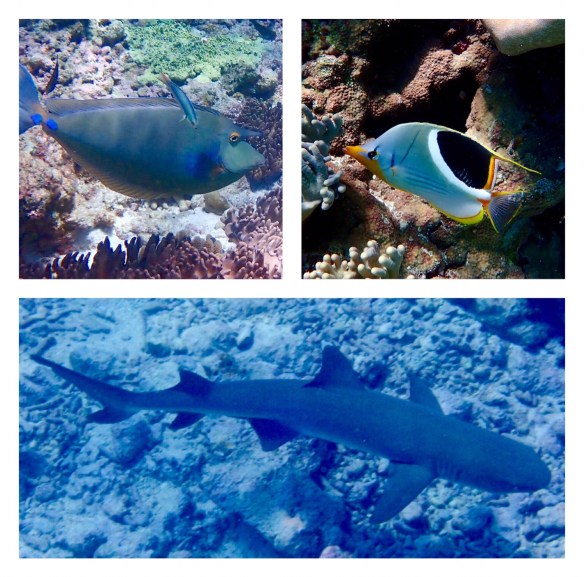
The Rip is a channel cutting through the coral at the end of Direction Island, the current runs at about 3kts and it is full of large grouper, trevally and white tip sharks, all enjoying the fast flow of nutrients. The coral walls either side provide overhangs, crevasses and bommies crowded with smaller fish. The dingy firmly in tow it made for a great, if rather quick, drift snorkel.

Inhabitants of the Rip

Today the wind is stronger than ever, the fetch across the lagoon forming white horses, we have put on our swimmers to make the crossing to the pavilion and are temporary connected to the world.

No Pain, No Gain

Thursday 20th Sept 2018

Hanging on, precariously against the messy seas and high winds, a masked booby taking a rest from the buffeting of these gusty conditions, perches on our dingy. I, in a similar state, sit huddled in the corner of the cockpit, his presence breaking the monotony of my night watch. The predawn sky gradually lightens to reveal another day of rough seas. The best thing that can be said about our passage from Lombok to Cocos Keeling is that it’s been fast, we covered the 1141nm in just a few hours over 6 days.

Masked Bobbie resting on the dingy

You would think that after 25,000nm, the milestone we reached a few days ago, that we would be better at reading weather forecasts and that we would realise that 12kts really means 8kts ie not enough to sail by, which is what we had for the first two days and that 20kts actually means well over 30kts, producing the rough seas that plagued us for the rest of the journey.

It’s not that these rough seas were scary, even as large waves loom over us, Raya copes with these conditions as if they are all in a days work but it is really uncomfortable. Eating and other essential tasks become difficult and sleeping is near on impossible. On our off watches we roam the boat, steadying ourselves between handrails, dragging a quilt, trying to find the best place to sleep in the current conditions. Some times diagonally across the main bed works, or perhaps wedged into a bunk bed with a lea cloth or maybe the best spot is in a nest of pillows on the sofa. Often there isn’t anywhere that works and it’s just a matter of closing your eyes and trying to get what rest you can.

The captain clinging on while he catches up on some sleep
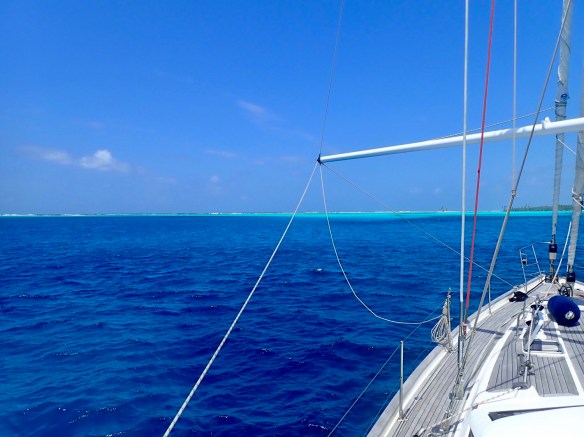
The big waves also brought us less welcome visitors. Flying fish flew on to the deck and into the cockpit in shoals, their frantic flapping leaving scales all over the place and making them impossible to pick up and throw back into the sea. One hit Rick square on the head, others bounced off the Bimini which must amazingly be 4 or 5m above their watery home, while others we found caught in the halyards on the mast.

We left Marina del Ray last Thursday for an anchorage away from the islands and pearl farms that surround Gili Gede to make for an easier get away the next day. We wanted to tackle the strait between Lombok and Bali in the lighter, early morning, breezes. It was still a challenge to avoid the worst of the overfalls but the 5kt current whisked us quickly out from Indonesia into the Indian Ocean.

The Indian Ocean, we really are on our way home now. With only seven or so weeks left before the cyclone season hits this area and with nearly 5000nm to cover we will for the first time on this trip be sailing for as much as we are at anchor. As we watched the turbulent water around us, discussed whether it was worth fighting the elements to make a cup of tea or sat through a chilly, drizzly night, the prospect of weeks at sea didn’t really appeal.

However this morning the sea had calmed a little and with just 10nm to go we spotted the last of the Oyster rally fleet leaving the atoll of the South Keeling Islands. Our spirits rose as we chatted on the radio to our friends on True Blue who gave us their top tips for enjoying our stay. And as we rounded Direction Island and entered the lagoon we were greeted with clear, calm, turquoise seas and three small black tip sharks. We were promptly checked in by the friendly Cocos Keeling police, washed our salt covered decks and drank our ‘got here beer’. This life’s not so bad, as they say, no pain, no gain.

Motoring in to the lagoon off Direction Island

Lombok, Marina del Ray

Thursday 13th September 2018

As we secure the last few lockers, finish a raft of maintenance and cook enough meals for a week at sea, around us the marina has emptied of Oyster rally boats and then refilled with boats from the World ARC.

Raya and 20 World ARC yachts.

Making the best use we could of the few quiet days between the rallies, we managed to refuel, get the laundry completed and take a trip into town to provision. Town is the capital of Lombok, Mataran, which is 20miles and an hour and a half drive away.

This was not a prospect we relished with memories of the hot bumpy rides we have had so far in Indonesia. Saturdays journey started with a short boat ride over to the mainland and here we immediately realised Lombok was a bit different from the other islands. The ever present scooter drivers were actually wearing helmets, our driver put on his seat belt and the road was smooth, newly laid tarmac. The views from the window however were chaotically similar. The first third of the journey we wound around the turquoise coast dotted with a few small resorts and passed through ramshackle villages and farms.

Farm buildings for cattle and goats

We entered a more built up area, a beggar sat on a stool in the middle of the road, perilously close to the traffic, school children filled the pavements and horse and carts risked life and limb cantering between the cars and scooters. We crossed a tumble down bridge in the middle of being replaced, mosques appeared around every corner and as we entered the city rice paddy fields incongruously filled the land between buildings

Schools out, half days on Saturday

We turned into a large car park and suddenly the noise and bedlam of Mataram disappeared. The large, western style shopping centre, shiny, quiet and modern felt like it had been dropped from outer space. It took a moment to get over the culture shock and then it was straight to the supermarket to stock up for the next couple of weeks.

Water taxi delivered us and our shopping back to the marina

With all the boats on the dock there has been a friendly atmosphere, everybody helping each other out. We were recommended a restaurant over the hill. A short walk, with a steep section over rubble and mud, followed by a badly crumbling path but it was well worth the effort. Perched on a slope, draped in bougainvillea it was completely charming, the food was good and the prices reasonable. Just don’t forget your torch for the walk back!

Crumbling path to the restaurant

And so our Indonesian foray comes to and end, we have after a few days of delays our exit papers and tomorrow we will set off on the first leg across the Indian Ocean. We should reach the remote atoll of Cocos Keeling in 6-7 days time.

Volcano Adventures

Friday 7th September 2018

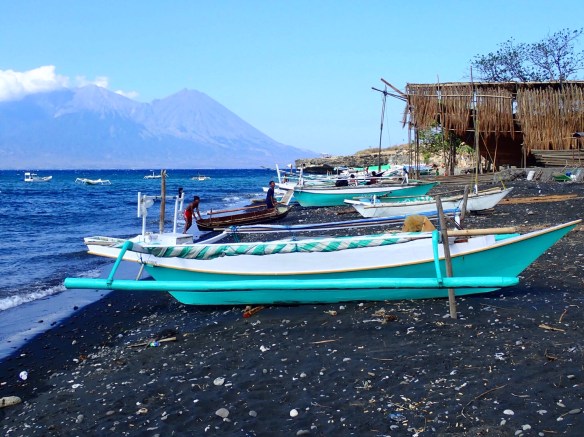
pBrightly painted wooden boats sit underneath the volcanoes on the dark black sand

We have arrived in a Gili Gede, an island in the South West of Lombok and are tied up in the half completed Marina del Ray. After over a week of day hop sailing, covering 300nm and 2 months with just the odd drop of rain. It feels good to not be rushing off at the crack of dawn, to be able to sleep with the anchor alarm turned off and to get some fresh water to wash down the decks.

All the islands from Java to Timor make up a volcanic arc that sits on the boundary of the Australian and South East Asian tectonic plates. Being on the extreme western edge of the so called ring of fire, a geologically active area that surrounds the pacific, it has active volcanoes and suffers from frequent earthquakes. Unfortunately demonstrated by the strong recent quakes in the north of Lombok Island that sadly killed around 500 people. Thankfully we haven’t been effected and nor has the south of the island where the marina is located, so we continue on as planned feeling that the best way to support the island is to visit and spend our tourist pounds. We sail past hundreds of cone shaped peaks, some rising to over 3000m straight from the sea.

Gunung Sangeang

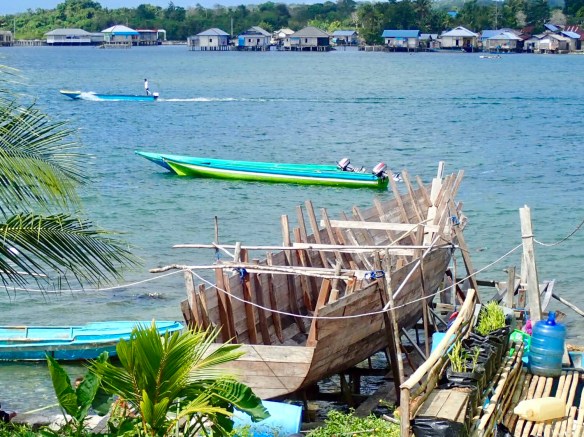
Leaving Komodo our route took us along the north coast of Sumbawa. Nestled between the mountains and the sea, in the shadow of the huge volcano that is the Island of Sangeang , sits the village of Wera. A centre for traditional boat building it appeared that the whole village was on or around the black sand beach, either building, repairing, playing with or sailing boats. The boats are beautiful pieces of craftsmanship, made entirely from wood and ranged from the kids built toy boats, through the common long boats, up to a 30m long fishing boat. As we walked along the sand, regrettably again dodging piles of rubbish, we were mobbed by hundreds of children and encouraged by the obviously proud boatmen to photograph their handiwork.

Traditional boat being built in Wera

Continuing our journey we spent one night in Karanga. As the early morning haze began to clear it offered us a backdrop dominated by Gunung Tambora, the volcano that in 1815 erupted with such force that it filled the air with clouds of dust. This dust spread across the planet and was so thick it partially blocked out the sun, plunging the world into “a year without summer”.

Unfortunately a swim in the green seawater lake nearby, in the Caldera of Saltode Island, wasn’t possible, the anchorage was too rough to risk leaving Raya or dinging ashore. We moved on to the island of Moyo and managed a snorkel and a visit to the beach but the continuing choppy seas thwarted our plans to eat at the resort across the bay.

It was time to find a calmer anchorage and a more tranquil spot couldn’t have been wished for. Hidden behind a sand spit at the marvellously named Potapaddu Bay we found still water.

Raya anchored in the calm of Potapaddu Bay

We had a pleasant snorkel on the coral wall on the outside of the spit and as the afternoon wore on fishing boats started to appear from the village. Eventually they overcame their shyness and came across to say hello and see if we had any gifts. And we did. We had read that the villagers of Sumbawa were very poor but Wera had been too crowded to start giving out things and at Karanga it was a bit rough. The half dozen boats that crowded around us here were much more manageable. We gave away T-shirts, fishing hooks and line, toys and the ever in demand pens and paper. However the most popular gift was perfume. Penny had bought with her two boxes of tiny perfume samples and when we demonstrated what they were and let them smell my wrist, their expressions of delight was a picture. For your Istri (wife) we told them, giggling they added them to their stash of goodies .

With only a few days left of Penny and Stephens holiday we needed to push on and our next challenge was the narrow strait between Sumbawa and Lombok. We had another early start to try to get as far through the passage as possible before the winds filled in. We stayed as close to land as we could winding through the small islands and reefs, Mount Randi towering over Lombok in the distance. As we entered the channel for real, Penny was first to spot the overfalls, with 20kts of wind against us and 5kts of tide with us we knew eventually we would have problems and a line of white on the horizon was fair warning. We avoided as much of the turbulence as we could but eventually decided that 3hrs more of this discomfort wasn’t worth it and dived into a deep bay to spend the night before venturing on early the next morning.

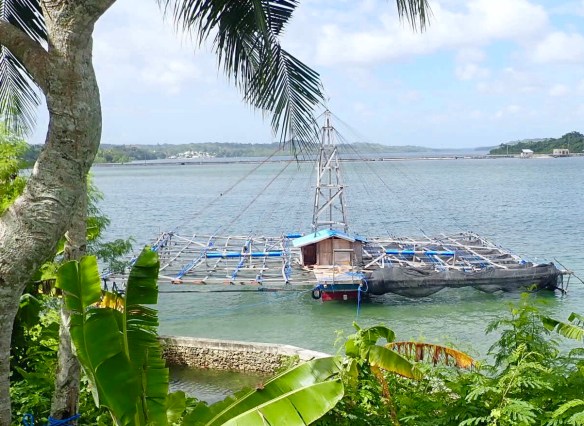
Mid-morning we enter the protected natural harbour at Alang, heading for the lovely beach at the Ekas anchorage. We were glad we had entered in good light the bay was full of fishing platforms, apparently they are farming lobsters. An intense half hour ensued as we gradually worked our way through the hazards.

The beach here is named Heaven Beach and despite a rather difficult dingy landing, there is a surf break here, we had a pleasant stroll. High on the cliffs sat a small resort that was a one hour drive to the airport, so it seemed a good place to drop Penny and Stephen.

Heaven Beach, Ekas, Lombok

While they enjoyed a day of spa treatments before their long trip home we pushed on to Gili Gede. Again we had to face a tough sail, this time the channel between Bali and Lombok. For two hours we fought against a 5kt current but although frustratingly slow at least this time the waves were behind us.

We arrived at the marina in high winds to a chaos of Oysters, the Oyster rally were preparing to leave. We dropped the anchor for the night, it would be easier to tie up in the morning after most of fleet had departed. Ashore we had a quick catch up with our Oyster friends, we may see them again briefly in Cocos Keeling.

Komodo,

Friday 31st August 2018

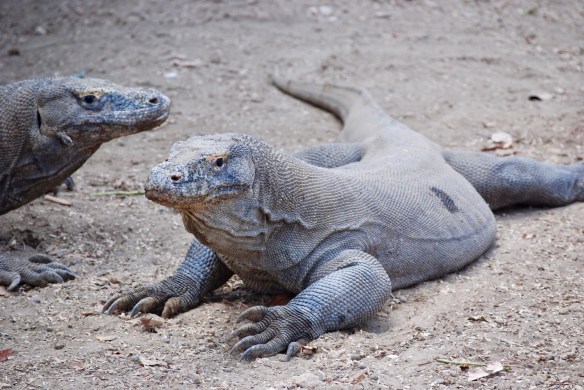
Wednesday morning we got up at daybreak and armed with just water and our cameras we went to find our guide to go dragon hunting. Komodo National Park is home to the infamous komodo dragons, a giant lizard of the monitor family they can grow up to 3m in length and weigh up to 90kg. They kill their prey in a particularly grizzly way. Laying in wait they ambush their victims by hiding in the undergrowth, they attack using their large clawed front feet and sharp shark like teeth. If their prey escapes this first onslaught the dragon retreat and watch, their saliva contains a rich mix of bacteria, so most bites become fatally infected. The dragon stays close by until the casualty slowly fades and becomes too weak to defend themselves, at which point the dragon strikes again. They are carnivores and will attack large water buffalo, deer, wild pigs, smaller dragons and occasionally humans. It is recommended not to explore the islands without a guide.

Male Komodo dragons collected around the Rangers housing

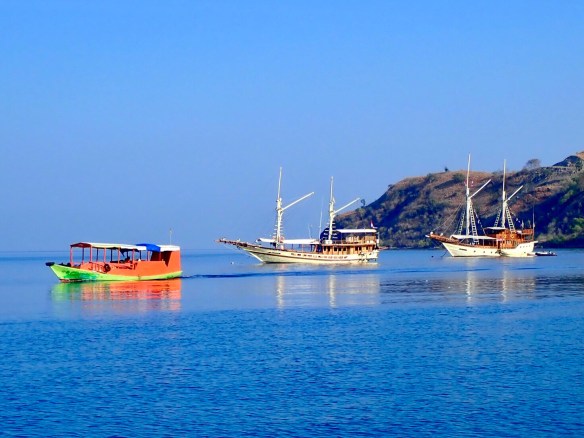
Having picked Penny and Stephen up from the airport Monday afternoon, the next morning we left Labuan Bajo and wound are way through the countless reefs and islands that make up the west coast of Flores. We anchored down a narrow creek, Loh Buaya on Rinca Island. There is a Rangers station here where you can pay your park fees and join guided tours to see the dragons. We booked in for an early morning walk the next day and then settled on deck to watch the chaos of tourist boats that crowd into every available space, everyone in search of that komodo dragon moment.

Tourist boats fill every available space

As the sun dropped and the bay thinned out, a dingy safari revealed the Island was home to much more than the dragons. We spotted the bright turquoise of a kingfisher perched in the mangroves, a large heron waded in the shallows, birds of prey soared above the hills, a couple of deer wandered through a clearing and monkeys foraged and squabbled on the sandbanks.

At 6.30 the next morning as we followed the path from the dock to the Rangers station, more monkeys skitter across our path, a large water buffalo wallows in a small almost dry water hole and deer graze under the trees. Water buffaloes struggle during the dry season as there is little water around and no fresh grass . The whole island was in fact very dusty and brown, the only green provided by the trees growing in the valleys. Dried river beds snaked along beside our path and scorched hills towered above us.

Penny and Stephen on the parched hills of Rinca Island

We met our guide and armed with only an ineffectual looking forked stick, he leads us off in search of dragons. This turned out to be easier than expected, despite assuring us that they didn’t feed the dragons a group of about seven lolled, labrador like, in a cluster outside the Rangers housing. This of course guarantees that everybody gets to see a dragon and is an easy place to snap some photos, but it is difficult to accept they are not encouraging them to stick close by in some way. Luckily, during our 2hr walk, we also saw a young male stomping through the undergrowth and a female guarding her huge nest. Easily visible were two hollows, one a decoy nest, the eggs, up to about ten, were laid in the larger hollow which was about 3m long and 2m deep and were covered with soil and leaves to protect them during the 8 month long incubation period.

Female dragon guarding her nest

Returning to Raya the creek was beginning to fill up again, we motored off to find a quieter bay and do some snorkelling, as the National Park is also renowned for its crystal clear waters and stunning coral. We have had some marvellous snorkelling in Indonesia and off the north coast of Komodo Island and again off Banta Island the reefs didn’t disappoint. Especially impressive here was the amazing variety of soft corals and brightly coloured sponges. In the exceptional visibility and midday sun the extensive coral garden at Banta was stunning.

Coral gardens off Banta aisland

There is however a continuing problem with plastic rubbish on the beaches and in the sea. It is a tragedy that some of clearest waters we have experienced are also the most polluted.

Labuan Bajo

Sunday 26th August 2018

Sitting in a calm bay, with hardly a ripple to disturb us, this anchorage is perfect to spend a week catching up on paperwork, doing some regular maintenance and preparing for our next guests, my sister Penny and husband Stephen. We have arrived in Labuan Bajo, a once small town on the west coast of Flores. It has grown rapidly over the last ten years or so, to support the tourist trade centred around trips to nearby Komodo Island with its giant lizards and the amazing diving that is available in the clear waters and coral drop offs. It has an airport, crowds of backpackers and hundreds of tour operators.

Traditional style phinisi awaiting the next group of tourists.

We originally sailed to a bay south of the town and near the entrance to the harbour. The Puri Sari Beach Hotel opposite the anchorage has set itself up as the go-to place for visiting yachts, helping with everything from laundry to organising transport into town. They have a small pool you can use and a nice restaurant. However we found the bay rather busy, a constant stream of passing tourist boats churn up the murky water, the dark sand beach and water are strewn with rubbish and there is no dock for easy crew pick up.

So we have moved a few miles north to Wae Cicu Beach, a pretty curve of sand backed by more resorts but there is less traffic, there are dingy docks available and the water is clean enough for a cooling swim.

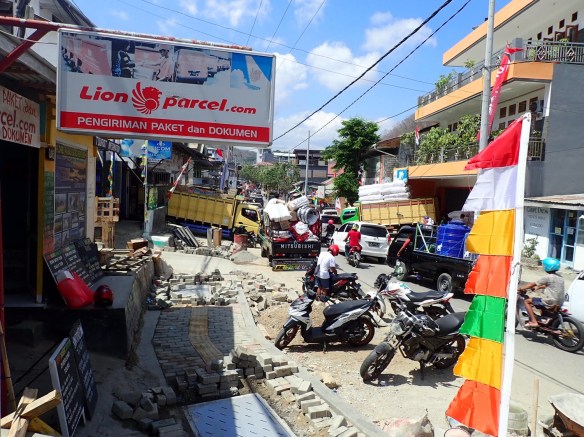
Raya anchored in Wae Cicu Bay

Ashore an unfinished road curves steeply up and down the coastal hills. The streets are full of overloaded trucks with precariously perched cargos, a selection of cars most of which are way past their best, rickety buses and a million scooters dodging between it all. A trip into town is a hair-raising experience. I hold my breath as I watch a tiny girl trying to cross the road, a group of old ladies stumble as they tackle the uneven, half completed pavements and to further confuse things a school band marches across the junction. Noise, heat, dust and a strong smell of drains.

Downtown Labuan Bajo

Despite all this we rather like Labuan Bajo, it has a friendly feel and everyone has been incredibly helpful. The market, a bit out of town and off the tourist map, was very ‘local’, large bags of rice and other unidentifiable grains line the entrance, a buzz of flies comes from the fresh fish stalls, rows of clothes and plastic goods fill makeshift shops and the fruit and veg stalls are bursting with goods. I swoop on a pile of broccoli, a rare delicacy for us and fill my bags with melons, mangoes, tomatoes and much more.

We have also managed to find some high quality diesel and someone set up to bring it out to us. Fabio, a ‘cool cat’ with long hair and flashy sunglasses, with some helpers came to Raya, his boat piled high with Jerry cans, he pumped 500l through a filter and into our tanks

Unfortunately, it would seem that was not the only thing they delivered, the next morning I found a small snake on the galley floor. After much girly squealing Rick came to my rescue and trapping him under a bowl tipping him overboard. Unfortunately, he turned out to be a rather good swimmer because today he reappeared, washed out of a deck drain on the swim deck as we cleaned the stern. Rick caught him again and this time flung him with the boat hook about fifty metres away. We watched incredulously as immediately he swam back to us. We then tried to get him to stay in a bucket so we could take him into shore but he was getting rather cross and aggressive, unsure of his identity we sadly felt we had no choice but to dispatch him more permanently.

An unwelcome and determined visitor

Still squirming slightly and convinced snakes would appear from every crack, it was back to work. We’ve got a lot of sailing to do over the next few months, Raya needs to be in tip-top condition.

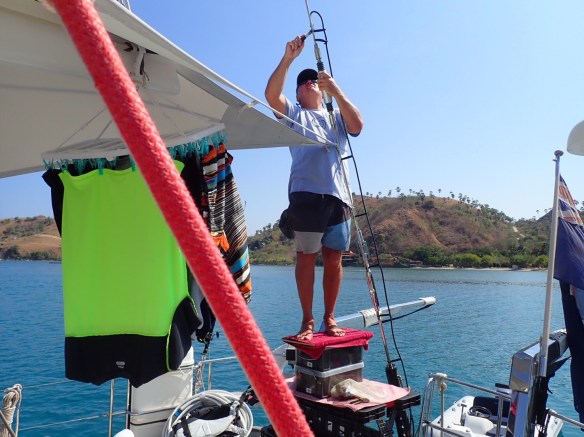
Balancing precariously, replacing the rusting SSB aerial connector

The Great Cap Giveaway

Sunday 19th August 2018

Dipping further off the rally radar, we have had some lovely quiet days in a couple of anchorages in the NE corner of Flores. The dry northern coast of mountainous Flores is very different from the jungle clad islands we had visited to the north. Ever increasingly high hills turn monochrome as they disappear into the haze that cloaks the centre of the island.

The 48hr sail south from Hoga was slow in the light winds and where normally we would have motored to keep our speed up, we persevered under sail to save fuel, fuel of the right quality is difficult to find here. Slow, however, turned out to have its advantages. Even with a good look out, in daylight, we barely avoided the hazard of, seemingly drifting, small fishing attraction devices or FADs. How many near misses we had during the hours of darkness is best not contemplated.

6ft high bamboo FAD

As we approached our first stop Bari Bay, the wind completely died and we had, eventually, to turn the engine on. As we motored in calm seas, accompanied by dolphins, we came upon a fleet of small fishing boats. The frantic waving of one fisherman alerted us to his net that stretched across our path to another boat half a mile away, it’s top marked by tiny almost invisible floats. We immediately turned off the engine but stopping a sail boat takes time and even in full reverse we only just made it..

It was therefore with relief we put down the anchor in pretty Bari Bay to rest overnight. The village here is very basic and with midday low tides making things difficult, we decided not to go ashore for a visit, this however didn’t stop the village visiting us. Our first callers were four teenagers who paddled out to say hello and ask to come aboard for the enevitable selfie. As with all the kids we have met here they have a few set phrases in English – ‘how are you?’, ‘my name is’, ‘where are you from?’. They are always extremely polite and delightfully excited to be picturing themselves, with us, in various poses around the deck. For the past few months every rally meeting and every information pack has contained a peaked cap, we had gathered quite a collection. So Rick found four and gave them one each, ‘cool’ they smiled.

Word obviously got around, as gradually more children paddled their canoes out to us. Despite the language barrier I can happily report that ‘can I have a hat please’ was easily understood. By dusk our large cap selection ran out.

The kids from Bari Village loved the caps we gave them
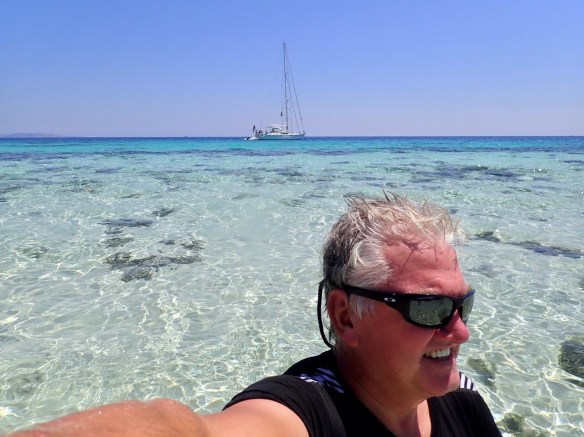
The next day we were again motoring in very light winds avoiding more small fishing boats. The glassy seas a perfect palate for the flying fish that draw lines with their tails as they take off to skim the water for sometimes hundreds of metres. The route took us between the reef systems that line this coast and we were glad yet again of the satellite photos from Google Earth that clearly identifies them, making avoidance a lot easier. We slipped through a small break off Bodi Island and dropped the hook in a beautiful anchorage on its west coast.

With its white sand beach, shallow lagoon and turquoise, crystal clear water it really was stunning. We swam off the boat, snorkelled the reefs and wallowed in the shallow lagoon with a cold beer.

Anchored off Gili Bodo

The island itself is uninhabited, so as we sailed into the bay we were surprised to see smoke rising from behind the hill. As the light began to fade and the wind direction changed, rather disconcertingly, lines of flames started to appear over the ridge and spread down towards the beach. Luckily as it smouldered through the night the wind took the smoke away from us and it appeared to burn itself out.

Flames spreading across the hill side

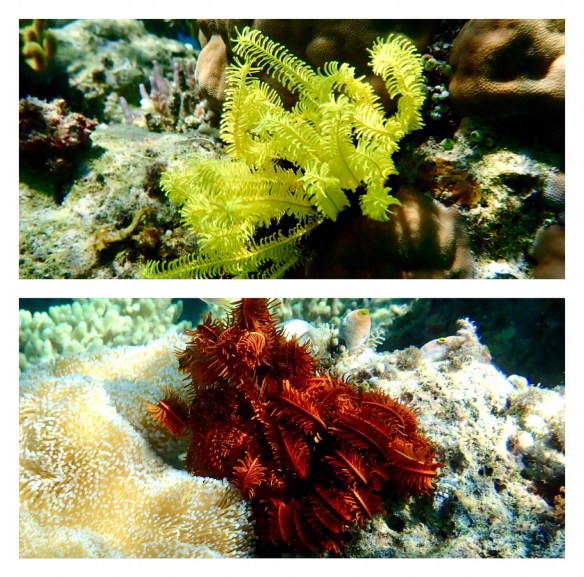
The next day with the flames gone, we were excited to see monkeys on the beach. They walked along the tideline presumably in search of food. We jumped in the dingy to get a closer look but at low tide the shore was unreachable across the surrounding reef. Even with the telephoto lens capturing a photo of them was impossible. More easily photographed were these amazing feather stars in deep crimson and brilliant lemon that we found while snorkelling on the edge of the reef.

Colourful feather stars

Hoga Wall

Monday 13th August 2018

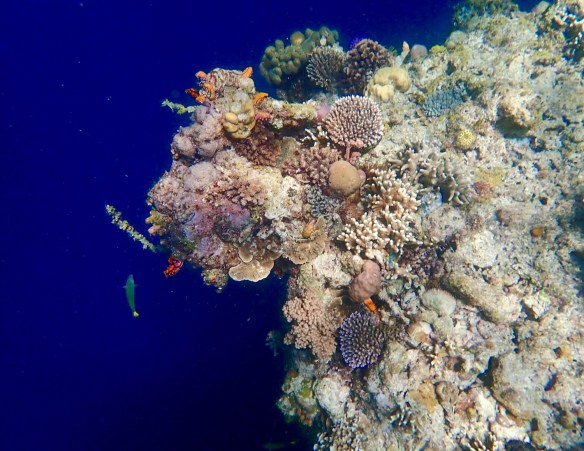
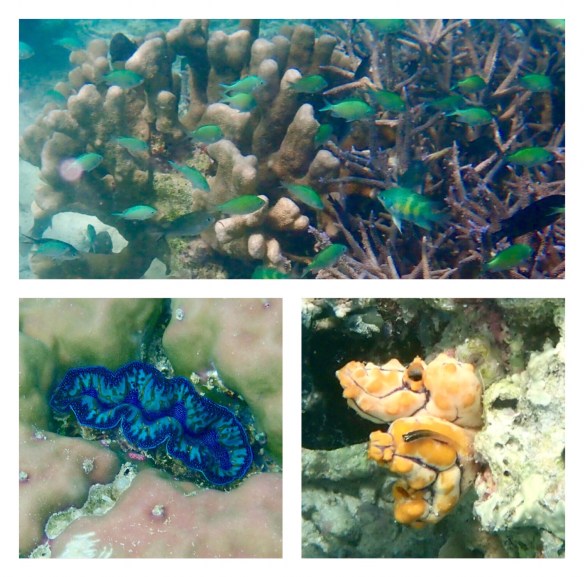
We have just snorkelled off a coral wall, the edge of the encircling reef around Hoga Island in the Wakatobi National Park. Wow! Thousands of reef fish of all shapes, sizes and colours. A mix of healthy soft and hard corals, nudibunch, feather stars and dazzling giant clams.

The edge of the reef – Hoga Island

The prize of snorkelling this reef however has been hard won.

Last Tuesday we started to raise our anchor from the deep waters at Banda Island. Not the quietist of windlasses at the best of times, this morning it started to screech and strain horribly. We let the chain back out, a day of boat maintenance was obviously in order.

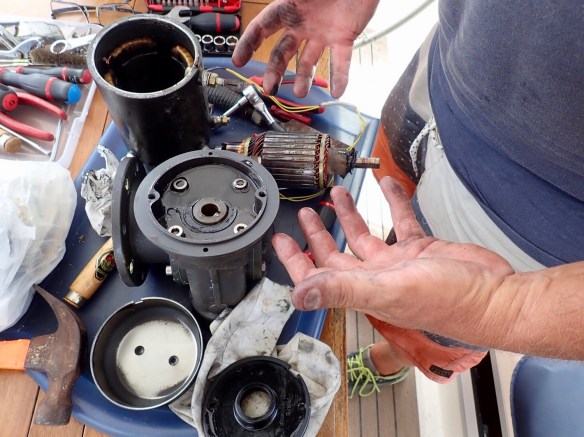
For the rest of the day Rick, with me as his plucky assistant, disconnected, stripped and cleaned the windlass motor and gearbox. It, encouragingly, looked in pretty good condition, one oil seal had disintegrated, could this be our problem? Could we find a replacement?

Unbelievably for a small town, with seemingly nothing recognisable for sale except cheap Chinese plastic goods, the hardware store turned out to be an Aladdin’s cave and actually had the exact required part.

Innards of the windlass motor and gearbox
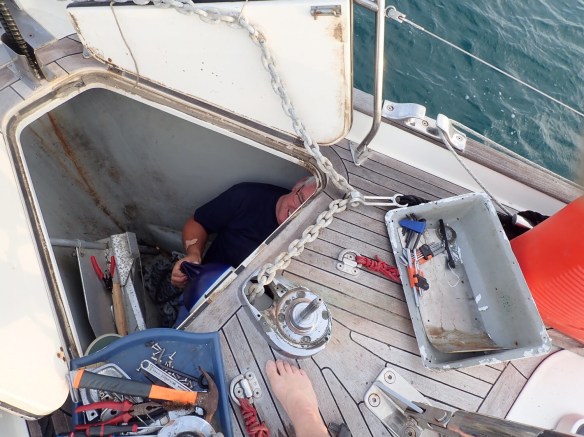
With the windlass back together, the noise gone, we went to bed happy. The next morning however under the strain of trying to pull in 80m of anchor things didn’t look so good, every 30m the motor would overheat and cut out. Our time in Indonesia is limited, there are so many places we want to see. We could of course let the anchor out easily enough, so we decided to carry on with our plans. We gradually coaxed the anchor up and set off for Hoga, we would tackle the problem again with a different view from the cockpit

I, and a lot of the rest of the fleet, had had a cold while in Banda, miraculously Rick seemed to have avoided it, unfortunately, a few hours into the journey Rick started to feel unwell. It was a long 48hr sail, with Rick trying to maintain a brave face and me doing as much as I could of the watches. Luckily Friday he began to feel better and by midday we were anchored off Hoga Island.

No rest for the wicked however, having worked out a plan of how we could raise the anchor on another of our winches if necessary, Rick had one more thing to check. He hadn’t looked at the drive shaft that runs down the centre of he windlass, so back he went into the cramped anchor locker.

Not the most comfortable place to work

The shaft was almost completely seized, after a bit of encouragement from a hammer, another oil seal replaced and a good clean up, he put everything back together yet again. We had originally anchored in the cruising books suggested spot, through a pass in the reef, into a lagoon. However it was on the windward side of the island and gave little protection in the brisk SE winds and at each high tide the fetch was breaching the reef, making things a bit uncomfortable. So nervously we tested the windlass, the chain came up quietly and efficiently we breathed a sigh of relief, then motored back through the pass and anchored off the reef in a less windy position.

The edge of the reef clearly visible

The reef drops straight down from one to thirty metres, we are anchored very deep yet again but the coral wall here is spectacular. With my ears still a bit suspect from my cold we haven’t dived but at low tide we have drift snorkelled along its edge, the variety of corals and fish just 100m from the front of the boat is amongst the best we’ve seen anywhere.

It’s difficult to explain the feeling of wonder as you dip your mask into the water and the coral garden comes into view. With the sun high and bright in the sky the colours are at there best, pinks, purples, blues, whites and yellows shine back at you. All the normal reef characters are here from tiny turquoise damsel fish, through white and blue puffer fish. Multi patterned yellow angel fish, royal blue and yellow striped sturgeon fish and incandescent blue, fork tailed, redtooth trigger fish. A shoal of black sturgeon with a pink tail and sheer white fins passes by and a pair of black and white striped, yellow finned oriental sweet lips pose for a photo. I hear Rick yelp, he has almost bumped into a sea snake, at a metre long it is by far the largest one we have ever seen. The wall drops straight down fading into the depths. A 3ft grouper emerges briefly from the blue and larger shadows suggest life beyond our vision.

A clown fish, the sea snake, a colourful puffer and two sweet lips.
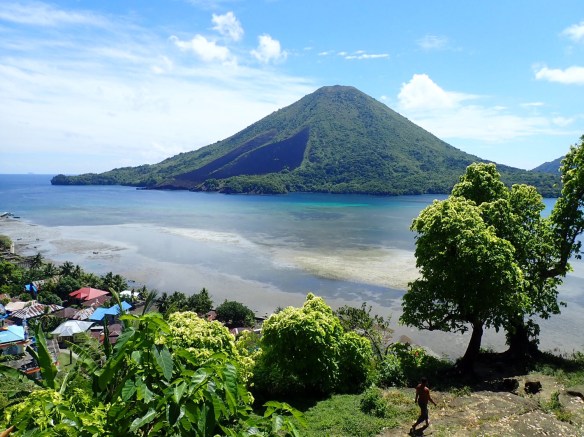
A small dive resort sits ashore, a large dive boat overnights one day and our friends onboard Il Sogno, another oyster 56, joined us yesterday, but for most of our time here the only people to be seen are the few locals in their motorised dug out canoes. We donate swimming goggles and buy bananas but decide not to attempt the mile and half choppy crossing to the village. Stocks of fresh food are getting low however, time to move on.

Spice Islands

Monday 6th Aug 2018

We are anchored beneath a volcano in 30m of dark water, surrounded by traditional fishing longboats, opposite tired but substantial colonial Dutch buildings. We have arrived in Banda, the centre of the spice Islands.

Api volcano dominates the view

Sitting isolated by hundreds of miles of deep ocean, a unique but fairly indifferent tree evolved here, the nut these trees produce was to generate great fortunes and inevitably in turn to be the cause of wars and atrocities. Nutmeg was first introduced into Europe when traded between the Venetians and the Arabs. As spices increased in popularity and there value grew, the emerging powers within Europe sent exploratory expeditions out to the Far East to try and find the source of these prized and exotic flavours.

Nutmeg was tracked down to the Banda islands and eventually in the 17th century the Dutch won out as sole controllers of its trade. They created the Dutch East Indies Company, the VOC, and earnt a reputation for extreme intolerance, the native Banda population was almost exterminated until the Dutch realised that they still needed the skills of the islanders to successfully grow the nutmeg trees. The English very upset to be missing out on such a lucrative trade attempted to raid Banda many times with only limited success, holding on to just one of the small outer islands, Run.

Run however turned out to have greater value than expected as from here not only did the English manage to spread the nutmeg tree to other parts of the World eventually reducing the Dutch stranglehold on the spice but also in a treaty drawn up in 1667, Run, was among islands swapped by the British with the Dutch for a strange new land called New Amsterdam. Not happy to keep the obviously Dutch name the British renamed it New York. From this has grown the local story that the tiny island of Run was swapped for the Island of Manhattan.

Evidence of the islands violent past is everywhere from the ruins of forts topping many of the islands hills to original cannons littering the streets in Banda Niera. It is not often that we tie the dingy off to a 400 yr old bronze cannon!

Not a normal dingy dock, we are having to use this old cannon as a cleat.

Nutmeg is a complex fruit and every bit of it is put to good use. The sour tasting flesh is sweetened to create jams and syrups, the bright red mace that lines the nut shell is used in sweet and savoury dishes, as well cosmetics and of course the inner nut produces the spice we are familiar with.

Fruits of the forest, a cut nutmeg fruit with an almond on the side

At one time in Europe just one sack of nutmeg could buy you a small house, today although not quite that valuable its still the main income for these islands. We took a boat to the largest island in the group and passing through another brightly painted village, the houses perching on the side of the hill, we walked up to a nutmeg plantation. Nutmeg prefers to be out of the midday sun and so is grown in the shadow of magnificent stately almond trees. In the plantation they also grow cinnamon and cloves, the latter is dried in the streets in the sun and the pungent scent fills the air.

Ancient almond trees cast shade over the nutmeg forest.
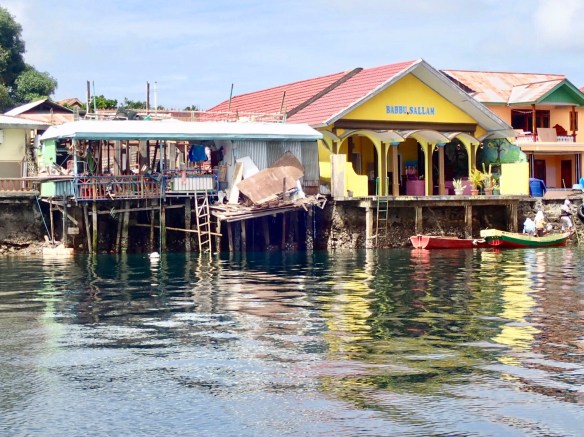
Back in the main town Banda Niera, there is an eclectic mix of buildings. There are a fair sprinkling of crumbling grand colonial buildings, now mostly hotels or museums, In the Cilu Bintang Hotel we drank a cold beer on the columned terrace, sitting on beautiful period chairs, surrounded by all the trappings of its wealthy Dutch past. Outside scooters scurry back and forth down the ever narrowing lanes that lead into Arabic style souqs or tightly packed areas of small colourful sometimes Dutch influenced houses. On the sea front, homes appear more ramshackle, docks and boats competing for space. And encompassing all this are the steep volcanic hills rich with lush greenery and the once priceless nutmeg trees.

One for the dodgy dock collection

The main volcano, Banda Api, erupted just thirty years ago and two large streams of lava run down its steep sides. We were told there was good snorkelling where the barren black rock reaches the sea but as we approach through the deep dark water this doesn’t seem likely. So it’s a surprise when we put our heads under the water to find the best coral we’ve seen since Fiji. Banda gets the thumbs up.

A Right Royal Welcome

Monday 30th June 2018

Selaya Fishing Village

This must be how royalty feels. Each village has been lavishly decorated with flags, their streets flanked by dancing warriors with crowds waving from their doorsteps.

A right royal welcome to Selaya

The villagers have all entertained us with music and dance troupes, the boys armed with spears and swords perform a traditional war dance, the girls, heads demurely tilted, sway with fans or tassels. The cruisers, or yachters as we are call here, have been invited on to the floor, our clumsily efforts paling in comparison. Food has generously been prepared, mostly fish and interesting dishes made from seaweeds, a speciality of the region, all deliciously spiced as is the way with Indonesian cuisine. I drank a ginger tea, that thick and sweet, can be best described as a cup of liquid ginger cake.

The effort each village has obviously put into our visit has been humbling and we feel we have given little but our presence in return.

An evening of entertainment at Wab Nagufur Beach

Of course along with all entertainment comes speeches from the local dignitaries and people high up in the ministry of tourism, often full of self importance keen to be seen by each other doing their bit. The villages have gone to great lengths to supply English speakers to translate and the message is ‘please tell other people to come and visit our islands’. Tourism is currently centred on Bali and the rest of Indonesia is keen to share in the spoils.

There is certainly plenty of traditional Indonesia to explore, the colours every where are incredible and the people welcoming. If there is enough infrastructure, transport, accommodation, freedom of movement is another question however.

The children especially are delightful, bright smiling faces greeting us at every turn. Most have a few phrases of English and are excited to use them. With over 30 boats in the anchorage, parking of each dingy is quite a challenge especially with a two metre spring tide added into the mix. We returned one evening to the dark dock all wondering how we were going to reach our dinghies which were now three metres down below the quay. No problem, adults armed with torches had assigned one small boy to each dingy, who on request paddled it to the steps so we could get on. Such small attention to detail by the locals continued to make us feel special.

Hundreds of smiling faces

By the end of four days, however, our enthusiasm for coach trips over pot holed roads and sitting sweltering through official pronouncements of welcome were beginning to wane. So Saturday we took a last trip into the larger town of Langgur, cajoled a couple more million rupiah out of the ATM, stocked up with what we could find at the market and prepared to set off.

Finding anchorages here is not easy, coastal waters are very deep right up to the surrounding reefs and information from those that have gone before is sparse. From the charts and google earth I picked out a likely spot about 40nm in the direction towards our next rally stop, with the potential for shelter and a chance to swim and snorkel. A few other yachts were heading the same way and between us we felt we could narrow down the choices of bays. The one I had picked, turned out to be full of fishing and seaweed growing rigs and exposed to fetch. On the north side of the same island, Palau Walir, another boat found a quieter spot and we all converged there.

Finally we could swim, the water was 26 degrees, a reef sat just a hundred metres from our stern and there were no crocodiles or deadly jelly fish.

Colourful beneath the water as above

The reef was best snorkelled at low tide where as the beach was only reachable when it was high. Unfortunately the turquoise water and white sand was spoilt by more of the rubbish we are finding everywhere in Indonesia. The beach was backed by coconut trees and there was evidence of a small amount of copra production reminiscent of that in French Polynesia. The odd long boat came past and we found a small traditional dug out canoe full of fishing nets. The rubbish is obviously not being produced in this bay but must arrive on the tide from other more populace parts. How the country starts to tackle this enormous problem is difficult to say but if they want to preserve their beautiful surroundings and the life in their seas that they depend on for food, and attract tourists, it is something they are going to have to do.

Traditional dug out canoe.

Dèbut in Debut

Wednesday 25th July 2018

It has been a long time since the Call to Prayer has acted as our alarm clock, we have arrived in Debut, Indonesia and sit anchored in sight of three mosques. The Call here is much more tuneful than we remember from our time in the Middle East and adds to the exotic atmosphere we have immediately felt.

It is a beautiful day, the light is soft, the bay calm and in the cool morning air we sit, for what seems like the first time in months, without being battered by high winds.

It was, after eight months, strange to be leaving Australia. But we didn’t have much time to dwell on the matter, with the wind behind us, Raya was in her element, we flew out of the Torres Strait and into the Arafura Sea. After the first day it was rather rolly, with often flogging sails, in a lumpy sea but it was good to reacquaint ourselves with the challenges of longer passages after day sailing for so long.

Small dolphins joined us a couple of times to play at the bows and with the moon setting in the early hours we had the best of both worlds, half the night was moonlit, the other full of stars. We had been warned that their would be a lot of fishing activity, especially at night and to keep far offshore where possible. Huge, unlit, fishing rigs can be very nasty if you don’t spot them in time.

Bamboo and wood fishing rig tied up in Debut

Luckily we didn’t knowingly come close to one, we did however nearly get caught in one of the large nets that are trailed up to a mile behind small fishing boats, their ends only marked by tiny flashing lights. Others were not so lucky we know of at least three boats that got caught.

On Sunday, as dusk fell, we began to realise we were surrounded by brightly lit boats. These delightfully, rustic craft, amazingly anchored in over 40m, shine lights down into the ocean to attract and then catch squid. In the growing darkness an intense glow appeared on the horizon, we checked the chart more than once for a possible city but the shore was over 30 miles away and from what we could see was sparsely inhabited. As we came closer we concluded it was in fact a city, a city of hundreds of squid boats.

Fishing boat city

We arrived in a Debut, after working hard to slow the boat and time our entry, at around 9am on Monday morning. The route into the port was unmarked and uncharted. Luckily we had come prepared, marking the chart with waypoints I had taken from satellite images of the reefs while we still had internet in Australia.

Once anchored safely we managed to celebrate with a ‘got here’ before a continuous stream of officials began arriving at the boat. They arrived by traditional long boat, their approach announced by the lawn mower putt putt of their engines.

Quarantine offers arriving by long boat

It has taken us two days to process all the paperwork, fight through the confusion surrounding the data and phone systems and equip ourselves with, at 10,000 Indonesian Rupiah equal to only 50p, literally millions in local currency.

We did get the time to wander around a few of the streets close to the dock. The colours here are vivid, the prettily painted houses and brightly coloured flowers are all backed by lush greenery and the blue of the sea.

Main street down to the wharf at Debut

This is only the second year the rally has started their Indonesian travels in Debut and the sailors on the yachts are pretty much the only outsiders that ever come here. The town is in festival mode, friendly faces excitedly gathering at the dock offering to help us in anyway they can. And in this world where the smart phone is king, everyone is desperate to have a selfie with the visitors.

Tomorrow the official celebrations start, local dancers will greet us, there is a trip to a fishing village and dignitaries all the way from Jakarta are hosting a welcome dinner.

Loved this local wooden boat in construction at the bottom of the garden.

End of Oz

Tuesday 17th July 2018

We have arrived at Thursday Island at the very most northern point of Australia. Towards the end of the week we will check out at customs and head for Indonesia, our Australian East Coast adventure completed.

You can find our track at http://my.yb.tl/sailrayatracking/

The anchorage at TI, as Thursday Island is known, is rather bumpy, so the fleet of the sail2Indonesia rally have congregated a mile or so southeast off Horn Island. As soon as we stepped ashore we knew we were back to Island life. The dodgy dock was crowded, the roads and pavements were full of pot holes and the supermarket, well let’s just say we need to reset our expectations.

Getting the shopping into the dingy was a bit of a challenge for us and the guys on Alexandra.
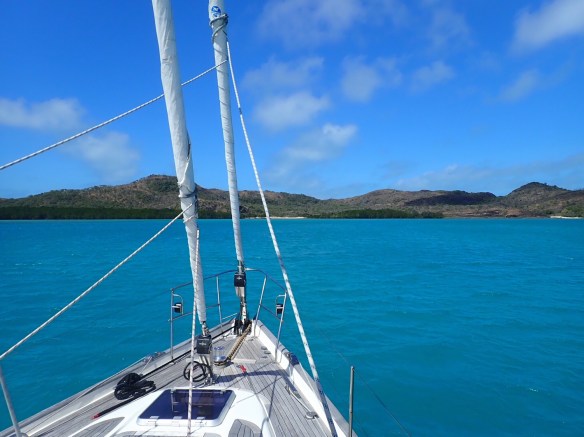
The last few days of sailing up the coast continued to be good, although with the ever narrowing shipping channels winding their way through the reefs and islands, a good look out was required at all times and with the frequent changes of direction, sail changes made for a busy trip.

On the first night we stopped at a recommended anchorage off Morris Island. Just a tiny speck on the chart and not much bigger in real life, we were doubtful that it could give us any protection and prepared ourselves mentally to sail on through the night. Little more than a long sand spit about half a kilometre long, with just one palm tree and a bit of scrub there was no let up in the SE wind but surrounded by a large reef the swell disappeared, so we dropped anchor and got some rest. We had caught a large Spanish Mackerel in the morning but all plans of sharing a fish supper with our fellow cruisers was quashed, the wind deterring us from lowering our dinghies.

The next day, Wednesday, we set off on the 24hr sail up to Adolphus Island, just off of Cape York it was a good launching point to time our arrival through the tide driven currents of the Torres Straight.

Anchored in splendid isolation in Blackwood Bay, Adolphus Island
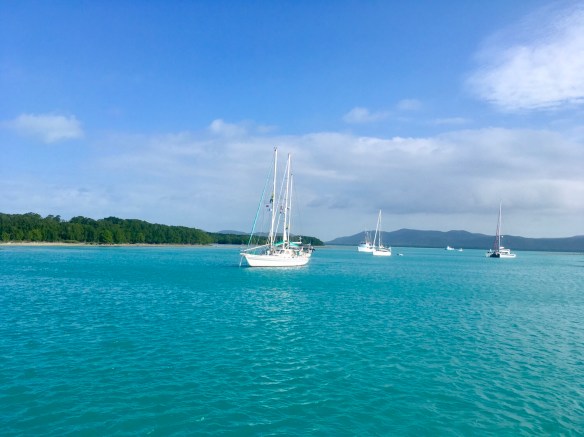
We still had no internet so I still had no Navionics on my iPad, I was dependant on the guys on True Blue and Matt on his computer in the U.K. to work out the tide times for us. With their help Raya was whisked along by a 3kt current into the anchorage at Horn Island.

Anchored with the rally fleet off Horn Island

The promise of a bigger supermarket and a couple of restaurants, meant yesterday we took the ferry to Thursday Island. It’s a great system with the ferry Captain also being the bus driver. Once the ferry docks, everyone moves to a mini bus and is dropped around the small town and island as required. To return, you just call for the bus who picks you up and delivers you back to the ferry. With the security of the driver of both being the same person you know the ferry can’t leave without you.

Being only 10 degrees South of the equator we are deffinatly back in the tropics and we had to remind ourselves to slow down in the humid heat. With only one main street and the sea front, we easily found our way around and although bigger and a bit smarter than Horn Island, it still felt a very long way away from the Australia we had left behind in Cairns.

Harry the local croc lounging on the banks of the anchorage

In Captain Cooks Footsteps

( After nearly a week we finally have a couple of bars of 3G, see delayed post below. )

Flinders Islands

Monday 9th July 2018

We are anchored with three other boats off an incredibly beautiful, remote group of islands, the Flinders Islands. As far as we can tell there are no other people or buildings for a hundred or so miles in any direction, just a little band of yachts sheltering from the brisk winds as they sail north to set off for Indonesia. We did get a visit from the Australian border forces plane however, requesting over the radio the registration and cruising route from each of the boats, security seems tight on these northern extremes of the Australian Coast.

We know all the boats here, cruisers we have met all through our trip, so it’s very sociable and as there isn’t a phone or internet signal, invaluable, as we swap notes on weather and tides from our various satellite and long range radio connections. I am feeling particularly information bereft as my trusty and much used Navionics App for some reason will not allow me to use my downloaded maps offline. I am missing it’s clear presentation and tidal and current data, but there seems nothing I can do without a network connection.

The sun did, mostly, come out for our last day in Cairns and we set off for Lizard Island some 140nm north in good winds and blue skies. We had rigged the pole for the downwind trip and it felt so good to have the engine off for the whole journey. It did rain a bit during the night but generally it was a very pleasant sail.

Downwind sail rig whisking us at 8kts northwards

Mrs Watson’s Bay on the north east coast of Lizard was full of boats, with, finally, a functioning island resort sitting to one-side. The beach is of fine white sand and the water clear, a track leads up to the highest point of the island about 350m above us. This lookout is famous as the spot where Captain Cook, having already gone aground just off Cape Tribulation, climbed to try to find a channel through the hundreds of reefs to open sea. Due to his meticulous note keeping, his trip up the Australian Coast is well documented and celebrated at many of the stops we have made, plaques and statues abound as each community claims their connections to the great man.

It would have been easy to spend a couple days, unfortunately Lizard Island has a reputation for bullets of wind, extreme gusts that scream between the hills and straight into the anchorage. With winds building we needed to find a more protected spot, we only had time for a quick walk, the next morning before sunrise we headed to the Flinders Islands in the lea of Cape Melville.

The Barrier Reef runs for over a thousand miles parallel to the mainland, creating a passage all the way up the Queensland coast. This may have trapped Captain Cook but produces a low swell haven for us, the sailing over the last couple of days has been amongst the best we have experienced in Australia.

Flinders Island also has a history from Cooks time, fresh water springs, during the rainy season, bubble up between the boulders at the far end of the beach to the west of Aapa Spit. They have provided precious fresh water for thousands of years to the indigenous visitors and more recently to the British ships that were charting this coast. Graffiti left by the sailors still adorns the rocks nearby.

200 yr old graffiti, no luck deciphering it however
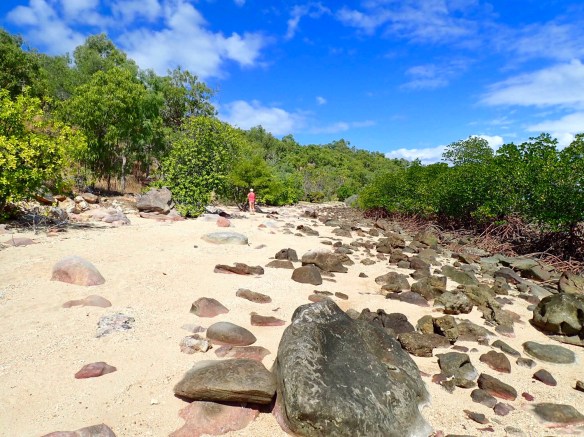
It made for a pleasant walk down a sandy corridor with the mangroves that line the shoreline on one side and the rust coloured boulders and cliffs on the other.

Graffiti walk on Flinders Island

Pretty yellow flowers and bright green fruit hung from what otherwise looked, being devoid of a single leaf, like dead trees and creeping along the sand were the purple pink flowers of bind weed. We could hear a few birds but the island appeared strangely free from animal life.

Beautiful flowering trees

We had spotted more activity in the water, seeing turtles and what we thought might be dugongs, in our pole light off the stern, one evening we saw a sea snake, the boat next to us saw a strange white coloured shark and the mangroves looked like a perfect home for crocodiles. Despite the welcome increase in temperature our travels north have found, nobody has seemed game for a swim.

Salties, Showers and Swashbuckling

Sunday 1st July 2018

We don’t really feel we are seeing Cairns at its best, unbelievably it is still raining. We dash around, heads down, trying to get from one place to another without becoming too wet.

Today, to escape cabin fever, I risked the drizzle and went out to stretch my legs on the waterfront boardwalk. When we arrived last week, we had one day of sunshine, this area was teaming with people, visitors and local families wandered along the paths entertained by buskers and street performers, today the paths were almost deserted. The attractive artificial lagoon sat empty and forlorn, a few groups of backpacking kids huddled under trees damp and dazed from the previous nights revelries, rain coated Chinese tourists shelter under umbrellas putting on a brave face determinedly continuing to snap photos, even the pelicans seem to have had enough of the weather.

Pelicans on a rainy Cairns beach

Despite the rain we carried on with our plans to hire a car. Tuesday we used it for a last scout around the chandleries and for a final stock up on provisions for our trip to Indonesia. Every locker onboard now groans with goodies.

Wednesday we treated ourselves to a day out, driving up the coast to Mossman Gorge and the Daintree River. The coast road sweeps dramatically around bays and over headlands but the normally blue sea looked green and murky under the grey skies and the beaches damp and windswept in the drizzle.

On the upside the weather had kept many people away, so our visit to Mossman Gorge was relatively uncrowded. The gorge sits in the southern end of the Daintree Forest, one of the Worlds oldest continuing forests. Having escaped ice ages and volcanic destruction it is thought to have been around for 135 million years. A few of the plants are of ancient origin and found uniquely in this area.

The atmosphere inside the forest is extremely humid, creating a marvellous earthy scent, the sound of cascading water and an intense green surrounds you. Despite all evidence to the contrary this is the dry season and the Mossman River flowed gently through the boulders, tumbling over small waterfalls. All around however, signs and markers warned of the rivers potential power, after torrential summer downpours it becomes a dangerous raging torrent whisking away everything in its path and frequently breaking its banks.

Mossman River

In the afternoon we travelled further north to a much more tranquil River, the Daintree. We had a river trip booked for 4pm in one of the smaller tourist boats. Boatman Daintree River Tours run trips at dawn and dusk when the birds and animals are more easily spotted along the banks. Unfortunately so dismal were the conditions I think most of the wildlife were sitting sheltering inside the densely forested banks looking out at us instead. However our prime objective was to see a crocodile and luckily Scarface, a large male, was obligingly sitting on his favourite patch of low tide sand.

At 4 1/2 m Scarface is possibly the largest Salty on the river

Being a small craft we were able to meander up narrower creeks, Murray our extremely knowledgable guide filling the void left by the lack of animals with fascinating information about the passing trees and shrubs. Who knew that the mangroves here survive their tidal salty homes by growing vertical aerial roots that act a bit like snorkels helping with the uptake of oxygen as the tide ebbs and floods. To cope with the excess salt, as well as filtering as much salt as possible through their roots, they sacrifice a proportion of their leaves to gather salt, the leaves turn brown and drop off taking the salt with them.

Aerial roots of the Mangrove trees

As we rejoined the river, Murray spotted a giant billed heron flying near by. A secretive bird, a sighting is much sort after by the birding community, which explained the excitement from our fellow passenger who set his camera, bedecked with a huge telephoto lens, into action. The heron settled on a nearby tree and we moved in for a closer look, to our surprise it let out a croaky growl, a sound as far away from bird song as you could imagine. Over a meter tall they spear fish in the shallows but have been known to eat small snakes and even baby crocodiles.

A rather damp and ruffled giant billed heron
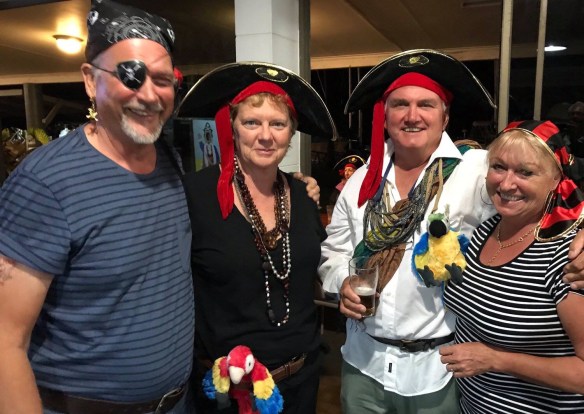
Back at the marina it was time for the Indonesian Rally briefing, the blue sea and skies of our destinations, looking even more alluring against the backdrop of rain out of the window. The presentation was followed by a pirates party and the Indonesian Rally participants were joined in the Cairns Yacht Squadron bar by the crews from the Oyster Rally. Feeling rather betwixt and between, we wandered from one group to another and had a very enjoyable evening.

Swashbuckling with Oyster friends Heather and Bob

There are signs in the forecast for less rain next week, we plan to leave Thursday, it would be nice to see Cairns in the sunshine before we go..