Mantas at Musket

Wednesday 6th August 2017

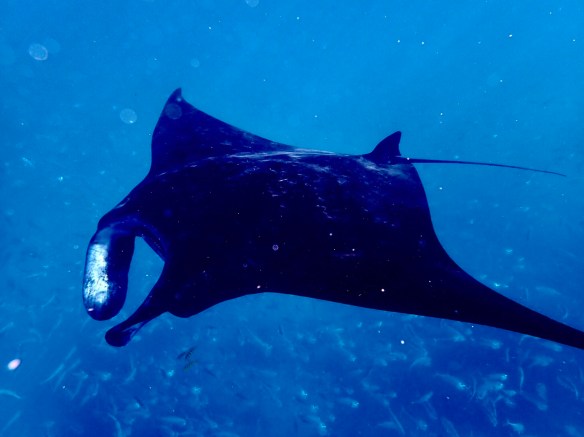
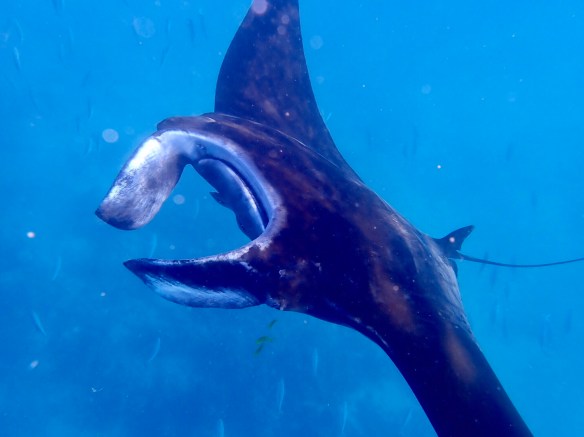
Our spotlight that illuminates the back of the boat, makes for easy landing from the dingy at night and also casts a pool of light off of the stern into the water. This light attracts insects, tiny fish and krill, these in turn lure in other creatures looking for an easy meal. It has provided hours of entertainment over our travels but none so much as our experience last night. We returned from our BBQ at the bar to find a beautiful black and white Manta Ray dancing in the spot light. It swooped and rolled scooping up the mass of krill as it went, oblivious to us watching and filming it or the dingy almost on top of it. Mesmerised we watched its graceful twists and tumbles often right on the surface, other times it went deep only to re emerge ghostlike from the darkness. As it rose to the surface we could see the huge cavity with which it filters the food rich sea water and as it rolled it exposed its white underbelly with two remora stuck fast.

Scooping up the krill has he comes to the surface.

Back flips exposing the white underbelly and two remora.

The only disappointment was that Charlie and George, still drinking at the bar, missed the show, especially as the Mantas didn’t put in an appearance the two days we were at Manta Ray Bay. Luckily the drift snorkel through the Tokatokanu passage is one of the best snorkels we have found here with or without Manta. We take the dingy up current through the pass, jump in and drift with the strong current back over the coral towing the dingy behind. It is a fantastic sensation as you fly over the reef passing over a million fish big and small, spotting eagle rays and sharks on the way. At one area of the reef shoals of chromis, small turquoise fish, form dense lines of a thousand individuals that sweep and undulate around the contours of the coral looking like fast flowing underwater rivers. When we pop out the other end we just jump back into the dingy and do it all again, and again, and again.

Rivers of Chromis sweep over the coral

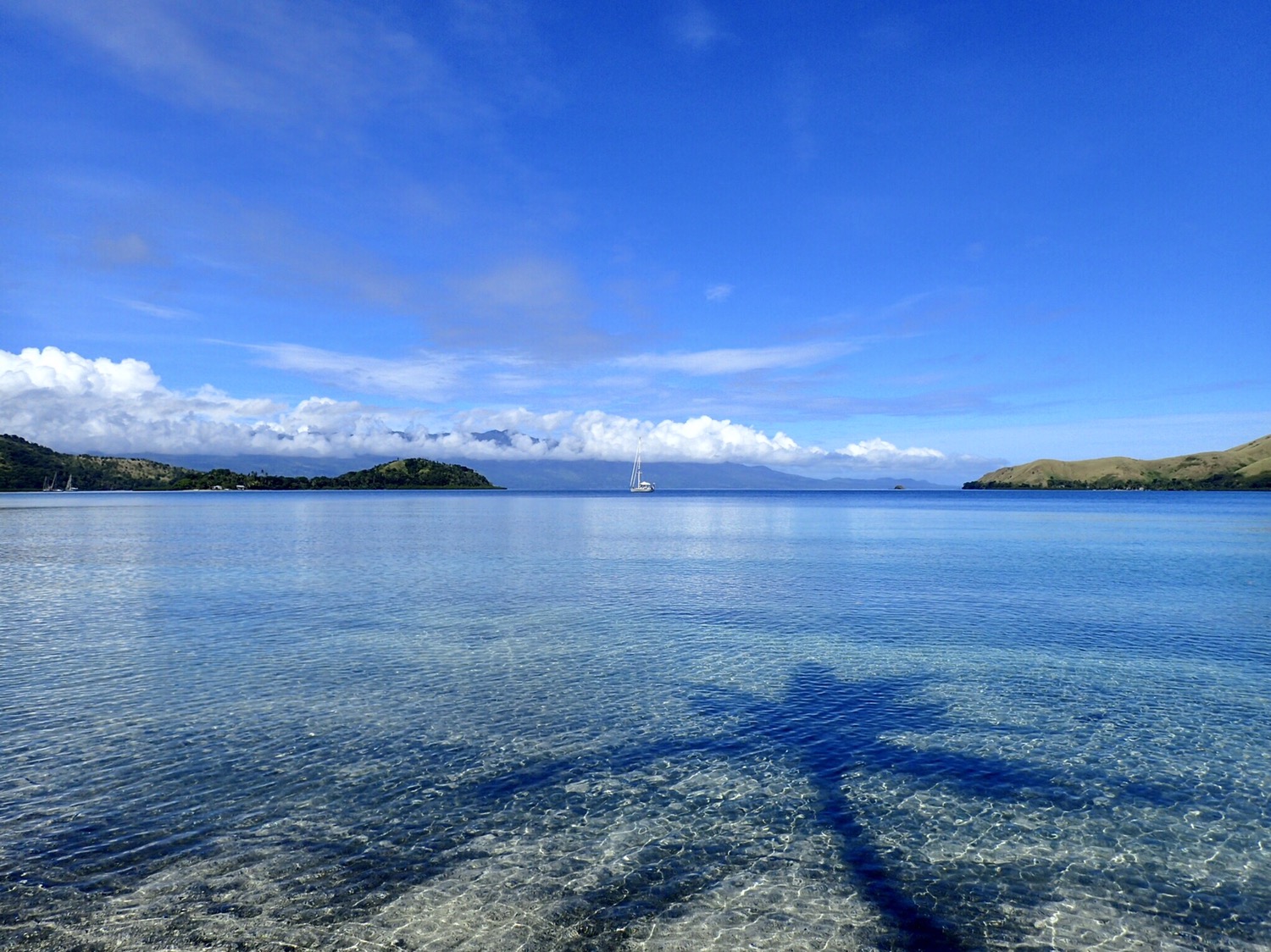
For our final day with the boys, we motored out with our friends on Knockando to a sandy cay, surrounded by nothing but turquoise sea. The snorkelling was a bit of a disappointment but the location was so remarkable in the calm conditions that we just swam and floated about enjoying the view. We moved on to the outer reef at Musket Cove in search of better coral but a sudden dramatic increase in wind drove us back to the anchorage and an evening in the bar.

At anchor off Sandy Cay

George and Charlie hopefully had a great time with us, they were fun to be with and they appear to have remembered to take all there belongings with them but have kindly left us with the colds they bought from Sydney. As we all coughed and sneezed our way into Denarau harbour, Raya sounded much like a plague boat. We swapped the boys for Ricks niece Ashley, the poor girl will have to put up with two ill old people for a day or two.

The extreme beer drinking experiment was not really a success

Musket Cove

Friday 25th August 2017

We have spent a pleasant four days in Musket Cove sat in the resort’s small marina. With three restaurants, a large pool, beaches to explore and a bustling activities centre it feels like being on holiday. Some of the time at least. Unfortunately we have had a lot of cloud, some rain and a cool wind that has, due to the direction we are tied to the pontoon, been screaming into the cockpit, at times, keeping us hiding below. Jumpers have been worn!

Pretty place to tie up to the dock – Musket Cove Marina

The weather started to change last Sunday. After a nice day spent Saturday off Octopus resort, meeting up with our friends from Crazy Daisy, Sunday morning we headed South. There was zero wind, the calm flat sea was dark and oily and with clouds building, the atmosphere was heavy and oppressive. Rick slightly under the weather with a tummy bug, snoozed in the cockpit, everything was so still and the ocean so empty it felt like I was the only living thing around. Then has happens in the tropics, the rain starts and the world comes back life. So it was, a very bedraggled Raya and crew tied up at the dock.

Monday dawned dry but windy. Musket Cove is connected to the mainland by the Malolo Cat, an hour ferry journey across to Denarau Port. While I stayed aboard cleaning and preparing for the arrival of our next guests, Charlie and George, Rick took the ferry across to complete some chores and have a look around the chandlers. With a shuttle from the airport to the ferry it was also an easy way for the boys to reach us the next day.

Moored one boat down from us on the dock were Clare and Darren from Knockando and frequent visitors to Musket, over a drink at the bar they filled us in on all the local information, including the best snorkel spots, a run down on the restaurants and how to buy cheaper beer.

This turned out to be invaluable, Charlie and George arrived exhausted from their exploits in Indonesia and Sydney but still able to sink a can or two of Fiji Gold and keen to get into the water. A mile off the marina is a long sandbar, as the sunshine appeared from the morning cloud, the white sand glowed in a turquoise sea. We took the dingy, sluggish under the load of four people, out through the shallow marina channel, through the anchored cruising yachts and past four or five super yachts. One giant, Dragonfly, is a sleek 240ft long by only 32ft wide motor yacht and Google tells me is the fastest superyacht around and Google should know, it is owned by one of their co-founders.

Charlie and George on the sandbank, Musket Cove

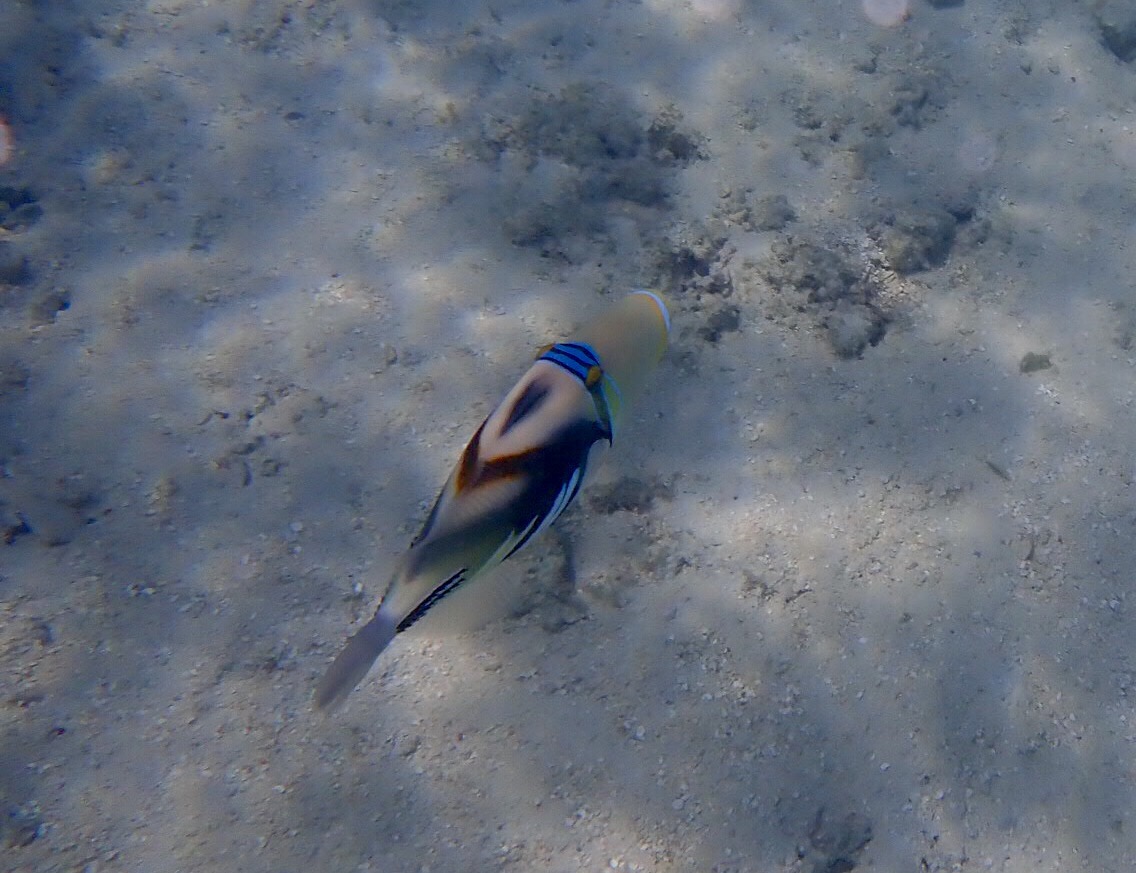
The snorkelling off the bank was murky but the lack of visibility was compensated for by the thousands of fish. Along side the normal array of reef dwellers we spotted a group of 2ft long trumpet fish and numerous trigger fish, including a group of my favourites, Picasso triggers.

Picasso Trigger Fish

We availed ourselves of the resort facilities for another couple of days. The boys went diving, we all enjoyed the self cook BBQ at Pirates bar, we swam in the pool and stocked up on the slightly pricey supplies at the shop. Then having made Raya shipshape yesterday evening, we plan to leave on the high tide at 9am this morning and head for a night at Navandra.

A last thought, I spotted this article on the BBC news website and it made me smile.

The problem of having to ration your energy requirements to make that essential cup of tea was big news in the real world, for us in Raya World, this is an everyday feature, just replace electric car with water maker/water heater/toaster.

Busy Blue Lagoon

Saturday 19th August 2017

We spent another 4 days at anchor in Blue Lagoon doing nothing very much but watching the world go by. Sandwiched between three islands this seems to be one of the few spots in the Yasawas that is free of the effects of ocean swell and so an ideal place to catch up on some sleep, do a few small jobs and relax while a trough passes over the area . Quite a few other boats obviously agreed and the anchorage was relatively full.

As we entered through the reef last week one boat name caught our attention and led to a ‘what a small world’ moment. Onboard, having sailed up from their New Zealand base, was the sister and brother in law of some friends of ours from our old home town of Cranbrook. In fact it turned into a very sociable couple of days with all the crews getting together most evenings at the Yacht Club bar in the small Nanuya resort.

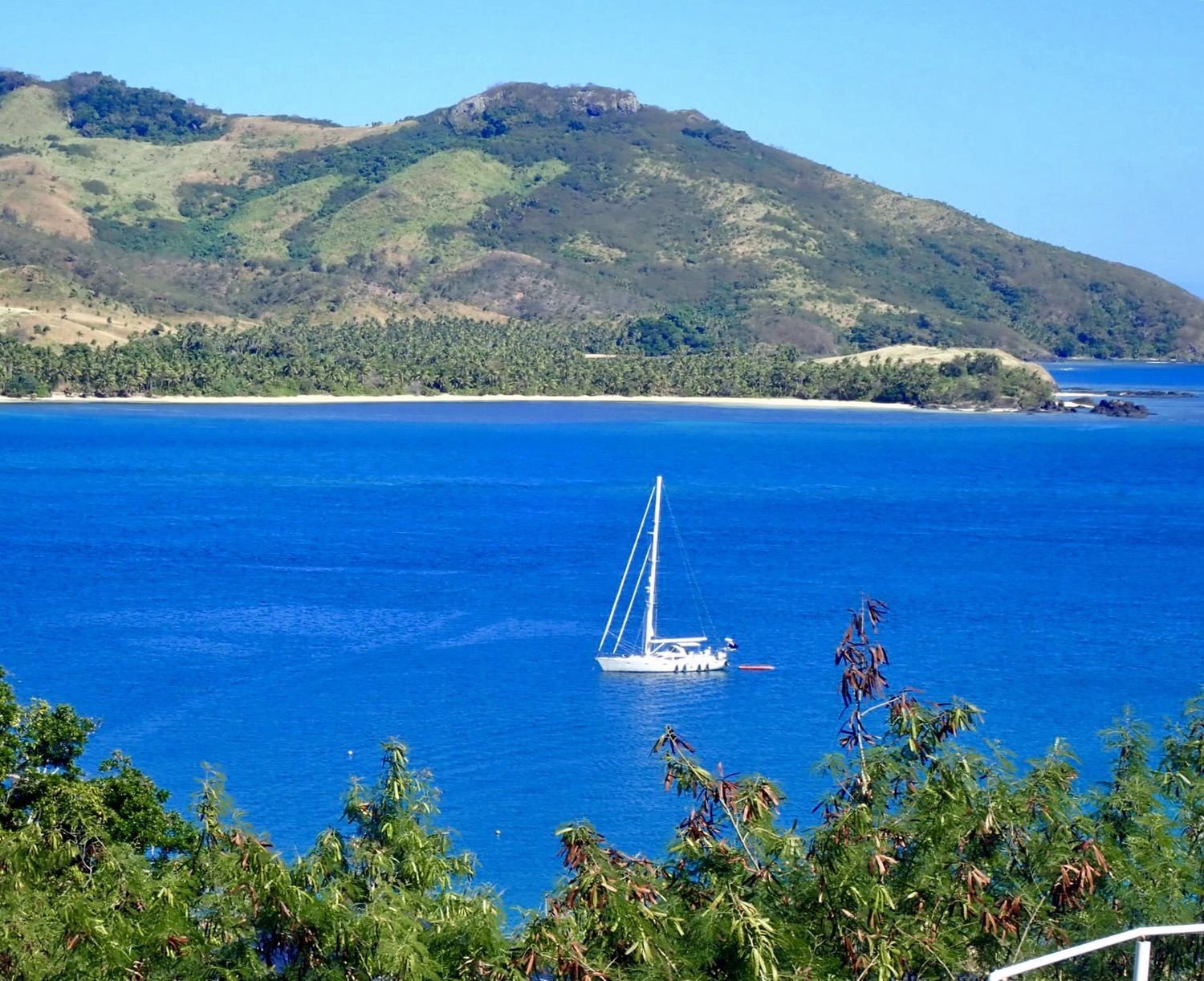
Raya at anchor in the Blue Lagoon

Despite its uncrowded feel it’s a busy area. Surrounding the large lagoon hidden amongst the trees are two or three villages, three or four backpacker and more up market resorts, a glamping site and a beach area used by a small cruise ship that comes in once a week. All the resorts in the Yasawa and Mamanuka islands are fairly small and they blend well into the unspoilt landscape.

In fact the whole economy of the area revolves around the tourist industry, the villages provide the staff, grow a lot of the fresh food and are involved in the transport of goods, locals and tourists between one island and another. There seemed permanently to be one boat or another crossing the lagoon.

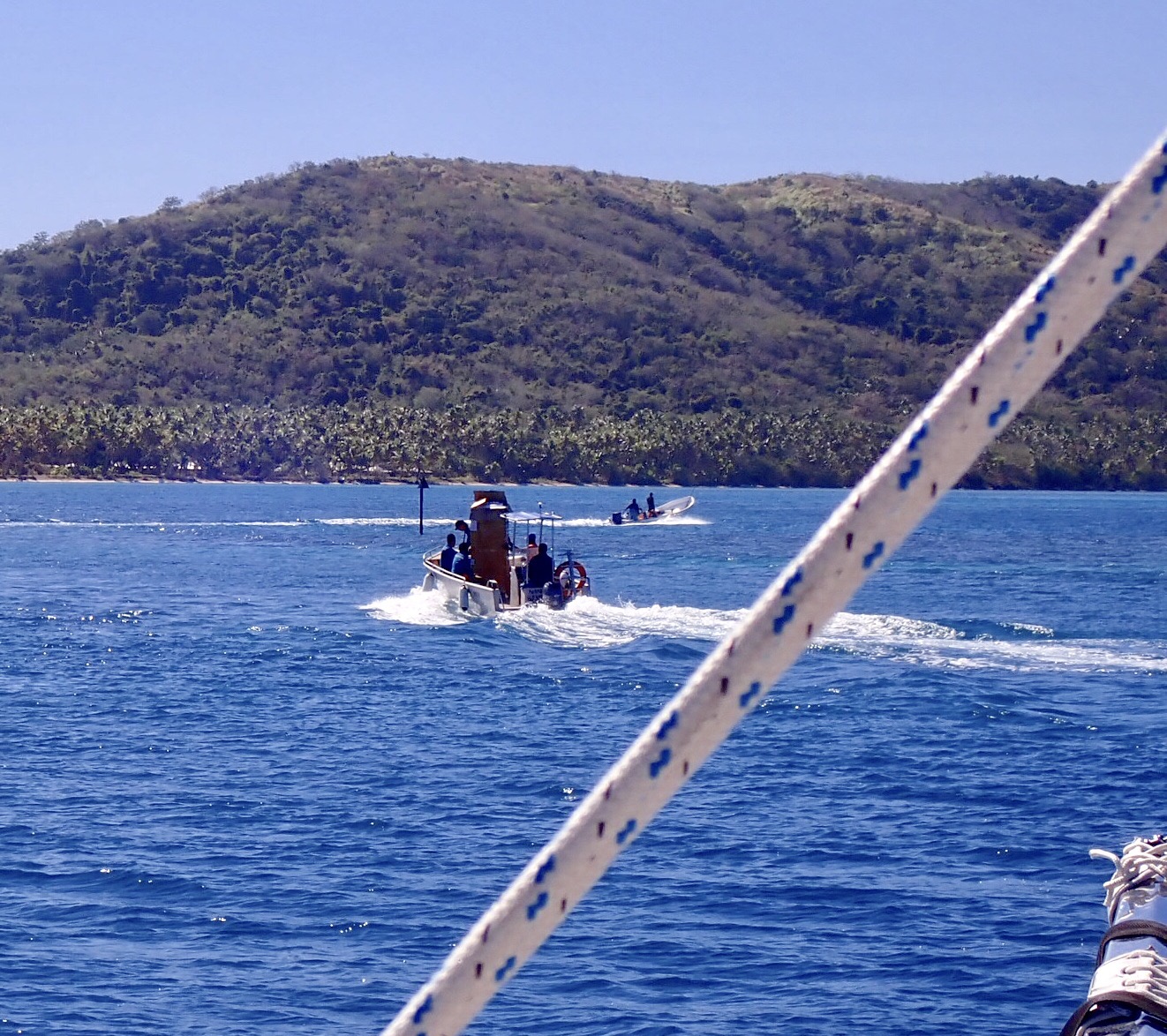
The villagers whizz about in their all purpose longboats that convert into everything from the school bus, to a fishing boat, a taxi or goods delivery van.

Fridge delivery

The villages and resorts are kept supplied by landing craft that ply back and forth from the mainland. In such treacherous waters, even with their shallow drafts delivery is dependent on the tide. We watch in admiration at the skill with which these large boats are navigated through the anchorages and complex reef systems.

The larger of the two landing craft keeping the islands supplied with goods.

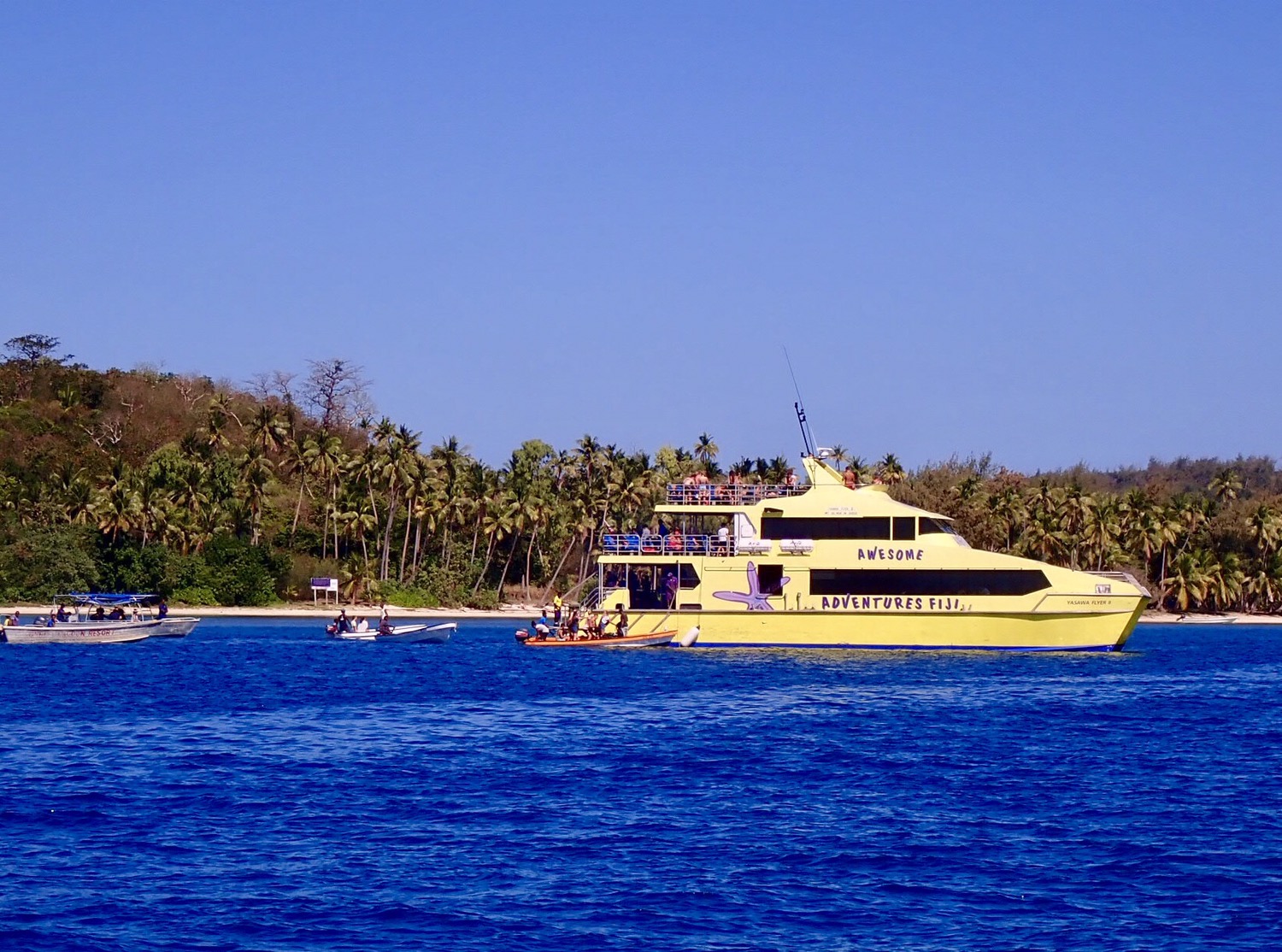
A few tourists arrive daily on seaplanes that noisily land frighteningly close to the yachts. However most people arrive on the Flyer, a bright yellow catamaran that will be forever synonymous with our trip here, it daily delivers and picks up passengers from almost every resort in the island group. Bringing in its wake not just waves that set us rocking but a fleet of small boats that act as go betweens, transporting goods and guests from the Flyer to the shore.

The Yasawa Flyer

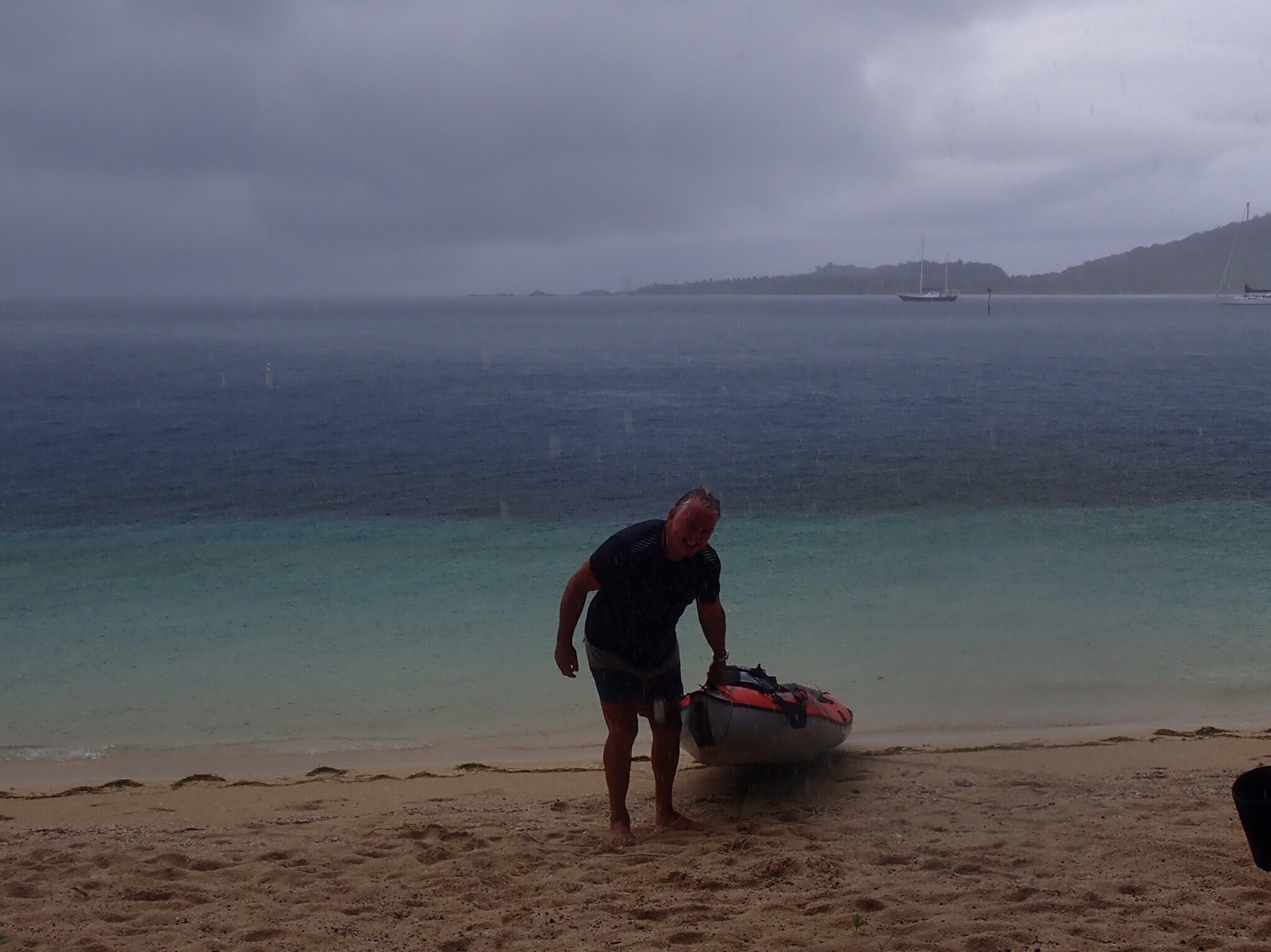
On Wednesday we added another form of floating transport to the Lagoon, setting out on our kayak to feed the fish off the reef half a mile away at the other end of the island. We could see the sky was darkening but the sea was calm and the wind nonexistent, we didn’t think a little rain would harm us. About halfway a sudden deluge began, it brought so much rain we could hardly see even the few metres in front of us. We paddled to shore and hid under a palm tree, five minutes later it stopped and we carried on our way. Then through the trees we saw another band of rain approaching, the wind had began to pick up, the signs weren’t good, so we quickly turned for home. Not being particularly proficient paddlers the trip back was rather, shall we say, challenging, especially as we kept getting fits of the giggles. By the time we reached Raya there were 2ft waves running and it was blowing 25kts, thank goodness we were upwind, I think had we paddled out the other way we might still be out there!

Not the best time to chose to take out the kayak.

A Day in our Life at Anchor

Sunday 12th August 2016

Of course a large part of the charm, and the challenge, of our life afloat is that we don't really have typical days, but sometimes it is good to take ones eyes off the highs and lows of life and focus on the everyday.

Saturday we were anchored off the beautiful island of Navandra, we had arrived the afternoon before, sailing north to escape the crowds and choppy waters at Musket Cove. I find I wake early most mornings and love to catch the sunrise, this Saturday morning, the sky was streaked with high clouds that lit up long before the sun appeared above the hills on the eastern side of the bay. The sea is calm but overnight a swell has begun to creep in. Navandra is a remote uninhabited Island and the early morning sounds were restricted to the childlike bleating from a couple of goats somewhere on the island and the distant roar of waves crashing on the reef. I search with the binoculars but I can't spot the goats on the shore or perched on the large rocky outcrops that poke out from the undergrowth. They sound close and must be hidden amongst the trees.

I make myself a cup of tea, turn off the anchor light, unfurl our ensign and settle down to check my messages and look at today's weather forecasts. There is only a weak 3G signal here so things are slow, but it soon becomes clear that despite the roll we are anchored in quite a good spot. The tall mountains on the main island of Fiji, Viti Levu cast a wind shadow that, depending on the direction and strength of the wind, falls generally across the Lasawas. Its size and exact position changes from day to day and appears on the wind maps in blue, representing light winds. Today a thin finger of blue stretches out and falls over Navandra, either side of us is swathed in the oranges and reds of forecast high winds. When Rick wakes we take the decision to stay another night in the bay.

Unfortunately yesterday when we came in, keen to tuck as far in as possible out of the wind, we anchored a little close to the reef, we were probably fine but all night we were slightly anxious of our position, especially if the wind direction changed. If we wanted to stay and relax we needed to move, so we pulled the anchor up, motored backwards and reset it a bit further out.

Once settled we got on with some jobs, Rick checked and topped up the engine oil and then turned on and checked the newly reinstalled watermaker high pressure pump. I wash a line that was used to attach us to the mooring buoys in Vuda. Sitting submerged in the unclean marina water for the month we were there, it has languished, avoided, in various spots on the boat looking and smelling disgusting ever since. As the boat swings with the breeze we are turned broadside to the swell, which rocks the boat uncomfortably, my bucket sloshes soapy water, Rick wedges himself to avoid spilt oil.

The white beach beckons but we can see the surf rolling in and know from experience that, in these conditions, it will be too difficult to land and relaunch the dingy with just the two of us, so we opt instead on going snorkelling. It feels refreshing to be in the water, we have great visibility below the surface and the view above the water is stunning. It's a pleasant half hour, we see nothing particularly spectacular, I spot a large grouper however I can't catch him for a close up look and the coral is not in good condition but there are plenty of reef fish. Particularly abundant are the pretty striped surgeon fish that seem to be everywhere we look.
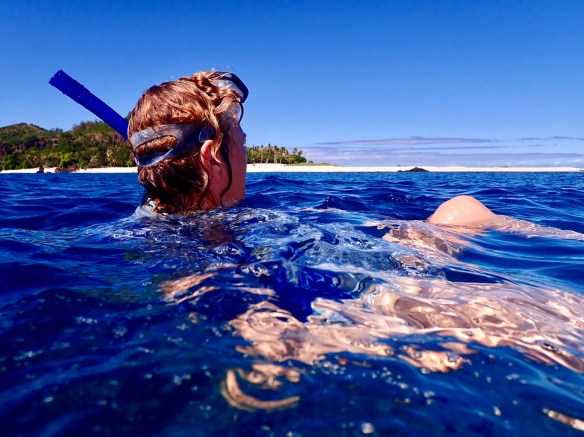
Snorkelling in Navandra Bay

Back onboard Raya it's time for a beer and to make some lunch. Rick knocks up some French Onion soup while I make some cheese scones. I carelessly, in these rolly condition, tidy last nights wine glasses to a basket on the counter. Just as I am about to put the scones in the oven, the boat lurches, the wine glass tumbles and the scones are lightly sprinkled with shards of broken glass. We are much more conscious of waste than we were before we entered the Pacific and instead of rejecting them we spend ten minutes picking over the tray before popping them in the oven.

We survive lunch without lacerating our mouths and spend, as we often do, a few hours in the afternoon relaxing. It's not easy laying on the bed when it's rolly, Rick lies star like across the bed to read his book, I take a brochure, about the delights of spending the cyclone season in Australia, on deck and start planning our period 'down under'. I look up every now and again to marvel at my surroundings. In the mid afternoon sun the colours seem to have, if possible, intensified, the trees even greener, the beach even whiter, the sea even bluer. The only sign of activity is a group of children from some of the five other boats in the anchorage clambering on the rocks and running on a far away beach, now at low tide even the surf is quiet. The swell however continues to roll in.
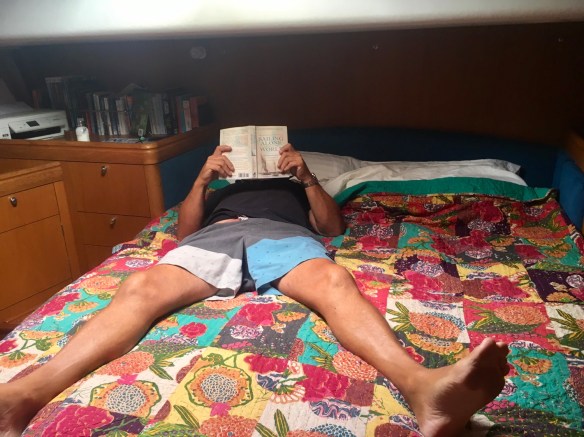

Bracing against the rolling of the boat

The sun sets undramatically behind a build up of cloud on the horizon but leaves behind a splendid pink glow that fills the sky. We had read of the dramatic Perseid Meteor shower due over the next few days, so as soon as it is dark enough, with all lights extinguished, we sit on deck to see if we can spot some shooting stars. With the moon yet to rise it is a spectacular scene, Jupiter shines brightly low in the sky, Antares a red twinkle to our West, the cloudy expanse of the Milky Way stretches above us. We spot the Southern Cross and the plough, upside down this side of the equator, but no shooting stars. (We learn later that the shower is only visible in the Northern Hemisphere).

We tidy and check everything is shipshape on deck, lock on the dingy and go below to begin watching the TV series of the Crown, which with the cheap telephone data here, I managed to slowly download while in the marina. Rick has the last of the cheese muffins and with an uncomfortable crunch finds the inevitable chip of glass that slipped us by.

Then at what is commonly known as cruisers midnight – 9pm, we jostle for enough bed space to assume our star shapes and attempt to sleep. Rock and roll, rock and roll.

Fairwells and Favours

Thursday 10th August 2017

We stayed in Manta Ray Bay one more night, not only to swim again with these wonderful creatures but also in the morning to fulfil Matts ambition to dive with sharks. Sharks and many other large fish often gather in areas of the ocean where, in a form of symbiosis, much smaller fish swim around them removing parasites and algae. These smaller fish, often small varieties of wrasse will even enter and clean inside the sharks gills and mouths. One such cleaning station exists on the reefs that run in the passsage just south of the Manta Ray Resort and is almost guaranteed to have sharks present.

Matt and I signed up for two dives, it was a bit early on the tide for the sharks so they took us first for a cave dive. Personally I find caves a little barren, much preferring the coral gardens and walls with all their colour and life, but it was fun twisting our way through the narrow passages, each turn revealing a change in the light, dark corners or bright shafts of sunshine. Unfortunately near the end of the dive the route took us sharply down and through an archway, Matts ear didn’t equalise adequately and he was left in a lot of pain. Between dives I called Rick and he bought us over some chewing gum, Matt desperate to do the shark dive chewed energetically to loosen the ear area as much as possible. Still in pain he managed to clear his ears enough to get down to the cleaning station and was rewarded with close encounters with white and black tip sharks and a large grey shark that cruised back and forth with his mouth wide open allowing the tiny yellow wrasse to clean his teeth.

Saturday dawned with hardly a breadth of wind, we were headed to Musket Cove where Tony and Gilly were leaving us for a couple of days of luxury at the resort there. It had been a shame that the wind had never been right for us and they never got a proper sail. Especially as when we started to approach our destination and its surrounding reefs, where it’s too tricky to sail, it suddenly picked up. By the time we were anchoring in the cove it was blowing 20kts and white horses topped the choppy waves. Not the best conditions for dinging people and their suitcases into shore but all were landed safely, if a little damp. Later that evening we joined them in the resort restaurant for a final supper and discussed what a good couple of weeks it had been. They had been perfect guests.

Tony and Gilly enjoying the snorkelling

The next evening it was time for a last meal with Matt, now back in Vuda we had an enjoyable time listening to another really good band playing at the Boatshed. Still with earache we waved him off armed with Ibuprofen for the plane. We will miss him, especially his enjoyment and knowledge of the fish and coral and his youthful energy helping around the boat and dingy.

Great having Matt onboard

Our second reason for returning to Vuda was to overhaul our high pressure pump for the watermaker. Just as we were leaving a few weeks ago Rick discovered an expert in Laukota, a town just fifteen minutes up the road, the pump was beginning to become a bit unreliable, a service was overdue. With a bit of nudging, they finished the job in two days and Wednesday afternoon Rick with our ever helpful taxi driver Abdul drove up to pick it up. Then a complication, there always seems to be a complication, the company would only except cash. Since our return to the UK we seem to have triggered multiple security alerts and our cards are being continually blocked. After no luck at the ATM Rick tried the bank but they had no facilities for international exchange. While, frustrated, Rick called me to see how much cash I had, Abdul appeared out of his bank with F$2000 to lend us, what amazing generosity. While Rick recovered the pump, I called the banks in the UK and armed with a stash of all our cards I managed between them to make the marina ATM give me just enough money to pay him back.

We are now back at Musket Cove to catch up with friends before heading back up to the Yasawas and a bit of a break before our next guests arrive.

Majestic Mantas

Thursday 4th August 2017

The banging of the drums summoned the resort guests to the boats, Manta Rays had been spotted in the channel. All around us cruisers jumped into their dingies and we all raced to the shallow passage that runs between Naviti and Drawaqa Islands where the Mantas come to feed.

The scene above water was fairly chaotic five or six resort boats, half a dozen dingies, two or three large groups of snorkellers and a couple of dozen individual swimmers all jostled for space. Our hopes of a close up sighting were not that high, we couldn't imagine the Rays would join this melee. But then a resort guide raised his hand nearby, everyone swam towards him, we slipped into the water from our dingy and there just a few feet below us was a huge Manta. A gasp from Gilly, a squeal from me, we could hardly believe what we were seeing.

We spent over an hour swimming with these majestic creatures, at over 4m across they filled our vision, they glided over the coral with just the slightest undulation of their wings, swooping gracefully to turn, ignoring the excited crowds above them. Effortlessly flying against a current that took significant energy for us to overcome, gradually the crowds fell away and the years of pounding up and down swimming pools gave Matt and I the advantage, we swam alone with one Ray, escorting it out towards the open sea. At one point it drifted to the surface coming within touching distance and revealing a community of cleaning fish on its underside, he seemed unbothered as Matt dived around him snapping photos. Such an amazing experience and a real privilege.

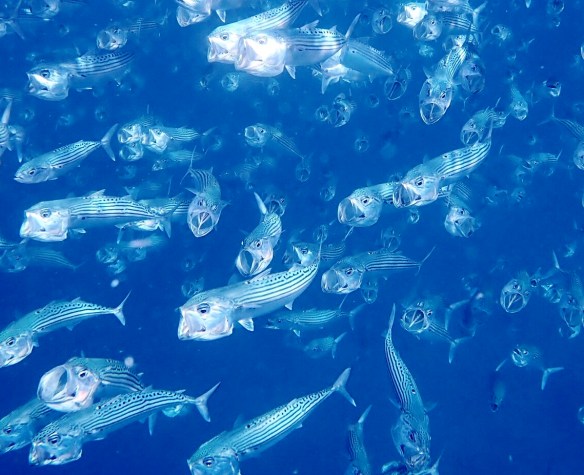
When we managed to drag our eyes from the Mantas we realised that the pass was brimming with other fish. Shoals of a thousand Blue Chromis, Yellow Tailed Snapper and an almost translucent, filter feeding, rather scary, unidentified fish that seemed to dislocate its jaws to open them abnormally wide in its bid to scope up as much plankton as possible.

N.B. Apparently the filter feeders mentioned above and pictured below are Long Jawed Mackerel, thanks Cindy.

Team Raya returned to the boat awestruck, decision taken to go again tomorrow.

The Blue Lagoon

STOP PRESS : Wow! Just swam with Manta Rays – pictures and details to follow.

Wednesday 2nd July 2017

The Blue Lagoon has kept us captive for a few more days than expected. The waters have remained calm despite some high winds, the beach is long, with white sand and backed with palms, the snorkelling is great and the resort has a cruiser friendly beach bar, why leave?

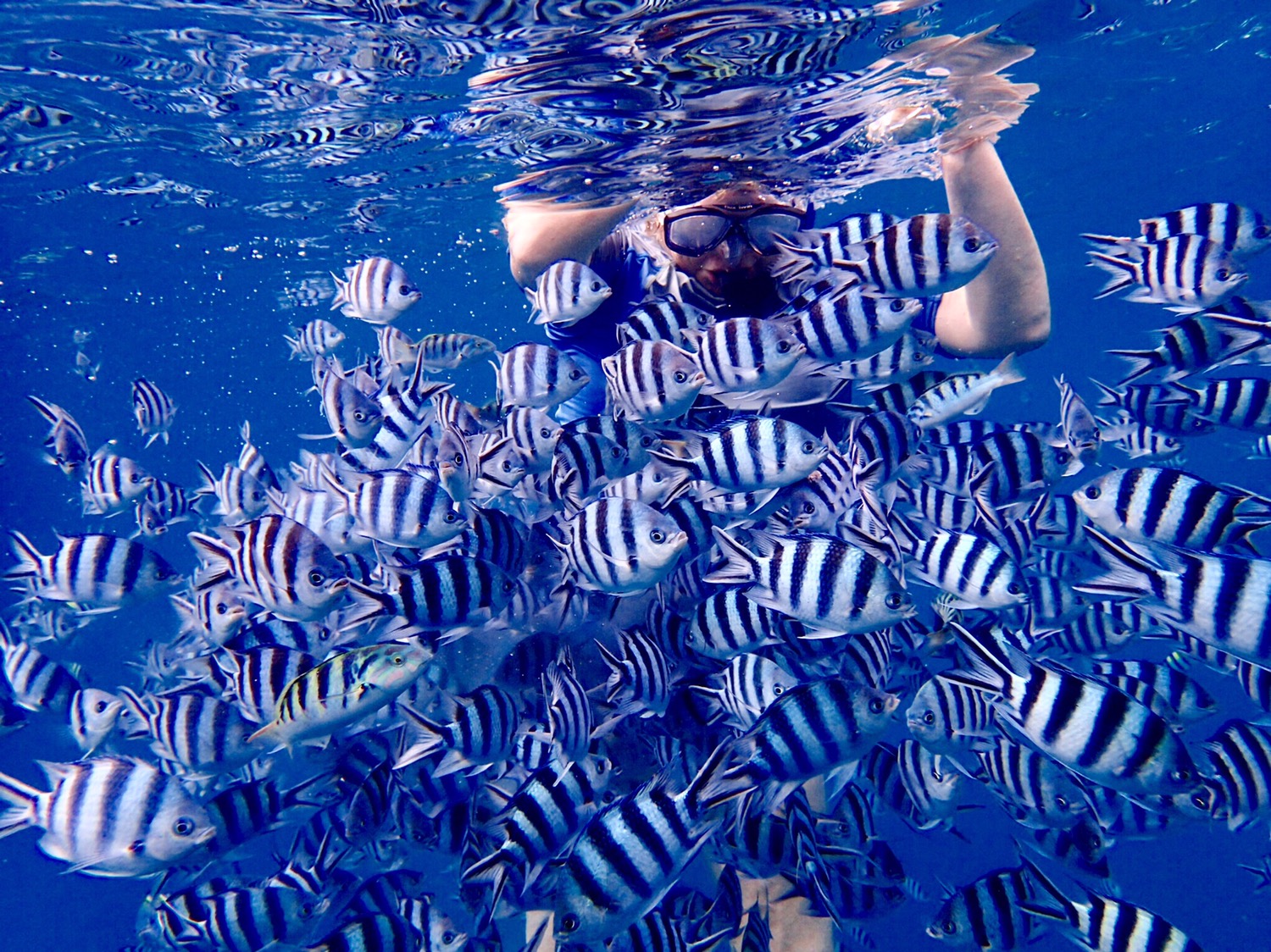
To encourage a tentative Gilly to join us, we started with a gentle snorkel off the beach. Our expectations weren't high but the few people already there seemed to be enjoying themselves. What a great surprise, the small reef was teeming with fish and when Matt started feeding them with the bread we had bought we were inundated with Sargent Major's. The next day we stepped up the level and took the dingy out to the large reefs in the channel where we found pretty coral, a huge variety of small fish, Matt even spotted a turtle chomping on the reef.

. Gilly feeding the Sargent Major's

Sunday at lunch in the Boathouse Bar, despite the rain it was still warm and pleasant, we saw the resort ran tours up to some limestone caves. We could have sailed up in Raya but thought it would be nice to let someone else take the strain for the day. What we hadn't counted on was that this meant we would arrive with all the other resort boats. Our hearts sank, the beach was full, luckily nobody on our trip was in a hurry, so we waited in the shade until things cleared. The caves were reached by following a path around the cliffs and then descending down some steep steps. The water that filled the first cave was lit by a large gash in its side letting in daylight, the second cave, reached by diving down through an entrance in the rock, was in complete darkness. Rather eerie until the guide shone his touch upwards and light filled a smaller cavern. Luckily Matt had his dive torch as well to light the many crevices. Fun but not an unmissable experience.

Limestone caves at Saw-I-Lau
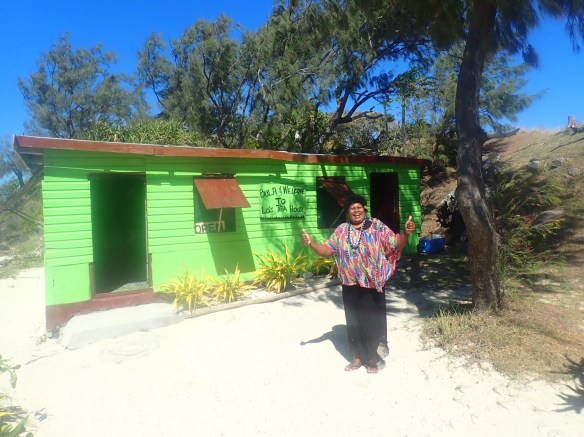
Tuesday we felt it was time to stretch our legs, we had been told that the path up and over the island led to, bizarrely, a tea house that sold chocolate donuts. The view from the top of the hills was magnificent, revealing clearly the reefs we had painstakingly navigated around just a few days previously. After a hot but pleasant 40mins we descended into a small village of tidy gardens and colourful dwellings and right on the beach, Lo's Tea House. In true Fijian style most of the items on the menu were unavailable, we settled on lemon tea and, of course, donuts. The tea comprised of three lemon leaves, freshly picked from the tree outside the back door and boiling water, it was surprisingly tasty and very refreshing. In contrast the donuts were probably the most wicked things you could eat, dripping in oil and sugar, they were delicious.

Lo's Tea House

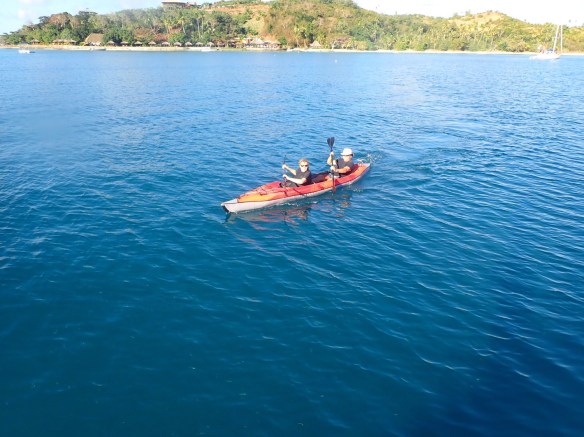
In between all these activities we have finally got out the kayak and actually managed to steer it around the bay. A good couple of days

Rock and Roll

Saturday 29th July 2017

It was a relief to finally find calm waters as we entered the area known as the Blue Lagoon. We had had two rolly nights and we were all ready to be rid of the swell and to enjoy some flat seas. It was a shame we had had to move on so quickly because the previous two anchorages had both been very picturesque and inviting.

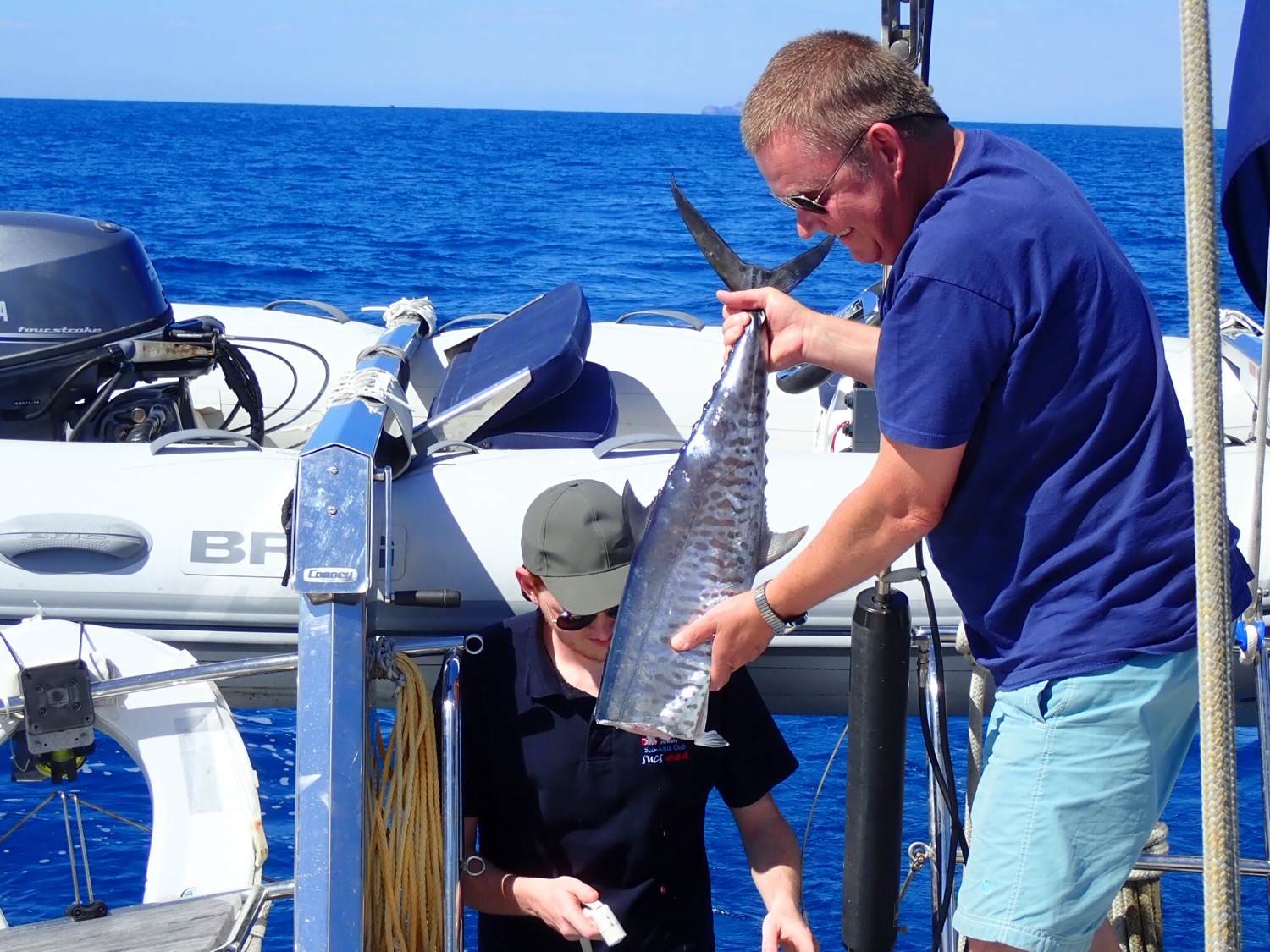
Thursday morning we left Vuda, via a top up at the fuel dock and headed out towards the Yasawa islands, a string of volcanic islands that run down the western side of Fiji. It was a lovely sunny day, not quite enough wind to sail but onboard with us, were Matt and our friends freshly arrived from the UK, Tony and Gilly. Five eager people enjoying being out at sea and looking forward to a couple of weeks cruising. A great morning was topped off when the boys landed a large Wahoo just as we rounded the reefs off the Island of Navandra.


Navandra is two small islands at the south of the Yasawa chain, they are uninhabited and have white sand beaches surrounding a rocky interior, true 'out of the guide book', South Pacific scenery. The anchorage was a bit uncomfortable but it was too beautiful to leave. We settled Raya at anchor, made a salad and were eating the Wahoo about as fresh it comes, just an hour after it was caught.

It was great to be back swimming from the boat and the reef off the beach gave us some good snorkelling. That evening we joined cruisers from the half dozen boats in the bay for drinks around a beach bonfire. We discovered this was a very special island, the fading light cast a pale grey wash over everything, slowly it turned to pink in the setting sun, our surroundings made the rocky water worth while.


The morning brought more swell and the surf breaking onto the beach gave for an interesting dingy landing, but with five of us to control it and drag it clear up the beach we got ashore. The sand was powder soft and the huge boulders in the centre of the island gave the place a rugged feel. At one end a big jagged lump of rock was joined to the main island by a spit of sand. We paddled, shell spotting, watching hermit crabs and tiny white crabs that tumbled along the sand in the breeze.


Once back on the boat we reluctantly upped anchor in search of calmer waters. The plan was to gradually make our way north through the chain and the nearest likeliest looking bay was on the north end of the island of Waya. From the chart Nalauwaki Bay looked well protected from the forecast wind and swell direction. On arrival we found the dramatic hills, reminiscent of those in the Marquesas Islands, delivered visually and did a great job blocking the wind, however, the swell somehow was creeping around the headland, deflecting on the opposite shore and making us roll more than ever. Two late in the day to move on we made a bid, in the dingy, for a few hours ashore. There was a village, a nice beach and paths leading up into the hills, but despite the enthusiastic arm directions from a villager on the beach, the crunch of the bottom of the dingy on the coral dissuaded us from venturing in. 


Early the next morning we left and postponing stops along the way we headed for what has to be the most protected bay in the Yasawas, we are anchored off Nanuya-Sewa and very lovely and flat it is too.

Ready for the Islands

Tuesday 25th July 2017

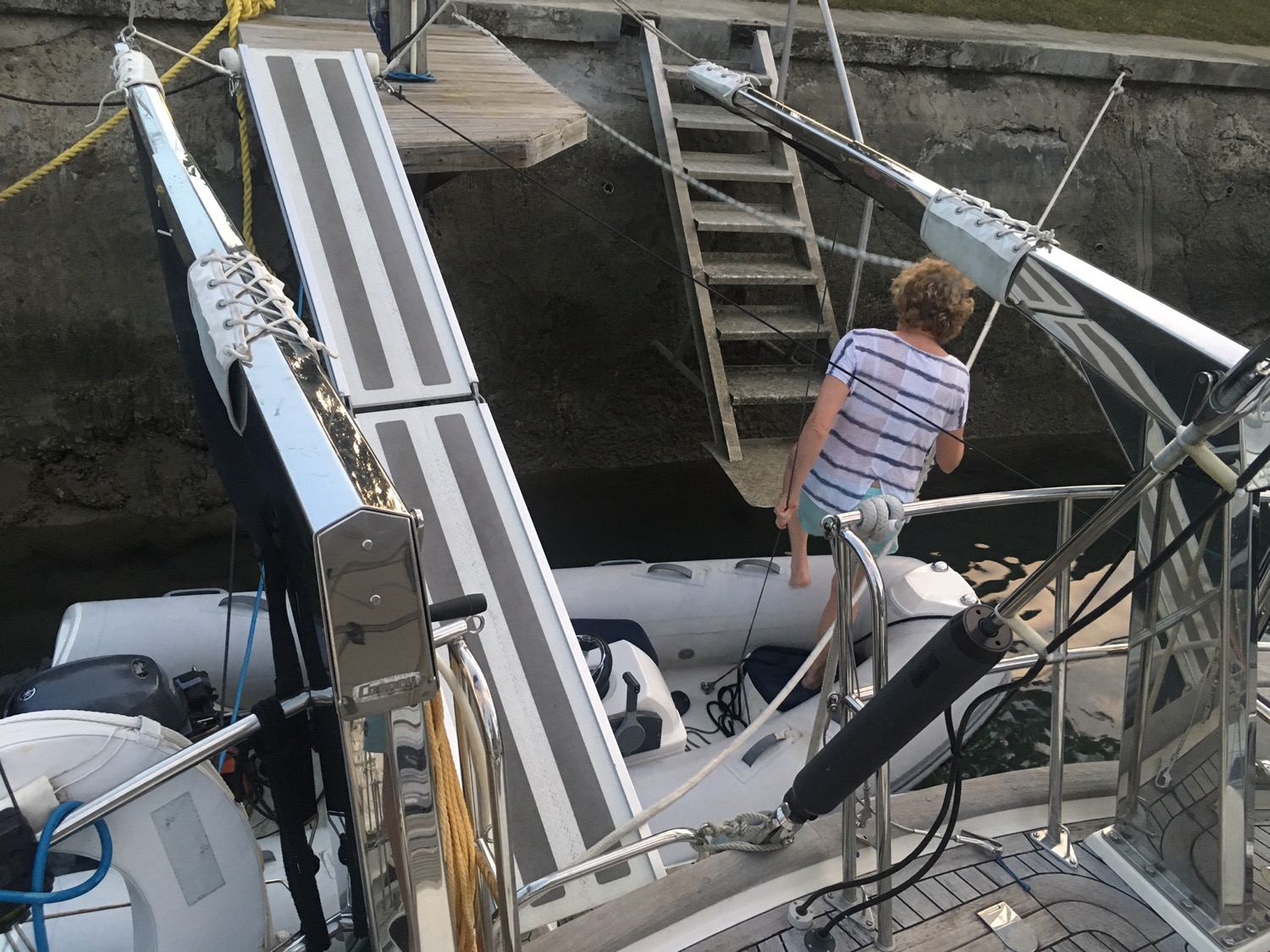
Much as we like it in Vuda we are now more than ready to get away and out to the islands. We have had a couple of very hot, humid, windless days, we are being plagued by mosquitos and tiny biting noseeums and then there is still the ongoing challenge of being attached to the fixed dock, that often requires scaling a near vertical passerelle as you leave or return to the boat.

Good to have Matt onboard to help with all the provisions


Since our return from the UK we have been busy preparing things for our guests. Matt arrived yesterday and Tony and Gilly join us tomorrow. So it has been a week of cleaning and provisioning. Luckily we have had the help of Abdul the taxi driver to ferry us around to the shops and run us to and from the airport.

This part of Fiji is relatively built up, lining the road into town are houses and light industry interspersed with fields and fields of sugar cane. Sugar export is the countries primary source of income and the industries presence is very obvious in this part of the Island. Trucks loaded with canes pass us on their way north to the large sugar mill in Lautoka and smoke billows from the plant and scattered fields on the hillside, leaving a sticky dust on our decks. The development of the sugar industry has not only effected the landscape of Fiji, at the beginning of the 20th century as the plantations grew there was a massive influx of workers, most came from India and now their decendence make up nearly 40% of the countries population.

Once past the fields of sugar cane and just beyond the airport is the supermarket. By Pacific Island standards this is a good supermarket with a much wider range of food than we have seen before. Matt and I fill the trolley while Rick picks up our ordered frozen and vacuum packed meat and buys copious amounts of wine. Then it’s on to the large fresh fruit and veg market. Heaps of produce weighed heavily on the tables and stunning flower arrangements added to the colourful scene. One very full taxi returned us to the marina and the exhausting job of getting everything onto the boat and put away, begins.

Colourful Nadi market.

As always in between times I’m on the look out for exciting bird life. There is a tree with ripe red fruits next to the boat that is attracting Red Vented Bulbuls, starling like birds with a red patch under their tails and a crest on their heads. Scattered through the undergrowth are small brightly coloured Parrot Finches with bright green bodies, red heads and red tails. Then today perched on our neighbours rigging was a Pacific King Fisher. Hopefully in a couple of days we’ll be back amongst the sea birds.

Pacific King Fisher

Surprise Visit

Tuesday 18th July 2017

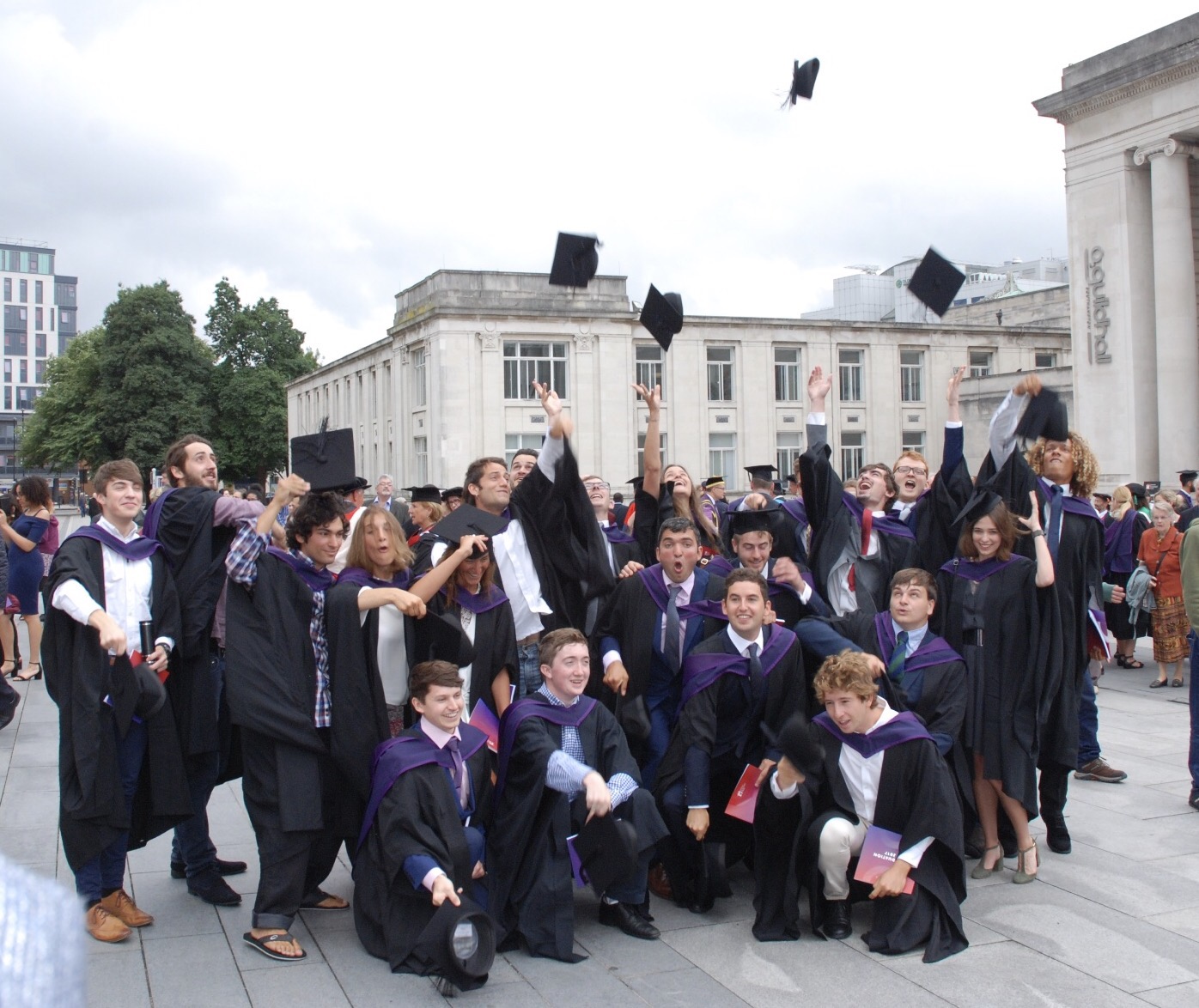
We are rapidly coming to the end of a very short but enjoyable trip home. We celebrated Ricks Mum’s 90th birthday on Saturday and Matt’s graduation on Tuesday. 

Well done to Matt and all his class mates

The decision to fly back to the UK was only taken a few weeks ago and we managed to keep it secret enough for the big ‘Ta Da’ entrance at Rick’s Mum’s party. But our presence was a close run thing.

Never again will we transit through the US. Our first hurdle came when we discovered that even to pass through the airport we needed an electronic visa. The process of application for the both of us took us about 21/2 hrs, that was 15mins longer than we were actually in the country. This short transit time was set out by the airline itinerary, we assumed it would be ok. Had we known that the US has no international transit system we would have thought again. It took us over an hour just in the immigration queue, we ran to the baggage reclaim, picked up our luggage and sprinted to the next queue, customs check, another mad dash and we were in the queue for the lifts, then with one final spurt we arrived puffing and stressed at the British Airways check-in desk 20mins before the plane was to take off and five minutes after the flight had closed. Lawrence at the desk worked wonders and with a few calls got us on to the flight. Our running however was not over as we then had to re-enter US customs with the enevitable queues and get to the gate. Flagged on by a BA member of staff we reached the plane a few minutes before take off. 

Unfortunately our luggage was not so lucky and didn’t make the flight, so another fretful night was spent imaging the big party entrance marred by us flouncing into the proceedings in our travelling clothes. But British Airways, efficient again, ensured our bags were couriered to us, they arrived just in time for a quick whisk over with the iron.

Ricks Mum was, of course, delighted and we had a lovely family day.

Nana gets some help blowing out the candles

Since then we have whizzed around the South East of England visiting family and a few friends. The warm and mostly sunny weather has been a real bonus, we haven’t been in the UK during summer for three years and we have enjoyed gardens in full bloom, green countryside and pleasant evenings taking advantage of the long hours of daylight.

There is always some new bit of technology that confuses us on our return, this time it was ‘caution’. Every now and again our hire car would announce ‘caution’, we couldn’t work out what was triggering it. Ten miles later ‘caution’, fives miles ‘caution’, twenty miles ‘caution’ , it became rather irritating and we assumed it must be being triggered by a proximity alarm, but there seemed to be no consistency. A few hundred miles later we finally worked it out, it was warning us as we approached speed cameras, ‘caution’ suddenly became our friend.

The ten days went very quickly and we are now heading for the airport, our waistlines larger and our luggage full of English tea, boat spares and new deck shoes. Although saying goodbye to everyone is always difficult, I’m glad to say the excitement of our trip through the Pacific is still fresh, we are looking forward to being back on board Raya and back out to the islands.

Friends in Vuda

Vuda Marina


Thursday 6th July 2017

We have found the best spot to pass the time of day in the marina is sitting at the outer table in the Boatshed Restaurant and Bar. Not only is the view great but there seems to be a permanent cooling breeze even when there isn’t a breath of air onboard Raya. In the evening as the marina is full of cruisers, here to reprovision or get repairs, the atmosphere is very sociable, from 5.30 onwards the Boatshed is again the place to be.

View from the Boatshed Bar

The cruising community in the Pacific is really quite small, so when fifty or so boats are all in one place we can pretty much guarantee there will be boats around that we know. Just in the last week in the marina or nearby we have bumped into friends from Full Circle that had greeted us as we were towed into Opua last October, kindly giving us some food after the New Zealand customs had stripped our larder bare. 

On the oppposite wall to us is Freebird II skippered by the engineer who helped fix our engine and having left Opua, the day before us, shares the experiences of the horrendous trip up to Savusavu. 

Yesterday, Started with a Kiss sailed in, our first contact with them was on the radio when we spotted each other mid passage between Bora Bora and Tonga and have kept in touch ever since. We spent a convivial few hours together in the Boatshed when they lured us into an evening of rather too many Mai Tais and today they have shared their anchoring waypoints for the Yasawa Islands, our next port of call. 

Finally, a few boats around from them is Taistealai who we haven’t seen since they arrived into the berth next to us in St Lucia in the Cartibean, eighteen months ago, having both just finished the Atlantic crossing.

We have also met a whole new group of boats, having been so tightly squeezed together it would be impossible not to make friends. To starboard there is a large yacht that helped guide us in to our tight berth, they have a three year old red head, as I glimpse him running back and forth I keep getting flashes of Matt at his age. On the other side of us is a boat from the World ARC, a rally that circumnavigates the globe in just 16 months. We had a very enjoyable evening with a group of them on Friday, their timetable takes them off to Vanuatu this Saturday, they will be in South Africa by Christmas, it’s exhausting just chatting with them.

Unusually alot of this chat has been about the unfortunate catalogue of medical problems that is besetting the crews at present. One person has been laid low with a horrible viral infection caught from a mosquito bite in Tonga, Dengue Fever. Another has a serious intestinal problem and is having to be flown out to New Zealand and yet another guy is in hospital with a badly broken leg having somehow fallen off the dock walkway into the water. The rustle of papers fills the marina as its occupants are prompted to check out that their medical insurance documents are in order.

Talking of insurance, Vuda is known as a cyclone safe haven. On the protected side of the island and with numerous cyclone pits many people persuade their insurance companies to allow them to keep their boats here during the summer instead of sailing to lower latitudes as we do.  The cyclone pits are long thin 6ft deep trenches cut into the ground, where wedged in with tyres, boats sit hoping for some protection from the violent winds. They have proved effective in the past but I’m not sure we would feel happy enough to leave Raya in one. We have met people who were here during Cyclone Winston, Vuda was not hit badly but nearly twenty yachts dragged on to the reef further east in Savusavu. One captain told us how he motored against 130kt winds and zero visibility for four hours to keep his boat from breaking away from its mooring. 

Cyclone pit


I think we’ll keep to our plan of spending the summer in Australia.

Fender to Fender

Thursday 29th June 2017

Getting on and off the boat from our stern-to berth at Vuda Marina is, to say the least, interesting and each yacht is squeezed in literally fender to fender. Our view from the stern is of a boatyard, we are less than a hundred metres from the noisy boat lift and a fuel depot sits just outside the perimeter. However, the place has a friendly, ramshackle feel, there are plenty of trees to cheer things up and the marina staff were welcoming and seem efficient, we rather like it it here.

We arrived in Vuda Marina yesterday after a nice couple of days in Musket Cove. Musket Cove Resort, famous for its annual September regatta and the warm welcome it offers to yachts all year around, is on an island in front of a basin surrounded by reefs. The channel in is narrow and busy with yachts, resort dive boats and ferries, for the first time in Fiji, our charts were a bit off but luckily it was well marked and the day was bright.

Musket Cove

We arrived to a calm blue sea, white sand cays and a sprinkling of superyachts, Rick even managed, at the poolside bistro, to find that elusive burger, we decided to stay a day or three. But as is the way with living on a boat, by mid afternoon a breeze had sprung up, the tide had come in and we were bouncing about in a short chop and thoughts of snorkelling, dingy safari’s or finally breaking out the new kayak were put aside. I did try swimming my six laps around the boat but with each breath came a wave and a mouthful of water.

With the forecast set for it to stay on the windy side, after two nights we sailed over to Vuda. As we motored into the circular Marina we were shocked when they directed us to the smallest of spaces, about to protest, we looked around to see every boat squashed in cheek by jowl. Rick did a brilliant job squeezing us in while I repeatedly ran from bow to stern passing lines to the dock boys. Just occasionally it would be good to have some crew!

Squashed in Fender to Fender

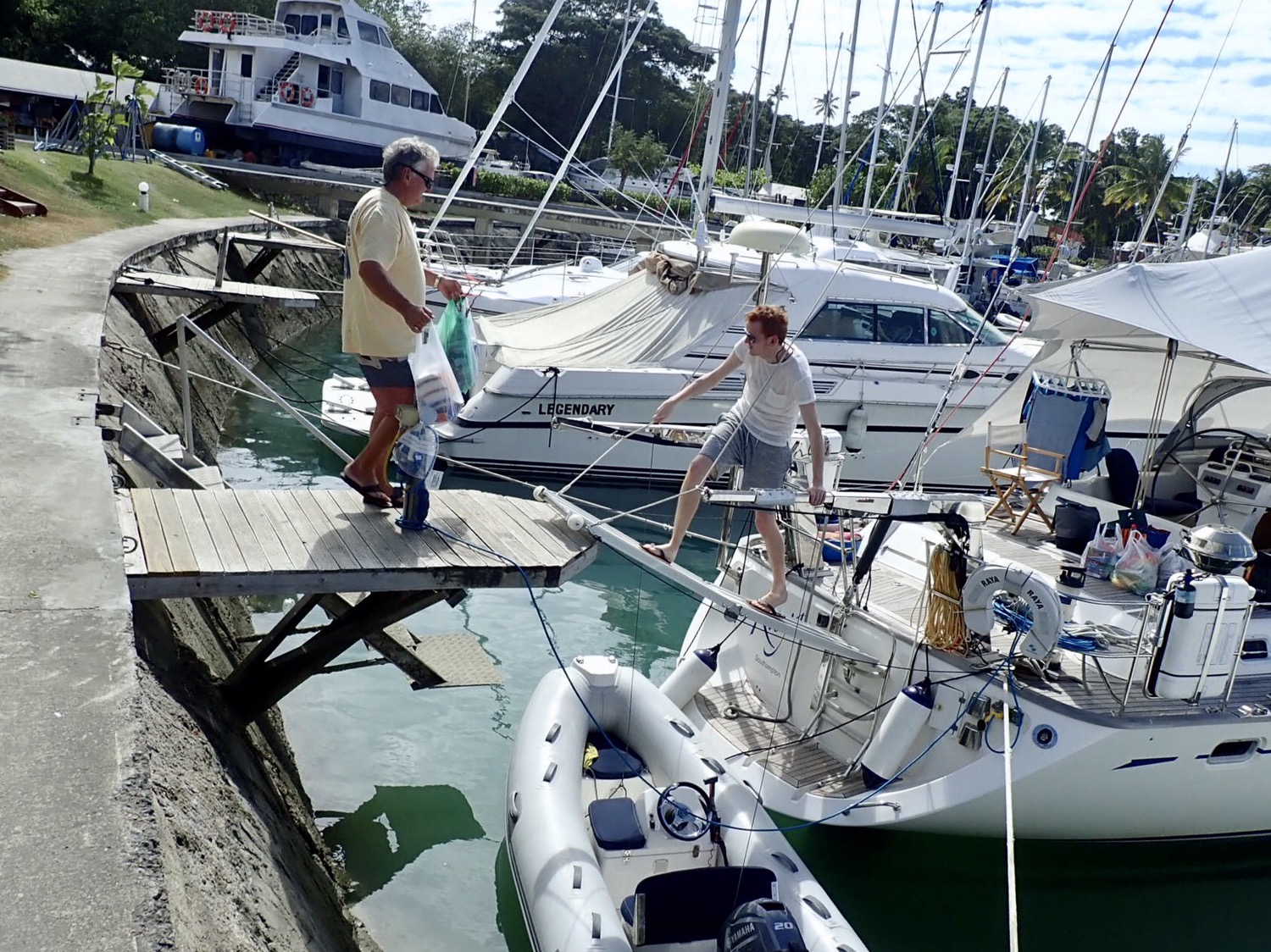
There is a two metre tide here and the dock is a concrete wall with a short, rickety wooden pier  built out to each berthing spot. Most boats are using the narrow marina planks to disembark, luckily we have our slightly wider passerelle but at very low tide that becomes too steep so we are using the dingy as a stepping stone to a ladder. 

Getting off the boat is a bit of a challenge

In fact being attached to a fixed dock with the rising and falling of the tide makes everything more complicated. It took a while to work out all the lines but we got there in the end and having rid ourselves of two weeks worth of rubbish and washed down the decks, things began to feel better. Next job is to figure out how to restock our supplies, then we will spend a couple of days getting a few maintanence jobs done.

But for now, it’s time for a cold beer, we are are off to investigate the bar.

Skirting the Reefs

Sunday 25th June 2017

We realised how fast we’d been sailing when we both noticed a drop in wind and speed, we looked up to discover we had only slowed to 7.5 kts, our normal cruising speed. For the previous two hours Raya had been comfortably sailing at over 9kts, in fact for a while we were gliding along at over 10 kts. As we entered the notorious wind acceleration zone that is created by the squash of air running between the two main islands of Fiji, the breeze that was at first struggling to fill our sails quickly increased to around 25kts. The area leading up to the narrow Vatu-Ra Channel and into Bligh water is surrounded by reef and so despite the increased wind the sea stayed relatively calm. We had found Raya’s sweet spot, a force 5/6 wind, hitting us at 110 degrees, in calm seas, fantastic sailing.

We had woken early for a prompt start for the 50nm from Makogai Island to Volivoli Bay on the NE corner of Vitu Levu. Unfortunatley it was pouring with rain and we sat in a dripping cockpit waiting for a break in the clouds. We had, as is our habit now, recorded our track on our entry in through the reef so the lack of light was not too much of a problem for our exit but we didn’t fancy sailing in the torrential downpour, we made a cup of tea. Finally a little after 8am the rain started to ease and we raised the anchor. Our late start luckily turned out not to be a problem, our high speeds soon made up for lost time and as we approached Nanano Passage the sun broke through spectacular clouds and the reef systems were easy to see. 

We had decided on this spot off Volivoli Point as our next stop because in the cruising guide it was revealed that the resort here was cruiser friendly and had the best cheese burgers in Fiji. Having been in small remote anchorages for quite a while now the promise of a cheese burger was embarrassingly exciting. Much to our disappointment burgers were no longer on the menu, in fact the food was a bit of a let down all round. However our surroundings more than made up for the lack of culinary excellence. The wind had dropped and the sea was still and shiny, like an oily soup, there were reefs to explore with our snorkels and in the distance the most spectacular backdrop of escarpments. As the sun moved and the shadows of a few clouds skidded across their surface, the colour and texture of the rock was set in constantly changing relief.

Anchored off Volivoli

We were gradually working our way to the West and a bit more civilisation, so this morning we took off again to wend our way through the reefs on the inner passage along the north coast. It was an interesting route, the arid hills backed by rugged mountains a complete contrast to the jungle covered slopes we were use to. The weather was very calm in the quiet between two weather systems, a haze lay around us and with perfectly flat seas produced a surreal and relaxing environment. But this was not a journey for napping, the route took us skirting past and around numerous submerged reef systems, concentration and frequent direction changes were the order of the day.

We are using a combination of things to navigate the reefs, firstly of course are our eyes, in good light with the sun behind you most shallows are easy to spot. Then of course we have our charts and they prove, most of the time, to be extremely accurate. But occasionally they can be a bit off, so as a check we also plot waypoints taken from other cruisers websites, such as the essential Pacific guide put together by SV Soggy Paws, official cruising guides and often just from friends that have been places before us. And this year we are also increasingly using Google Earth, the satellite pictures show reefs and shallows that are often difficult to see from sea level. 

Reefs around Volivoli showing up clearly on Google Earth but hardly visible at sea level.


Having safely negotiated the string of hazards along the north of the island we sailed on towards Lautoka. It became depressingly obvious that we were approaching more populated areas when the normal collection of leaves, branches and coconuts that float by us all the time, were now joined first by polystyrene take-out trays, then by old carrier bags and an assortment of colourful plastic waste. The traffic picked up as well, since we have left Savusavu a couple of weeks ago, except for the odd yacht or local longboat, we have hardly seen another boat. Lautoka docks were busy with tankers, ferries and tourist boats, we sailed on past and although quite crowded with yachts have found a peaceful anchorage for the night in Saweni Bay. More reefs tomorrow however, as we head for Musket Cove

South from Savusavu.

Thursday 22st June 2017

Undoubtably one of the loveliest parts of our life is waking continually to a different view. This morning we are anchored off Makogai Island in the middle of the Koro sea to the northeast of the main island of Fiji, Vitu Levu. My view is limited by the low cloud that is bringing us showers, but brightened by the arch of a complete bright rainbow bridging the main island and a small rocky outcrop.

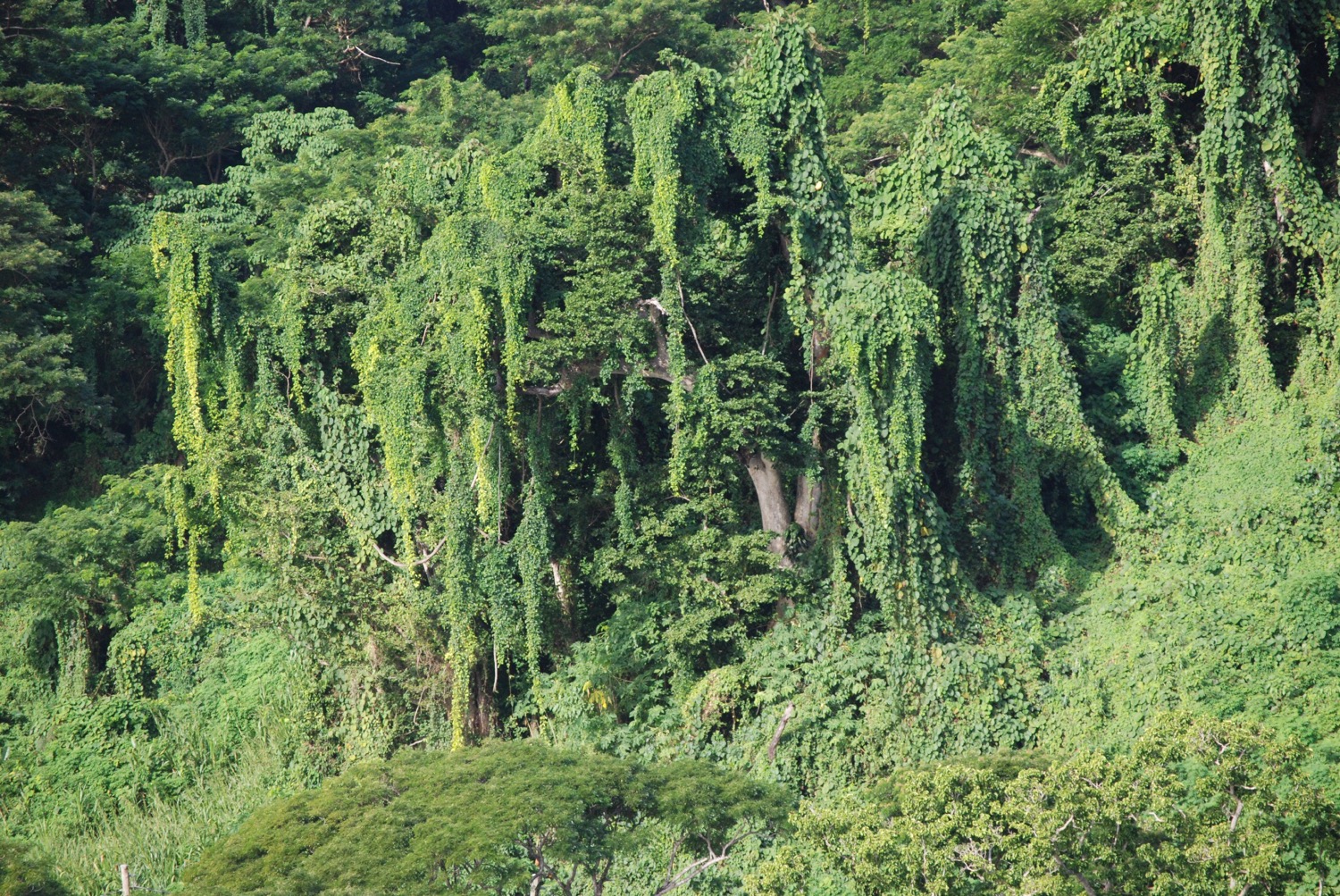
Last weekends view was very different, we sat just east of the Cousteau resort, about 3 miles out of Savusavu. A road lay between the narrow beach and the hills behind. Buses, trucks and taxis ran frequently out to the resort, the newly surfaced road crunching under their tyres. About three times a day we were surprised to see a small tanker that drove slowly past and, with what seemed like the Fijian equivalent to salting, sprayed the new surface with water. Dotted through the hill above the road were upmarket western style villas, with large verandas, cultivated gardens and four wheel drive cars tucked in the garages, above them, was woodland. One patch particularly fascinated us, a group of large trees were swamped with vines, these seem to have completely taken over the crowns and were draped and running off the branches. It made us think of bright greeen, melting ice cream cones
Vine covered trees looked like they were melting in the heat


Once we had sat out the high winds, Tuesday we ventured outside Savusavu Bay and sailed the 20nm to Namena island. Namena is a tiny island in the middle of a oblong lagoon edged with reef, it is a marine reserve and one of Fiji’s top diving spots. It was a fast broad reach, in a beam sea and we we’re looking forward to a smoother time once we got inside the pass but we were to be disappointed. The Fijian reefs systems all seem to be a couple of meters lower than the similar structures we encountered in French Polynesia, the consequence of which is that the ocean swell enters much more easily over top.  The lea of the island gave us some protection but with breaking waves, snorkelling and diving on the passes or reef walls was not going to be feasible.

We were relieved when we spotted the one mooring buoy in the bay, anchoring in the windy conditions with choppy waters in a sea bed littered with coral heads was not inviting. Just over a year ago this area of Fiji was right in the eye of Cyclone Winston and Namena Island was hit by winds of up to 145mph. Many trees were lost and still litter the island and the resort that perched on the hill above the beach was completely destroyed. The Island is now derserted, but our friends on Blowin Bubbles who are very keen divers were here a couple of weeks ago, had checked the mooring out, added new floats and given us its coordinates. 

The view from the cockpit was again different, a craggy limestone headland sits at the end of the otherwise palm covered island. There are reportedly 600 breeding red footed boobies nesting on Namena and we had a great time watching all the avian activity. We assumed the main flocks of birds were the boobies although we never spotted their red feet or their characteristic fish catching method of formation diving. In fact they didn’t seem to be feeding at all, all their time was spent with dramatic inflight dancing (flirting?) or protecting their nests from flocks of frigatebirds and a couple of very determined hawks.

Loved the dead tree, looking like it had been splattered onto the rock

In search of calmer waters we sailed on towards Makogai Island, with lessening winds our crossing was slower but very pleasant as we gently pushed further south. Makogai Island was also hit hard by Cyclone Winston and is still trying to recover. For nearly seventy years the island was used as a leper colony and people from all over the Pacific were sent here to be cared for by the nuns and priests that ran the hospital. The ruins of an obviously sophisticated settlement are scattered everywhere across the island, along with, we are told, an extremely poignant grave yard. More recently this bay at Dalice on the western side of the island has been taken over by the Fisheries Dept as a research and conservation centre. A lookout post was positioned on one of the highest hills for counting and cataloguing passing whales and in the bay was a large turtle and giant clam hatchery. Since Clyclone Winston these activities have been reduced to just one family, slowly, trying to restart the program. They kindly showed us the tanks containing hundreds of half inch long baby clams. In about six months time they will be big enough to be transferred to cages and put out into the bay and then eventually transplanted to marine reserves all around Fiji.

Sadly for now the only giant clam we saw was an empty shell, a meter across, sitting on the beach. The four clams that were reportedly on the bommie in the bay have all gone. They are a delicacy in Fiji and a giant clam can be worth thousands of dollars and in the hunger that followed the cyclone anything edible was no doubt fair game. The Goverment is beginning to rebuild the infrastructure at the site, so the tiny clams we saw today should have a more protected future.

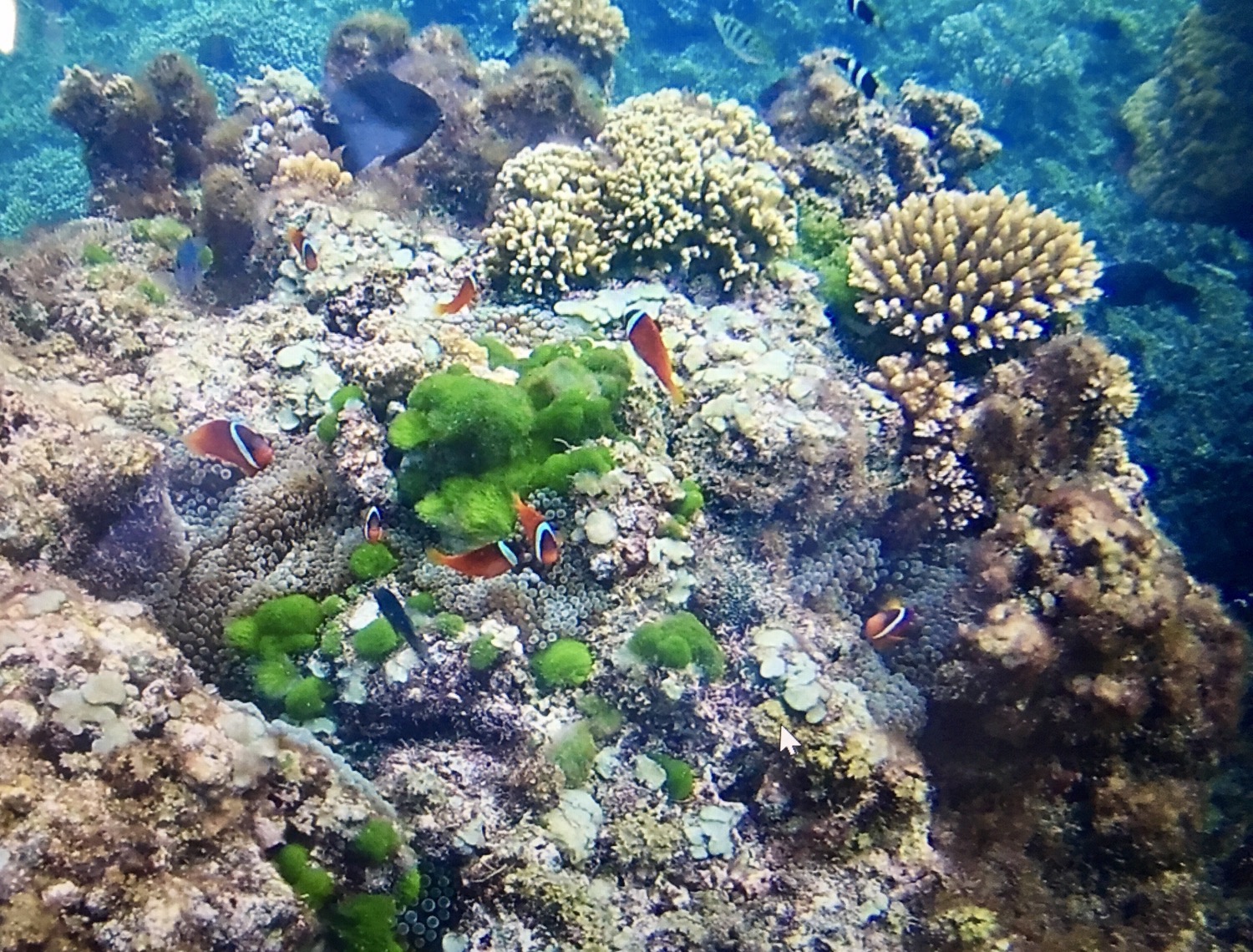
We may not of seen clams when we snorkelled in the bay but there was plenty of colourful reef fish including this clutch of anemone fish. 

Anemone fish off Makogai Island

Reality Check

Friday 16th June 2017

There was a particular moment last week that made us smile, a classic cruising moment. All around us was wonderful blue sea, palm trees, coral reefs and sunshine, however we were below. Having not been anywhere near a shop for over a week I was kneading dough to make some bread. I am doing this while straddling Rick who is prone on the kitchen floor, head deep inside the engine room. He is trying to fix a recalcitrant high pressure pump so we can make some water. There is a rich odour wafting from a large bowl of rotting food waste waiting to be donated to the local pig, a long list of waypoints for our next reef strewn trip sit waiting to be plotted onto a chart and on deck is a mountain of towels and swimwear refusing to dry in the 85% humidity. It may seem like we spend our time in the islands drifting from one idyllic spot to another but this life is often quite challenging.

Sunday having spent the night anchored in Buca Bay, we took Penny and Stephen ashore to meet their taxi, luckily we had gone in plenty of time – no taxi had been ordered. Frantic discussions ensued as another car was cajoled into the four hour return trip to Labassa. As we waited anxiously the quiet dock began to fill up, car loads of people also with suitcases joined us, then two jam packed busses arrived, the chaotic scene added to the tension. Then a large boat appeared in the distance, suddenly the reason for all this activity became clear, it was the scheduled ferry to Taveuni. Finally a car, of slightly dubious road worthiness, but willing to do the trip to the airport, made its way through the crowds. We waved a fond fairwell, slightly worried that the car wouldn’t make it up the first hill, little alone all the way to Lambassa. Happily our concerns were unfounded, they made their flight in one piece and with time to spare.

Penny and Stephen’s last sail

Back on Raya we still had a couple of problems to sort out, the most serious of these was the problem with the high pressure pump for the water maker, which was refusing to start. Having no water maker serverly curtails our indepence from marinas and the small towns around the coast, we made the decision to return to Savusavu. We followed our track back through the reefs and into Viani Bay for the night, once anchored Rick took one more look at the pump and there it was, a broken wire on the starter capacitor, easy to fix, we were back in business.

However, a return to Savuavu had a few other atractions. Not least the ability to rid ourselves of nearly two weeks worth of rubbish. Rubbish continues to be a big issue onboard, even with the care we take to unpackage everything, it still builds up depressingly quickly. The only answer is to store it until we reach a large enough town that we feel will dispose of it responsibly. On top of that we were also low on fresh provisions and the calm of the harbour would be an easier place for Rick to work on the boat. So the next morning we headed west and with SE winds were rewarded with a great sail back to Passage Point and Savusavu.

As we left a chilly New Zealand our water temperature read out suddenly informed us that the sea was a balmy 30C, we had bigger things on our mind at the time and forgot about it. Then a couple of weeks ago the log packed up. The log is on the same transducer as the water temperature and is basically a small paddle wheel that sticks out through the hull. The rate at which it spins gives us our speed through the water, clocks up the miles we have done and is the core information that the instruments use to calculate true wind speed and direction. None of this is vital, it is good practice to sail with just apparent wind readouts from the wind vane and the GPS gives us speed over the ground but still it would be good to get it fixed. After much analysis by Rick and a conversation with Andy from Green and Regis, our instrument people in Southampton, Rick has rigged an ingenious fix. This involves using a LED bulb as a makeshift resistor that fools the unit into thinking the water thermometer is working and switches back on the readings from the log. A good example of making use of the finite things we have onboard.

Alternative use of an LED bulb

As we approached Savusavu we could see crowds of masts, it is now well into the Fiji cruising season and the area is very full. We opted to anchor just outside the entrance to Nakama Creek, still within easy dingy distance of town but with the added bonus of catching more of the cooling breeze. On Thursday afternoon we watched as another 56 sailed in, unfortunatley the normal Oyster welcome was rather subdued, onboard they had a devastated couple they had rescued from their sinking boat. The yacht had hit a reef the day before and despite being successfully refloated by nearby cruisers and a dive boat, that night they began taking on water that they couldn’t control and they had to watch as their home and all their belongings slowly sank beneath the waves. A sobering reminder to the rest of us of how careful we have to be.

Busy Savusavu


Albert Cove

Sunday 11th June 2017

In the North East corner of Fiji lies the small Island of Rabi, Thursday afternoon we anchored on its northern shore in Albert Cove. The population of Rabi are not Fijian but Micronesians, originally from the Island of Banaba, a tiny speck in the Pacific Ocean near the equator and part of the Republic of Kiribati. Banaba came to the notice of the British Pacific Island Company at the end of the 19th century for its rich reserves of phosphate, over the next 40 years they gradually, with very little recompense to the locals, stripped most of the island bare. After further devastation caused by Japanese occupation during the Second World War the British bought Rabi Island with the Islanders Provident Fund set up for to receive phosphate royalties and moved the majority of the population to Fiji. Rabi is a beautiful and fertile land but not the home of these displaced people.

Albert Cove


We learn their society is run by elders and everybody acts together as a community, sharing childcare and food production. Albert cove has just three or four simple shacks. Members of the village on the western shore appeared to rotate their occupancy of the land around this bay to create an income from harvesting copra (dried coconut meat) for the production of coconut oil and growing Kava, a root with slight intoxicating properties, to sell to the Fijians. 

As we carefully wound our way around the coral reefs into the bay we first spotted Baea fishing the shallows with a large net. In Fiji the owners of the land also own the beach and the fishing areas around that land, it is therefore appropriate, in the more remote spots, to ask permission to anchor, explore the beach and swim in the sea. Tradition requires the presentation of a gift or to use the Fijian, sevusevu. This is normally a small amount of Kava root that is ground and prepared for a ceremonial drink. We had been told that the people of Rabi not being Fijian did not partake in sevusevu, so we went ashore instead armed with biscuits, Coke and Kitkats. Baea and her family were very friendly and she spoke good English, her husband cut coconuts for us to drink from and we chatted for a while. We, rather abashed, as they explained their history and the arrogant actions of our forefathers, they aghast, when asked how many people lived in our village, by the the concept of the millions of people living in London and fascinated by Penny’s status as a career woman. Further along the beach was Monique and her friend, cousins of Baer but much younger and after a polite introduction came an embarrassed request to charge her and her friends phone, having collected one from Baer too, we returned to the boat free to roam the bay.

Baea and Monique pose for a photo


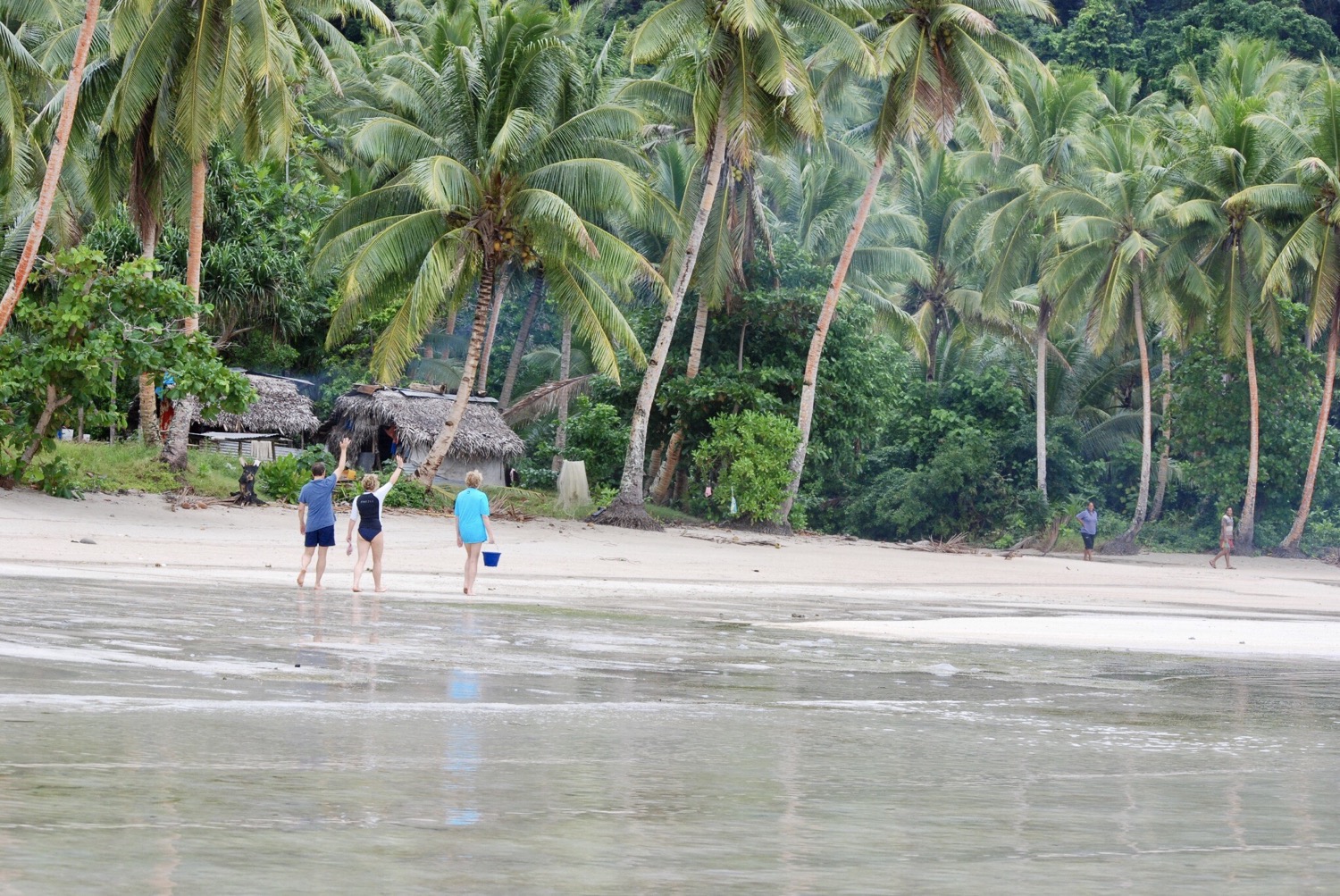
Albert Cove is a piece of paradise, a long curve of white sand, edged with palm trees, mangroves and Futu trees, also called the  poison fish tree, it’s pretty flowers belie the dangers of the highly poisonous seeds that are contained within large box shaped pods. Beyond the beach area were high jungle covered hills and out to sea a double line of reefs lay under the bright blue water. The reefs not only made for good snorkelling but meant the bay was well protected from the ocean swell.

The next day we returned to the beach with the phones, it was a bit of a mystery as to their use, as the bay had not even a sniff of a signal. More immediately useful for us, and them, was the large bucket of food waste we bought ashore for the very grateful family pigs.

Food for the pigs


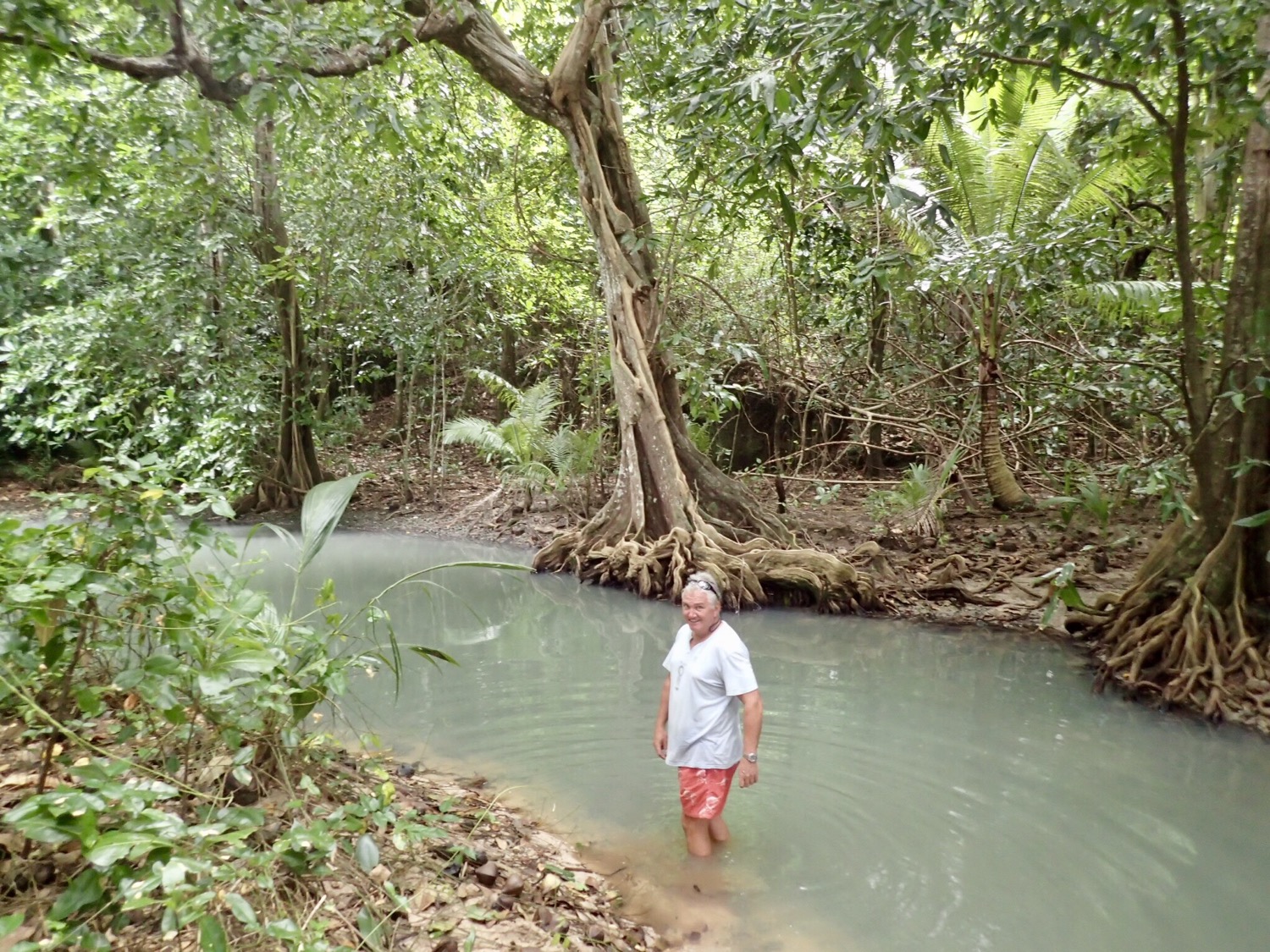
Baea had told us that an English man who had married a local girl had built a small house on the far end of the beach, now very old he had not visited for a while but the house was still perched on the rocks behind the trees. At high tide, so we could get over the encircling coral we landed the dingy on the beach. With our adventurers hats on, we scrambled through the trees to discover a fresh water pool, magnificent Banyan trees and high up a cliff, nearly engulfed by the undergrowth, a small blue hut. Just yards from the beach the atmosphere of the shady clearing felt very different, cooler, the colours muted compared to the brightness outside and slightly spooky, we didn’t linger too long and never discovered how anyone could have actually reached the hut.

Incredible roots of the Banyan trees.


Saturday morning as we slowly prepared to up anchor a longboat came around the corner to pick up Baer, her husband and friend and return them to the village. Their two small very pink pigs were scooped up and dumped squealing into the boat and they motored out of the bay. About an hour later a group of three young men armed only with a large bag of bananas came to take their place.

As news of more terrorist atrocities and the political chaos caused by yet another controversial U.K. election filtered its way to us through our satellite connection it was humbling to watch theses happy, generous people, living such peaceful and simple lives.

Sun setting over the distant hills of Vanua Levu

Cabbages on Rainbow Reef

Raya anchored in Viani Bay

Wednesday 7th June 2017
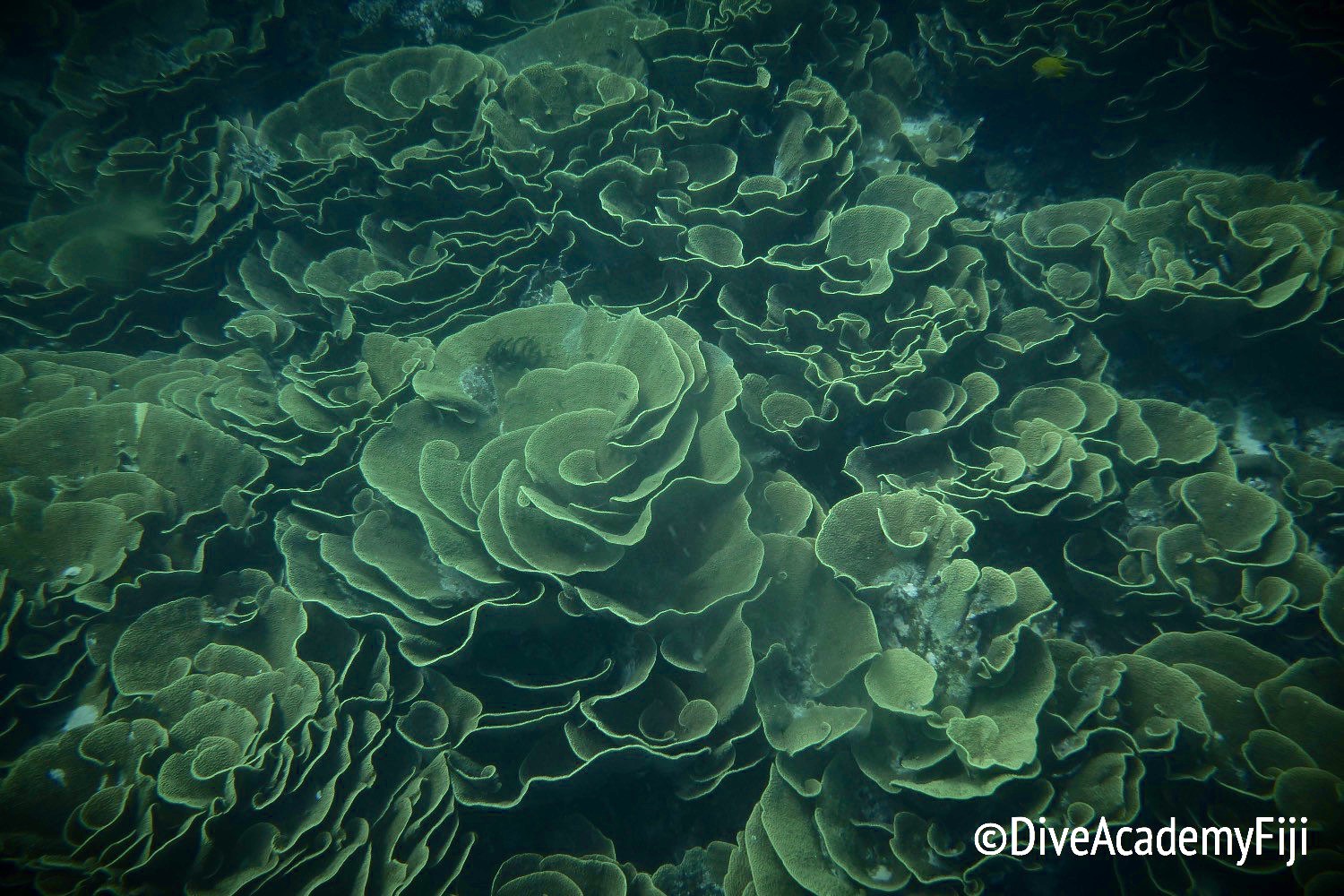
Sometimes you come across a sight in life that’s totally unexpected and unique. Although the name should have prepared us, the reef called the cabbage patch is astonishing, the coral here really does grow in formations that look like giant cabbages, none of us had ever seen anything like it. With no camera to take diving deeper than 15m we took no photos, but this was a sight that needs to be seen to be believed, the picture below comes cutesy of the http://www.diveacademyfiji.com

Cabbage Coral


With what appears to be a sparsely inhabited shore, Viani Bay surprisingly, is home to over 150 people. Fifty of these are children so the bay has its very own school. Each morning a couple of the narrow longboats they use here for everything from ferries to fishing, turn into the school bus and go around picking the youngsters up and dropping them on the beach in front of the school ready for assembly, the sound of fifty young voices joined in song drift across to the bay.

Beach at Viani Bay

Next to the school, hidden between the trees, is the Dive Academy of Fiji, run by the very friendly and experienced couple Marina and Jonnie. They invited us in for tea and biscuits as we discussed the options for diving the world famous Rainbow Reef. Having been sorely tempted to join the morning Manta Ray dive, we instead opted for two coral and reef fish dives in the afternoon.  The coral here although bashed by Cyclone Winston just over a year ago is recovering well. Marina came out to Raya to pick us up and our first dive, at Nuku reef, was on a gentle drop off. With a perfusion of varied hard and soft corals it was surrounded by countless reef fish. Shoals of small blue damsel fish, colourful inch wide angel fish and myriad other tiny species crowd the coral heads. Parrot fish, squirrel fish and picture perfect butterfly fish dart in and out of the crevices, a metre long trumpet fish hangs vertically above us, a grumpy titan trigger fish guards his patch and a couple of sharks linger lazily in the blue.

After an hour of surface time, spent again drinking tea in the dive shack, we went for our dive on the cabbage patch. We descended on to a similar scene to our first dive, highlighted by the appearance of a turtle, then Marina led us around a bend to the amazing sight of the cabbage patch itself. Each coral head is about a metre wide and the patch stretched out of sight in each direction. Again smothered in fish, larger species patrolled the top while the smaller ones live within the folds of the cabbages. Despite the lack of light from a dismal cloudy sky and the pressures on our aging ears, it had been a great afternoon.

The next morning we upped anchor and wound our way inside the reef system to Buca Bay. Described in the cruising guides as having two wharfs and a road, we are informed it makes a perfect place to pick up or put down crew. It also added that there was little or no chance for reprovisioning but oddly there was an opportunity to buy an ice cream. Sailing back to Savusavu would waste a precious day of Penny and Stephens time, so we sailed into the bay to investigate. With little signs of life, a small group of houses stood at the head of the bay and a few bigger buildings sat on the southern edge of the deep inlet, the expected wharfs from the boat appeared to have crumbled to piles of sticks and rubble. The water was a dark green and full of flotsam, we slowly entered the bay dodging large branches and coconuts, are hopes weren’t high. 

We dropped the anchor and Rick and Stephen took the dingy to investigate further, as is often the case, hidden behind the trees was a whole community. Besides the road connections to the rest of the island, there was an Adventist school, a small hospital and a tiny shop. There was one serviceable dock and an easy beach landing, the shopkeeper could organise taxis to the airport and although the shop had no fresh food it did sell delicious ice creams.

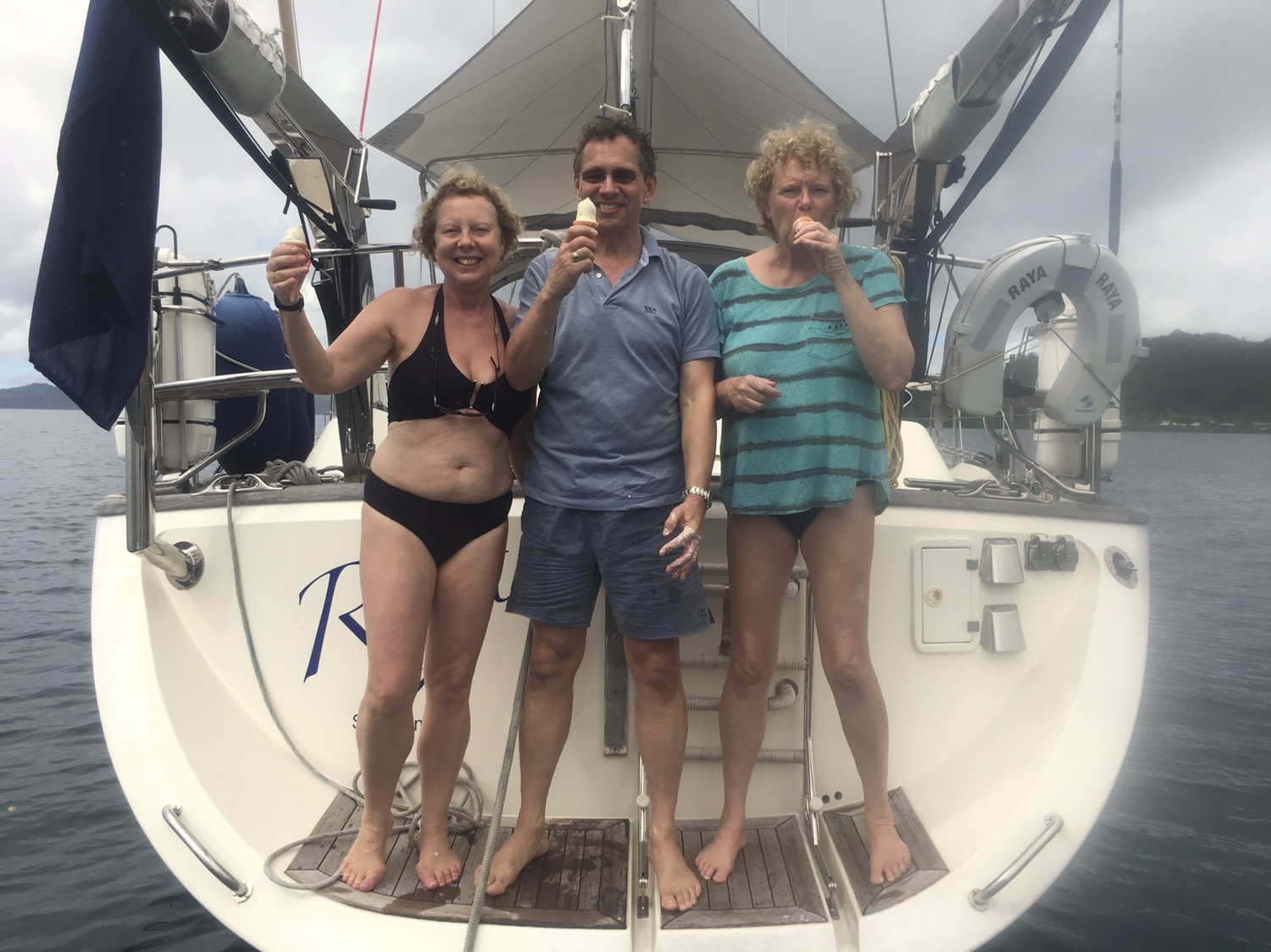
Banished to the swim deck to eat very melts ice creams.

Happy we could drop our guests here for their departure on Sunday we motored across to the northern coast of Kioa Island. A beautiful deserted spot and with the sun finally out, the beaches shone, the trees were a brilliant green and the sea was a vivid royal blue. We put on our snorkelling gear and went off to explore the encircling reef. Again the coral was healthy and the fish plentiful and diverse, unfortunately we also spotted half a dozen Crown of Thornes a distructive and invasive species of star fish. With no real means of removing them to be destroyed on land we sadly had to leave them where they were. 

It was a fine evening, we drank a gin and tonic and watched the sun dip below the hills of the mainland, a few minutes later the sky was washed in the palest pink, a soft breeze brushed the decks. Life felt good.

Back in Silky Warm Water

Sunday 4th June 2017

The rising sun pops out above the surrounding high hills and the anchorage at Viani Bay is suddenly bathed in sunlight. With not even a whisper of wind the dark, silky water reflects the hills, the only ripples are created by the occasional local small motor boat passing in the distance. The misty silhouette of Taveuni Island dominates the horizon, bird song drifts over from the wooded rim of the bay, a crowing cockerel, chatter and laugher reaches us from the village. It is so good to be back to our Pacific idyll.

Early morning in Viani Bay


With the fridge struggling to cope with copious mounds of spinach, lettuce and tomatoes, the freezer topped up with steak, chicken and tuna and the fruit bowls bursting with pineapples, manderines and coconuts, we headed out of the marina a few miles down the coast to an anchorage off the Michelle Cousteau (son of Jacques) Resort.

Despite all this food onboard, we decided to spoil ourselves and take lunch at the resort restaurant. As they were only 50% full they were happy to let outsiders in, the service was friendly, with nice but pricey food and the best Mojitos we have had since Panama.

Out for lunch at the Michelle Cousteau Resort

 Out of the marina we delighted in being able to just flop off the back of the boat into the fabulous warm water. Things got even better when we discovered some nice snorkelling a couple of hundred metres away. Split Rock was as discribed, a large coral bommie carved in two by a deep gulley. Hundreds of reef fish crowded around the surprisingly healthy coral, including two large Clown Fish diligently guarding their Sea Anemone, a couple of bright turquoise and pink Parrot Fish and a large shoal of stripy Sergeant Majors. We had bought some stale bread with us which created a feeding frenzy, so many fish So close was quite scary especially when they started nipping at us instead of the bread.

Feeding the Sergeant Major Fish

The prevailing winds over Fiji are the SE trades, so travelling south or east has to be timed carefully. Saturday the winds were forecast to be extremely light with calm sea, so at 7am we set off for the 46nm due east to Viani Bay. With what little wind there was directly on the nose, this was always going to be a motor sail but the engine and the early start ensured we reached the pass into the bay with the sun high in the sky. Moonshadow were conveniently an hour ahead of us which meant we could watch their path through the reefs into the bay and confirm our route in.

Anchor safely down we swam and relaxed, thumbs up for Fiji so far. 

Too Hot

Wednesday 31st May 2017

Raya tied up at the Copra Shed Marina


It may seem churlish to complain but ITS TOO HOT! After seven months out of the tropics it is taking us a few days to acclimatise. With high humidity and temperatures around 30 C every small amount of effort brings us out into a sweat and sleeping is difficult. The Copra Shed Marina is half a mile up Namaka Creek and right in the middle of Savusavu town, so its not the best place to swim, emergency cooling down is achieved by driving the dingy ten minutes out into the bay and jumping into the water.

Cooling off with a beer


Our first job, once the customs formalities were completed, was to clean up the boat. The decks and fittings have been liberally hosed down, four bags of washing have been processed for me at the marina laundry and the new washing machine onboard has done a good job with all our jumpers and winter clothes, that are now, along with the heavy weight quilts, packed away in deep storage. And the cabins and salon are almost neat and tidy, ready for Penny and Stephen who arrive today. In between times we have been enjoying the company of John and Deb from Moonshadow, who are tied up next to us, with the odd drink, excursions to the excellent local chinese restaurant and swims in the bay.

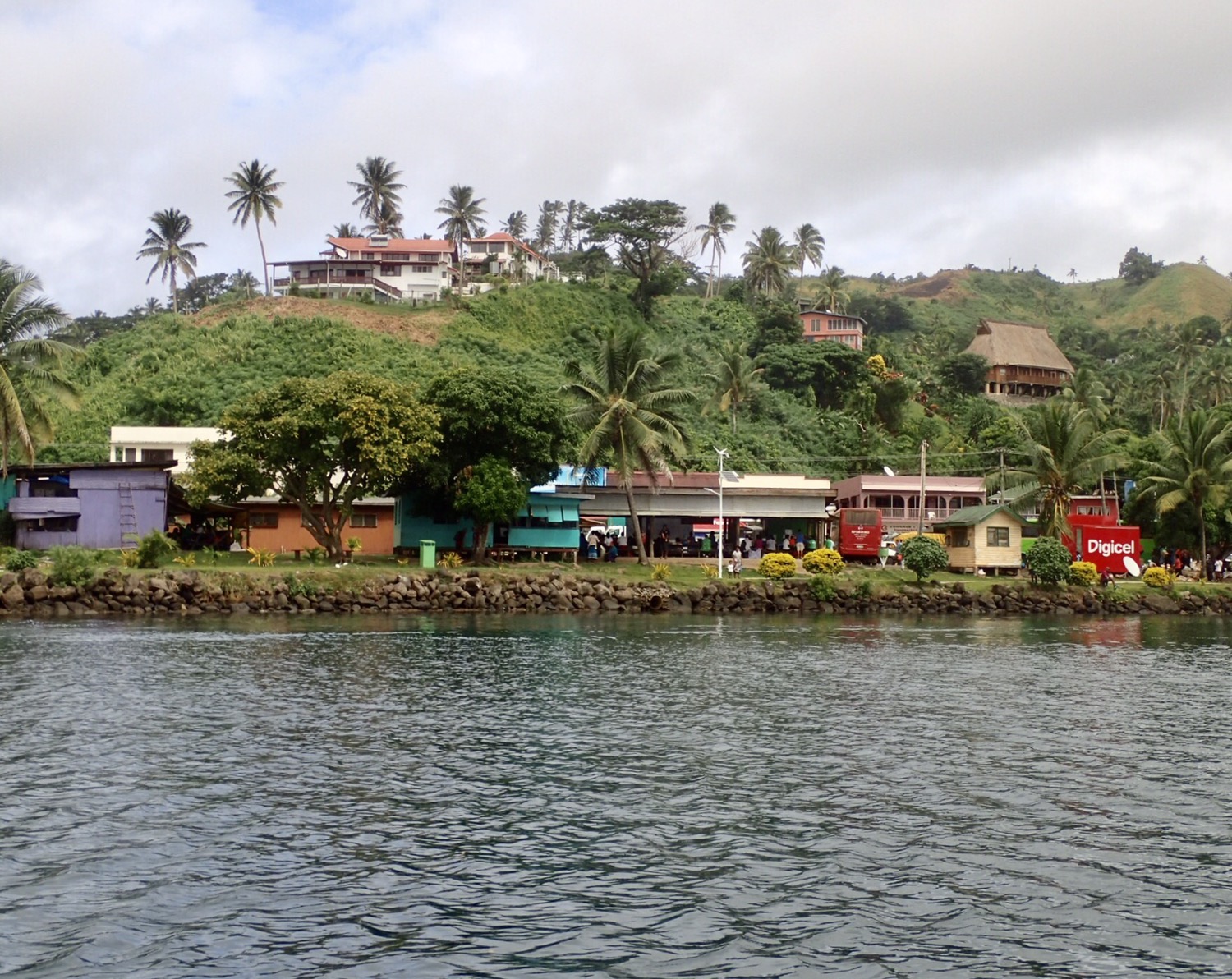
Savusavu is quite a large town by Pacific Island standards and besides the Chinese there are another half dozen restaurants and plenty of shops. The town lies almost exclusively on one street that runs parallel to the creek, a line of colourful but ramshackle buildings. 

Savusavu photographed from the creek

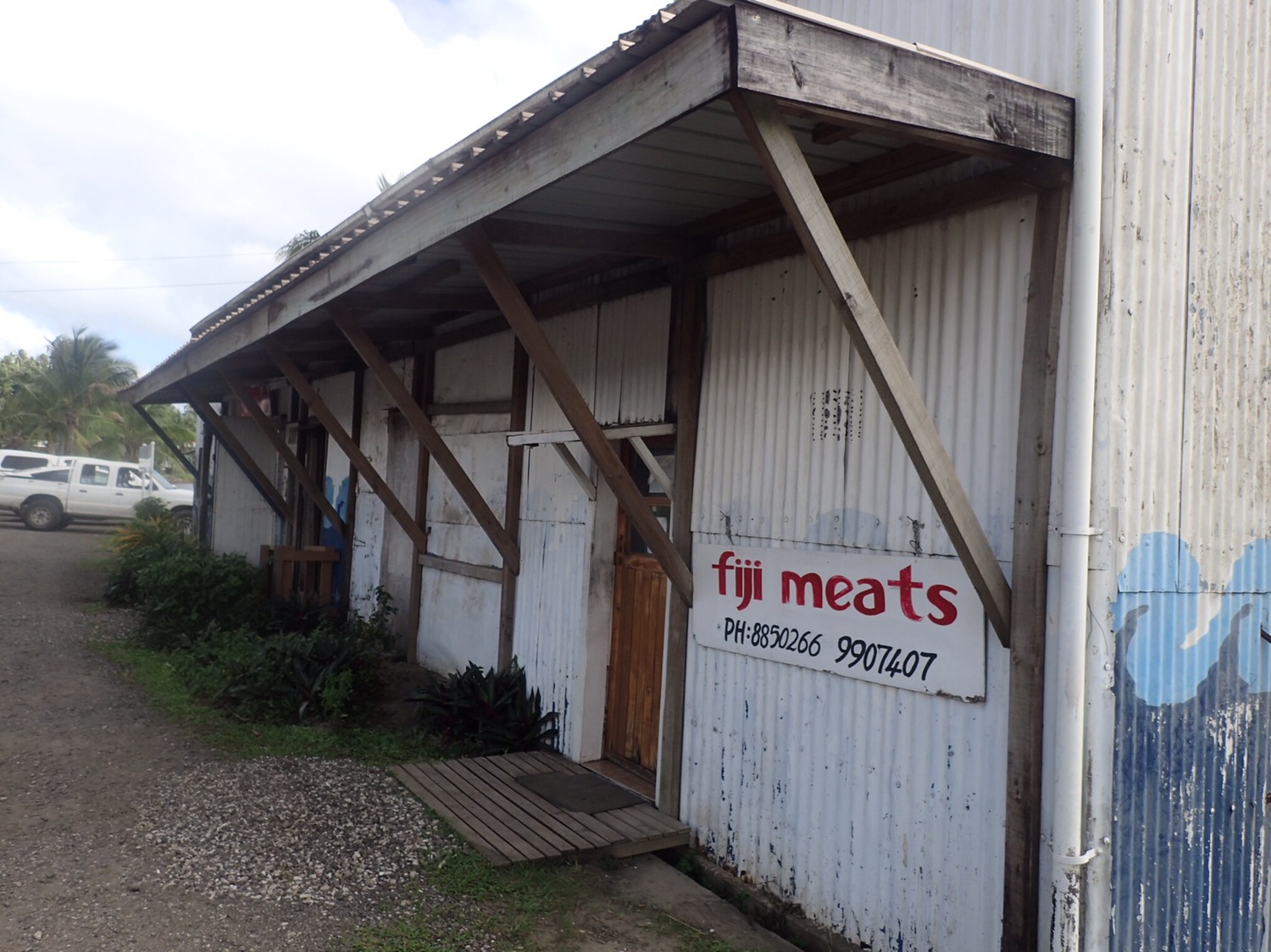
There are few purpose built structures, everything from the customs office to the bus station to tiny, scruffy electrical stores are elbowed into whatever space is available. There is a large fruit and veg market that looks pretty good, there are a couple of supermarkets that aren’t badly stocked and we have found the ‘it’s better on the inside’ meat store that friends on Kinabalu told us about in Opua.  It has taken us a day or two to get out of the everything always available mindset that we had in New Zealand and back to the buying what you can when you see it statergy, that works best here. With a bit of flexibility provisioning for four people for two weeks shouldn’t be too much of a challenge.

Luckily we were told in advance that despite appearances the meat here was very good.

We should get our cruising permit signed and sealed this morning, so once Penny and Stephen arrive we shall head out. First stop just a few miles down the coast but with clean water and a snorkelling reef I’m sure that the heat will be more easily endured.

Safely in Savusavu

Friday 26th May 2017

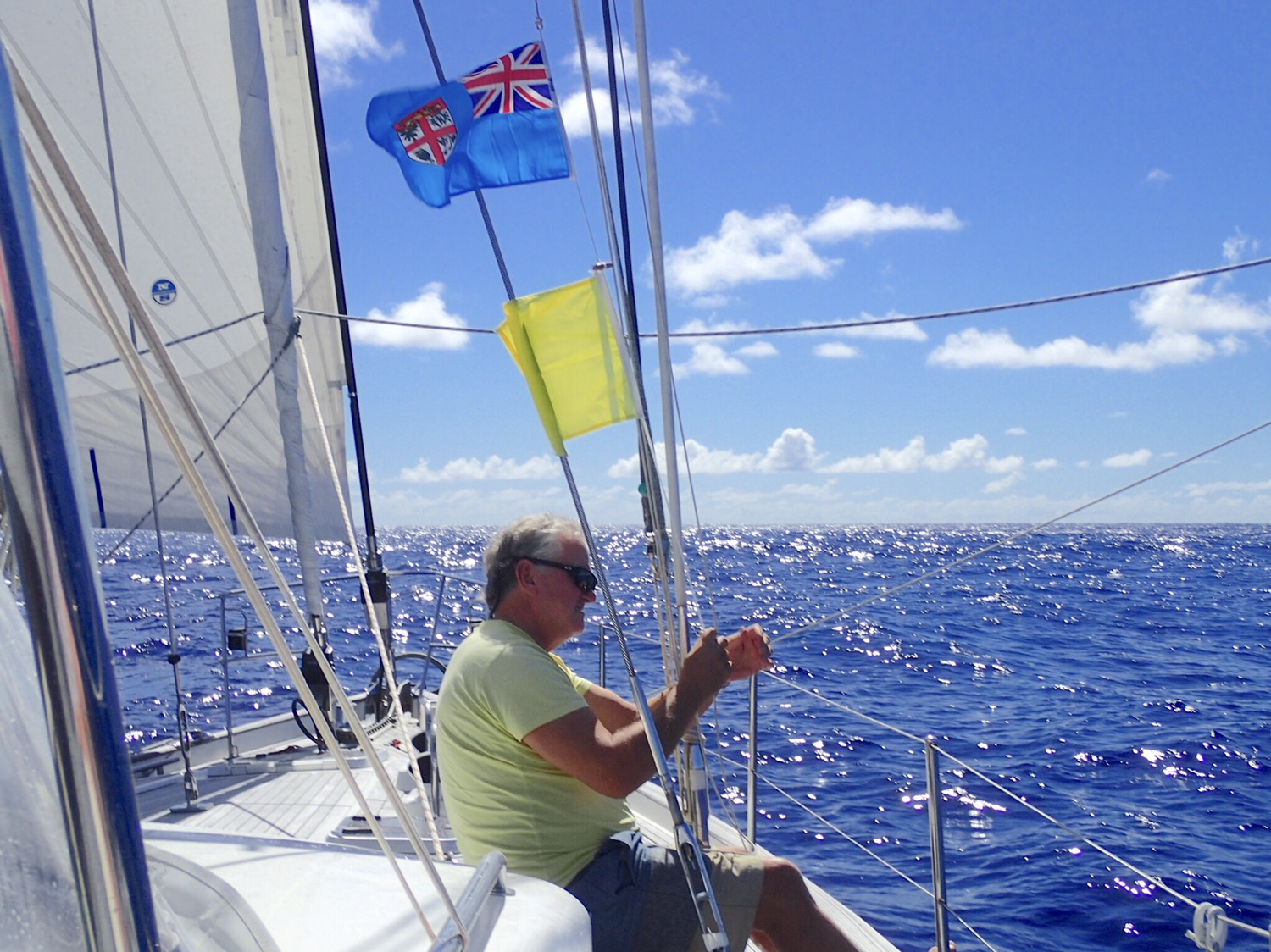
Raising the curtesy and quarantine flags as we enter Fijian waters.

Thursday as we neared Fiji, the stormy weather of the past five days had gradually disappeared and was thankfully replaced by rapidly calming seas and light breezes. As we finally relaxed the evidence of what we had been through lay all around us. Every inch above deck was encrusted with salt, damp wet weather gear hung from hooks and door knobs in both heads, one shower contained a pile of soggy clothes, the seats in the salon were a makeshift bed, general untidyness filled every corner. I had the odd bruise and bizarre muscle strains under my armpits where I had been hauling myself up and around with the handrails, Rick battled with a ‘too much stugeron’ headache.

In less than a day we had gone from putting our heads above the sprayhood to be blasted by spray filled cold air and risking a wave straight in our faces, to the delightful feeling of soft warm tropical air, from wearing two or three layers of clothing under our wet weather gear, to wearing shorts and applying sun cream and from having trouble getting any food down at all to enjoying a delicious lamb curry. Having spent most of the passage with extremely reefed sails, for over a day we had sailed with less than half a main and part of the staysail, now with every scrap of canvas out, we struggled to reach 5 kts and the engine had to come on. With delight we spotted our first sight of land the most southerly island in Fiji, Matuku, all was well.

Land Ahoy – Matuku Island

As dawn approached on Friday we were just 20nm from Savusavu, during the night we had seen our first boats in six days, a couple of fishing vessels passed us by, one a little too close, coming straight for us, at about 100m Rick spotted the whole crew waving hello from the deck. Then two more AIS targets appeared on the chartplotter, they were two boats we knew well. After sailing over 1150nm and leaving Opua 48hrs apart from each other we were converging on Point Passage, the pass through the reef into Savusavu Bay, within the same half hour.

By 9.30 we were all tied up to the dock in the Copra Shed Marina and after the initial euphoria of arriving, swapping tales of 60kt gusts, gigantic waves and how fast you can go with just a handkerchief aloft, and of course, drinking a very well deserved got here beer, we were ready to drop into our wonderfully still beds. 

Alas, formalities still had to be completed. Officials from four departments, Customs, Immigration, Biosecurity and Health took it in turns to file onboard to fill a myriad of forms and inspect the boat. If that wasn’t enough we then had to traipse around town to three different offices, paying fees and collecting our passports. In our tired state and swaying from land sickness, in temperatures of over 30 C, we hardly noticed the town around us but it definitly feels friendly and welcoming, plenty of time to explore, when we’re rested.

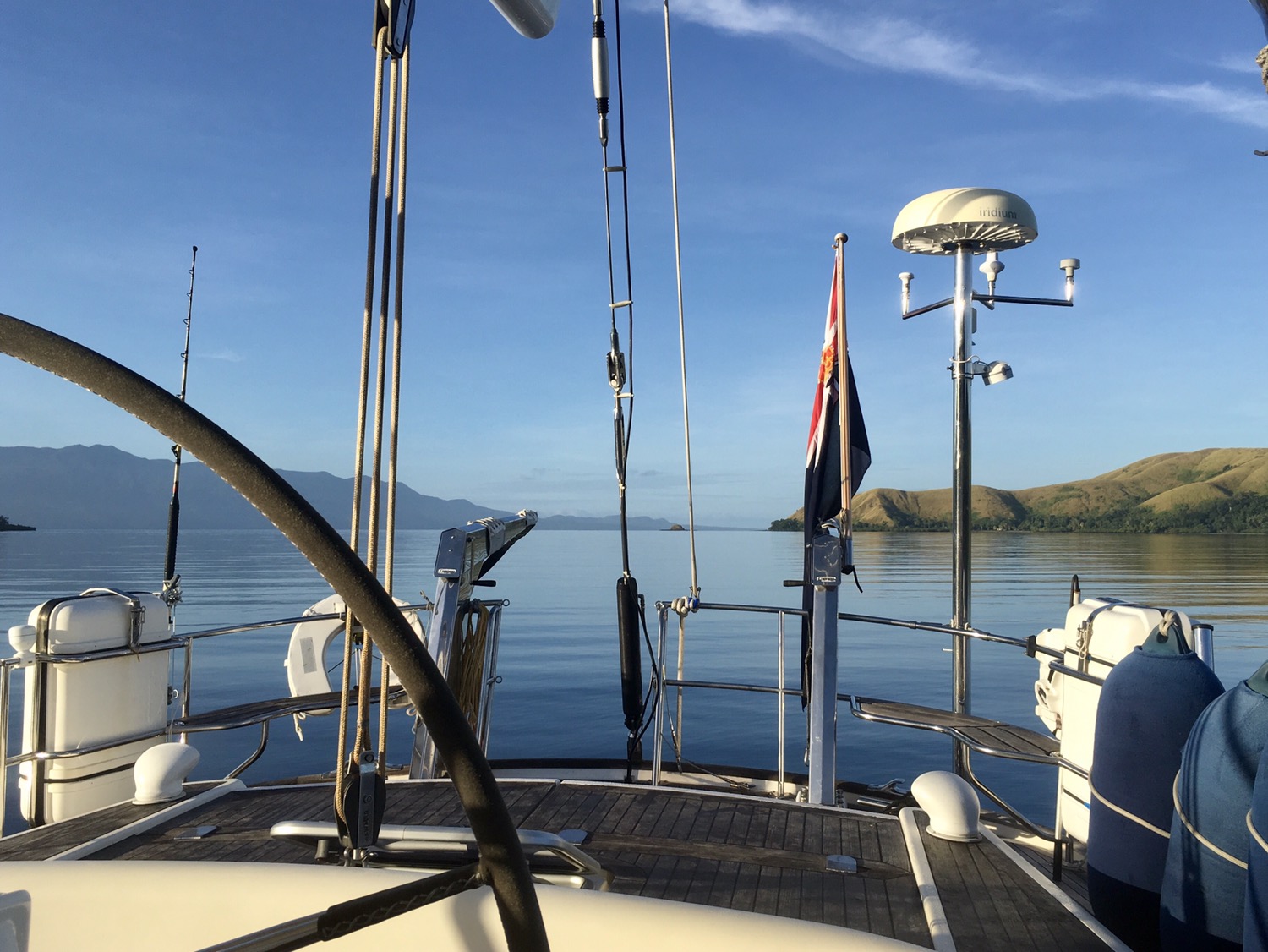
Early morning view from the cockpit


Ricky Puts His Shorts On – Finally

Wednesday 24th May 2017

As I picked myself off the salon floor, made slippery by our sodden boots and lethal by the heavy seas, I felt I had hit, literally and metaphorically, a low point in this passage. We were both very tired, it has been a rough, grey and wet crossing, For a few moments I indulged in a wave of self pity, but it’s just us out here, no other option than to keep going, so we try to smile for each other and get on with whatever has to be done to get us to Fiji.

Rick securing the pole
We finally left New Zealand on Friday. All that week the forecasts swayed from good to bad and back again, each day the decisions onboard each boat swayed too and fro. It started to become apparent to us that there was never going to be a perfect time to leave. We took the decision at the very last minute as we walked to the customs office, swaying from cancelling our appointment, checking out, cancelling our appointment or checking out? We checked out, they are very strict in New Zealand, once you have your exit stamp, that’s it, no turning back.

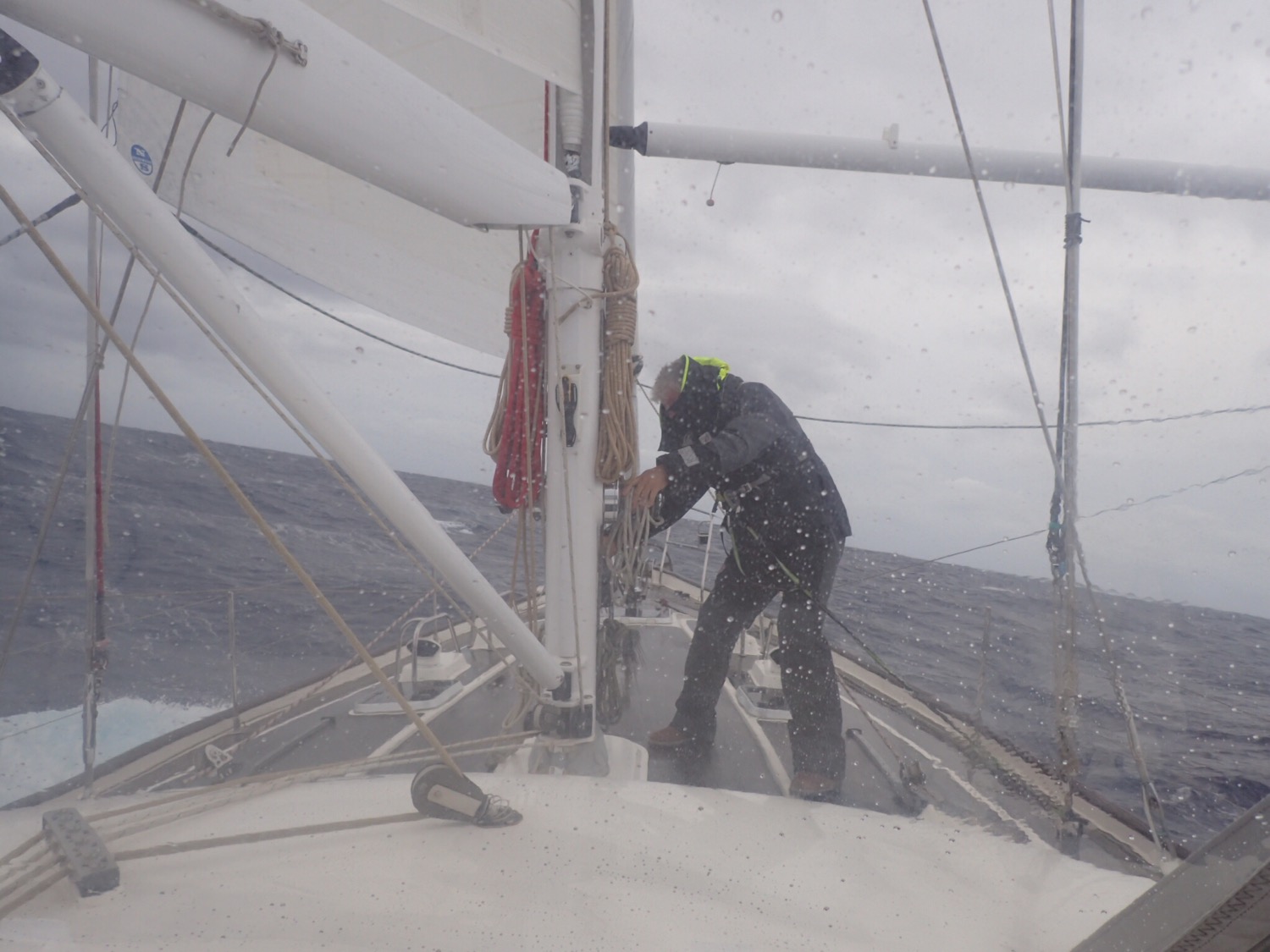
Now we are hopefully through the worst of the passage it definitely feels like the right decision, the prospect of a Mojito in the Copra Shed Marina Bar in Savusavu, Friday night, encouraging us onward. There were times in the last couple of days  however, when the boredom, indecision and chilly weather of the last few weeks in Opua seemed like a luxury. Almost from the outset we have had messy seas and as the winds built to a steady 30+ knots the waves grew bigger and came round onto our beam. Two or three times a day one would hit us wrongly and crash over into the cockpit. Twice these waves were bid enough to fill the cockpit floor with six inches of water, add in the spray from waves over the bows and frequent showers it has been a very wet and unpleasant few days.


The movement below made life extremely difficult, having to put on and off our heavy wet weather gear, boots and life jackets each time we changed watch was exhausting. The niceties of life, all thoughts of writing a ‘finally left New Zealand’ blog, even trying to read, were quickly put aside. It was all we could do to make sure we ate something and got some sleep. Shares in our seasickness medication of choice, Stugeron, will be sky rocketing.

The hoped for increase in temperatures were also slow in coming, so when we got our first glimpse of sunshine yesterday our spirits rose. This turned out to be premature, the breaks in the clouds did indicate us moving from the NZ high pressure system into the tropical trade winds but it was accompanied by frequent violent wet and extremely gusty squalls. As we watched them track across the horizon our hearts would drop knowing that this ominous blackness was coming our way. In the worst to hit us we registered 60+ kts winds, the last thing we wanted in our bone weary state was to be constantly trimming the sails and fighting the now very rough sea.

Raya of course has, as always, not put a step wrong, she just ploughs on and on, shrugging off the high winds and riding out the large waves. Shame her crew can’t ride out the storms quite so easily.

Now through the front the weather has improved dramatically, the winds are a nice 22kts and with the easterly miles we fought to make early on, we are now sailing comfortably down wind. Rick has his shorts on and it is calm enough finally, for me to write this blog.

Still Here

Sunday 14th May 2017

Although fairly confident that Raya could outrun the approaching deep depression, bolstered by Cyclone Donna’s arrival in New Zealand, yet another out of season cyclone – cyclone Ella has formed and is currently just north of Fiji, the prospect of being sandwiched between the two systems was rather unappealing. So yet again another potential weather window passes us by. We are, with what’s now rumoured to be nearly a hundred yachts, still here.

Bright but chilly in Opua


People with experience of this part of the world are saying they have never known the weather to be so volatile this late in the season. The cyclone season officially finishes on the 30th April, but with above normal water temperatures in the Western Pacific, nature is ignoring such deadlines. Cyclone Donna eventually turned into a category 5 storm the most intense cyclone ever recorded for the month of May. The island populations on Vanuatu are, with the help of aid, having to start picking up the pieces from the devastation it left in its wake and the yachts that risked leaving last week are paying the price. We know of at least eight yachts that are sitting out the stormy weather, precariously anchored, midway between NZ and Fiji or Tonga in tiny remote atolls that give precious little protection. Some boats turned around just beating Donna back to NZ, the ones that pressed on had a rough and in some cases damaging passage.

So when we complain that we had a rather uneventful week, we know it was better than the alternative. And, it had one big upside, a shipment of compact washing machines arrived in Auckland. Friday we hired a car, drove the 3 1/2 hrs to the supplier, picked one up and drove the 3 1/2 hrs back. Then came the difficult bit, getting all 55kg of it from the car, along the pontoon, on to the boat, down into the salon and then into its cupboard in the aft head. It wasn’t easy but with much head scratching and the appliance of science, we, well Rick, got it, in and running by Saturday lunch time without a strained back in sight. Miraculously it turned out to be identical to the old one, so the restraints that keep it in place at sea and the pipes fitted exactly.

Hooray, new washing machine?

Next window, Thursday/ Friday, well maybe?!?

The Fleet Waits

Sunday 7th May 2017

Hardly a wisp of wind blows across the deck, the midday sun is warm, activity in the marina is sultry and slow, a mood of disconsolate acceptance hangs in the still air. The benign weather, nice as it is, unfortunately represents another missed weather window. As the calm centre of a high pressure passes over us, its back edge will bring northly winds closing any opportunity to sail north. As predicted the disturbed systems hanging over the tropics have produced bad weather over the islands. The tropical storm spotted last week, has deepened to produce a cyclone. Cyclone Donna is a rare out of season, destructive, category three cyclone and is currently bashing Vanuatu. It’s future path appears unpredictable, the risks of leaving New Zealand on Friday were too high, so with the rest of the cruising fleet, we wait.

Everywhere jobs that have languished way down at the bottom of ‘to do lists’ written years ago, are seeing the light of day, cars are being hired for day trips and many boats have sailed into the bay to pass the time. Yachts that left for Fiji early last week are being nervously watched by tracker, SSB radio and any other means, they report back high winds and rough seas but luckily all lie east of Donna and are OK for now. The obsessive weather map watching has stopped, departure with the arrival of the next high, due at the end of the week looks uncertain and rest on the shoulders of Donna, everybody is settling in to be here a while longer.

Not that that is too awful a prospect, the nights have been chilly but the days sunny and pleasant. Today Rick is taking advantage of the calm to paint the black side vents, a job that has been hanging over us since being put aside as we rushed to leave Southampton. I’m not sure Raya has ever been so polished.

Spraying the side vents


The previous two days however, feeling a little let down by more delays, we deserted our cleaning posts and decided to get out and about. Friday we went for a walk on the local beach, encouraged by the sturdy boardwalks we walked on around the wooded coastline. The boardwalk stopped but it was a pleasant and varied track, over tree covered cliffs, mangroves and across rocky beaches, we were enjoying ourselves and we walked on. An hour and half later after a particularly steep section, we keenly wanted the end of the track, the town of  Paihia, lunch and a taxi home, to be just around the next headland. Not a chance. There is something about us and walking, normally so organised and well prepared in life, we seem to set out for strolls that turn into hikes. We only had second hand directions of what lay ahead, we didn’t even have a bottle of water, we had on too many layers of clothes for the conditions and my footware was woefully inadequate. Another hour on and we made it across the beach, the last part of the walk, just before the incoming tide cut us off, half an hour later and we  would have been forced to retrace our steps – all the way back. 

Coastal path from Opua to Paihia


Saturday with still sore feet we hired a car and drove north. The car from Rent-a-Dent was mostly dent free but small and uncomfortable, we abandoned plans for the three hour drive to the very northern tip of New Zealand and the dramatic cliffs at Cape Regina and instead stopped about halfway to check out Doutless Bay and the Karikari Peninsular. Here the scenery is very different to what we’ve been use to, flat by New Zealand standards, with wide open white sand bays and the start of the huge sand dunes that stretch up the most northern of New Zealand’s beaches. Dominating the landscape was Pampas grass, an invasive species introduced from South America, it seemed to be growing everywhere, even amongst the woodland and tree ferns. We drove to Maitai beach at the very end of the peninsular and strolled its large curved shore and then stopped in the seaside town of Manganui to eat fish and chips on the harbour front.

Maitai Bay

 Back on the boat I steal a glance at the weather forecast. If the remanents of Donna do dip south enough to hit New Zealand, we will have, yet again, stormy wet weather, this may disrupt the next high pressure system, produce very rough seas and wipe out yet another weather window, I wonder how long we need to be here to become permanent residents!

Deferred Departure

Monday 1st May 2017

Weather, weather, weather, my brain has gone to mush staring endlessly at wind forecasts, pressure charts and swell projections. Each model appears to tell a different tale and each picture changes hourly. Add in our preference to arrive in daylight and not at the weekend when customs will charge exorbitant overtime fees, finding the right time to leave, for the sail up to Fiji, is not an easy task. 

Saturday we decided against leaving today, firstly we have three lots of orders in at the local chandeliers and engineering workshops that didn’t arrive Friday. Secondly, the winds are due to turn northerly a day early, so waiting for the spares and leaving late in the afternoon might have meant not clearing the northerly flow and having to bash into the wind for 24hrs. Finally, the weather for our arrival in Fiji looks very lively, the South Pacific Convergence Zone has moved south, with 25kt winds, 3-4m seas and a developing tropical storm just east of Vanuatu. Once the decision was made we both relaxed, another window is looking to open up at the end of the week and to be honest we have been so busy of late that a few days wait will probably do us good. 

So after finishing our jobs today, laundry and downloading cruising guides for me, inspecting the quadrant and tightening the steering cables for Rick, he is treating himself to an afternoon movie while I am sitting writing this on the forward deck, in watery autumnal sunshine, seeking protection from the chilly southey wind that is blowing directly into the cockpit. The marina is in the throws of major reconstruction and today they are hammering, very loudly, piles into what will be the new wharf. At least the dredger that was in constant use amongst the berths when we were here a month ago has been forced, by the number of boats now moored up, to take a break and sits abandoned at the end of the pontoon.

Working on the new section at the marina

Boats of all shapes and sizes have congregated waiting for the sail north, along with the numerous independent yachts such as ourselves there are now thirty five boats, that are joining the Pacific Circuit Rally, gathering around us. This ‘Rally World’ is reminiscent of our ARC experience a year and a half ago, crews busy working on their boats, nervously comparing notes on what still needs to be done and running around from one information session to the next social event, we feel slightly like intruders. 

They are due to leave on Saturday so the downside of our delay is that it will mean checking out at customs, paying up at the marina office and getting fuel with a huge crowd. On top of that temperatures are expected to drop over the next couple of nights to around 8C, the winter woolies are back out and the call of the tropical sunshine is becoming louder. Fingers crossed, well rested and well prepared, the weather will allow us to escape before the crowds and get away on Friday.

Our yellow brick tracker is still running, so if you are interested, you can watch our progress at http://my.yb.tl/sailrayatracking/

The track of our cruising in New Zealand.

Fixing For Fiji

Tuesday 25th April 2017

Slowly and painfully I unwrap my legs and wrestle myself upright, I have spent the last hour and a half wedged between various bits of rigging and the outside rail cleaning the brightwork (stainless steel fixtures). Fifty six foot seems very large when armed with just a duster and a toothbrush. My stiffness was not helped by the couple of hours I had already spent crouched and bent cleaning the bilge in the bottom of the engine bay. Rick’s in a similar state having spent one half of the weekend bouncing about, mostly upside down, replacing cables and tidying wires in the dingy, the other half dismantling and manhandling a heavy washing machine off the boat and today removing and servicing the water maker high pressure pump. We are not the young flexible things we once were. Why we ask ourselves, after six months in New Zealand is there still a last minute rush.

Polishing the brightwork


Fiji everybody assures us has quite good shops and services and it’s unlike leaving Panama, sailing out into the unknown, we now know we can easily survive on very little, life at anchor is in fact a very simple affair. Still, with a possible weather window opening up early next week, it’s difficult to resist one last visit to the big shiny supermarket, one last purchase of possibly essential spares or one last download of books on to our Kindles.

Preparations have been mostly going well, stores are topped up and stowed, Rick has completed a dozen tasks that he’s been meaning to do for months, I have started cooking and freezing passage meals and routes and cruising research is well underway. However, there have been a couple of untimely breakdowns, firstly the battery of my trusty iPad has started to fail. As anyone who has spent time on the boat with us knows, I love my iPad using it for everything from downloading weather and emails, to keeping up to date with friends on Facebook and writing my blog. At sea it’s our connection to the satellite, it acts as a secondary chart plotter, it gives us vital information on tides and distances and its Goggle Earth app helps us navigate through treacherous coral reefs. We decided we couldn’t risk being without it, so, fingers crossed, it’s ordered replacement will arrive Thursday and I will find time and enough Internet to download everything we need to get us running again.

Not so easy to replace is the second breakdown, the washing machine which has seemingly been on its last legs since we left the UK two years ago, finally gave up the ghost on Friday, it’s corroded inners irreparable. It’s a compact model, it’s diminutive size essential to allow it to get through the door of the bathroom where it lives. After an extensive search it appears there is only one such model sold in New Zealand and the country is completely out of stock. So life in the islands will be further simplified, it seems the best we can do is to replace my washing machine with a bucket. Cleaning the length of the boat with a toothbrush suddenly seems quite easy.

Dead washing machine