Not So Peaceful Pacific

Monday 21st March 2016

Position : 06 46 S, 107 10 W (middle of the Pacific Ocean, a long way from anywhere)

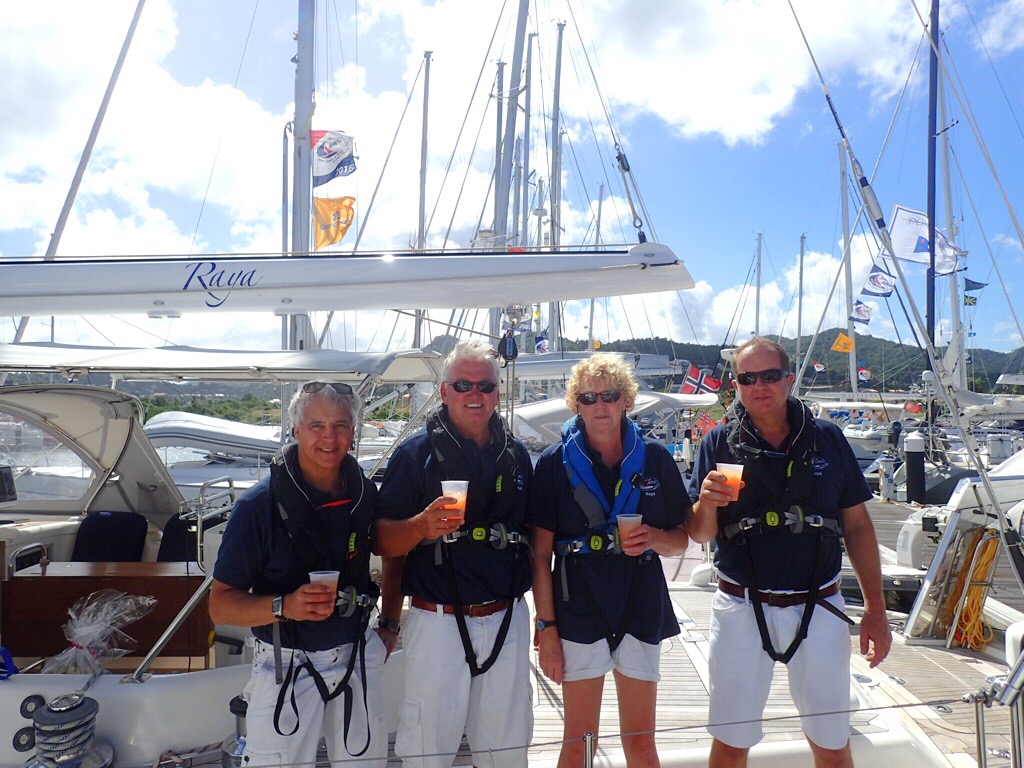
Last night we reached 10,000nm sailed on Raya, almost exactly a year since our first post-refit sail. All that seems a very long time ago now, a lot of water has past under our keel since then. We still get things wrong sometimes but we are gradually moving towards the accolade of Salty Old Sea Dogs. Actually the Salty and Old bits seemed to have come rather too easily, the Sea Dog status is more of a challenge.

It’s been a relatively eventful trip so far. We were given a fitting farewell to the Galapagos by a clutch of penguins dodging and diving, fishing around the boat. This helped to cheer me up as I painfully applied antiseptic to a large graze I had acquired, tripping up a high pavement, returning to the boat with last minute supplies.

As we sailed away we glimpsed a whale and were treated to a final formation fly-past by a flock of blue footed boobies. Alas, down below things were not so good, Rick was up to his elbows in diesel unblocking a fuel pipe to the generator. From the evidence of the filters and now this blockage, it looks like the fuel we picked up in either Panama or Galapagos wasn’t that clean.

The sailing was great however with flattish seas and F4 winds, we made good progress. To top it off on day two we finally properly saw our first whale, a couple of short finned pilot whales swimming with a pod of dolphins.

But the status quo doesn’t last long at sea and we were soon becalmed and the motor was on. The drop in the wind was expected and one of the reason we were sailing south west rather than directly west out of Galapagos. The southeast trade winds were forecast at below about 4 degrees south, the decision was how much to motor using our precious fuel knowing we had nearly 2500nm still to go, to get us down to them. Our patience, especially mine, is not great but after about nine hours of motoring we managed to coax the sails into taking us along at 6kts.

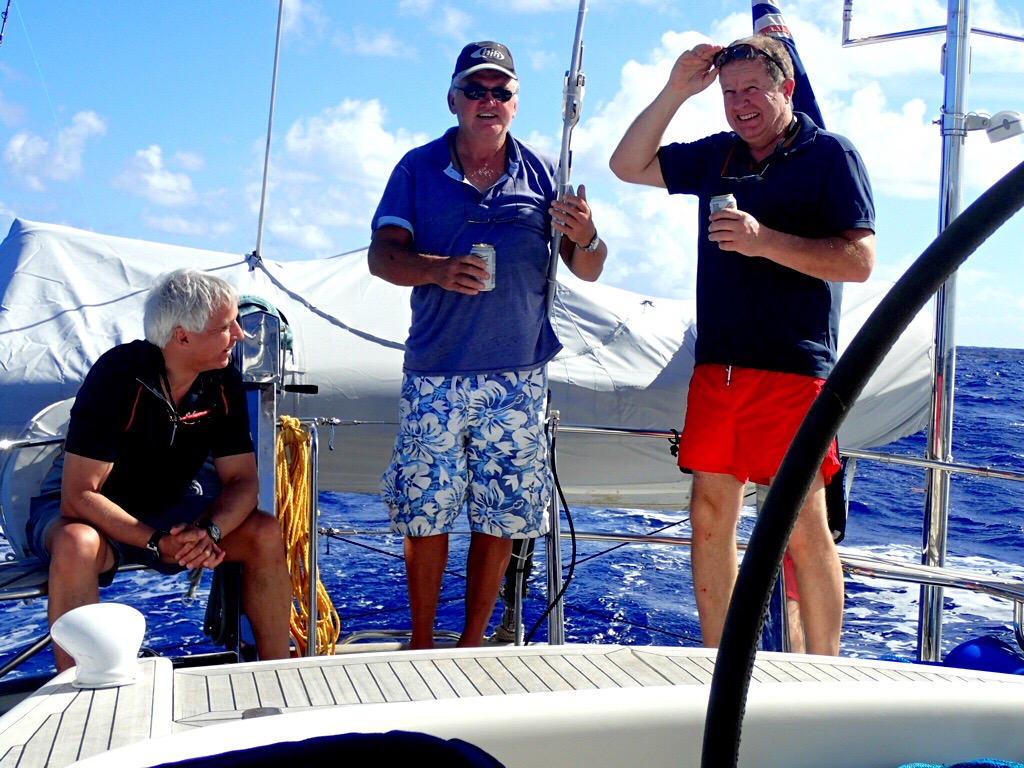
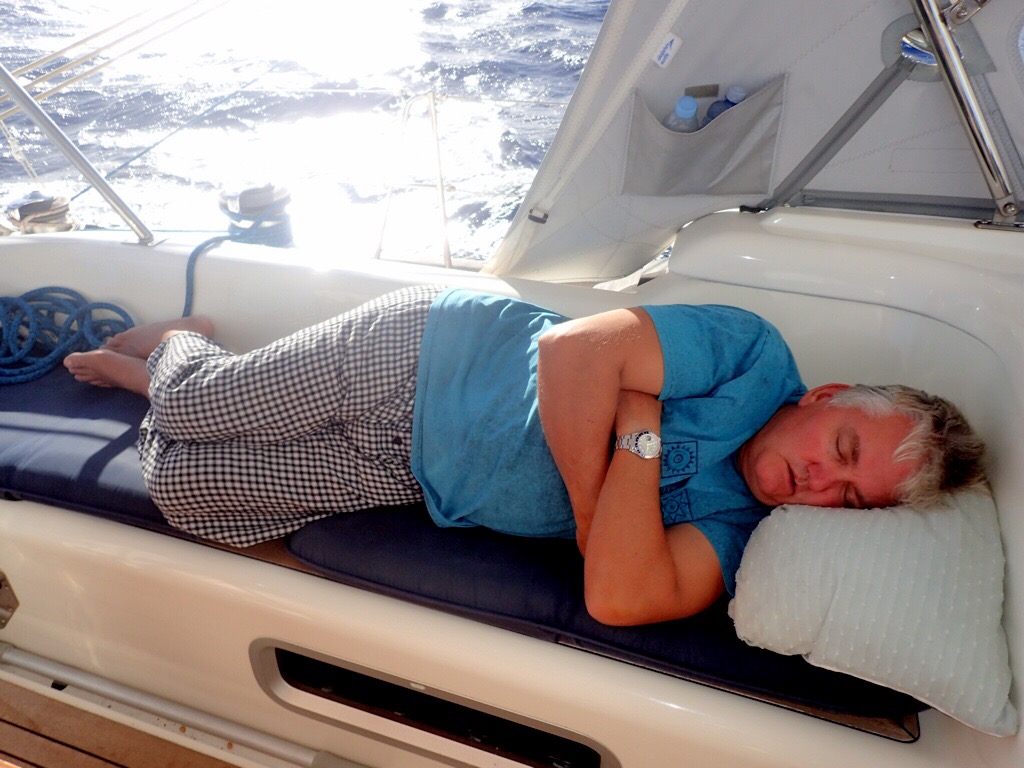
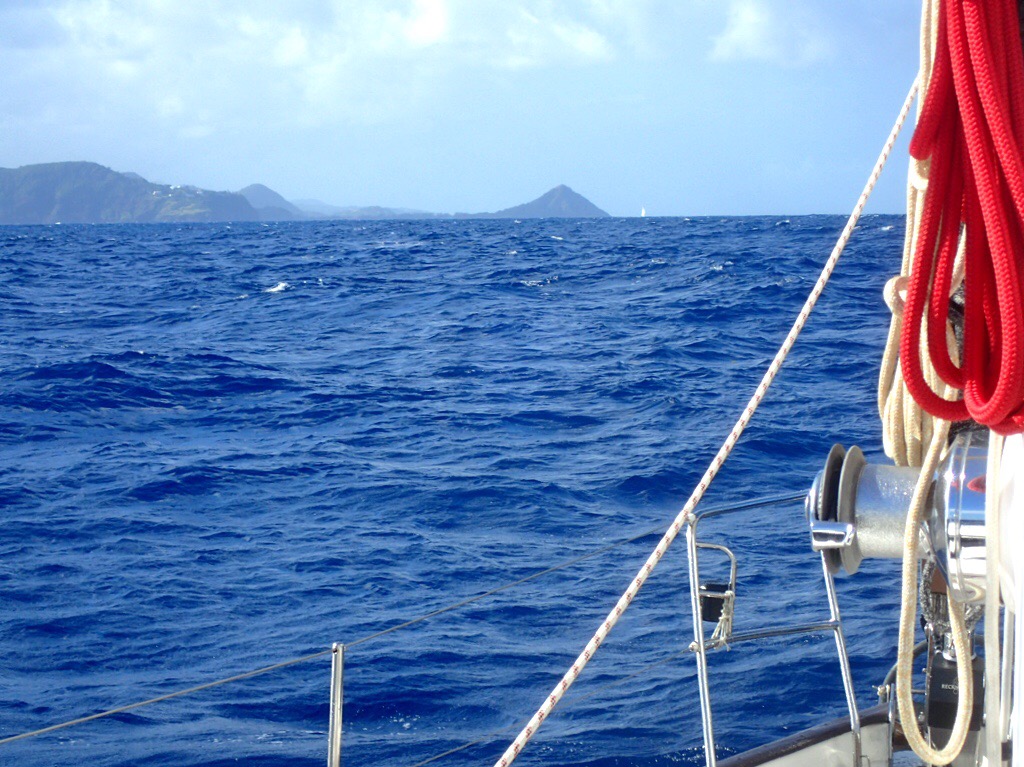
We now, six days in, have good winds and are sailing fast straight for Marquesas, if we keep these sorts of speeds up it should make for a quick trip. We are paying for it however with a 3m swell on our beam, making life, especially below, rather uncomfortable. The skies have been grey for the past few days, with a scattering of showers making the nights dark. On the upside the watch system with three of us on board is working well, after a couple of nights pairing with Rick, Ian is now happy doing a watch on his own which means we are doing 3hrs on, 6hrs off. Six hours of sleep seems like luxury on passage and we are all relatively rested despite the conditions.

The flying fish are again doing their thing and landing on the boat throughout the night. As well as the normal scattering on the deck, we have had one baked in the morning sun stuck to the large salon windows,  a squid (how does a squid fly?…) on the coach roof, one that flew right up onto the Bimini roof and bounced back into the sea and one that like a guided missile came out of the water and hit Rick straight in the eye!
Surprisingly we have seen quite a few boats, yesterday we were checked out by a navy vessel, they didn’t come close enough for me to ascertain their nationality but in away it is comforting to see them around and about and a large tanker slid by on the horizon enroute to South America. More difficult were the five or so vessels from a Japaneese fishing fleet we came across during the night. As they are following the fish, turning this way and that their route it is difficult to judge, especially the one boat that didn’t have AIS. Luckily they were not hard to see being nearly 200ft long and lit up like Christmas trees.
A few days ago getting into the rhythm of the sea we relaxed and were enjoying the ride. Relaxed a bit too much maybe, the winds were freshening and we decided to put a reef in the main before darkness fell. Disaster, a lapse of concentration and a gust of wind popped our super sensitive inmast furling system again. Rick has reefed the mainsail by hand to about two thirds which should be ok for the whole passage but does mean when we get to Hiva Oa the first island we visit in the Marquesas group, we will have to find somewhere safe to detach the boom – probably at anchor?!?

Add to that the fact that I have, fighting with the swell, just managed to tip the omelette egg mix on to the galley flour not once but twice! You see this Sea Dog stuff is not as easy as it sounds.

Galapagos Photos

Here are a few more of our photos from Galapagos

Union Rock


Indigenous population spot s strange new swimming spieces


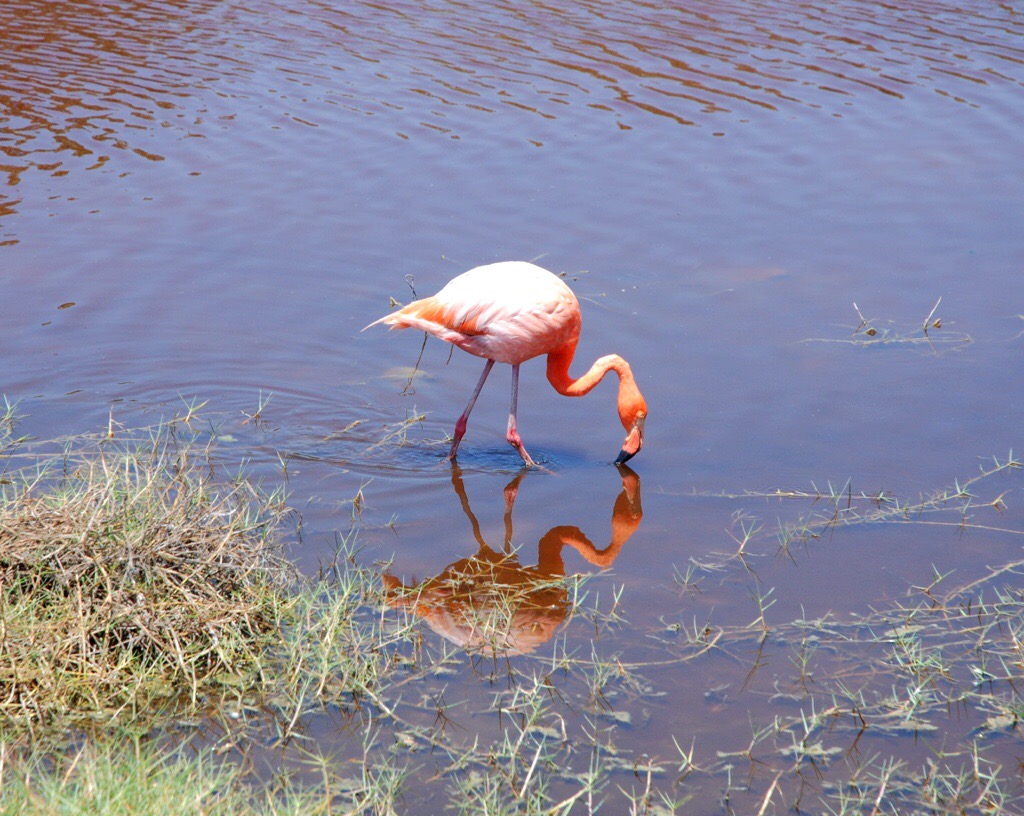
Galapagian flamingo


Blue footed boobies in formation fly pass


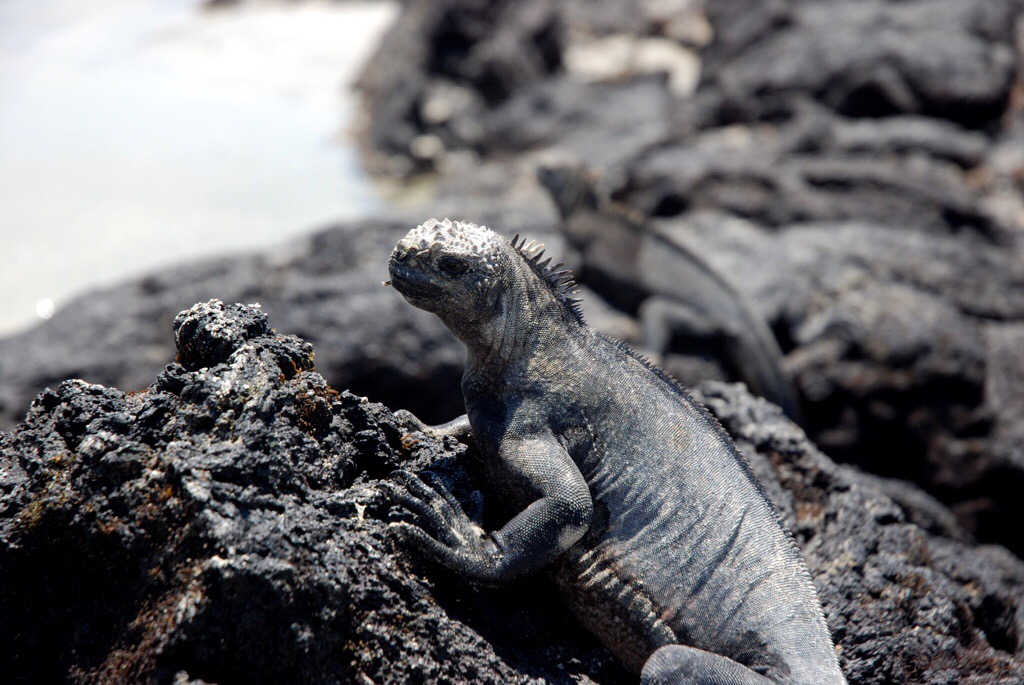
Marine Iguana on watch


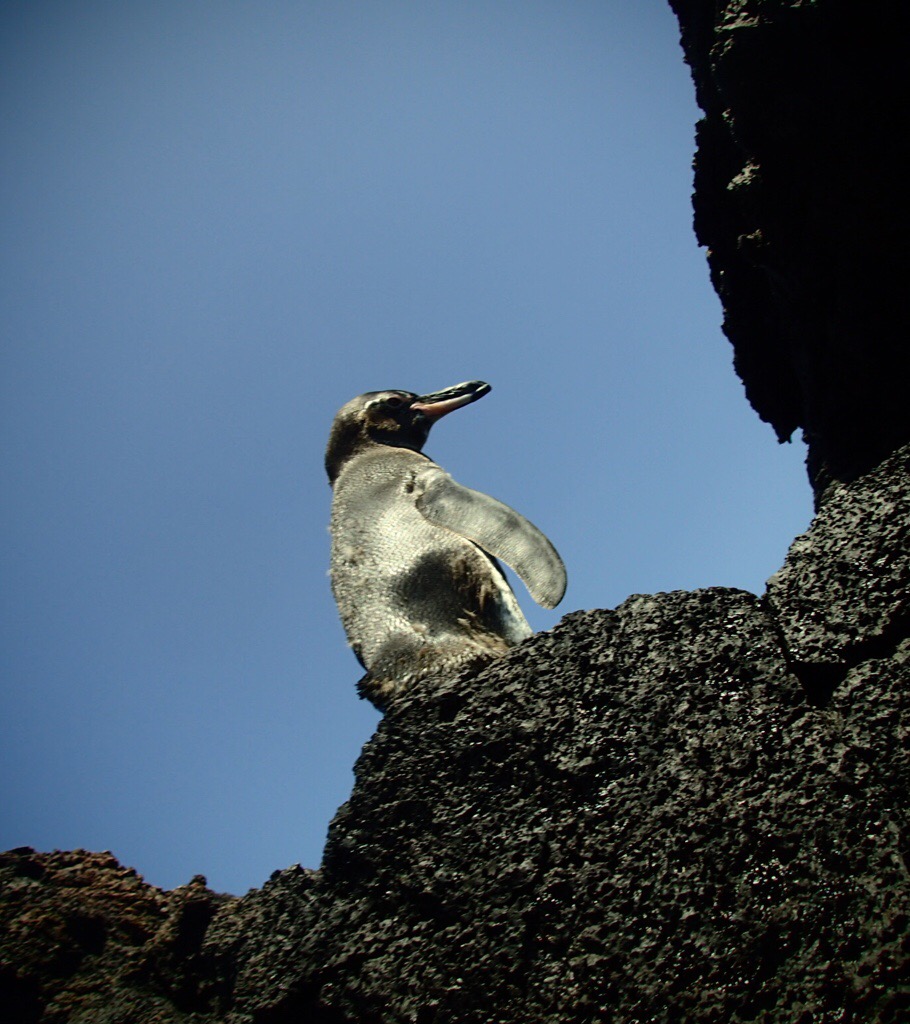
Galapagos penguin dreams of going south


Beautiful seahorse


Lava heron lets Rick up close and personal


Idyllic Isabella

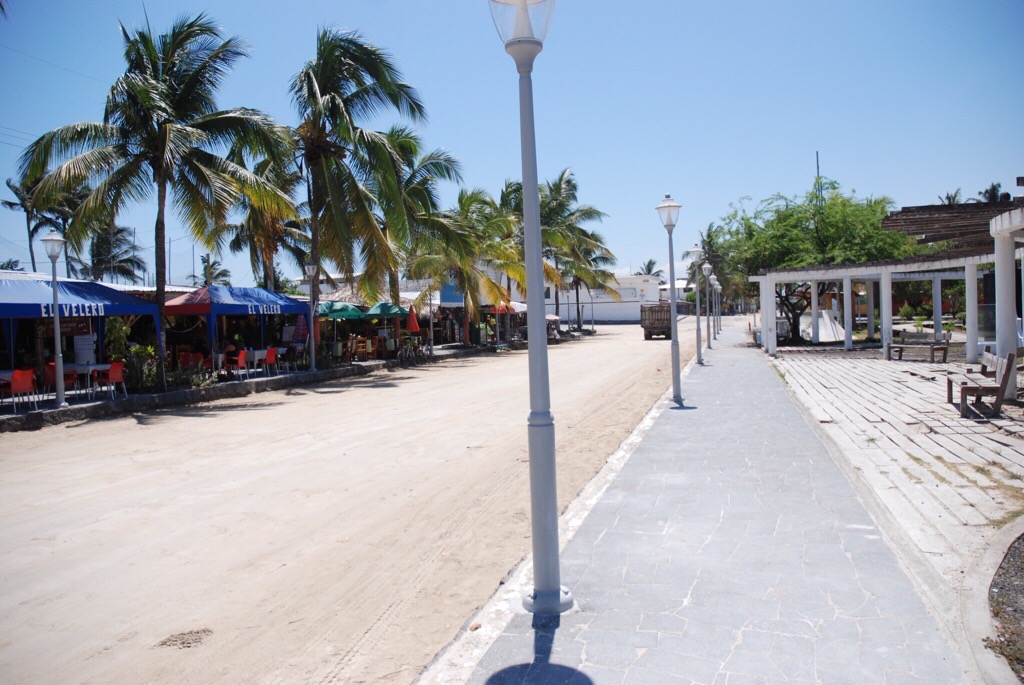
We arrived in Isabella after a pleasant crossing from Santa Cruz at four in the afternoon on Friday. We weave through the shallow reefs to an anchorage off the main and only town, Villamil. It’s a beautiful anchorage. The ocean swell crashes onto the beach on one side of the bay,  we are tucked behind some small low rocks that protect the eastern side and in the distance are the rolling volcanic hills that cover the Island. 

We are, as always in Galapagos, dependent on water taxis that, as we are to discover, are few and far between in Isabella but this evening we are lucky and one picks us up after ten minutes. Nothing can land through the waves near the beach in Villamil so we are dropped at a dock a fifteen minute walk from town. The path in is adorned with flags from around the world welcoming visitors and the road is of smart new paving stones. As we reach town however the roads turn to sand, there is hardly anybody around, it feels like we are walking onto the set of a Spaggetti Western, we expect a gun slinging cowboy to come around the corner at any moment. But of course the town is actually full of the same friendly people of Galapagos as we have met on the other islands and a mix of backpackers and middle aged adventurers.


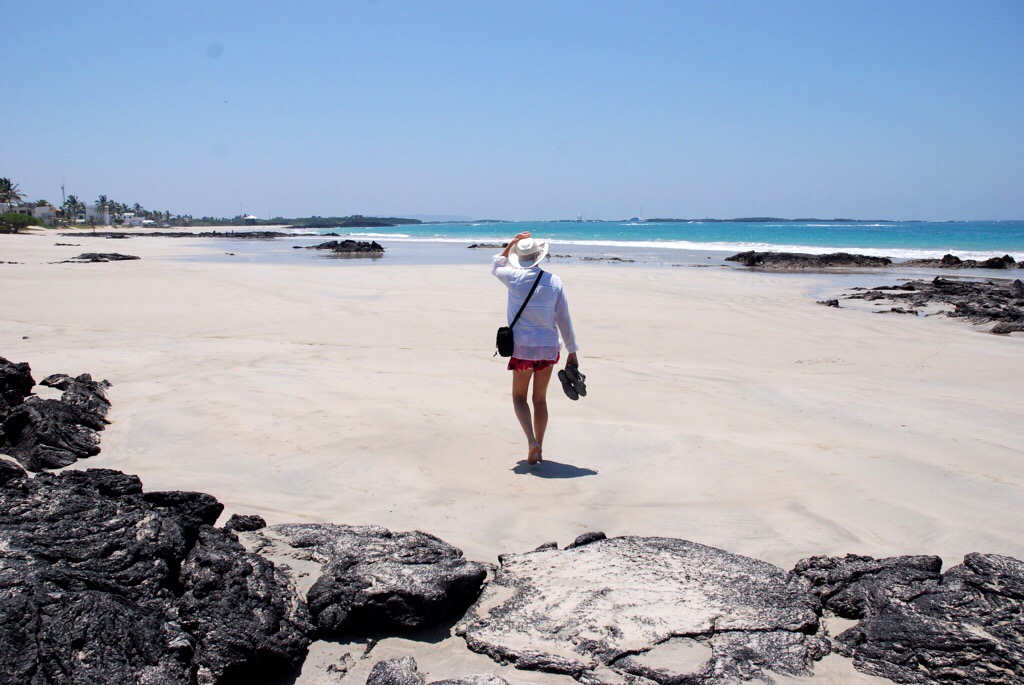
There are plenty of small restaurants and bars and we sit down at one watching the sunset behind the hills looking out over one of the best beaches we have ever been on. A curve of soft white sand a mile so so long, interspersed with the typical jet black volcanic rocks of the Galapagos. Being on a great beach with the surf rolling in always lifts our spirits, we rather like it here.

  
You can’t explore much without being on tour, so we join a group for a snorkel around ‘las Tunnels’. Galapagos was formed by volcanic activity, in places as the molten rock cooled the outside formed a crust with the lava still running underneath, as the lava runs out this forms caverns and tunnels which over time have collapsed and eroded to create a unique landscape.

  
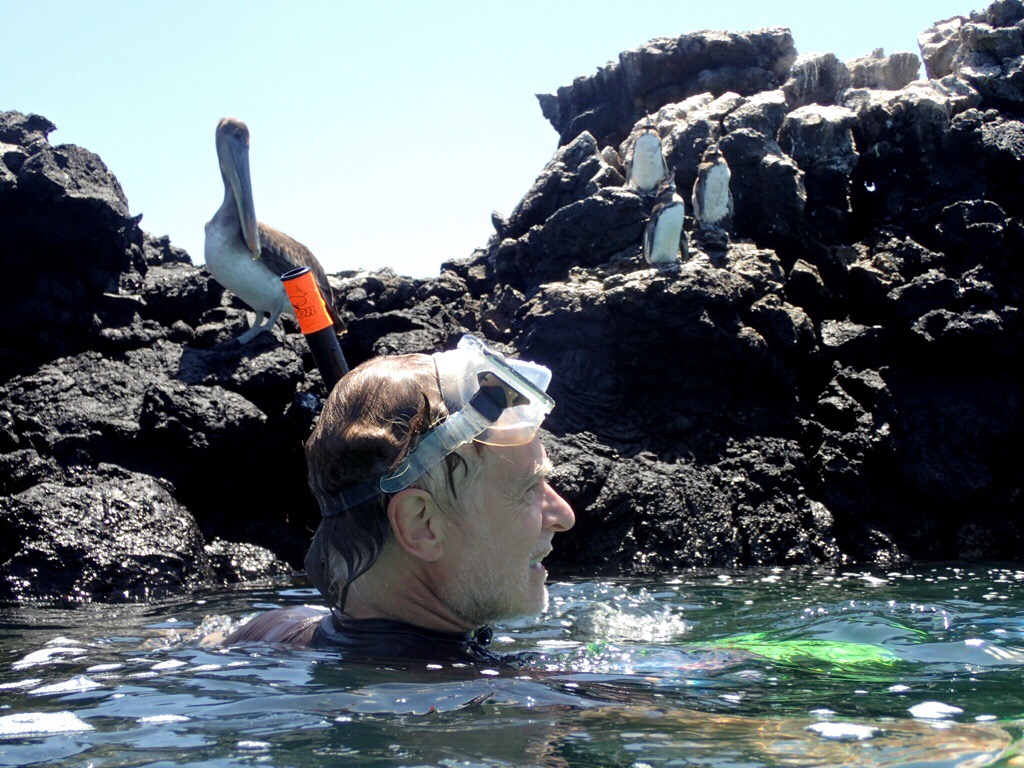
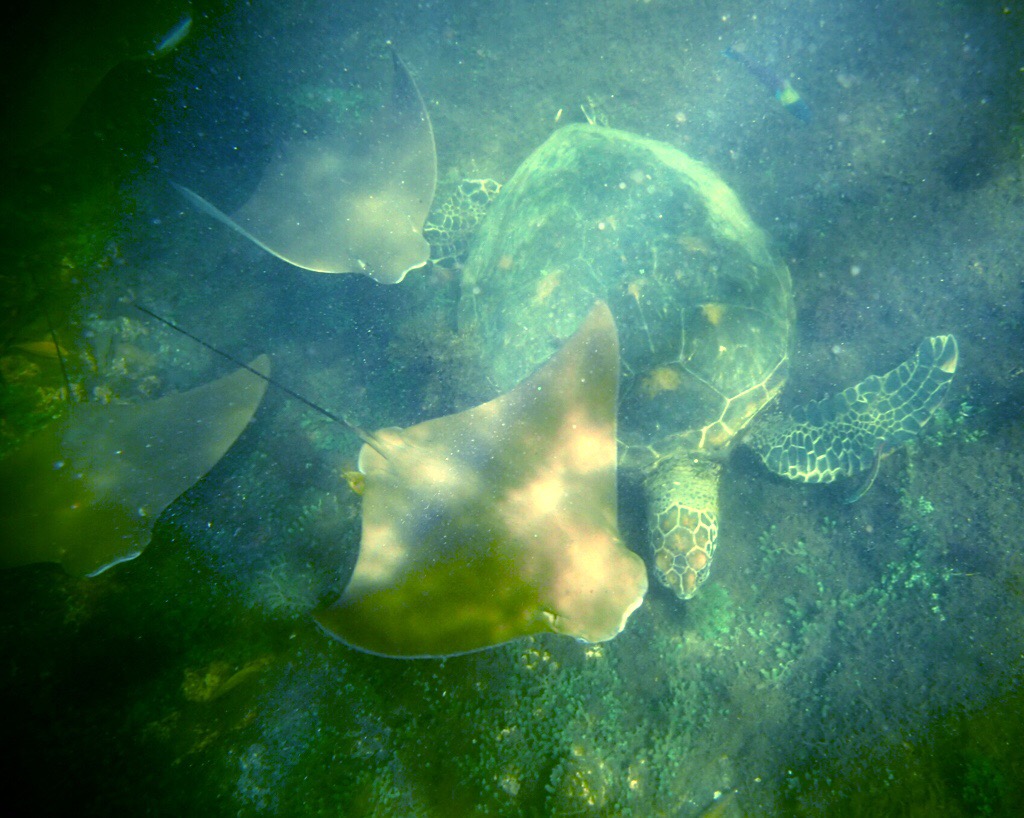
The sea has began to invade these areas and as everywhere here, forms a haven for wildlife. We are not good at tours we rebel at being herded and the visibility wasn’t brilliant but even we had to admit that this spot made for a gob-smacking  snorkel. Where else in the world would you see a school of golden Rays glide serenely over a giant green turtle, a pelican posing with penguins, an eight inch tall sea horse nestling in the weeds, large marble rays and sleepy white tip sharks all in one place.

  
The Galapagos has produced so many brilliant photos, I will publish them in an extra post. We set out for Marquesas so will be at sea for about three weeks and the blog will be restricted to text. The AIS signal will no longer reach land after about fifty miles but you can watch our progress at http://my.yb.tl/sailrayatracking/.

Abundance of Life

Being onboard seems to have inspired our friends to become film directors. Here is the link to the video Stephen produced of our journey from Panama to the Galapagos, writing the accompanying music as we went along.

Again the password is Raya

Thursday 10th March

At the risk of repeating myself, the Galapagos is amazing. As we sat down to lunch at the waters edge, little did we know that we were sitting down to a full on wildlife show. Casually swimming past we saw a 4ft Ray, three turtles, a marine iguana and numerous sea lions, one of which jumped, out of the sea into the hotel pool and then onto a sun lounger.


This however was just the side show, the main event was produced by the incredible birds. The sky was full off hundreds of them – black lava gulls, sleek shearwaters, circling frigate birds, comical pelicans and the stars of the show, synchronised diving blue footed boobies. A group of three or four boobies continually flew a circuit of the bay before right in front of us, at great speed, diving straight down into the sea, popping back up, gullets full, all in exact formation. We hardly knew where to look next, agog at the spectacle. When you did turn away to enjoy your food, you were quickly distracted by the squeal of delight from your fellow dinners or the large splash as a pelican hit the water, just a metre from us.

The Galapagos lies at the meeting of two Pacific currents, the cold Humboldt current and the warm equatorial current, the mixing of the two brings huge amounts of plankton, that in turn attracks the wildlife. The day before we had joined a two tank dive boat for a trip to Seymor Island. We entered the water and right there were a vast shoal of large fish, uncommonly, of many varieties swimming together. The visibility is never brilliant here but it was clear enough to see below us and eventually swimming amongst us numerous six foot long white tipped reef shark, three or four times we saw the bizarre silhouette of groups of hammerhead sharks and a couple of elegant blue spotted eagle rays. The highlight of each dive however were the huge manta rays, some four metres accross, that glided gracefully above our heads.

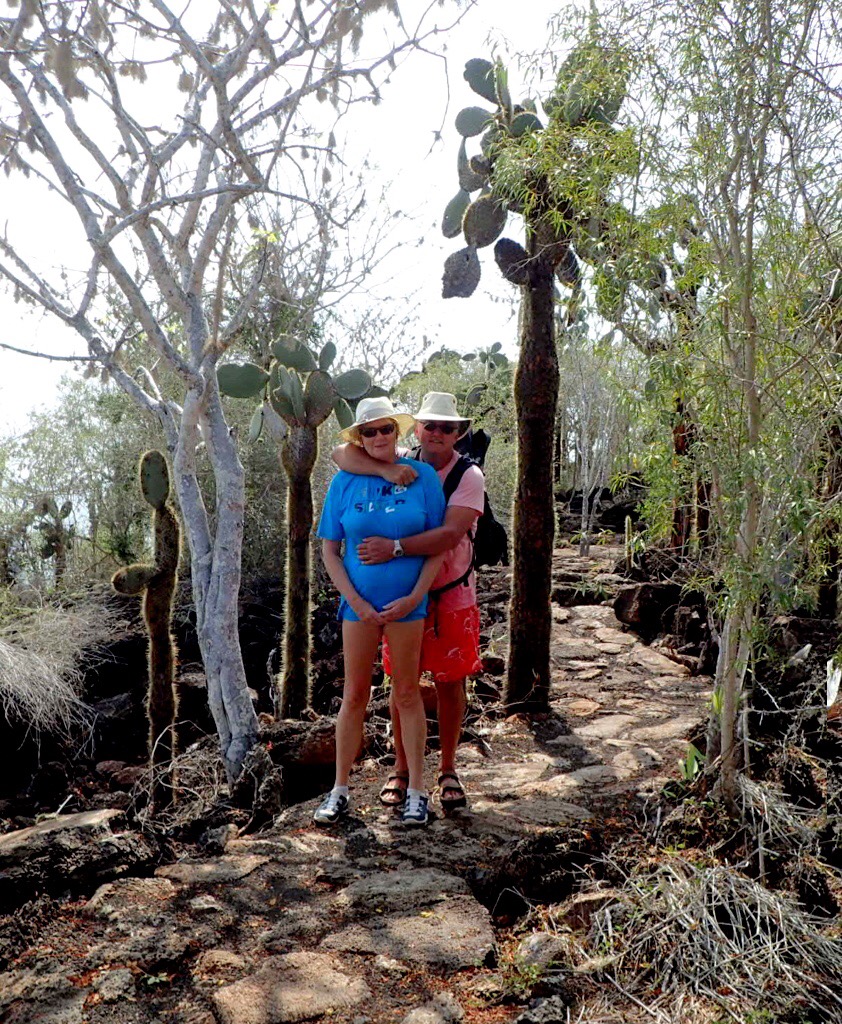
In contrast the day before we had followed a trail through a cactus forest, in the Galapagos the cactus have evolved to grow tall on a tree like trunks, to avoid being chewed by the iguanas and tortoises on the ground. Driving through the highlands if you don’t look too carefully the scenery often looks almost like the English countryside, but down in the arid zone by the coast we have been no where else even similar.


The trail led us to a rift in the rock that was filled with brackish crystal clear cooling water, a protected spot for spawning parrot fish.
 

It is difficult to explain quite how abundant the wildlife is here, just sitting in the cockpit  I am surrounded by fishing birds, the continual splashing of jumping fish presumably being chased by something bigger. A turtle frequently pops his head up to say hello and the occasional sealion still attempts to defeat the fender defences on the swim deck. Walking through the charming, friendly town the people share thier public spaces quite happily with the animals. At the small fish market there were more animals than people, Pelicans quietly waiting with a couple of sea lions for their turn to be thrown the guts of the next fish.


Ian has arrived to sail the long leg to Marquesas, but first we have a few more days in the Galapagos we sail to the third island of our stay here, Isabella.

Close Encounters of a Friendly Kind

We stood on the deck and waved goodbye to the thirty two yachts on the World ARC leaving for the Marquesas Islands, with mixed emotions. The previous morning we had left San Cristabal for the second island on our visit to the Galapagos, Santa Cruz, in the hope that we would catch the rally just before they left. We were keen to see our friends on the Oyster 56, Into The Blue, we had met early on in our mutual ‘around the world’ planning phases, had crossed the Atlantic with them but as they were part of the World Rally we hadn’t seen each other since St Lucia. We had a great evening together discussing our experiences in Panama, looking forward to the trips ahead and discussing the pros and cons of life afloat. The time together with our friends and other participants reminded us of the support and camaraderie that travelling in a rally brings, we had considered joining the World ARC at the beginning of our travels but they whiz around the world in just sixteen months, we plan to wander around much more slowly.

We had had a nice few days in San Cristabal. The small town of Baquerizo Moreno made up for its lack of sophistication by its incredible friendliness and the National Park have done a good job of providing well marked paths for us to discover. These meandered through the cacti, palo santo trees and lava fields to beaches and cliffs where you could see the plentiful  wildlife. The paths were challenging enough to give you the pretence of an intrepid explorer but without requiring too much effort in the tropical heat or distracting you from the surrounding views. The preservation of the flora and wildlife is admirably the top priority of the people here and they work hard to look after thier unique environment.


Clambering across the boulders of lava

 
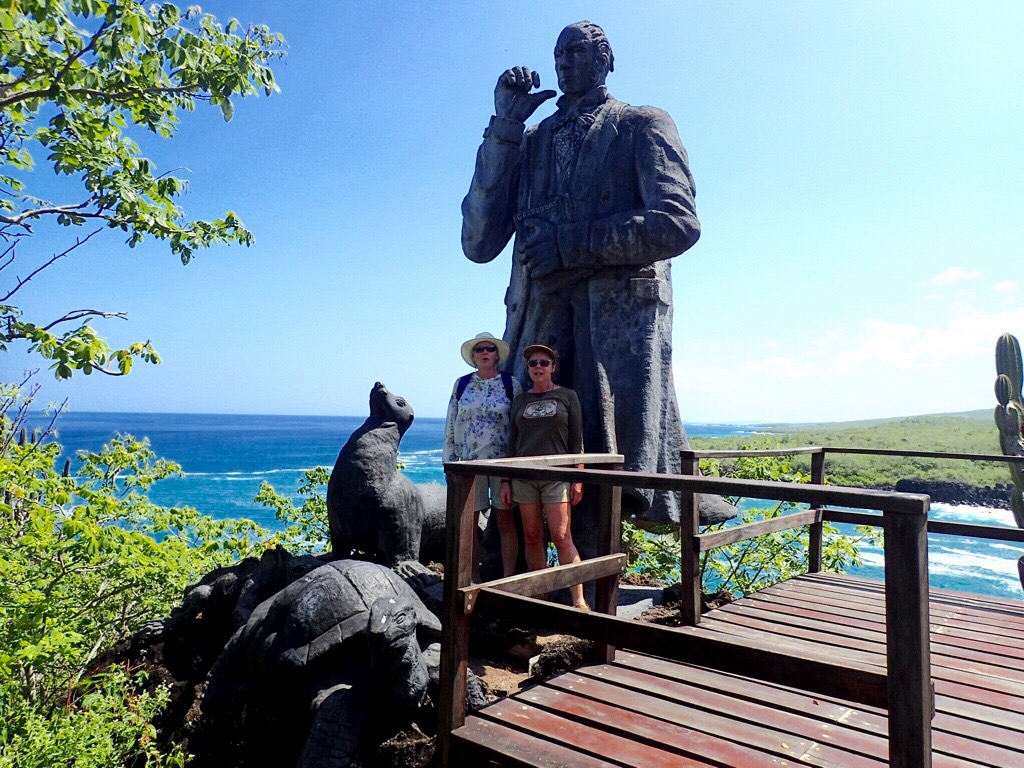
 We climbed up through the hills north of Wreck Bay to the cliffs of Cerro de las Tijeratas overlooking a rocky cove where if you climbed down to a wooden platform the snorkelling was apparently very good. Unfortunately there was a big swell hitting the island, great for the surfers riding out beyond the reefs and the sea crashing onto the cliffs made for an amazing sight but meant entry for us in through the rocks was impossible. This cove was the first landing site of Charles Darwin and a huge statue stands in recognition of the world changing insights he drew from his visits to the islands. 

  
The platform where he stands gives fantastic views of the north coast and the thousands of birds that nest in the cliffs. We saw frigate birds, gulls and to our great excitement a blue footed booby. We met bobbies sailing between Grenada and Bonaire, they are incredible divers that plunge straight down into the sea to catch their prey. In the Galapagos there are three varieties one of which that has vivid blue feet. Their mating ritual involves them proudly raising these bright feet as high as possible and much like the tortoises yesterday showing off their long necks, the highest foot attracts the most females. The girls here obviously have a thing for lofty achievers.


Blue Footed Booby

 
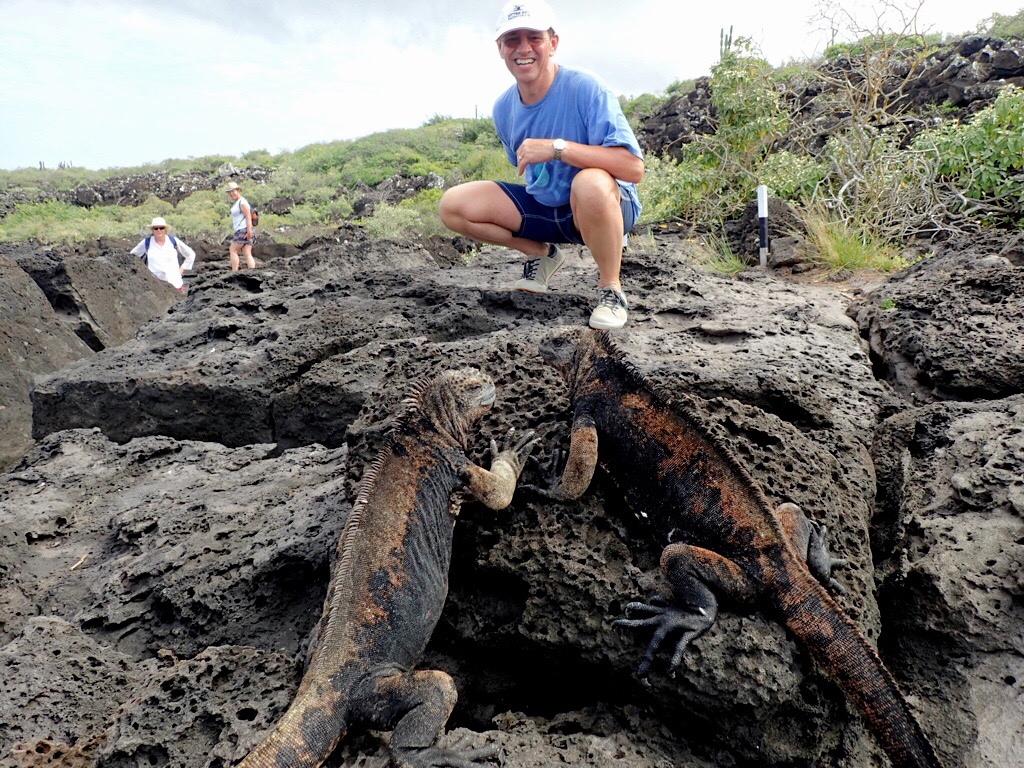
The next day we took a taxi a few kilometres to La Loberia Beach where we spotted Galapagos herons and red beaked tropic birds. Clambering higher across boulders of lava, again we saw blue footed boobies but this time also large marine iguanas, dozens of them basking in the morning sun raising thier body temperature for the day ahead. 


Marine Iguanas

 
Feeling that our own body temperatures were rather too high we walked back down to the beach to cool off. We had a great snorkel, amongst the rocks we saw a large school of yellow tailed surgeon fish, huge parrot fish and three turtles. The amazing thing about the wild life here is that they are unafraid of you, everything including the birds, sea lions and turtles allow you to approach them. The largest of the turtles about a metre across allowed us to watch him feed and then swam with Rick for about ten minutes. 

  
Over the next few days we shall be exploring Santa Cruz, however our tourist hats must be mixed with our working hats as we begin preparations to follow our friends across the 3000 miles of Pacific Ocean to Marquesas. 

Sea Lion Wars

The novelty of the sea lions on the swim deck wore off abruptly when in the middle of the night I popped my head up to check all was good with our anchor, only to discover a huge male lounging in the cockpit on our cushions. That he had managed to get up the back and on to the deck was a bit of a shock but we were to discover they are a lot more acrobatic than we thought. He was very reluctant to give up his comfy spot but he eventually moved back to the stern when I shoo him away. However he refused to retreat down to the swim deck, as I walked towards him he leapt towards me, barking and baring his teeth. I jumped back with a scream, grabbed the boat hook and a faux battle commenced, eventually after a few threatening stabs towards him I finally persuaded him to back down. I blocked the gate as best I could with buckets and tied lines across between the stantions. The most disconcerting thing was not my ten minute fight on the aft deck but the fact that none of my fellow crew members so much as turned over in their beds! I returned to nightmares of one falling through the hatch on top of us while we slept. What we ask ourselves would you do with 100kgs of angry sea lion below decks?
Rick tried tying a criss-cross of ropes across the swim deck but they just wiggled between it all until they found a comfy spot to sleep and then complained noisily when they had to untangle themselves to get back into the water. So then he tried hanging all seven of our large fenders off the stern but they just push them aside and slide underneath enjoying the shade they provided. However it does seem to prevent them getting up on deck, so we have come to an uneasy truce.

If you can’t find a boat to sleep on then the middle of the pavement will have to do

In search of less awkward wildlife we took a tour to the highlands. Here there is a fresh water lake in the caldera of an old volcano, El Junco lake. There is rumoured to be lots of wading bird life and extrodinary views across the island, unfortunately for us, we climbed up into the clouds and could see nothing more than a round body of water. We descended back down to our taxi and continued on to the Giant Tortoise Breeding Centre, La Galapaguera. These lumbering beasts are truly gigantic, many of them sixty or seventy years old. Each island has its own indigenous sub-species, all of which became endangered and some species extinct after years of providing fresh meat for passing ships and latterly by the introduction of goats that ravaged their food source. Most of the goats have now been irradicated and the breeding centres are making good progress at re-establishing sustainable populations. We spent a fascinating hour or two watching them wander about there large park. We found a large group at a feeding station, two of which were competing for the attention of a smaller female. To show you are top dog each tortoise stretches his neck as high as possible, the highest stretch wins the girl.

Neck streching wars

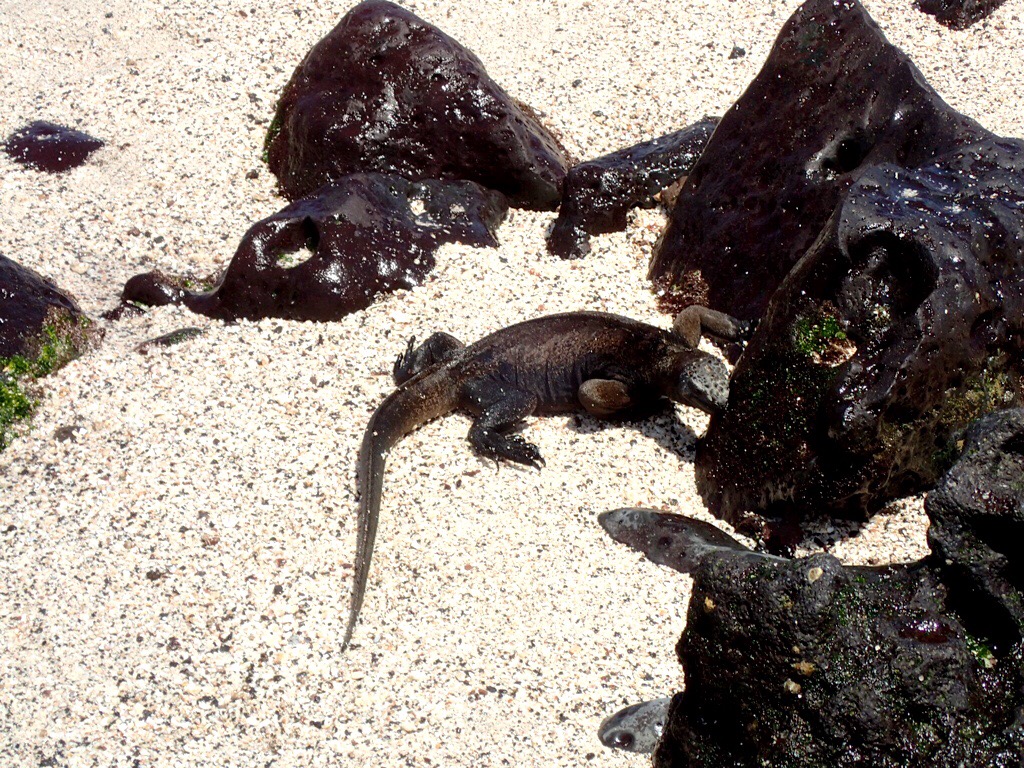
To finish the morning we stopped for a cooling swim at a beautiful cove, the waves crashed against the rocks and for a moment we almost could have been in Cornwall. Reality soon hit as a seal lion emerged through the waves and called for her pup, that emerged from the rocks and excitedly waddled towards her, the rocks themselves appeared almost alive as they heaved with a thousand small black crabs and then we realised some were actually alive they were small marine Iguanas.


Marine Iguana

 
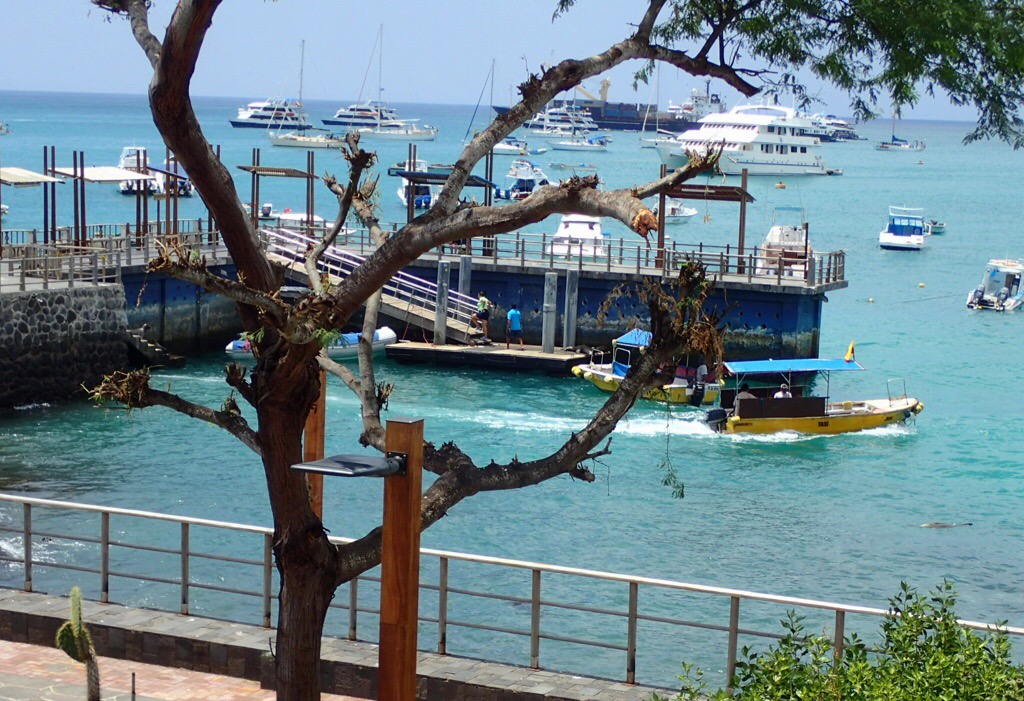
We returned to a busy Wreck bay, close in are thirty or so local fishing boats, to the east is the navel base and a couple of grey navy vessels, the yachts at anchor had increased to ten boats and there were a dozen small cruise boats busily transferring passengers on and off. All along the shore, on every rock, inch of beach, step and even sea front road are hundreds of sleeping sea lions and between them all buzzes three or four water taxis or ‘Taxi Aquatic’. We can call them up on the radio, and in the absence of anywhere to land our dingy, use them to ferry us to and fro from the dock, a dollar per person per trip.

Taxi Aquatic in Wreck Bay, San Cristobal

Gliding to Galapagos

As we sailed and grew more confident in the boats surprisingly high speeds in the light winds, we turned slightly further into the wind and pushed forward on a straight course to the Galapagos . It felt like the boat was gliding effortlessly over the increasingly calm water. We had a strong current helping us along and as the breeze dropped further we marvelled at our continued rapid progress.


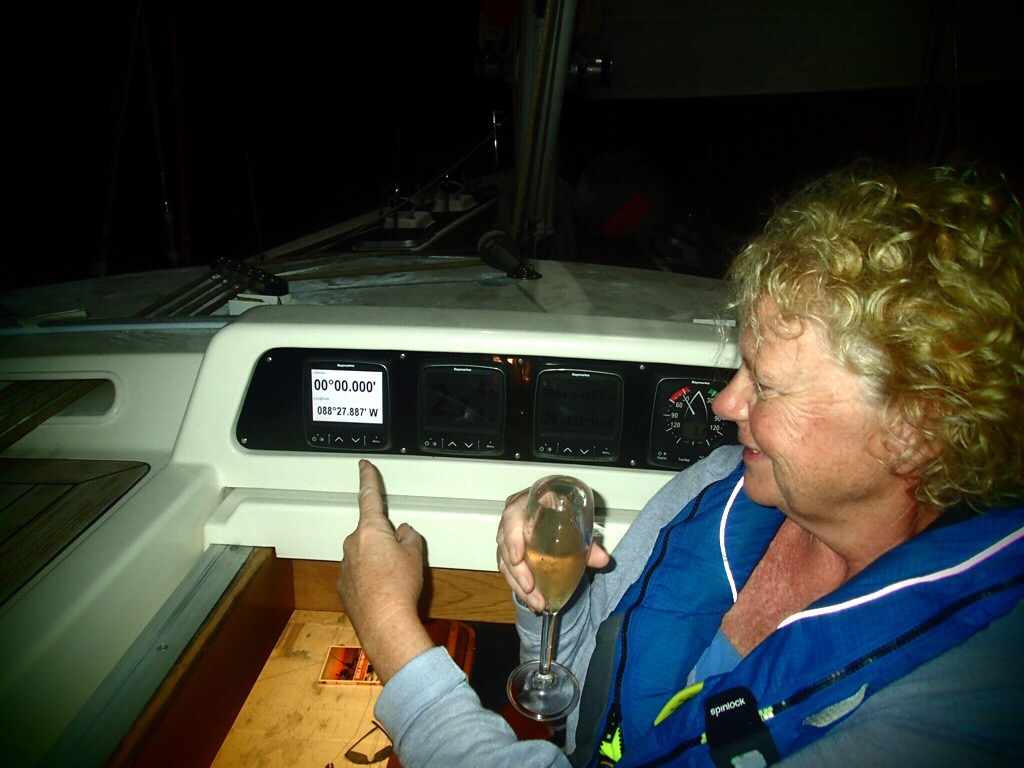
Finally, Wednesday afternoon and about 120 miles out, the wind dropped so low sailing was impossible and we started the engine. The sea became glassy smooth, the humidity increased and an erie mist hung in the air. At just after nine in the evening we approached the equator. We had suspended the watch system so we could all enjoy the moment and share a bottle of champagne. Tradition requires when you cross the equator for the first time that you make a donation to Neptune, so we filled five glasses, one for each of us and one for the ocean. The conditions were so peculiar we switched off the engine and moved to the back of the boat to fully witness our introduction to the South Pacific. Ghostly shapes of birds flew around us, the full moon shone through the dense mist casting a silvery sheen, the water, seemingly viscous, undulated slowly under us and the warm humid air enveloped us in a damp hug, none of us had experienced anything like it.


Slowly the morning sun burnt off the haze and the Islands of Galapagos came into view.

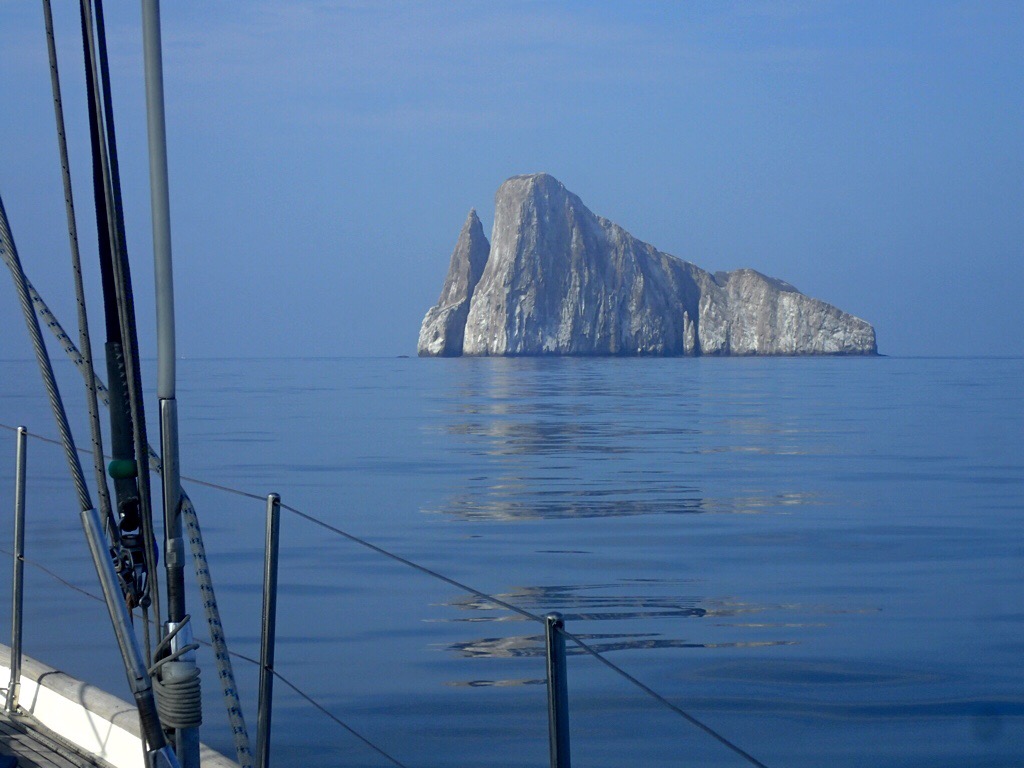
Kicker Rock off the North Coast of San Cristobal

By ten we were making our way into the anchorage in Wreck Bay, Puerto Baquerizo Moreno on the southwest tip of San Cristabal Island and the first stop of our visit here. Access by yachts is very restricted we have a pass to visit three of the islands but are limited to the one designated anchorage on each island.

Our agent hadn’t replied to my latest emails and we had no clue how to proceed with all the processes we knew we had to get through before we could go ashore. We flew the yellow quarantine flag, a hang over from the days when all crew had to be past fit to go ashore and is these days flown to indicate that we have yet to check in with customs and immigration. We needn’t have worried within minutes of dropping our anchor and while still drinking our ‘got here’ beer, the agents island representative was onboard sorting things out for us. We were informed the authorities would arrive at four that afternoon until then we must stay on the boat. 

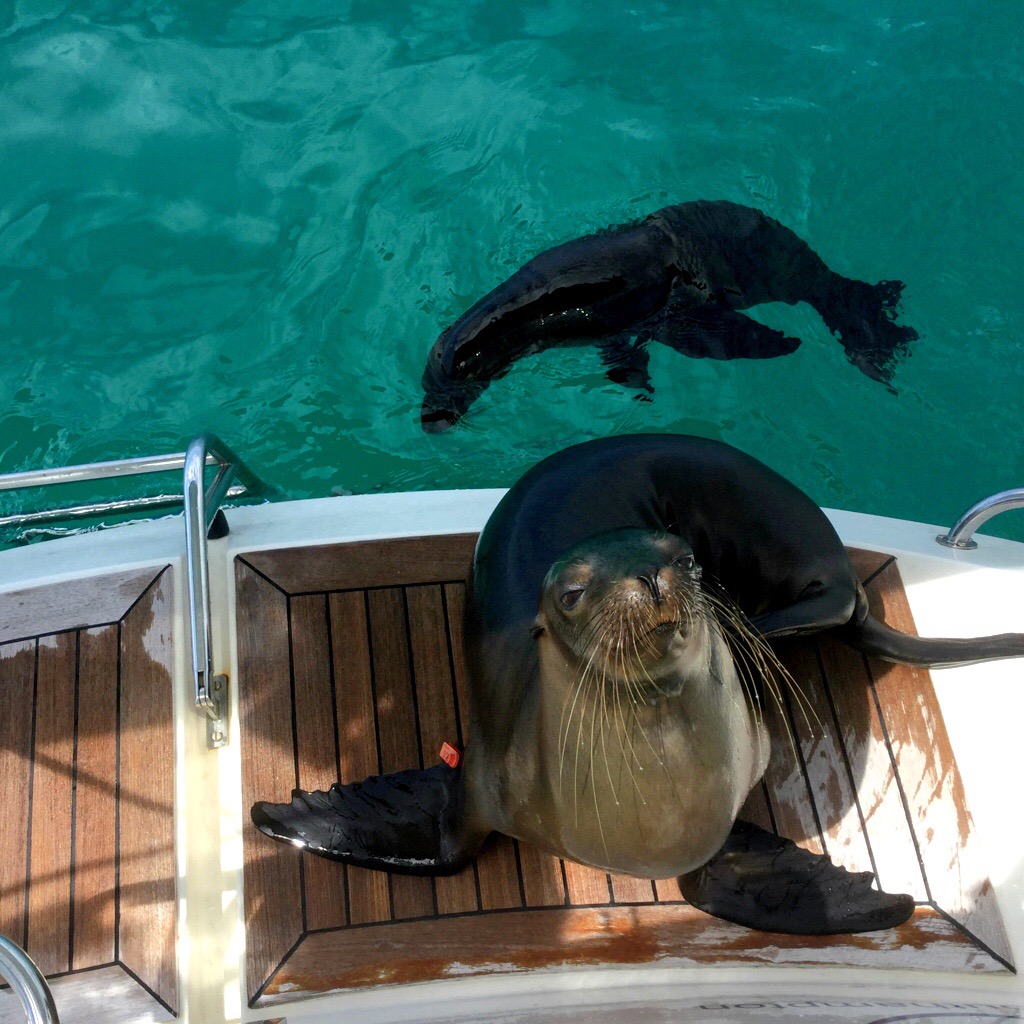
We were allowed to have a swim however, so feeling hot in the humidity we dived in. One of the attractions of these islands is, with no predators, how unafraid the large animals are here and soon after getting in we were swimming with sea lions. In fact one immediately laid claim to our swim deck barking at us as we approached the swim ladder and getting out of the water became rather precarious. It seems to have become the favourite spot of the bay, with battles occurring to secure a place on the warm teak. It is amazing to watch them, despite their rather grumpy nature, but they are very noisy, constantly barking at each other to maintain their place and loudly snoring in their sleep. 


On the dot of four a water taxi approached carrying six officials, one a diver who went into the water to check our hull, everyone else crowded into the cockpit and an orgy of form filling took over the boat. There was one person from immigration, one from customs, an official from the Nation Parks Organisation, the Port Captain and one from environmental control who walked around below searching for unwanted foreign species. Luckily all was past fit except for one rather mouldy looking orange that was, with a suitable amount of tutting, carefully bagged and taken away. Passports and forms were ceremoniously stamped and then it was hand shakes all round and we were free to enter Galapagos. It may have been a bit over the top but it certainly beat trudging into town and waiting around hot, bleak custom offices to be grunted at by glum bureaucrats. Galapagos gets the thumbs up so far.

Peaceful Pacific

Monday 22nd February

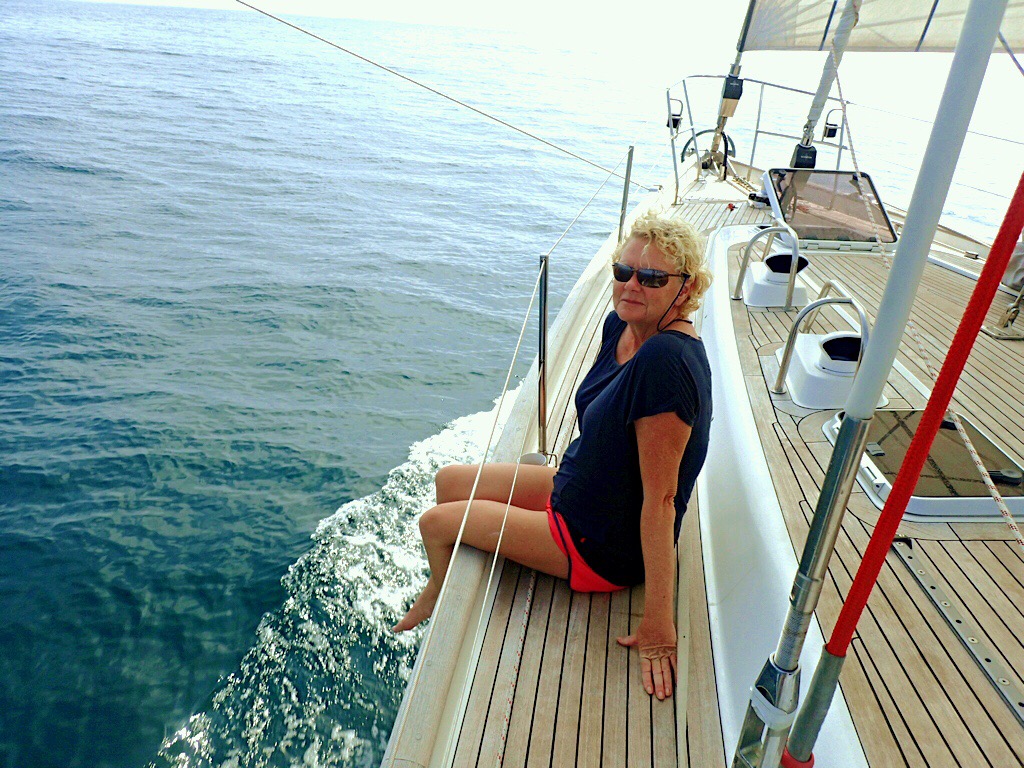
At this exact moment, right now, I can not think of a place I’d rather be. Sitting at the bow, in the shade cast by the Genoa, my feet, over the side of the boat, being tickled by the spray from the bow wave, my skin bathed in the soft Pacific breeze. The ocean spreads out around me, a vast area of nothing, just us.

We are 500nm NE of Galapagos, 03.58.200N, 82.58.418W, we have been at sea for two days and for the past day we have seen only the sea, the sky and an occasional bird. There has been the odd AIS target on the screen but the cargo ships, heading for ports on the Equadorian coast, have all been beyond the horizon and out of sight. We have had one flying fish on the deck but none spotted at sea and what we were sure were whale blows were disappointingly too far away to spot an actual whale.

We left Panama City early in the morning and sailed for Contadora one of the Las Perlas Islands. Just as we rounded the corner into the bay we saw our friends onboard Toothless sadly disappear out to sea on their own passage to the Galapagos. They had warned us the water here was murky, due to a cool seasonal current bringing blooms of algae and so it proved to be. The green soup effect wasn’t really enticing us in, but we were there for a purpose and valiantly put on our masks and armed with cleaning implements started on cleaning of the waterline and inspection of the hull. To be honest the visibility was so bad except for the bow thrusters that Rick attacked with a brass brush, we left the water just hoping the guy in Panama had done a good enough job for the authorities in Galapagos.

We flew out of the Gulf of Panama with twenty five to thirty knots on our starboard quarter. The Pacific, so far, has been a revelation, even now with only eight to twelve knots of wind we often have over seven knots of boat speed. It all come down to the relatively smooth sea state we have a much smaller swell than in the Atlantic and a lot less chop than in the Caribbean Sea. With little roll the sails stay filled and Raya, seemingly with a smile on her face, bowls along happily.

The wind did drop completely last night forcing on the engine but we are back to ‘perfect ‘ sailing again now. We are approaching the doldrums or to use the correct terminology The Intertropical Convergent Zone . This is an approximately five degree wide band of weather that runs anywhere from just south of the equator to about 10 degrees North, here the NE trades meet the SE trades. Basically an area where the conditions become confused resulting occasionally in tropical squalls but more often than not with no winds at all. Looking at the forecast for the next couple days and our run into the Galapagos we seem to have wind arrows with 0.5 kts written on them, lets hope they have plenty of fuel to top up with when we get there.

Full Up

While Jonathan was onboard he shot lots of film, from inside the cockpit, up the mast and racing along side us in the dingy. He has created a fantastic short video of our sail from Bonaire to the San Blas, you can find it here – 

https://vimeo.com/155366014. The password is RAYA.

We have had a very busy week preparing for our passage to Galapagos and meeting with old friends. One of the great things we are discovering about this trip is how many of our friends are managing to join us. We first met Peter and Junko during our stay in Japan, then we were all posted to Sweden together, they now live in Florida. Panama is part of Peter’s professional patch so they and thier girls came to see us for the weekend. We returned to the old town for dinner. What a difference from last week, after the Carnaval holiday, Panama City has come to life. The streets are full of traffic, the restaurants and bars busting at the seams and the shopping malls bustling, the old town felt young and vibrant.

Rick and Junko, dinner in the old town

Raya is also rather full, full of fuel, full of water, full of food. We are moored on the most seaward of berthsin the marina, so getting everything to the boat is a real challenge, a ten minute trek along rickety, rocking wooden pontoons, but we are almost there, every locker is jam packed and the fridge and freezer overflowing. We are unsure how good the provisioning opportunities will be over the next few months, so we are taking advantage of the large and relatively cheap supermarkets here. The cupboards are full of tins of tomatoes, beans, corn, tuna…… Behind and below the seats we have long life bread, stocks of tea bags, coffee, flour, ketchup……. the shelves are full of fruit, biscuits, nuts…….. And every nook and cranny has a bottle of wine, can of coke or case of beer.

We hear the alcohol in French Polynesia is expensive

Penny and Stephen have arrived and we set sail tomorrow for the Las Perlas Islands, a group of small islands that lie about 30 miles off the Panamanian coast. To enter the Galapagos your hull has to be completely clean. If they find so much as a barnacle lurking in some crevice, they send you twenty miles offshore to clean it, not something we fancy. So we are stopping at these islands, where hopefully the water will be calm and clear, to take a look and ensure the diver that we paid to give us a clean up has done a good enough job. Then it’s off to Isla San Cristobal the first island on our Galapagos adventure.

Windy City

I’m on laundry watch, the sheets are drying perpendicular to the decks and despite each one having ten pegs attaching it to the line I don’t want to take my eyes off of them. Rick remarked, as the bun on top of his burger flew off accross the restaurant “you know it’s windy when there are waves in your wine glass”. For the last week at least, Panama City has been the Windy City.

We spent a couple of nights in the Hilton to say goodbye to Jonathan and Sheridan and explore. It was a big holiday here and most things were closed for four days, so it seemed a good time to take a small break. It was carnival time and each night there were fireworks and the main sea front highway was closed for entertainment and parades. The security was very tight, I have never seen so many police and to enter everyone was searched. It all seemed rather unnecessary as the crowd was mostly made up of families, everyone was happy and good natured. The floats in the parade were suitably over the top and the music set the Central American scene but it was difficult as outsiders to feel involved, we moved on to explore the old town. 

  
Dating from the seventeenth century, a time of Spanish domination, it almost feels European.  Until recently the whole area was very run down but as the rest of the city  went through a huge expansion, tower blocks springing up everywhere, gradually the value of this piece of land has increased. Entrepreneurial youngsters began doing up properties and soon the authorities and private investors moved in. The area is now very smart, full of trendy restaurants and beautiful houses, with the odd incongruous slum tucked in between to remind everyone the job isn’t quite finished.
Back at the boat we are moored in Flamenco Marina with Panama City as a backdrop. There are only a couple of other yachts here it is full almost exclusively with brash, high sided, sports fishing boats. Despite our bag of a dozen different electrical connections we can’t connect to the power supply and are having to rely on our generator. There are so few women here that the ladies shower block is kept locked, so to use the toilet I have to request the key from the marina office and once in, the facilities are clean but basic. We are moored right by the entrance and in these windy conditions the berth is rather bouncy and the ‘Free’ WIFI is non-existent. At over $150 a day it has to be the least value for money marina we have been to. However, we need to be tied up for a while to get everything done for the long passages ahead. 

  
We look for the positives. It is fun to be back in tidal waters, we are rising and falling 5m each tide, the wind although strong, tempers the high temperatures and the bird life is incredible. Buzzards ride the thermals on the surrounding hills, flocks of Pelicans glide by and dive for fish feet from the boat, a multitude of seagull species take it turns to fill the pontoons, frigate birds lurk menacingly above us and there is even a small tame crane that patrols the docks. However, it is the prospect of what being here means that is the real source of our smiles – the Pacific adventure begins.

If we thought preparing to cross the Atlantic was a challenge we now have the prospect of there being little in the way of supplies or services until we reach Tahiti in about four months time.

We have pretty much sorted the boat out, the generated has been serviced, Rick has attached the new solenoid to the gas cooker and most routine checks are complete. However the domestic chores loom large, the boat needs cleaning top to bottom, the provisioning task is huge and there is the remainder of the laundry that needs watching.

South Thirty Echo Alpha

Friday 5th Febuary

We motor off the dock and weave our way through the anchored cargo ships and tankers to the ‘Flats’, the small ships anchorage. Here we wait in slight trepidation for our advisor to join us aboard and guide us through the first part of the Panama Canal, Gatun locks.

The Canal has three phases. From the Caribbean side you pass firstly through the three stage Gatum locks and into the large man-made  Gatum lake, the channel runs for about 12nm across the lake before it narrows and follows the canal for another 14nm to the final set of locks. The Pedro Miguel lock joined by the small Miraflores lake and two stage Miraflores locks which lead into the Paciffic. The Canal traffic has to be a finely choreographed to allow the flow of the huge lumbering ships that need to pass through each day. There is not only the two lock systems that are one way but a part of the canal itself that is too narrow for ships to pass. Everything is perfectly timed to enable the maximum transits. To be able to get from one end to the other in one day a vessel needs to be able to maintain a speed of ten knots, too fast for the smaller vessels, so they stay moored in the lake overnight.

We are informed that for the duration of the transit we will not be known as Raya. There are so many boat names, in so many languages, to make it easier on the radio and for the controllers, each boat gets a code name. We are S30EA, the S indicates we are southbound through the Canal. All traffic is numbered each day in the order they first enter the Canal, southbound boats are given even numbers and northbound boats odds. As the fifteenth southbound boat through we are number 30. The E is our position within the lock and A indicates that we will spend one night within the system. South thirty echo alpha is to become a familiar phrase over the next two days.

Our advisor  arrives at 5.15pm, much younger and more casual than expected, he smiles and gets us going. We are to follow a 538ft long and 78ft wide container ship – Ditlev Reefer, piled high with refrigerated containers.  We shall be sharing the lock with him and also two smaller yachts, which will tie up either side of us to form a three yacht raft. As we shall be in the middle the tricky job of handling the long lines that keep us central in the lock will be done by the two outside yachts, which is a relief but also slightly annoying as we now don’t really need the long lines we have prepared or the line handler we have hired.

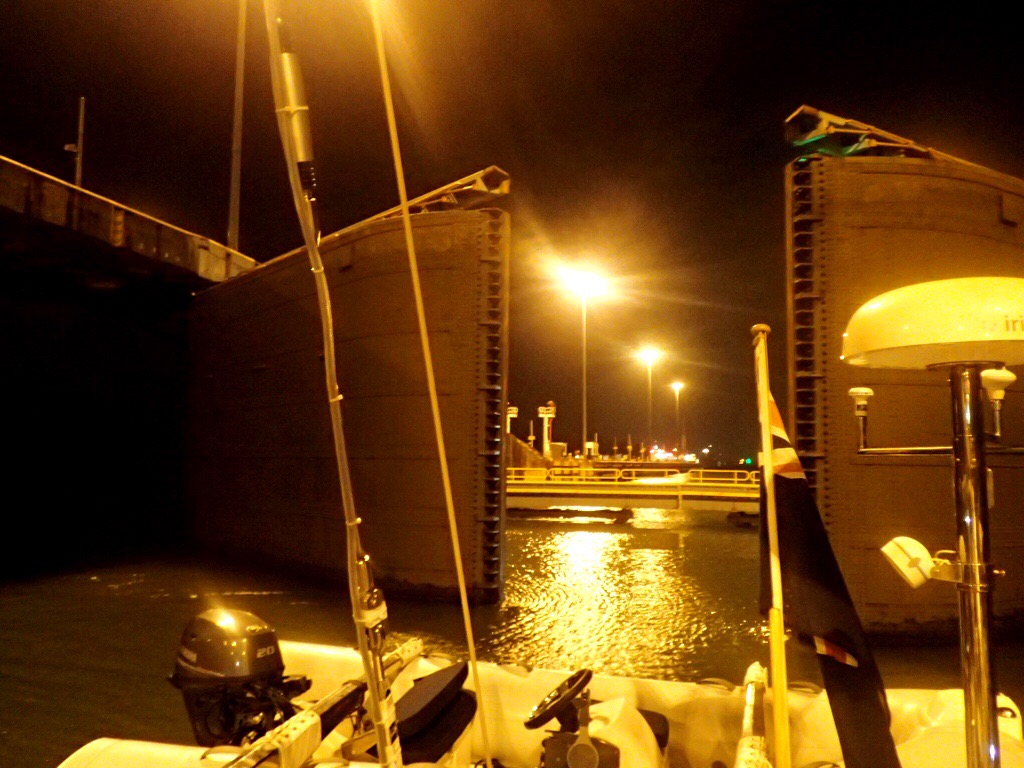
As we approach the first lock it is beginning to get dark, strong lights show the way. Rafting to the other two boats is relatively easy but feels very odd to Rick at the helm as he guides the three boats into position in the lock. We are dwarfed by the tall ship that looms above us. 

Entering the first lock behind the container ship Ditlev Reefer

The large gates clank shut heavily from behind, they are made of dark, riveted steel, Rick names them the Gates of Mordor. A ripple of excitement runs through the three yachts, cameras click, we all gasp in awe and wonder as millions of gallons of water start to fill the chamber lifting us the ten metres required to enter the middle lock. The process is repeated a second and then a third time until an hour and a half later we are finally 30m higher and can look back to, far below, the Carribbean sea.  We enter the man-made Gatum lake and moor up to a large bouy, unload our advisor and settled down for the night.

The ‘Doors of Mordor ‘ close behind us

The lake was flooded when the Canal was first created at the beginning of the last century, by damming the Chagres river. The hill tops, now islands, having been isolated for over a hundred years and have become an incredible haven for wild life. The guide books tell us they are home to amongst many other things monkeys, sloths, toucans and crocodiles. We are informed we should not leave the boat for a swim, advice we decide is worth taking.

At 9.30 the next morning are next advisor joins us, another young guy with perfect English. We are told they are Canal staff that volunteer for overtime to go through with the small yachts as they enjoy the excitement and varying nationalities of the crews. Edward is a tug boat captain, hoping to one day be a pilot guiding the large ships through and is very well informed.

It takes us five hours to motor the 30nm through the lake and canal to the final locks. We keep our eyes peeled for wild life and are rewarded by sighting three crocodiles, two small ones sun bathing, mouths scarily wide open and one larger specimen swimming closer to the banks. Apparently we are very lucky, most transits never see any sign of them. The lake turns from blue, to bright green, to brown as we approach the feed from the river which dumps tons of silt into the lake each day, creating the need for a very comprehensive dredging programme. Situated here, in this industrial but isolated position, is the high security facility that holds high profile prisoners including the ex-dictator of Panama, Maneul Noriega.

We vary our speed, allowing us to arrive at the Pedro Meguel lock for our allotted 4pm slot. Enroute we are passed by two huge tankers and one container ship. When at sea we think it’s a close shave if we come within a nautical mile of one of these monsters, even in the busy Southampton Waters it is rare to be quite this close, we could almost reach out and touch them.


For this lock we are tied alongside two pleasure craft full of tourists, a lot of them were English and American and seemed to be as fascinated by us as they were by the locks. We are followed in from behind this time by the 550ft long Chemical tanker Concept. The current locks are 110ft wide, the concept is 105ft wide that leaves just a couple of feet spare each side. They are guided through by locomotives that run on tracks either side of the locks and attach to the ships with cables, the drivers, guided by the pilot onboard slowly tighten and slacken these cables to inch the vessels into position. The widest boats we saw were 108ft wide just 2ft less than the locks!

It was a tight squeeze for the locomotives to fit the 105ft wide Concept into the lock.

It is then a quick motor through the small Milafores lake to the final two locks, again we are tied up to the pleasure boats and followed in by the Concept. But as we enter the second and last lock there is a fast current caused by the mixing of the fresh water behind us and the sea water of the Pacific in front of us. Docking with the pleasure vessel proves very difficult but with the team work of both crews and the advisor we finally get attached. We watch as the water level drops down the sides of the enormous walls for the final 10m, the gates begin to open and there we are approaching the Pacific.

Passing under th Bridge of the Americas into the Pacific Ocean

As we congratulate each other, another big step completed, it all still feels unreal that we are actually doing this. I look back at us sitting on the terrace at Ongley planning each stage and amaze that we are slowly but surely ticking each of them off.

Waiting our turn

 Wednesday 3rd February 

We spent a couple of days in Shelter Bay Marina, going through the process of admin and queuing for our turn to go through the Panama Canal. Onboard, every yacht has to have four sturdy lines, a minimum of 125ft long to reach up the high walls of the locks, plenty of fenders to protect the boat and four line handlers as well as the skipper on the helm. You are visited by an Admeasurer, a Canal official who measure the boats dimensions, checks that the boat can motor fast enough to keep up with the Canal traffic, is in good working order and has all the appropriate equipment. Raya passed on all fronts except we were one man down, we spent a few anxious hours asking around to find someone available to come through with us and finally found an experienced local guy who could help. It was then a waiting game until a slot became available.

Shelter Bay is the site of an old American base, when they handed the running of the Canal over to Panama at the beginning of 2000 the area was abandoned and the houses and streets are being rapidly claimed back by the rain forest. Just a couple of hundred metres from the marina is a 30min walk around an old road called the Kennedy Loop. On either side of the road is thick encroaching jungle, full of animals, birds and insects. It was great fun being able to walk through the undergrowth and see it close up while still being on the safety and comfort of talmac. There was great excitement as we spotted a band of monkeys leaping high above us in the tree tops. We were fascinated by a trail of busy ants, hundreds of them loaded down with bits of leaf they were carrying back to thier nest, so industrious had they been in their task that they had worn a path through what to them must have been giant leaf litter and sticks on the jungle floor. We could hear many types of birds flying between the trees and spotted flashes of exotic colourful feathers and above our heads sored a dozen buzzards. Last but not least we’re the huge butterflies of turquoise, orange and yellow fluttering between the flowering bushes.

  
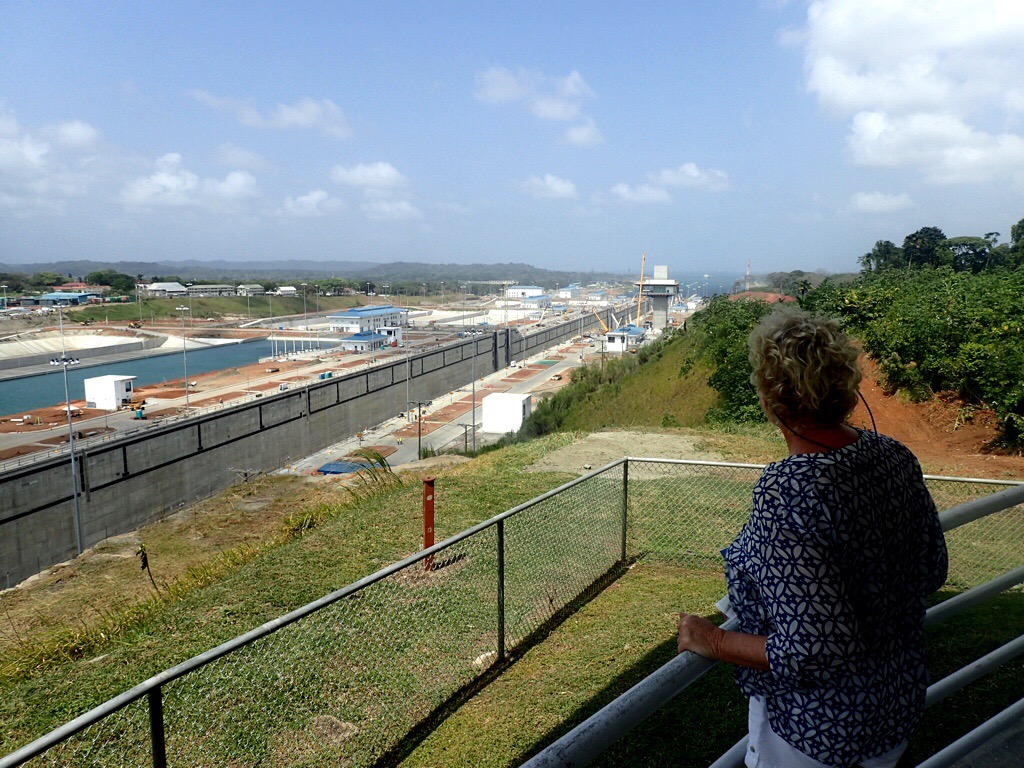
Rick our line handler also used his car as a taxi so we got him to run us to the viewing platform above the first set of locks we would go through, Gatum Locks. We watched as a huge tanker squeezed in through the side walls and was slowly lifted up ten metres. The scale of this incredible piece of engineering became clear, especially when we moved on to view the new locks they are building to accommodate even larger ships, where still in construction, we could see its massive bare bones. We came away more apprehensive than ever.

  
The marina itself promised much but delivered less. The entrance led from the Cristabal Harbour and was very close to the action at the beginning of the Canal but was totally isolated on shore and was miles from anywhere .The mini mart on site was always late opening and rarely had much for sale. Sheridan and Jonathan bravely took a taxi 30mins to the nearest town Colon, a rather run down place that supports the activities around the running of the Canal and where we were warned it was unsafe for tourists to wander on the streets but they did find a supermarket and picked up a few supplies.The marina staff were friendly and tried to be helpful but  everything was rather disorganised. The food at the one restaurant was okay but the service was so bad it was agony to eat there. There was a pool to cool off in but too small for lengths and a wifi service that at best was intermittent.  

Luckily our agent Alex whom we had hired to organise our canal transit has got us a cancellation spot, we leave tomorrow. 

Stunning San Blas

Monday 1st February 

I am almost embarrassed to post the pictures of the San Blas, so photogenic were these islands littering this part of thePanamanian  coastline, that we couldn’t stop clicking our cameras. The rough sail down was definitely worth every rocky moment. I apologise in advance.

Sitting in the cockpit anchored between two islands at the eastern end of Holandes Cays the views are stunning. Straight out the back is blue, blue sea stretching ten miles to the mountainous mainland shrouded in the haze. To the right is the palm covered island of Acuakargana the shore of which lies behind a long coral reef, the water is extremely clear and warm. We had a great snorkel amongst the pretty coral heads and the shoals of Blue Tang. In contrast was the guy we came across with his loaded spear gun (spear fishing is prohibited in the San Blas) clad in army camouflaged wetsuit with three unlucky reef fish tucked in his belt.

Back in the cockpit to the right is a tiny sand bank just exposed above the waves, that is surrounded by crystal water of multiple shades of the turquoise that I simply love. We seem to have finally arrived.


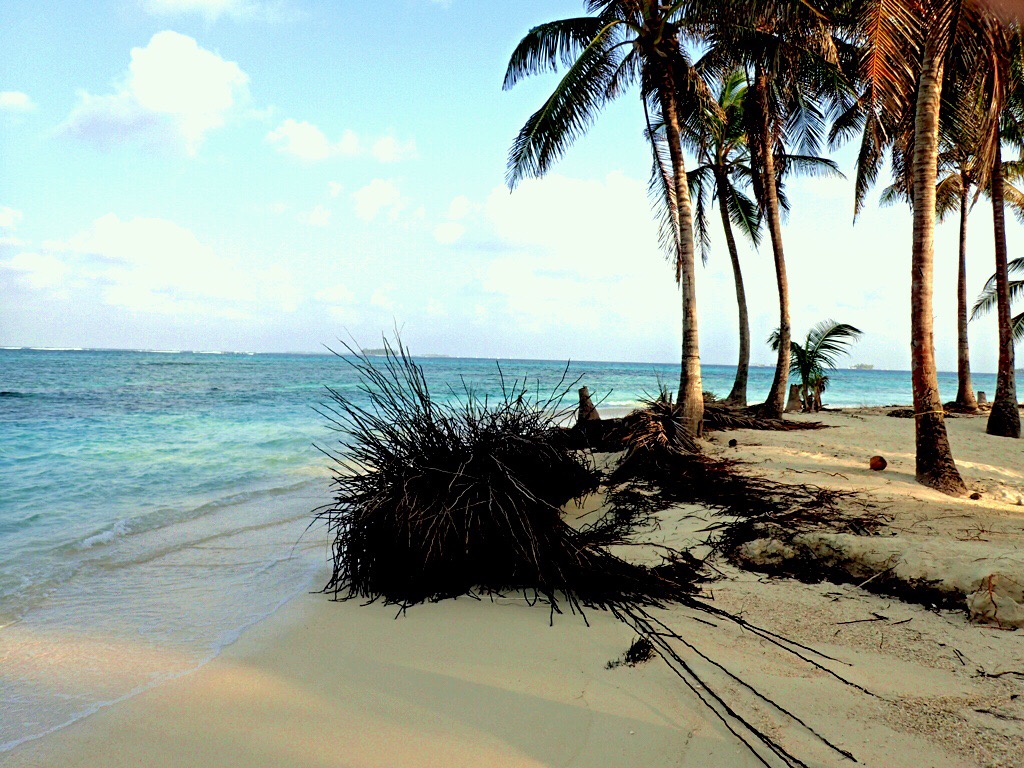
In front of us is Waisaladupat a slightly larger island again thick with palms and mangroves around its shore. It had an irresistible white coral, sand beach completely surrounding it, so just before dusk we took the dingy ashore and walked its perimeter. The shore was strewn with fallen coconut palms exposing thier amazing root systems, tendrils of which in some cases still clung to the sand in a last ditch attempt not to be washed out to sea. The trunks were often covered with small crabs using them as a bridge above the tide. Otherwise the islands were surprisingly rather devoid of wild life, the sea contained less fish than expected and in the sky there were pelicans, whose fishing antics are always fun to watch, but not a lot of other bird life.


Avoiding the mangroves that blocked our path around the island.

We had spent a night in two other equally beautiful anchorages. On each of the islands we have found huddles of small wooden huts roofed with palm fronds, these belong to the indigenous population the Guna Indians whom despite an airstrip connecting them to the rest of Panama and the continuous stream of yachts, continue to preserve thier culture and traditions. They seem accepting of all the visitors but we did feel a bit strange landing and walking on thier islands rather as if we were traipsing through thier gardens.

We were frequently visited by small groups of Guna that paddled out in sturdy dugout canoes to sell us lobsters. We had only been anchored for about ten minutes before we had a large specimen onboard ready to go on the BBQ, at the back of the boat and very delicious it was too. Other canoes are full of local crafts, including the appliquéd squares of fabric intricatly embroidered called Molas, Sheridan and I spent a very pleasant hour choosing and negotiating a few to buy as souvenirs. 

Gona dugout canoes ‘ulu’

Navigating the shallow archipelago was not as difficult as we had imagined, the passes through the coral were relatively deep and wide and the colour changes indicating the depths of the sea bed and position of the reefs easy to see from the bows of the boat. Looking back at our track on the electronic charts we were glad to have been warned to ‘eyeball’ navigate, it indicated we were anchored on top of the island and we had entered the lagoon by motoring directly across the reef.

We said a sad farewell to the soft white sand and turquoise seas on Sunday, as tomorrow we have our inspection with the officials for the Panama Canal hoping for a transit on Wednesday, a very different but no doubt equally fascinating experience.

Challenging Chores

Wednesday 27th January

The sun is rising behind us and even on a relatively benign night such as we have just had, the appearance of the sun is always welcome. We are 25nm north of the San Blas Islands and the point in our heads, where, throughout all the years of planning, the real adventure begins.

Bonaire to San Blas my route plotter informs me is 670 miles The San Blas are a group of small coral islands and to enable us to safely navigate the reefs it is important to arrive in daylight. This meant we either had to go fast or much slower and the high winds that are common off the Columbian coast have ensured this trip has been really quick. We have made really good time averaging about 7.5kts. The winds have been lively we have often had all the sails deeply reefed with gusts of over 50kts.

It’s not been the easiest of passages, we are all feeling a little jaded. Until this morning, when the sea has calmed down we have had a large swell, luckily mostly behind us. The middle days were the windiest and particularly rough with 4m waves looming up behind the dingy on the back of the boat. They seem to hang towering above you for a moment, before lifting the stern of the boat and if you are lucky, cause the boat to surf at great speeds, we broke our surfing record this trip with a top speed of 16.2kts! Not many waves catch you straight on of course and the further to the side they get, the more you roll and the more uncomfortable it is.

Even in a small roll life can be challenging, take two examples. Firstly cooking, the cooker is gimballed, that is, it rocks with the boat and therefore is always on a flat plane. It does take a big leap of faith to feel comfortable with a pan of hot food that is leaning dramatically towards you, looking like it will topple at any moment but of course the food is in fact flat and the surroundings and you are the things that are tipping over. Nothing you put on any other surface stays still, next time you cook even something simple just notice how many bits and pieces you have around you. Now try to imagined you are having to wedge yourself against the counter to steady yourself and that everything you put down is sliding back and forth, constantly – that is cooking at sea. We have overcome some of these problems by cooking in short stages, keeping as much as possible in the lockers till needed and we have numerous nonslip dishes, boards and mats that in most conditions keep things relatively still. We have deep bowls to help keep the food from spilling while you eat and a drinks rack to keep mugs and drinks upright. On short trips or when it’s very rough we resort to something pre made from the freezer, beans on toast or a sandwich but even for this trip, of just under four days, with three meals a day, that’s twelve meals and you can only eat so many sandwiches or tins of beans.

Then think of taking a shower, again if we are sea for one or two days we don’t bother. We are lucky, Raya has a large water tank and an efficient watermaker, so we can shower when we need to but if it’s at all rough it’s not easy. Firstly you need to undress, try taking your clothes off while you are clinging on to stay upright. Then into the shower, the soap, shampoo, conditioner etc won’t stay still, I put mine in the sink and step precariously out for them as necessary. To wash your hair takes two hands – again just try it with one, so I keep myself upright by planting my feet wide apart and pressing my bum against the wall, washing quickly. It feels great to be clean but still you need to dry and again you need two hands, comb your hair or whatever and then get redressed. This is not an elegant life.

One returns to the cockpit from the galley or the bathroom hot and bothered and in need of a rest. We are reminded yet again that the sailing is often the easy bit. But on the days when the sea and wind are feeling kind to you and when you arrive at somewhere as unforgettable as the San Blas Islands it is all definitely worth it.

Bonaire Bound

Wednesday 20th Jan
Jonathan and Sheridan flew out Saturday, they are sailing with us to Panama and through the canal with a few stops en route. After a morning provisioning and lunch at the beach we readied the boat to leave. Midmorning Monday we said a fond farewell to Grenada to sail westward. It is often hard to find a moment to look up from coiling the lines, stowing the fenders and checking the charts as we leave a marina or anchorage but I always try to make sure I say a quiet goodbye to places as we sail away.

For the first few hours the winds were light and directly behind us, add to that rather lumpy seas that rolled the boat and flogged the sails, it wasn’t comfortable. The 410 nm to our next destination, Bonaire, seemed like a long way away. Within a few hours however the sea settled, the wind increased and backed slightly to the north and a strong westward current appeared. For the next 48hrs that’s pretty much how it stayed. We were running a downwind rig with the genoa poled out to windward, the boom on the other side as far forward as the shrouds would allow and the stay sail pulled tight in the centre. With the favourable current we have been flying along often at over 8kts with the promise of arriving in Bonaire with an hour or two of daylight remaining. Today unfortunately the wind has dropped and is back in the east, so to keep us on schedule the engine is on.

But it has been a pleasant sail, conditions have been relatively benign, with little rain, sparkling sea and moonlit nights. The watch system has worked well and with Jonathan, an experienced sailor, onboard, Rick has got much more sleep than normal. We have been entertained by shoals of flying fish and flocks of fishing birds. We saw again the elusive green flash as the sun dipped below a crisp horizon and at night we have whiled away the hours identifying the stars using a clever star guide app on my iPad.

It is amazing how far the flying fish can fly, a few feet above the waves they swoop and glide, looking much like a swarm of giant dragon flies. For some reason at night they fly much higher, sometimes high enough to strand themselves on our decks, as Sheridan can attest to. During her early morning watch she was startled as one flew straight into the cockpit and hit her on the head!

We are sailing less than a hundred miles from the Venezuelan mainland so we have had plenty of bird life around the boat as well. Our favourites were the masked Boobies, largish white birds with black around their faces, on their tails and under their wings. They dive spectacularly, vertically straight down, to catch small fish which they eat on the surface before taking off and diving again.

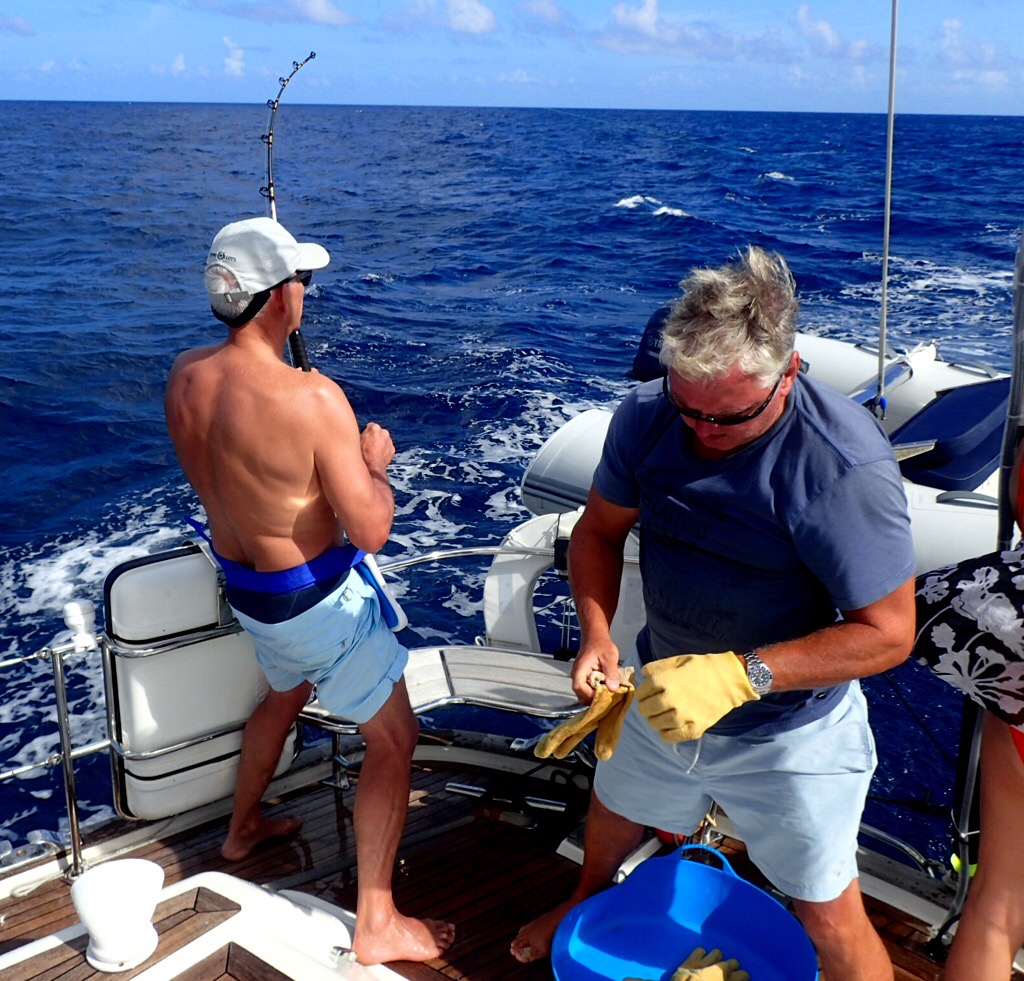
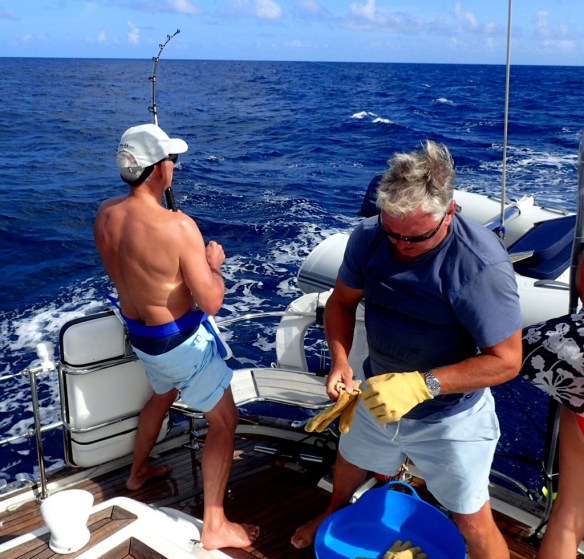
Not too much luck however with the fishing this trip, there was the ‘one that got away’, a 3ft Dorado that escaped as Rick attempted to haul him onboard and a Spanish mackerel too small to bother with, otherwise the rods have been quiet. We have noticed one odd thing, all our catches on the boat so far have been with the starboard rod, whichever lure is put on the port side nothing happens?
Landing the ‘fish that got away’

Friday 22nd January 

Bonaire is the B of the ABC islands, three islands that lie north of Venezuela and are part of the Netherlands Antilles. The coast off Bonaire is very deep and the water crystal clear, the National Park to the north is home to the rare yellow shouldered parrot and many of the beaches are turtle nesting sites. The authorities are making a big effort to preserve this pristine environment, imposing strict rules, there is no anchoring anywhere around the Island, large sections of beach are off limits and to dive or even snorkel you need a permit. Yachtsmen are asked to dispose of their rubbish correctly, use their black tanks at all times and be careful not to allow anything to end up overboard. A couple times a year the local population don thier scuba gear and take to the harbour to clean the sea bed.

We approached around the south of the island past the salt lakes, used still, to provide salt for export. We pass three coloured obelisks along the shoreline, spaced about half a mile apart, that years ago were used to indicate the location of varying grades of salt available to the ships arriving to take salt around the world.

The main island is kidney shaped with a small island lying to the west, providing a well protected natural harbour at its centre. We sail in as the sun sits low in the sky and pick up a mooring bouy off the main town. Kralendrjk is an interesting place, which we are finding as hard to describe as to pronounce. It stretches long and thin along the sea front, the buildings architecturally unremarkable but solid and colourful with their orange roofs and yellow and blue walls. The traffic moves along the streets at a snails pace and the locals, a mix of Caribbean, Dutch and American, are happy and helpful, there is a definite feeling of a place stuck, pleasantly, in the past.

After checking in at customs and immigration and wandering around, we pop into one of the numerous dive centres to buy our snorkel permits and get the low down on the best spots to visit. The island of Kliene Bonaire, an easy dingy ride away, is one of the spots recommended, so we collected our stuff and motor across. 

A wet crossing in a very full dingy

As we approach, the white sand and turquoise sea is breathtaking and when we put our heads underwater the clarity of the water is amazing. We are surrounded by hundreds of fish, of dozens of species, large dazzling Parrot Fish, inquisitive Sargent Major’s and large silver Bermudan Chub, yellow and blue Scrawled Filefish, two foot long Trumpetfish and tiny iridescent blue Angel Fish. The corals seem to sparkle in the sunlight. Bonaire, our guide book tells us, is one of the top three of the Worlds scuba diving areas, we were sceptical, could it really compete with the Maldives or the Red Sea, after our first rate snorkel we decide to stay another day and take a dive trip to investigate.


About 30m off the beach a change in colour from turquoise to dark blue marks where the sea bed drops away to hundreds of meters deep, creating what’s termed in scuba speak as a wall. These walls are brilliant to dive as they are covered in coral and fish and importantly to us, without a guide, you can’t get lost. The coral was extremely petty, hundreds of different varieties of hard and soft corals, the branches swaying in the current. The small fish weave in and out and the larger ones patrol up and down the sides. A shoal of bright blue Chromis rush past us, we peer warily into the never ending blue to see what might be chasing them. After 40mins we come to the top feeling exhilarated, but top three, well perhaps at other spots on the island.

Jonathan and I diving the wall

Calm, Colourful Days

Sitting on deck we watch a deep red sun set dramatically beneath the horizon and as the resulting flaming sky fades it reveals the smallest slither of a moon, that following the suns path, sets itself a few hours later. The last couple of days have been good days, I can’t remember the last time we have really relaxed and soaked up our life afloat. The weather has improved, we have calm, blue seas, blue skies and a soft cooling breeze. Caribbean weather at last.

At anchor in True Blue Bay

We left the marina still with grey skies, more squally showers and battled against a strong head wind around the bottom of Grenada and into Clark Court Bay. The entry to the bay was through a pass in the coral but the charts were accurate and the channel buoys in place so the lack of sun to show up the depth of water wasn’t a problem. Once inside it opened up to a large, deep and protected harbour and with surprisingly few boats inside we found a quiet space to anchor. I don’t know whether it was coming from the noise of the town surrounding the marina but it seemed incredibly quiet, the wind dropped and we relaxed.

We had been drawn to this spot by the promise of sausages. On the opposite side of the bay was Whisper Cove and a small marina, the guide book told us of a butcher that sells good quality local meat and home made sausages, looking out at the jungly green hills surrounding the bay this seemed unlikely but we took the dingy across to explore. We entered behind the few boats moored at the pontoon and hemmed in by mangroves it was shady and a little spooky. As we tied up to a neat and tidy dock we realised that the undergrowth was in fact managed, a pretty tropical garden. We climbed the hill to a veranda and an extremely welcoming restaurant, “Steak, Chips and a Beer for £8” said the blackboard, it tasted as good as it sounded. And sure enough through a door at the back of the restaurant was the butchers, having sampled the produce we stocked up with sausages and enough meat to get us to Panama and headed back to the boat.

Our next stop was a few bays down, we sailed past the crowds in Prickly Bay, around a small headland into the near deserted True Blue Bay. On shore The True Blue resort is a muddle of dark pink, blue and orange buildings nestled in the undergrowth. It has an equally colourful waterside restaurant the Dodgy Dock. 

I wonder why it’s called the Dodgy Dock Restaurant?

The bay lived up to its name, with the improved weather the sea is true blue. We haven’t done much, Rick filled some dents in the swim deck, I scrubbed around the waterline of the hull, we have read, explored in the dingy and foraged ashore for Internet. This we have found in the restaurants, so each day we have logged in and lunched.

After a day alone, we were joined in the bay by first one, then two other Oysters. One of the things we are really enjoying is meeting so many new people. It is rare in life to meet and make so many new friends but everyone has so much in common with each other that friendship within the cruising world is easy. 

Over the last week we have enjoyed a glass of gin or two with a couple from Tasmania, Bill and Naomi who are cruising the Carribean before sailing back to Hobart. A young couple, Charles and Zoe, with a beautiful, 1984, 37ft Oyster who like us have upped and left to sail around the world. Finally a lovely family from Cork, we first met during the ARC, on thier Oyster 53 Crackerjack, Sully, Joey and the kids, who are enjoying the Caribbean for a few months. 

People are extremely generous with their knowledge and time, happy to help each other out, freely swapping experience, information and discoveries. We discuss past adventures, future plans and the continual lists of maintainance to complete.They tend to be brief encounters but there is a real sense of community and with trackers, blogs and social media we can all follow each others progress and no doubt will bump into many of them again elsewhere in he world.

Holed up in Grenada

Before we left experienced cruiser told us that sailing around the world was just carrying out boat maintenance in exotic places. And so it is we find ourselves in Grenada, an island of wooded mountains, white sandy beaches, reggae, spices and rum, tied up to the dock of Port Louis marina, a marina much like any other, with spanner and cloth in hand and little or no time to explore. We are very aware that not only are the places we are about to visit even more exotic they are also more remote, so we are working hard here, in relative civilisation, to get the boat in as good a condition as possible. Doing anything is hard work in this heat, everything taking more time than normal, our clothes are soaked with sweat. We have to stop frequently to try and cool off and however much water, tea or beer we drink, it’s hard not to get dehydrated and tired, never the less, we are pleased with what we have achieved.

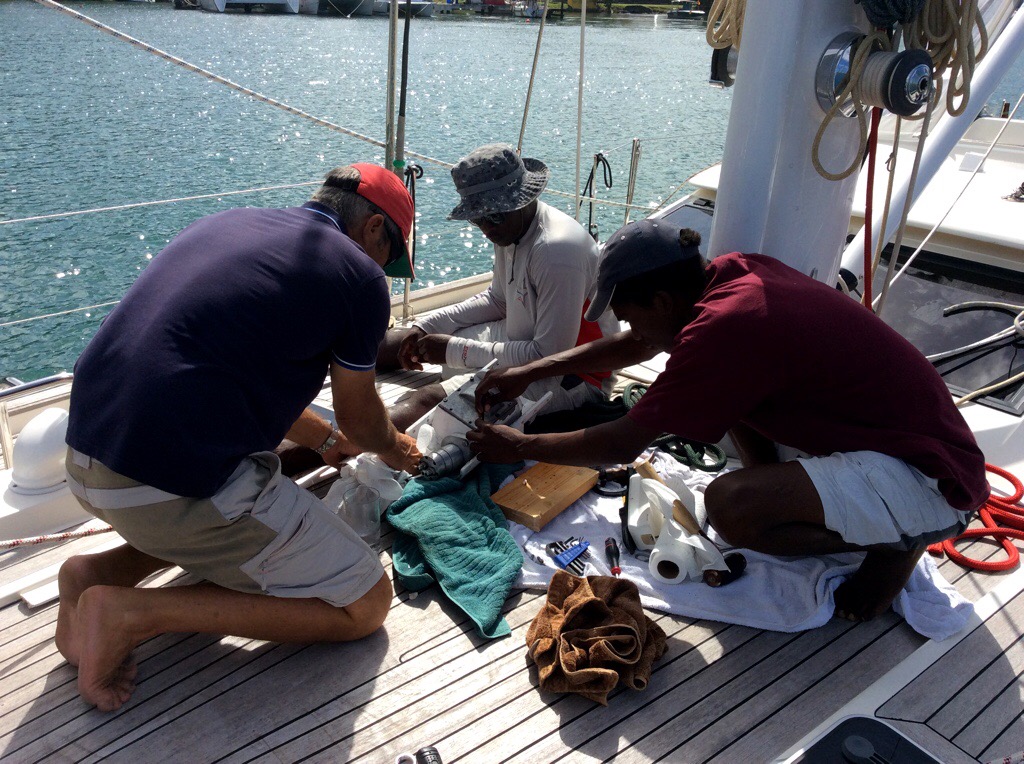
Rick has managed to fix the wiring problem on the “up” mechanism on the anchor and with help of the rigging company here, Turbulence and Harry back in Southampton the main sail furler is also fixed. He has been through all 26 of the through hull fittings that are below the water line and checked they are in good condition, repaired a leaky lid to the watermaker oil reservoir, got the boom lights, that have never really worked, working and almost sorted a problem with the gas supply to the cooker. 

Repairing the furler

Raya has been scrubbed and polished  inside and out and the provisions left over from the Atlantic crossing have been sorted and re-catalogued. Spares have been ordered and the charts for the next passage to Panama have replaced the windward Islands on the table.

While we have decent internet I have been battling with all the paperwork required for our transit of the Panama Canal and our visit to Galapagos. This has required dozens of emails to the agents that we have had to engage to help with this process and numerous forms, copies of passports and crew lists have been sent. 

Luckily the marina is very well placed with most of our requirements within a dingy ride. The chandlers, a supermarket, even the main town of St George’s all have dingy docks. St George’s, the small capital is surrounded by steep hills that run right down to the protected harbour. The waterfront is lined with rather incongruous Georgian style buildings, a legacy of times when the harbour was busy with Clipper yachts exporting spices particularly nutmeg to Europe, now the Clippers mostly carry tourists.

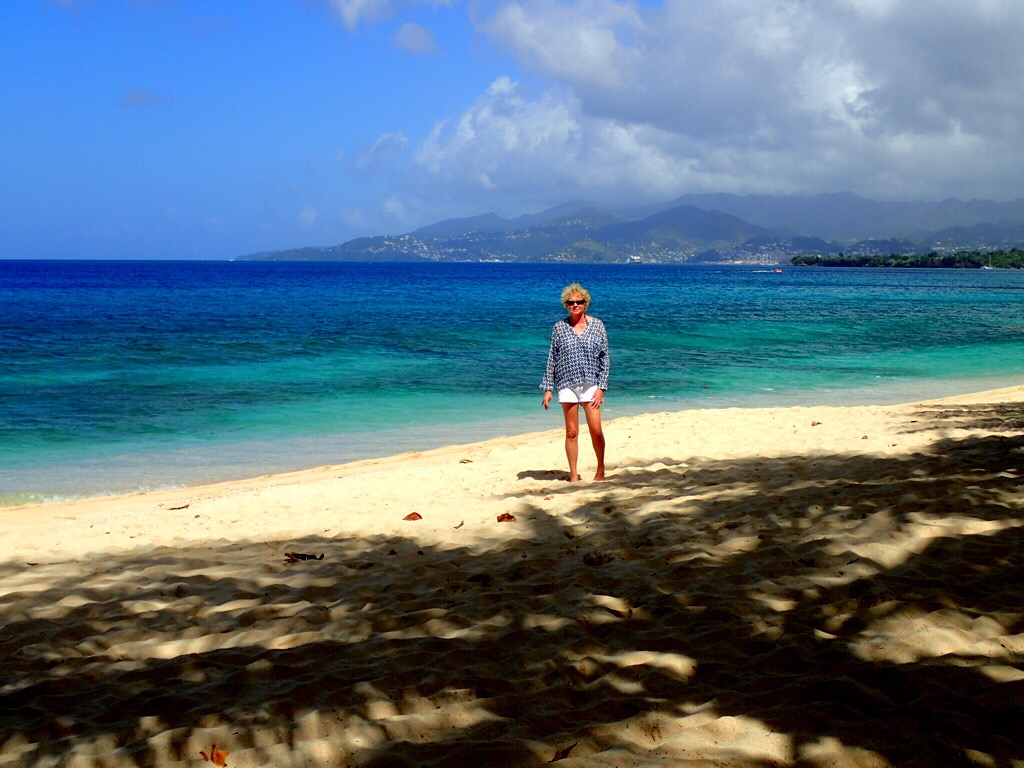
Yesterday feeling that we deserved a break we took a cab to a beach restaurant that had been recommended as one of the best on the island – The Aquarium. It lived up to its reputation, the location was picture perfect with tables right on a stunning beach, we played in the waves, ate lunch under the palm trees and drank too much rum. 

The beach at the Aquarium Restaurant

Today it was back to work but we had some help. One of the poles that support the Bimini had taken a bash during the Atlantic crossing and was proving hard to fix. We seem to be making a habit out of bumping into people even though we are half way around the world and bizarrely Rick’s brother and wife, who are on a proper cruise arrived into Grenada for the day today and with thier friends Bob and Yvonne, popped over to see us. Between the three boys they applied their combined engineering knowledge and a couple of hours and plenty of tea later we had a workable Bimini pole. 

Most of the jobs done, tomorrow we plan to leave the marina for a few days and anchor ina quiet  bay somewhere and catch our breath ready for the next leg of the journey.

Visitors, Tony, Brenda, Bob and Yvonne

Happy New Year

Well here we are at the dawn of 2016, time marches on relentlessly. We have achieved so much in 2015 but this new life is a continuous succession of challenges. This year we set off into the Pacific and waters unknown. Rick points out that when we swapped our house for a boat, as we set off from Southampton for Plymouth, did our first night sail, spent time at anchor, crossed our first ocean, it was all unknown and this is just another step. However as we waved goodbye to Rachael, Matt and Robyn for a moment our links to home and our comfort zone seemed stretched thin.

Rachael and Matt re-enacting Pirates of the Caribbean where it was filmed on Petit Tabac

Boxing Day brought yet another day of squalls, we were headed for the reef studded bay at Clifton on Union Island, with the hope of being able to snorkel straight off the boat. But with the weather being so stormy and the reefs so close we decided we should stay for as short a time as possible. 

We did have to go ashore however, as Union Island is the most southey island of the Grenidines to have customs and immigration and before we could enter Grenada we had to check out. This is one of the downsides of island hoping in the Caribbean, each island or group of islands is a new country and requires you to fill out a huge form in quintuplicate or whatever five copies is, on entering and again when you leave. This process takes place in a variety of drab offices, manned by stern and bored custom officers. You are advised to treat these formalities with due respect and to be smartly dressed, not so easy when you have arrived by dingy, are soaking wet and are  protectively clutching all your precious documentation. You are often required to queue at three different offices that each take money from you for various unknown reasons and to get your five forms stamped, they do this with such relish you wonder how long thier rickety desks will last.

Paperwork all correctly completed we stopped for a beer, Union Island was quite different from the islands we had visited so far. Between the small town of Clifton and customs at the airport, a five minute stroll, was a goat farm. The town was sleepy and friendly, the locals proudly announced it was the Caribbean of the 1960’s. We would have liked to stay but the straining of the anchor against yet another squall persuaded us otherwise and we sailed on to the Island of Caraicou, part of Grenada and another customs office.

Papers again stamped we settled at anchor in Tyrel Bay where we spent a pleasant couple of days dodging the rain showers and relaxing. There was a nice beach, yet another good beach bar and a mangrove swamp to explore in the dingy. The visibility for snorkelling hasn’t been brilliant but we did have a final swim at the marine park just north of us here in St Georges on Grenada. Statues have been placed on the sea bed and make for an interesting sight amongst the fish and the coral.


We are now moored up in the very plush – great showers and Internet cabled to the dock, Port Louis Marina, St George’s where except for a few days to explore we are based until Jonathan and Sheridan arrive and we head to Panama. Tonight there is a big New Years Eve party, at lunch time we sat and listened to the band setting up, they were brilliant so we have bought some tickets, have put on our dancing shoes and are heading across to join in. Here’s hoping our ears can take it. Happy New Year.

Christmas in the Cays.

Early on Christmas Eve we left Bequia with a succession of squalls battering us. The squalls first appear on the horizon as forbidding dark clouds and as they carry high winds and torrential rain when spotted we leap into action, reefing the sails, clearing the decks and then if possible hiding below. The rain reduces visibility to almost nothing and the winds rattle through the rigging. The high winds, in or out of the squalls are common at this time of year, locally called the Christmas Winds, we have been trying to concentrate on the Christmas rather than the Winds. Alas, the winds and squalls have continued, at times it’s a bit like we are holidaying in Devon, all huddled below reading, writing or playing scrabble. Of course it is still hot and when the sun comes out to play our surroundings are magnificent.

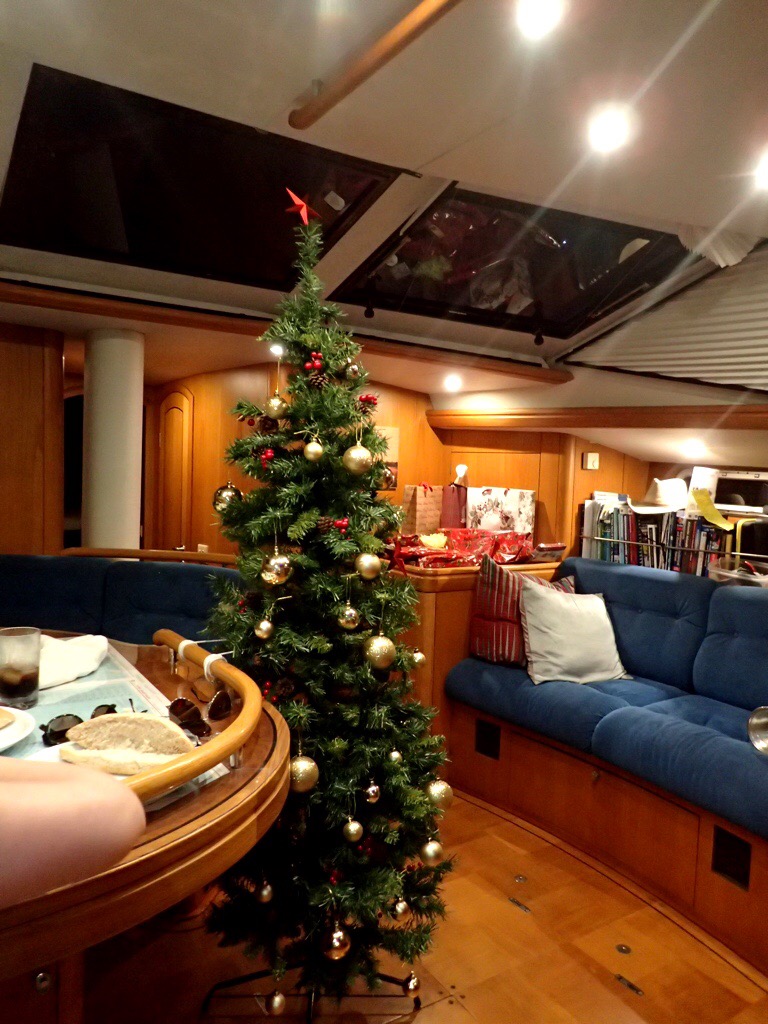
We arrived in the Tobago Cays at midday and Christmas really started when Rachael produced, Mary Poppins like, a five foot tree from her bag, Matt and Robyn brought baubles, Rick and I provided some fairy lights, which Matt strung around the cockpit and we played Chrismas songs on the stereo. The boat was transformed within minutes. 


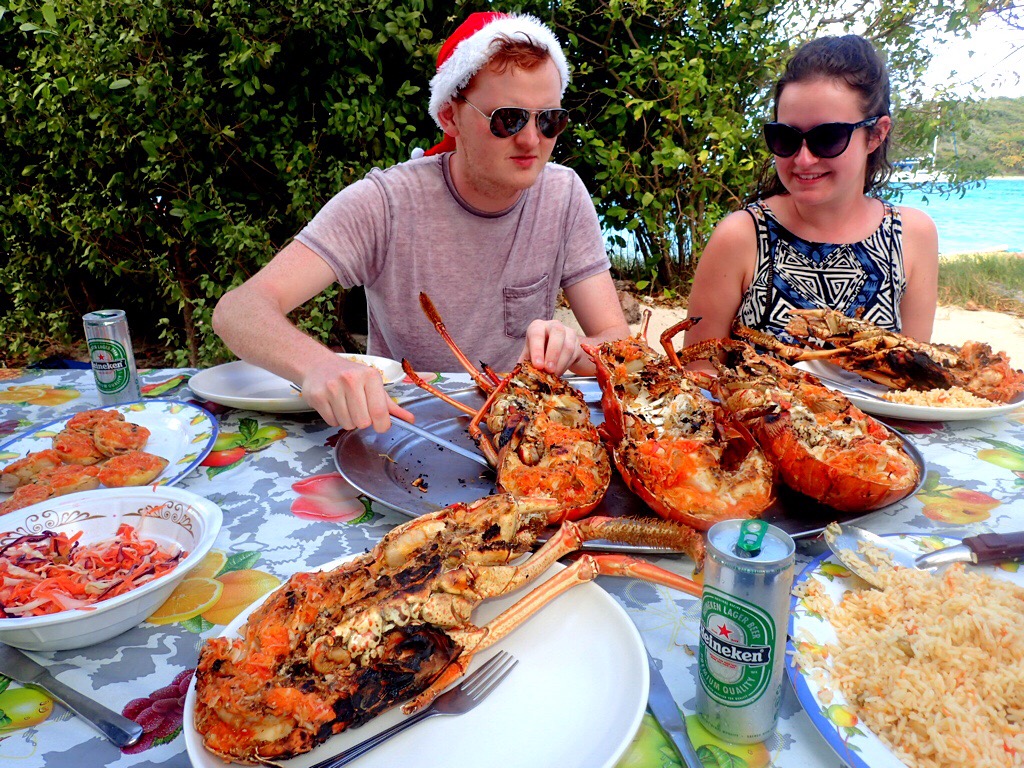
Christmas Day started as normal with scrabbled eggs and smoked salmon for breakfast, followed by present opening, at eleven our neighbors came over for a glass of champagne, we ate a large lunch and took a little exercise. However, it was very much a Chrismas with a difference, our few presents were constricted by luggage restrictions, the neighbours came over by dingy from their Oyster yachts and the champagne was the bottle we had won from the ARC. The excercise consisted of snorkelling with turtles and strolling with iguanas and our lunch was of huge BBQ lobsters that we ate at the beach.


When the sun comes out the Tobago Cays are a mass of amazing colours, the small islands, as we have witnessed, get plenty of rain and are a rich green, the coral reefs from above the water are a pale brown and the sea a kaleidoscope of turquoise and blues. 


The area is a national park and the snorkelling although challenging in these windy conditions rewarded us with lots of fish and much to our delight a turtle. The islands are uninhabited by humans but home to large, 3ft nose to tail, iguanas, which, use to the tourists stroll past you nonchalantly.


It was difficult to feel too Christmassy with the sun beating down and sand between our toes, we pinch ourselves to realise not just that we are here but that we sailed here, all the way from Southampton.

Blowy Bequia 

We are anchored off the small Island of Bequia in the Grenadines, half way accross the world but we are continually bumping in to people we know. Half the crews of the ARC seem to be here and in a villa on the other side of the island are our old friends Laurie and Ian enjoying a Christmas break with friends and family.

Talk about a room with a view, their villa, perched high in the hills, looks out to the Atlantic Ocean. We joined them for the evening yesterday, not only did they serve us a fantastic fish curry, they gave us a few hours on firm ground to relax.


The high winds came as forecast and Monday night there was pandemonium as gale force gusts screamed across the bay. Anchors and even moorings were dragging, we spent all night watching out for problems, our anchor held firm but the catamaran in front of us was not so lucky. Rick spent a few tense hours on deck as they, fast asleep, slowly but inexorably drifted in our direction. Eventually he managed to wake them, flashing a high powered torch through their hatches and they turned their engine on with only 3m to spare. As we chatted with others the next morning nobody had had much sleep and all had there own tale of near misses to tell. Thankfully today – Wednseday – the winds have finally eased but the bay is still quite rolly.

The dingy has been a feature of our stay here, it is our only means of getting from the boat to shore. Riding into the high winds, especially with all five of us onboard has been very wet, protecting the paper wrapped baguettes an impossibility. However, it is vital and tying it securely to the boat imperative but today it has “escaped” twice, we are lucky to still have it! The first time Matt dived in to get it back, the second time a passing water taxi rescued it for us, I think there needs to be some serious knotting lessons for the crew tomorrow.

Despite the rather lively anchorage, we like Bequia it has a small town feel to it, everybody is very friendly and it lacks that feeling of intimidation we felt in St Lucia and St Vincent. As we wandered around the few streets that make up the main town, buying bits and pieces for our Christmas celebrations, there was a happy mix of boaties, tourists and locals. The interior is made up of lush, tree covered hills and the coast is rugged. Where we are in Admiralty Bay, there are two great beaches, one of which has a fun restaurant/bar, there are plenty of jetties for dingies  and good snorkelling.

Rachael, Matt and I swam around the small, rocky headland that devides the two beaches and saw a good variety of fish, including a small, black and white moray eel that was swimming in the open instead, as is normal, hiding amongst the crevices of the rocks and a shoal of Caribbean Reef Squid that look much like cuttle fish, rather strange creatures but fascinating to watch. Rach and Matt also went for a dive on a reef further out where they saw many more and much bigger fish.

We plan to leave early in the morning tomorrow and sail to Tobago Cays, a few low islands and a horse shoe reef with stunning turquoise seas, where better to spend Christmas Day.

Laurie, Ian and the boys join us for a beer in Admiralty Bay , Bequia

Goodbye to ARC World

Yesterday we left Rodney Bay and ARC World with a mixture of emotions. Excited to be getting on with the next part of the journey, sailing through the Grenadines with the Kids over Christmas, sadness at saying goodbye to our ARC family – all the friends we have met over the past couple of months and slight trepidation at emerging back out into the real world from the ARC’s protective bubble.

Rodney Bay from the top of the mast

The final night in St Lucia was prize giving night. The World Cruising Club, organisers of the ARC, do a great job at including everybody in the prizes and everybody enjoyed the evening. We are still surprised at how well we did to win cruising class C and were especially pleased to win the a Oyster cup for the first placed Oyster in all the cruising classes, particularly as it was accompanied by a magnum of Moët.

We cast off from the dock at eight thirty for the fifty four mile trip to Walilabou bay on the Island of St Vincent. It’s funny how your perspective changes, a few months ago a 54nm trip would have seemed a long way but now it seemed like a quick hop. It was quite quick, we were anchored by four thirty, but it was also a rough trip, the channel between the bottom of St Lucia and the top of St Vincent was horrible – 3 metre swell on the beam, overlaid with messy waves and 40kts of wind. 

We arrived into a beautiful bay with a sigh of relief, unfortunately this was short lived, having crossed an Ocean with hardly a breakage, we arrived in St Vincent to discover the mainsail wouldn’t furl and the up button on the anchor wasn’t working. Tired from the difficult crossing this was the last thing we needed, but finally with the sail furled away by hand, the anchor set at the bows and the stern attached by rope to a tree, we dinged ashore for dinner. We would face these problems tomorrow.

Walilabou bay was used for the filming of the Pirates of the Caribbean and the ramshackle restaurant was full of props, including a dozen coffins, a huge water wheel and a model of Captain Jack Sparrow  clinging onto the top of a mast, as seen at the start of the first movie. The food to our tied and hungry tummies tasted excellent despite our rather alternative surroundings.

We woke to a freshening breeze and we felt uneasy about the position of the boat, it sat awkwardly between the anchor and the stern line, the rocks seemed uncomfortably close. The forecast was for the winds to increase so we decided to make a break for it and sail to our next stop, Bequia, a day early. This, of course, first entailed raising 1/2 ton of anchor and anchor chain by hand, well done Rick, Matt, Rachael and Thomas the boat boy. St Vincent we’ll have to visit you properly next time around.

Reflections on an Island

We have left ARC World, in Rodney Bay, for a few days to take Roz B, who flew out to greet us, for a couple of days sailing. It feels great to have escaped the heat and intense activity of the Marina and fantastic to finally be swimming in the warm Carribbean sea but we sit in a place of contrast. 

Anse Chastanet is a beautiful bay surrounded by steep wooded cliffs that drop right down to th sea. In the foreground is a pretty resort that sits nestled in the vegetation and where we had a very nice lunch yesterday. The background is dominated by Petit Piton – the pitons are the symbol of St Lucia, volcanic conical peaks that create a very dramatic landscape. The sunlight twinkles off a green sea reflecting the trees that enclose it, we are tied to a mooring bouy with just two other boats, it should be extremely tranquil.


Unfortunately our relaxation is tempered, there is a small swell that is rocking the boat just a little too much and we have been plagued by a swarm of tiny flies that has found us and our food. 

The real tension however comes from the boat boys that aggressively insisted on helping us pick up a mooring, demanding money for their service. They have been followed by others that continually buzz past us in a selection of rickety craft showing more interest in our boat than feels comfortable. Last week we were visited by the General Manager at Rodney Bay Marina, the day before Eric, Roz and I had dragged one of the security guards from the water, he was completely out of it, not having a clue where he was or what was happening, had we not been passing when he wandered oblivious off the end of the pontoon I’m not sure he would be with us now. I felt obliged to report the incident not just for the security of the boats he is meant to be protecting but for his own safety. So it was that the English marina head came onboard for a cup of tea and we discussed amongst other things the perception of crime on St Lucia that is damaging the tourist trade. Sitting in this lovely bay, although nothing untoward has happened, that perception is unfortunately being re-enforced. 

For the first few days after our arrival, life past in a daze of exhaustion and  excitement. We revelled in our achievements and the congratulations of others, as all our fellow competitors, sorry participants, began to arrive and the emails and messages from home flooded in. Our smugness only increased, when wandering the dock we discovered Pixel, the boat and that had pushed us the most, was a full on, open cockpit racing boat, with eleven professional crew hot bunking and surviving on a minuscule ration of water to save weight. Bonkers!

In quiet moments we reflect on the crossing, we all agreed the ‘racing’ had added to the fun, but overall that the whole experience had been more straightforward than expected. It seems we had very few breakages or problems compared to most and that most boats had used much more complicated routing than ourselves. Our success seems to be down somewhat to our ignorance, a lot to our meticulous preparation but mostly to the brilliant boat we have in Raya.

Atlantic Crossing in pictures


Team Raya preparing to leave Las Palmas


An upside to the Atlantic squalls

5000 miles sailing Raya, 1784 miles to St Lucia

Boys enjoying the moment


Sailing with our blue cruising chute


Sailng west

Erics second Dorado


Captain “just call me Ben” Smith grabbing some sleep


First sight of land for fifteen days


Rum punch welcome to St Lucia


The blog that got away

Below is a blog that seems to have got lost in the ether of Atlantic satellite comms. 

Halfway there

Monday 30th November

The suntan lotion is back out, the crew are in T-shirts and shorts and have smiles on their faces. The sea temperatures is up to 25C, the air is 28C in the shade. Our lat/long is 22N/35W and the flying fish have started to land on our decks, we have reached the tropics. 

Today with much excitement we successfully flew our big coloured cruising chute. Ricks relief was obvious as it launched without a hitch and sped us along in the now light winds, justifying all that effort to drag it out with us to Las Palmas. Unbelievably we are still leading our class and the cruising chute will help keep us competitive, we need all the help we can get Raya doesn’t really perform well in light winds.

We get a position update at midday each day from ARC Control, so we know more or less where everybody else is but we haven’t actually seen any other ARC boats for a couple of days now, there have been a few targets on the AIS but we haven’t even glimpsed their lights at night, the radio is silent.

We have been sailing for a week now but I still struggle to grasp the enormity of the body of water around us. There have been plenty of times in the last six months when we have been out of sight of land and there is nothing now to show there is not an island, or continent for that matter, just over the horizon here too. I try to visualise us as that tiny speck on the ocean you see way below on a flight to NewYork but in reality our world is the twenty or so miles to the horizon all around us. We have plenty of sea below us too, as we committed a broken plate to the depths, Eric reflected on what it would past on its 2 mile trip to the seabed.

We have had moments of wonder, such as the stars last night. With no light pollution the sky was full to bursting and the cloud of the milky way was as clear as day. To add to the scene there was phosphorescence twinkling in our wake – stars above and below us. Within an hour the moon had risen and the stars faded as the moonlight shone so bright you could almost read by it. There have been lots of magnificent rainbows, their colours bright against the dark grey of the squall clouds, one particularly impressive one was a complete half circle that ended seemingly metres from our feet. On their watch the boys even saw a rainbow created by the moonlight, a very obvious bow of dull colours, I didn’t even know such a thing existed. And yesterday we were joined by our first pod of Atlantic dolphins.

There have been moments of calm when we can relax and enjoy being in this unique spot. Times of high activity as we change sails or battle the swell to prepare lunch and moments of suspense as we check out the latest position update or await a bite on the fishing line we are trailing.

However there is one thing you can be certain of when sailing and that is that no particular moment or situation lasts long. One minute the boat is sailing along nicely and then a slight wind shift will mean we can no longer point to where we want to go and everything is different. 

It is five in the morning my watch doesn’t start until six but the roll of the boat is making it impossible to sleep, the wind has shifted and not wanting to change our downwind twin sail rig in the dark we have had to turn slightly north bringing the swell onto the side of the boat. There is not much wind and the sails flog noisily, our speed has dropped and St Lucia feels a long way away. At least I am warm and dry, a few nights ago on my 3-6am watch, I had the rolling, the flogging and rain! 

We crawl slowly towards the half way mark that with the high winds seemed we would reach yesterday but at this speed we won’t make it for another eight hours. Sunrise will lift our spirits, the forecast is for the light winds to continue, so it’s all hands on deck to raise the cruising chute back up and try and to push on as fast as possible.

Atlantic Time

Fri 4th

Time, normally it’s quite a straight forward thing, but here on Raya, six hundred miles from St Lucia, we are grappling with Atlantic time, which has four different times at once.

Firstly there is boat time, currently GMT -2 .This is the time we use for the the day to day running of the boat, particularly the time we use for the watch system. As we travel west we have to add an hour about every four days to keep sunset and sunrise in sync with life onboard.

Then there is ARC control time which is set at GMT, this is the time all their updates relate to and is essential as we work out weather forecasts and the position of other boats.

Next is St Lucia time, GMT -4 which as we draw closer becomes more important as we try to calculate our arrival time.

Finally there is the random times all our electronics are keeping, my iPad for instance can’t find what time it is mid Atlantic and I can’t find a city that is GMT -2 to set it to, so it is stuck on GMT -1. When I wake bleary eyed and confused for my watch grappling with what the actual time is, can be a bit of a challenge.

To add to the confusion not one of us knows what day of the week it is and if it hadn’t been for Matts birthday on the 2nd, giving us some point of reference, the date would be a mystery too. Talk of Christmas from back home seems incomprehensible, as does the fact that in a few days we will be in the Caribbean without going anywhere near Gatwick. We are all however very clear about how many days we have left at sea, at our current
pace that will be  3-4 days depending on our old friend the wind.

We are sailing fast, dead downwind, flat out with our twizzler rig (two genoas one set either side of the boat)  but its touch and go if it is fast enough, the opposition is closing in. We can’t actually go any faster so we are just trying to enjoy the ride which includes 12kt surfs down 12ft high Atlantic rollers.

Each day is different, the sea is rougher or calmer the sky cloudy or clear, we spot a way off tanker or the dolphins come to play but they are tending to meld into one. Tuesday however stands out amongst the crowd. it started badly with us ripping the cruising chute. We had flown it carefully all night with winds rarely going above 12kts, as the sun rose Hartmut and I were on watch when suddenly a gust of 50 kts appeared from seemingly nowhere shredding our beautiful blue sail. This sail is not essential but Rick was beginning to really enjoy mastering it and we may miss it in the light winds we expect to encounter as we approach St Lucia.

That afternoon our mood was lifted, Eric caught a fish, a magnificent three foot dorado, that he filleted and cooked for supper, delicious and probably the freshest fish we have ever eaten. As he also is in charge of bread making he is rapidly gaining a certain status however his attempts at walking on water still need some refinement.

Today is much like any other we trim the sails trying to squeeze every last bit of speed from Raya, we cook, eat, sleep, read and clean, we stare out into the never ending blue, fill in the log book and increasingly pour over the position reports.

We are now all ready to get there and setting all our clocks and especially our body-clocks back to just one time, Caribbean time.