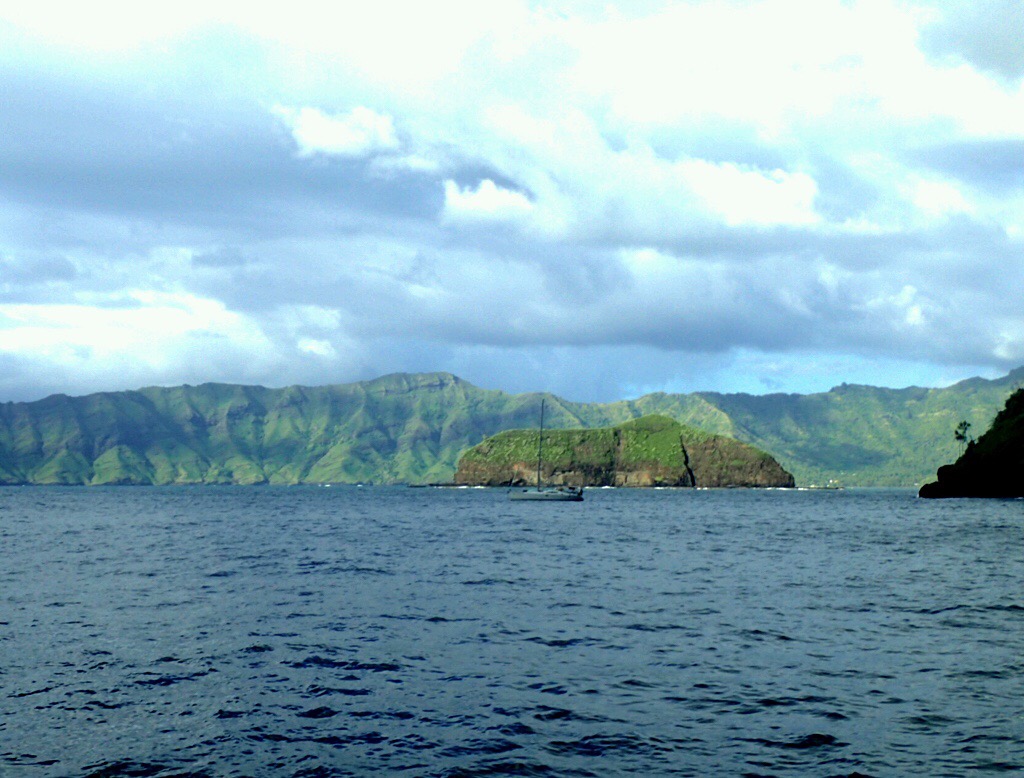
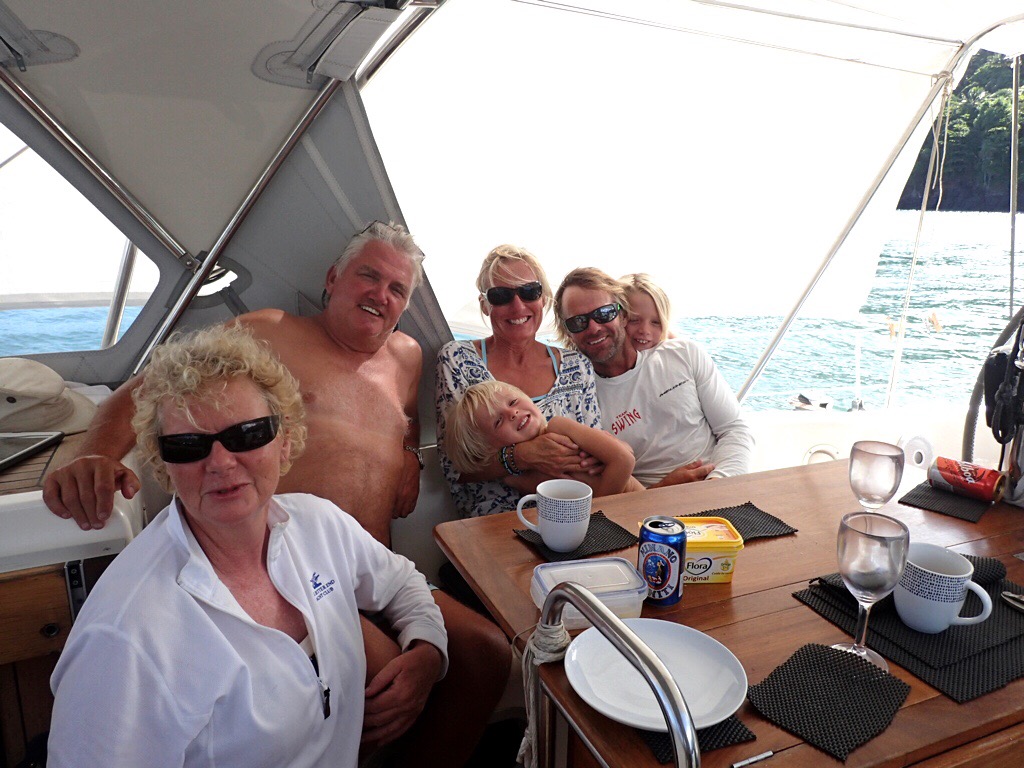
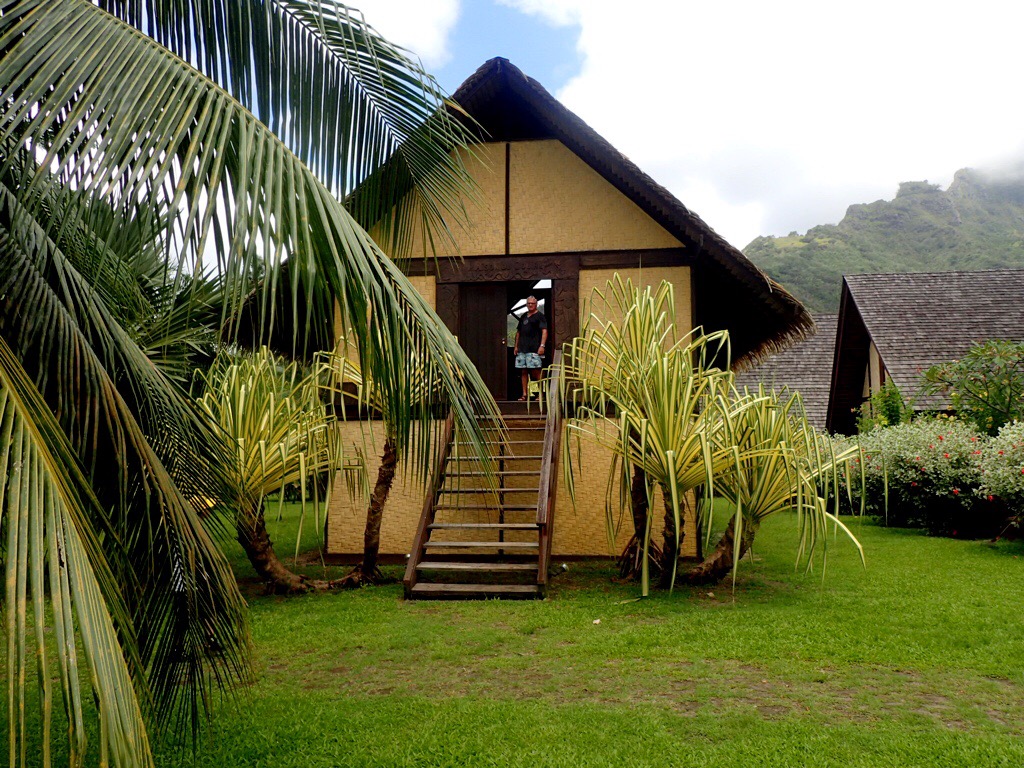
Music in Bora Bora

“Mayday Mayday”, not what we were quite a expecting to hear five minutes after turning on the radio to listen out for friends to make tonight’s dinner arrangements. “We see two people in the water calling for help, we are approaching the southern end of Bora Bora, we will attemp to sail back to them”. It turned out to be three divers, their dive boat had dragged its anchor and they surfaced from their dive to find it being blown by today’s brisk breeze inexorably out to sea. The yacht on the radio, Kiora, managed to get back to them and get them onboard, lucky guys, the sea is not friendly outside of the reef.

It was nice on arriving in Bora Bora last Tuesday, to find three or four boats we know moored in the bay just south of us. That night everyone was going in to the centre of Vaitape, the capital of Bora Bora, to see the Polynesian dancing. The fortnight leading up to 14th July, Bastille day, is a big celebration here, called the Heiva it is a competitive celebration of French Polynesian culture. Each day there are competitions, canoe racing, tapas fabric exhibitions, palm weaving demonstrations as well as  sports such as volleyball and beach soccer, most important are the inter-island traditional song and dance competitions. Ever since our arrival  in the Marquesas the importance of music here has been obvious, the unforgetable noise of the traditional drums has been the backing track for our stay. It seems every commune (equivalent of our boroughs) throughout French Polynesia is involved and from the evidence of the drumming, we have heard every where, they have been getting together to practice for months. Each island sends their best choir and dance troop, accompanied with thier drummers to the final in Tahiti. 

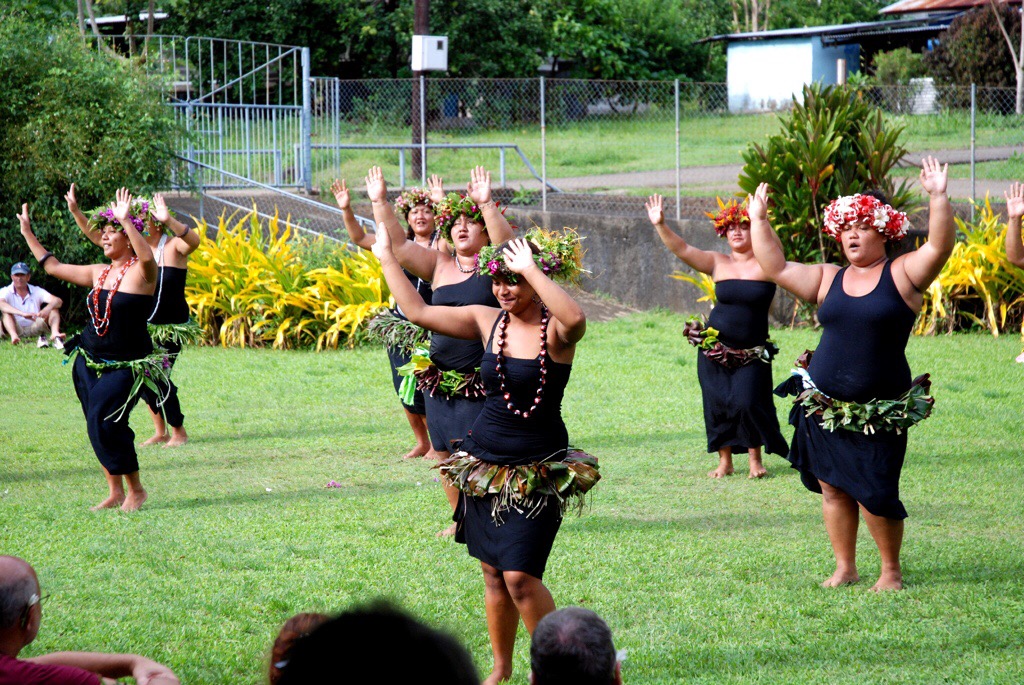
Here on Tuesday night we watched the final village performing for the judges in the hope of being selected to represent Bora Bora. The dancing in particular was spectacular, performed by over thirty female and male dancers from the commune of Nunue. Dressed in dramatic costumes and wonderful headdresses they twirled, jumped and vibrated, to the frantic rhythm created by an exotic mixture of drums. One of the main moves involves the girls shaking their bums at a phenomenal rate, we sit transfixed. We all walk back to the anchorage trying to work out exactly how it’s possible to move ones hips like that, our skinny Caucasian bums are just not fit for purpose. It struck us just how much effort had gone into the performance, the actual dancing was only half of it. The communes here are small with populations in tens rather than thousands, just making the outfits that were changed for each of the five performances must have taken weeks of sewing, the stage backdrop represented an underwater scene and was at least twenty meters long and the band comprised of about twenty players, what a great way to create community spirit.


A couple of nights later and we are again enjoying a musical performance, a local guitarist was playing in the Mai Kai Yatch Club bar. He was very good, apparently not keen on playing Polynesian music he sticks instead to the Eagles, Pink Floydd, Dire Staits……… He played with just his father backing him on base but had the knack of it sounding like there was a whole band inside the bar.

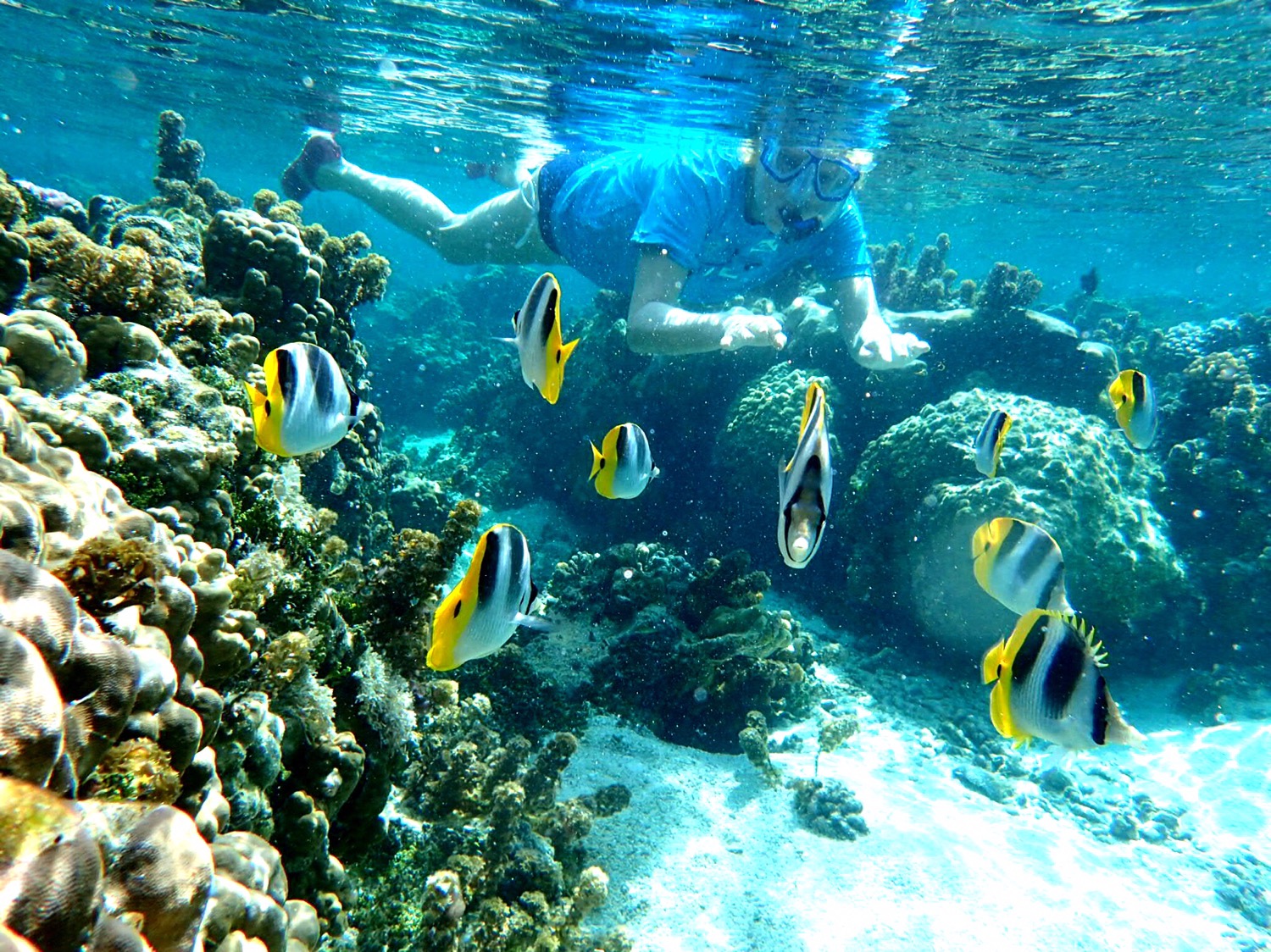
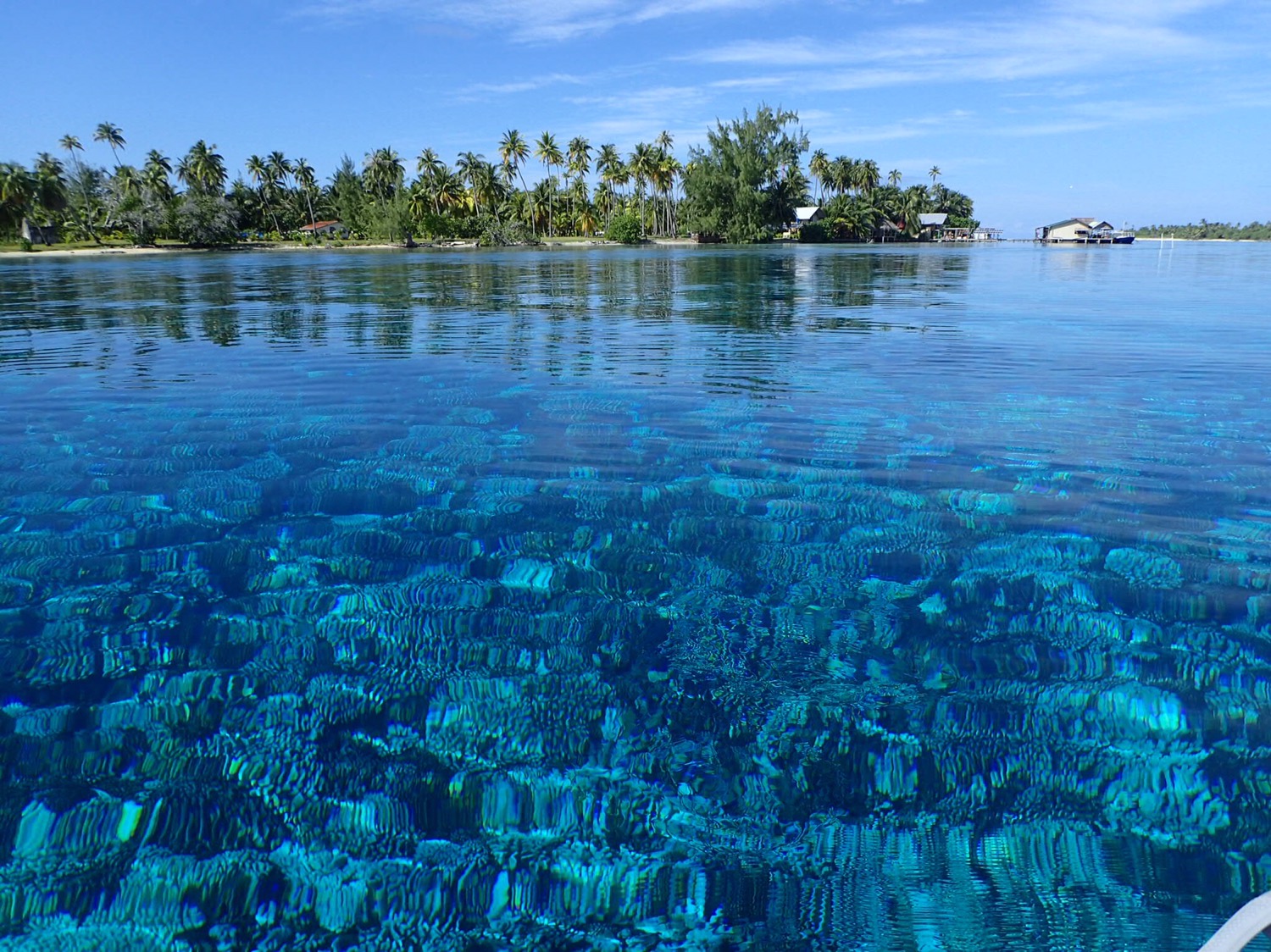
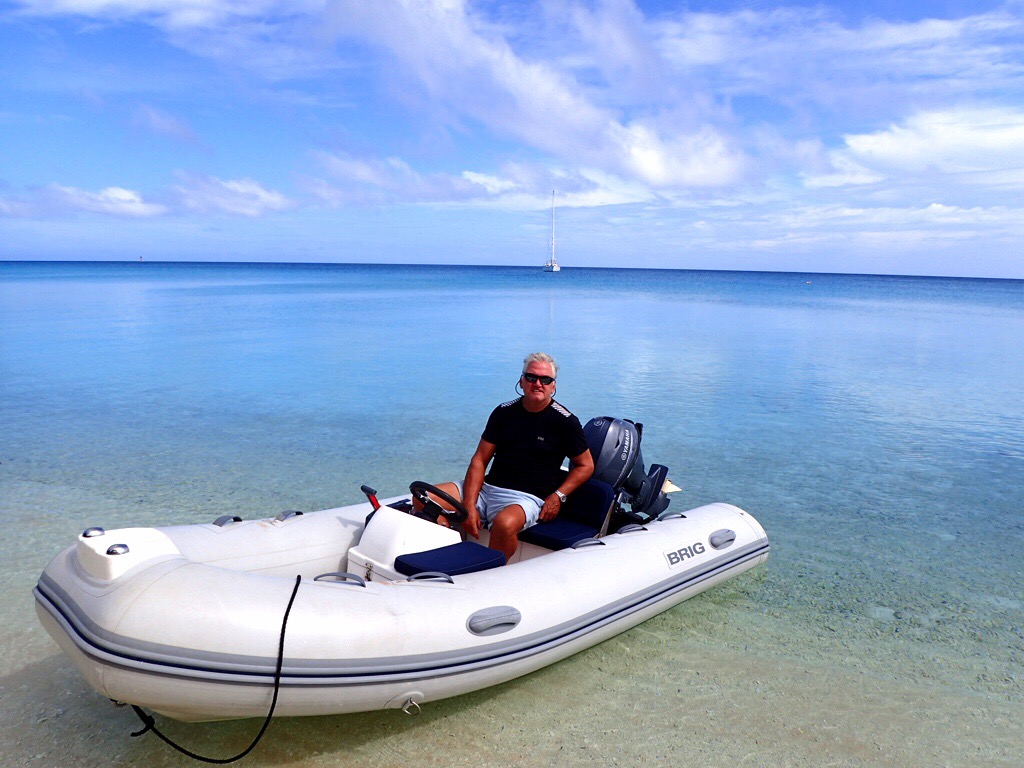
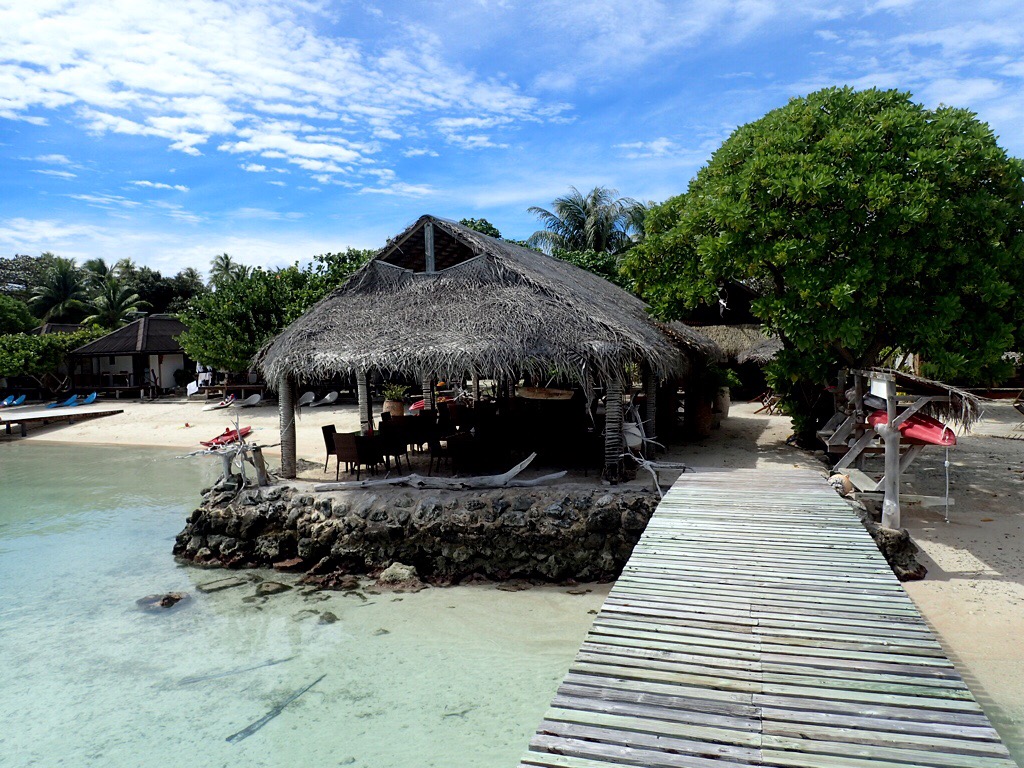
Besides the sampling of the local musical offerings and the odd meal out its been a quiet week. Again the wind has been blowing enthusiastically, swinging the boat in all directions and making dingy trips rather bouncy. We did have one calm day, Saturday, so we, with a couple of other boats, followed Steve and Lili to a snorkelling site a couple of miles dingy ride away. Steve and Lili from the yacht Liward have been cruising French Polynesia for three years, they love it so much they have just renewed their visa to stay for another three. As a result they know all the good places to go and took us all to a channel between two motu in the NW corner of the outer reef. On one of the islands was the charming small resort Blue Haven which kindly allowed us to tie up to their dock. The snorkel wasn’t quiet as amazing as the channel off Tautau but being bigger, had bigger fish including a six foot black tip shark that glided nonchalantly past about ten meters away.


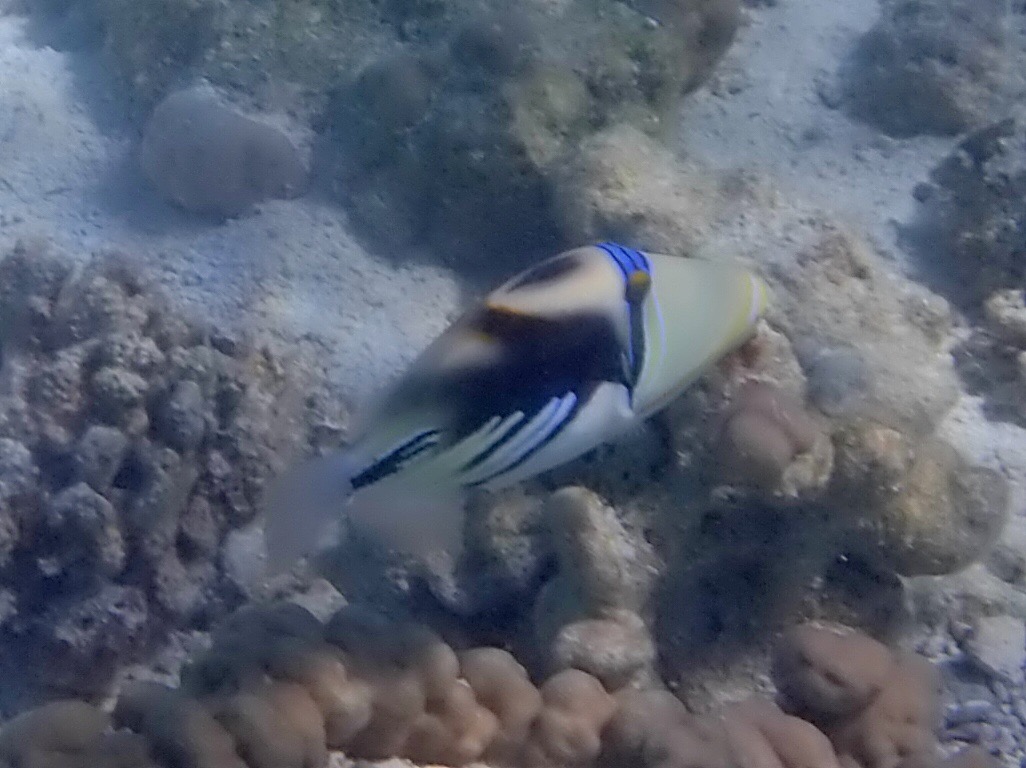
And I managed to get a photo of my new favourite fish. We have discovered its official name is white striped trigger fish, but for obvious reasons we had nicknamed him abstract art fish, we have just learnt the locals call him the Picaso fish.
Nine hundred thousand and one Oysters

Tuesday 5th July 2016

We are eating lunch in the Bora Bora Yacht Club and I am drinking wine from a delicate tall stemmed wine glass. We seem to have found civilisation. Bora Bora is packed full of luxury hotels, the tourist is king. The road that runs around the island and right next to our anchorage is busy, jet ski treks, full of honeymooning couples, whiz by and tourist boats rock us with their wake but for now we don’t mind, it’s just nice to sip our cold Savignon Blanc from a fancy glass.

Last weeks anchorage in Vaiorea Bay, Tahaa turned out to have more than just incredible sunsets, it was full of oysters. The  pearl farm whose bouys filled most of the bay had a jetty, thankful to the owner for his help in anchoring, we dingied over to see their pearl farming demonstration. It turned out to be very interesting. A spherical bead of shell, just smaller than the pearl required is seeded in the gonad of an Oyster with a piece of its mantle tissue. The mantle is the outer piece of flesh of the Oyster that creates the mother of pearl coating on the inside of the oyster shell or if enclosed in a small space with a piece of sand as in nature, or a piece of shell as when farmed, coats the irritant to create a pearl. The Pinctada Margaritifera Oysters that thrive in the warm, clear waters of French Polynesia have a black mantle that produces the dark colours of the local pearls. Once seeded the Oysters are left to create there magic in the cages on the other side of the lagoon. They are harvested after eighteen months, each oyster and pearl can go through this procedure three times producing a diversity of shapes, sizes and qualities of pearls. The farm managed an incredible 900,000 mature oysters with another million in its nursery.

Of course at the end of the demonstration is the shop, we perused the selection of jewellery, they are lovely but so expensive, we splashed out on just one, small, but top classed blue, black pearl.

View out from Bay Vaiorea


We returned to the boat, the sun now high in the sky, we grabbed our snorkel gear and drove the dingy the nautical mile back to Motu Tautau for the promised spectacular snorkel on the coral garden. We left the dingy anchored in the shallows off the northern shore and walked through the palm trees to the far end facing the outer reef. We then jumped into the channel between the islands. It was amazing, the gentle current pushed us back towards the dingy through a mass of mixed corals, it was great fun weaving though the bommies seeking out a route deep and wide enough to float through. 

Spectacular coral garden at Tautau


However the real wow factor came from the fish, there were millions of them and with no depth to escape, they just swim all around you. They were every shape and size from a few centimetres to a couple of feet long, in every colour and pattern imaginable, it was as if a teacher had given a group of six year olds a bunch of felt tip pens and asked them to design fish.We loved it so much we returned the next day to do it all over again.

Rick at the end of the Tautau channel


Back at the bay a Hallberg Rassy – Blue Raven had anchored next to us and they joined us for sundowners. As I think I have mentioned before, meeting new people is one of the highlights of the trip, when in real life do you invite people over just because they have turned up next to you for the night. We meet such a diverse bunch, from toddlers to eighty year olds, from New Zealanders to Swedes, from luxury Super Yachts to 30ft home builds and everyone has thier own stories to tell of how they came to be in this particulr tiny bay in the middle of the Paciffic.

The next morning we went a few miles up the lagoon to Tahaa’s main town Patio, again the water was deep but there were mooring balls to hook up to. We normally avoid mooring balls, we are bigger and much heavier than most of the sailing boats here but these looked robust and the breeze was gentle. We were keen to get rid of our rubbish and to the store, so we tied up and after an interesting ‘bilingual’ conversation between Rick and the Gendarme as to the bouys yacht size rating, decided to risk staying night.

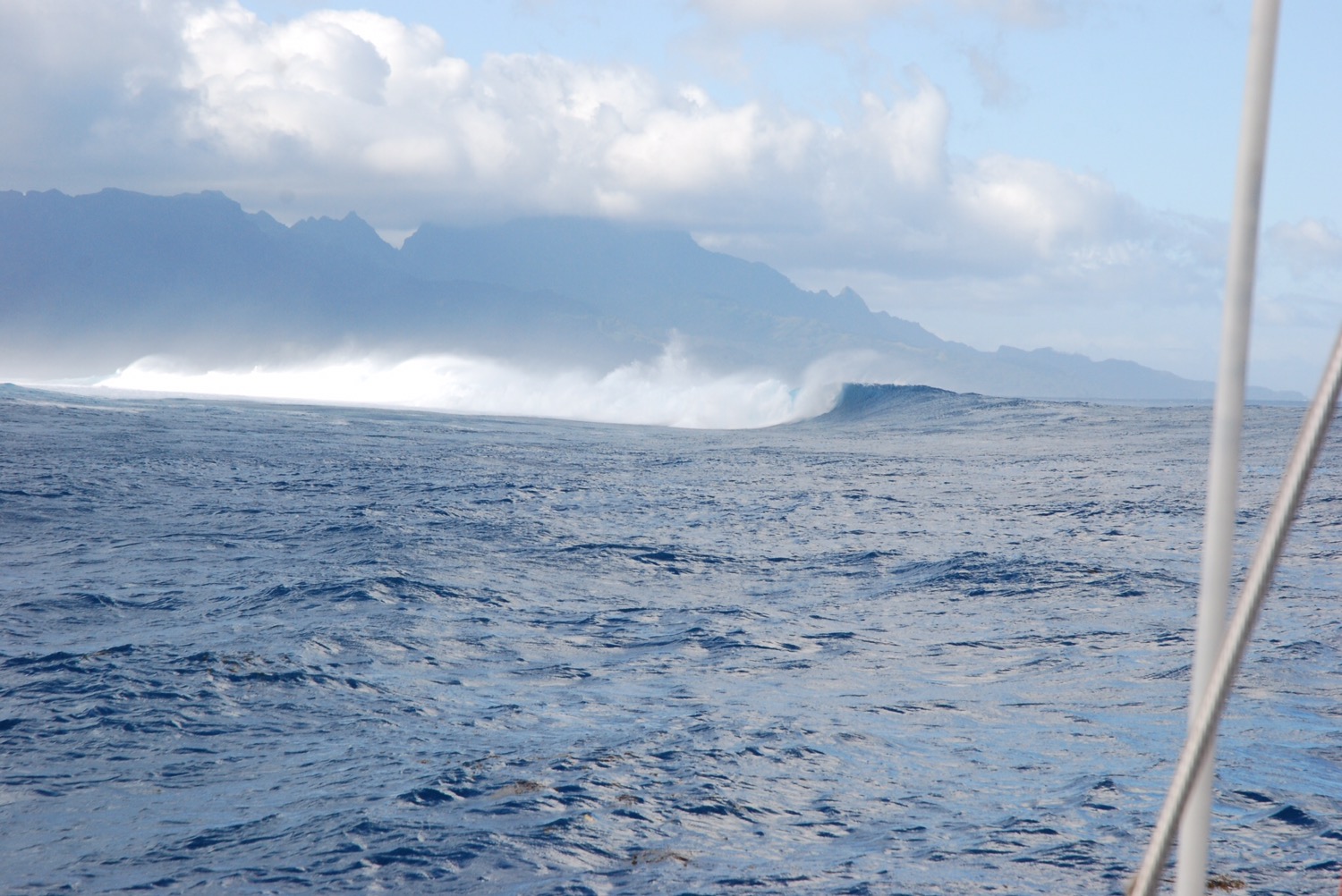
The mooring held fast and early the next morning we headed off. The sea outside the reef had built to a three metre swell overnight and either side of the pass the surf was huge, a wonderful, if rathe daunting sight. Amazingly the pass itself was relatively calm and full of Dolphins, our exit was straight forward. Our twenty mile crossing, however, with the swell on our side, was very rolly and the entrance through the pass into Bora Bora quite hairy with cross currents, traffic and a three knot out flow against us. Still we made it and here we are sipping white wine, enjoying the view and discussing how we will spend the next couple of weeks on the island before the next big passage, 1200nm to Tonga.


Fare, and Away

Friday 1st July 2016

With the forecast finally predicting a few calm days, Wednesday morning we headed North from Avea Bay towards the small town of Fare to restock. This meant sailing back up the narrow lagoon that encircles Huahini, this takes quite a bit of concentration, we have one eye on the chart, one eye on the channel markers and one eye on the colour of the sea to identify the shallows. Luckily we have four eyes between us and we snaked our way through the deep areas up to our next anchorage without incident. We click away on the camera but it is impossible to really catch the narrowness of the channel, the glorious colours of the sea or the grandeur of the hills.

Motoring up the Lagoon , Huahini


Fare is the capital of Huahini but it is tiny, like all the islands here there is basically one road around the island that follows the twists and turns of the coast. Everything is stretched along it, housing, shops, churches, industrial units …. A town constitutes just a more concentrated area of buildings on one part of this road. So Fare, like everywhere else, has just one street, we walk past the gendamarie, a supermarket, a ceremonial area, the dock and a bank but it is 2pm and every where is deserted – still lunchtime. The next morning is another story , every foot of pavement is taken over with food stalls. Cars, bikes and people jostle for space on the road. Everybody knows everybody else, it must take all morning to walk from one end of the road to the other as everyone stops to greet and chat to each other. We fill our bags at the supermarket and buy fruit and eggs from the stalls before returning to Raya.

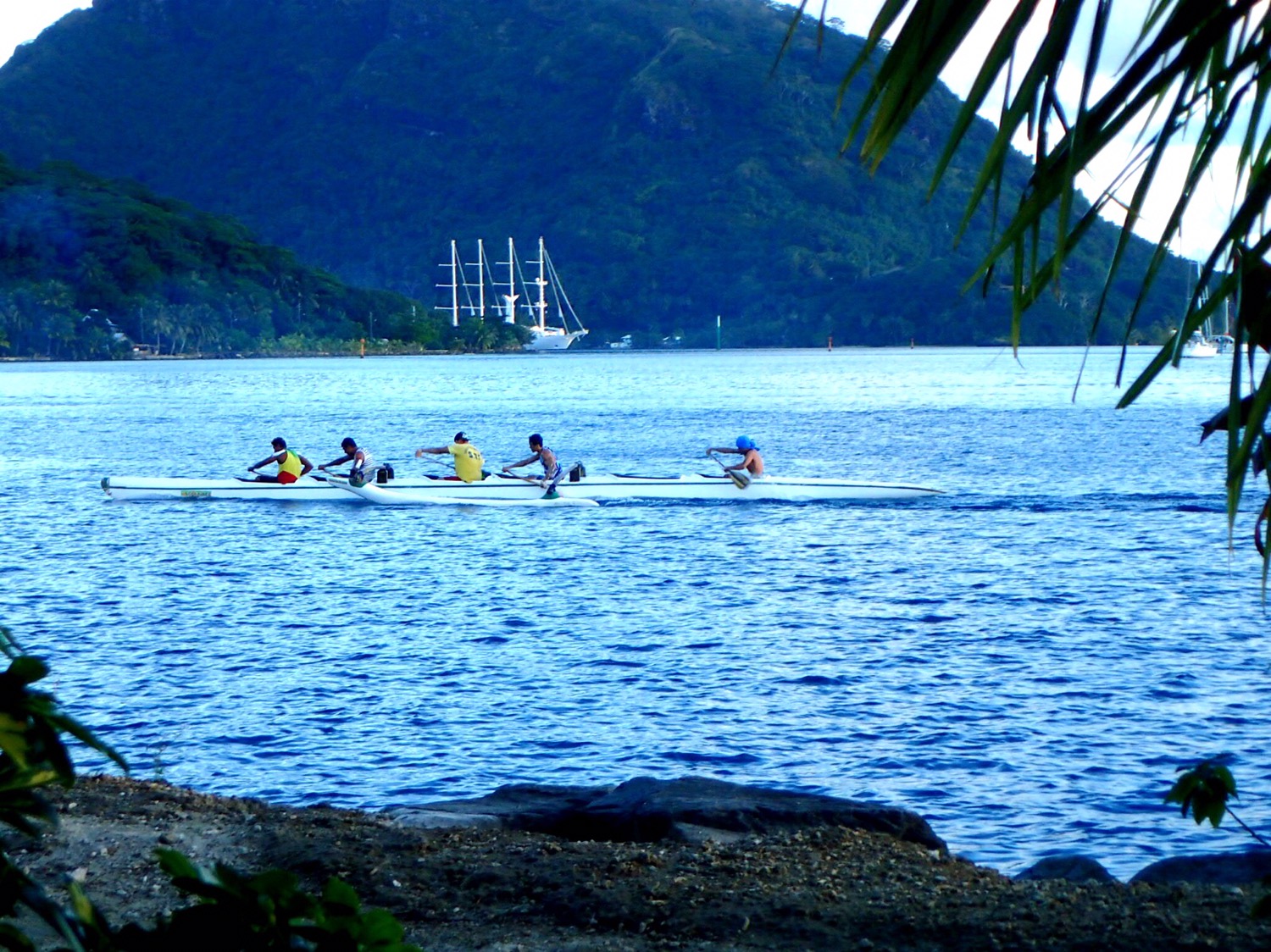
We were anchored on shallow sand just off the outer reef. The water and nearby coral looked inviting but when we jump in armed with brooms to clean the hull we soon discover there is quite a current running, I swim hard against it to check the anchor but decide cleaning and snorkelling can wait for kinder waters.We rock occasionally, the harbour area is busy with cruise ship ferries, small fishing boats and dingies but it felt great, to finally, not be taking a battering from the wind. The tradition of canoeing is alive and well throughout French Polynesia, in all our ports of call there have been crews or individuals training for the frequent regattas. In the Society Islands they use a modern version of outrigger canoes, we sit at the yacht club restaurant watching a crew of five sprint back and forth paddles in exact harmony with each other.


Thursday we get an email from our friends onboard their catamaran Yollata, the Raymarine instruments onboard have failed, they still have the GPS but no wind, speed or depth information and most disasterously no autopilot. When there are just two of you sailing the boat, the autopilot acts as an important third crew member, a crew member that never sleeps, never needs feeding, never loses concentration. They are 400nm into the 1200nm passage to Tonga and are appealing to the cruising community for any expertise or ideas of what might have gone wrong and things to check. Everybody does their best to help but it is difficult to diagnose from afar. We feel for them, it’s going to be a long tiring week ahead, especially with two young children onboard.

The next two islands on our continuing route west our Raiatea and Tahaa, they are contained within a single outer reef. We have been told of a beautiful coral garden that fills a shallow channel between two motu on the west coat of Tahaa. With the weather still set fair for the weekend we decide we should take advantage of it to make sure we can snorkel and appreciate the experience in good conditions. So Friday we head out of the Port of Fare, through the Avamoa pass, with a pod of dolphins swimming and leaping all around us. There is a steady 15kt wind from the ESE, it is only 20nm across the channel, so although it doesn’t take us quite in the right direction we shake out the sails and enjoy the ride.

We are welcomed to Raiatea by a flock of Red Footed Boobies, no great flying displays today, they just sit bobbing about on the waves, reluctantly taking to the air as we motor past, exposing their bright red feet and blue beaks, making identification easy. The pass into the lagoon is flanked on both sides by picture perfect dessert islands but the bay we had planned for our first stop looked less lovely, the water was brown and the shore lined with small scruffy warehouses.

It was still only 1pm, so we sail on through the central channel to Tahaa. There are a few sailing charter companies here and the next bay is full of charter boats, the next bay the bottom is too deep to anchor. We motor on, pass a striking church on the banks and dodge a surprisingly large container ship for inside the lagoon. We are now north enough to spot the Motu we expected to visit tomorrow and decide to try the sandy anchorage nearby. It is very steep dropping from 2m to 25m in just a couple of boat lengths we don’t feel happy enough to stay the night. It is now 3.30 and the sun is beginning to get too low to safely navigate the coral, we need to decide where to anchor. On the chart we spot a potential bay a mile across the lagoon but when we arrive half the bay is full of fishing buoys the other half is 25m deep. However, the pressure is on and  we put our nose a little further in to investigate, we hear shouts, arms wave frantically, the bouys hold oyster cages, this is a pearl farm. The kindly owner motors out and shows us where it is safe to drop our anchor, it is deep but too late to move on, so we are in 24m of water with most of 100m of chain out.

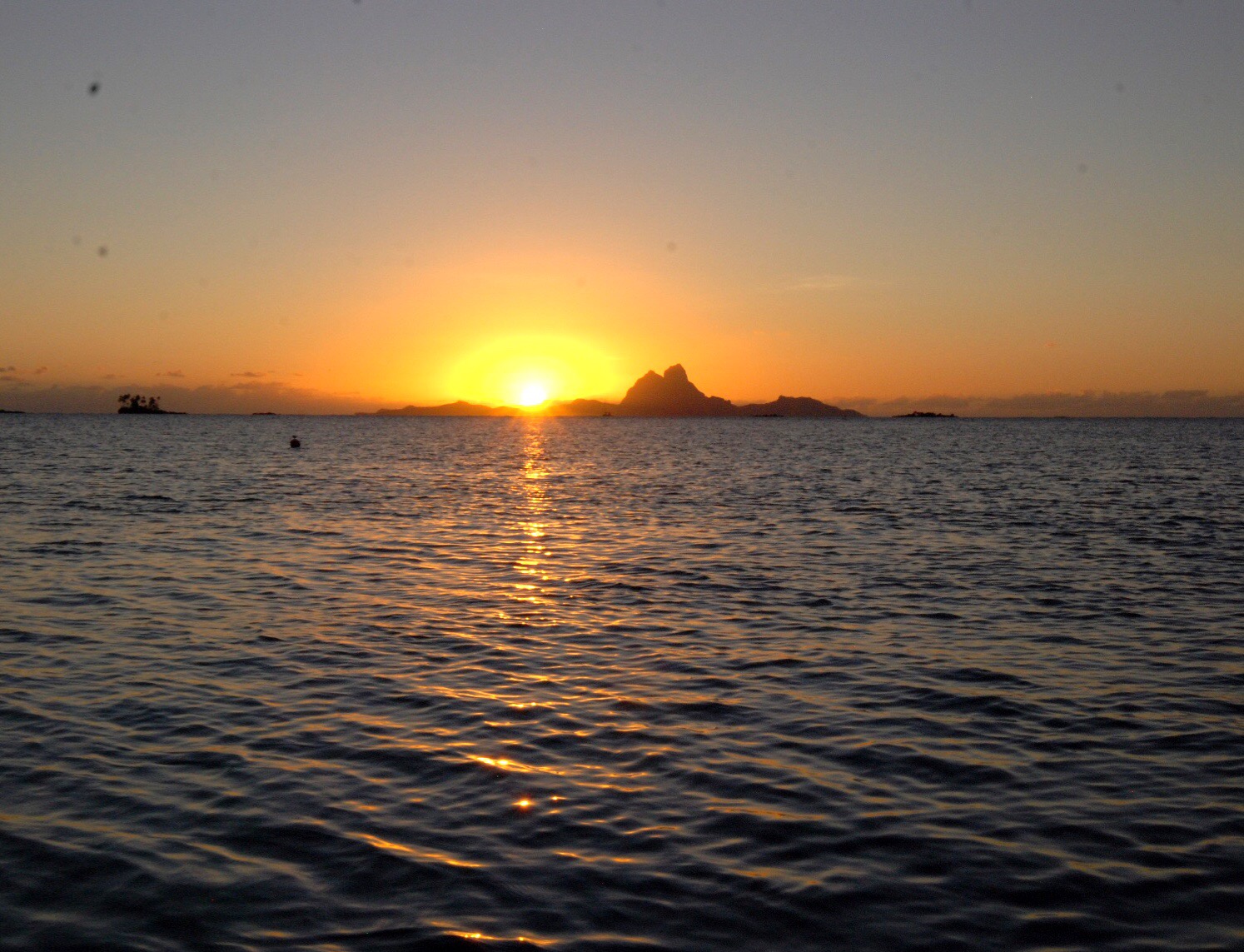
In had turned into a long day and as we sit down for our well deserved ‘got here beer’ we look around for the first time at our surroundings. We can hardly believe our eyes, beyond the lagoon ten miles away sits the dramatic outline of Bora Bora and we have a grandstand view of the sun setting perfectly behind its craggy  silhouette.

Sun setting behind Bora Bora

P.S. We have just heard from Yollata, after four tiring days, they have managed to cobble together a fix and have their autopilot functioning again.

Rain Stops Play

Tuesday 28th June 2016

The wind howls around us in the dark, the rain starts to beat down on our backs as we, as fast as we can, hoist the dingy on to the davits, it looks like we could be in for another lively night. The wind has turned around to SE and our protected bay is becoming bouncy. We are still being held hostage by the weather, high winds restrict where we can anchor, the cloud restricts the visability and the rain restricts trips ashore and keeps us below decks. We have done a long list of chores, read a selection of books and watched our limited video stock all the way though for the third time. Now it is time for the squalls to stop, the sun to come out and the wind to drop so we can enjoy our fabulous surroundings, unfortunately the forecast is doubtful.

We left Fare last Friday after just one night to hide from yet another forecast for high winds. We motored inside the lagoon, bordered on one side by the hills and bays of the island of Huahini and on the other the outer reef with huge perfectly formed surf crashing over it. The cloud subdued the colours and the current kept us focussed on the route, the fantastic scenery passed by mostly unnoticed. About four miles south we found a large bay, with just a small entrance, that was calm and to a degree protected from the wind. Bourayne Bay felt like a large lake, we were encircled by densely wooded hills a few hundred feet high, the water was deep, until a shelf, that stretched completely around the shore, rapidly shallowed the water to a reef that almost broke the surface. A few houses sat around its perimeter but we saw very few people, just a couple of locals fishing once in a while, when there is a lull in the wind it was beautifully tranquil.

With time on our hands we enjoyed watching the weather. The wind that sweeps across the surface of the water, the ripples identifying its path. The rain a wall of water bearing down on us, reducing the visability to a few metres and then the short breaks in the cloud, allowing the sun in to light up and to transform the landscape. We turn on the instruments to monitor the gusts, we see 20, 24 even 27kts, we track our path around our anchor, uncomprehending at the effects of the wind and currents on the pattern that is formed.


After three days the wind drops a little and we carry on down the lagoon to Avea Bay. A bigger contrast you couldn’t get, Avea Bay is fringed by a long sandy beach, buildings regularly puntuate the shore, a small hotel sits opposite us. The sandy bottom produces bright blue water that as you look out to sea turns to a turquoise strip in front of the reef. Outside the reef is the ever present line of white, the surf continuing to pound in from the ocean. 

Conditions are still squally but there are periods of sunshine to take advantage of, we take the dingy in to the pretty hotel Le Relais Mahana, for lunch. The Mai Tais were expensive, rather sweet and wishywashy, the food was good however and the view gorgeous. 

Table on the beach at Le Relais Mahana

The next day we go to explore the point at the end of the bay. We beach the dingy and walk along the sand, marvellous craggy trees lie low over the water. As we round the corner we are surprised to find large break waters built of giant boulders stretching out into the sea, more of the same have been used to create a wall. It is a major feat of construction, some one is trying hard to hold back the encroaching ocean. Set into the wall are two entrances from the sea each flanked by two proud Moai (traditional Polynesian staues), steps lead up to the community pavilions that are common here and the grounds are well tended but the buildings look abandoned and in disrepair. Nobody is around, a large sign says Private, we return to the dingy questions unanswered.

Curious buildings and wall at far southern tip of the island.


Back at the beach I swim out to the coral to assess it for snorkelling, the tide has changed and the water is racing from the ocean back into the bay. Rick drives the dingy while I fly along the shore travelling too fast to really see the small fish clustered around the bommies but the feeling of speed is so exhilarating I don’t mind. Approaching the bay the current and the coral stop and I swim to the dingy, it is shallow I could easily walk but the sea bed is covered with thousands of sea cucumbers (large slug shaped creatures about a foot long and belonging to the same family as star fish), I prefer not to put my feet down. 

We race back to Raya the sky is turning black and the wind is whipping up the sea. We tie up and dodge below, clean the galley, change the engine filters or watch Ground Hogday for the 650th time?

Rays, rain and referendum results

Tuesday 21st June 2016

I watch as two coconuts bob by, or is one a turtles head popped up for a breath of air, so common place are these occurrences that we hardly acknowledge them any more. We no longer sit in blue clear water, we are surrounded by a thick brown soup. Waterfalls have appeared in the mountain sides around us, the rivers at the head of the bay’s gush thier reddy, brown contents into the sea. We have had 3 days of rain, our whole world is soggy and damp and I have a cold, we have been remarkably healthy since we left the UK hardly a sniffle between us,  unfortunately I seem to have caught one in Tahiti and as it has poured with rain outside, my eyes and nose have streamed inside. 

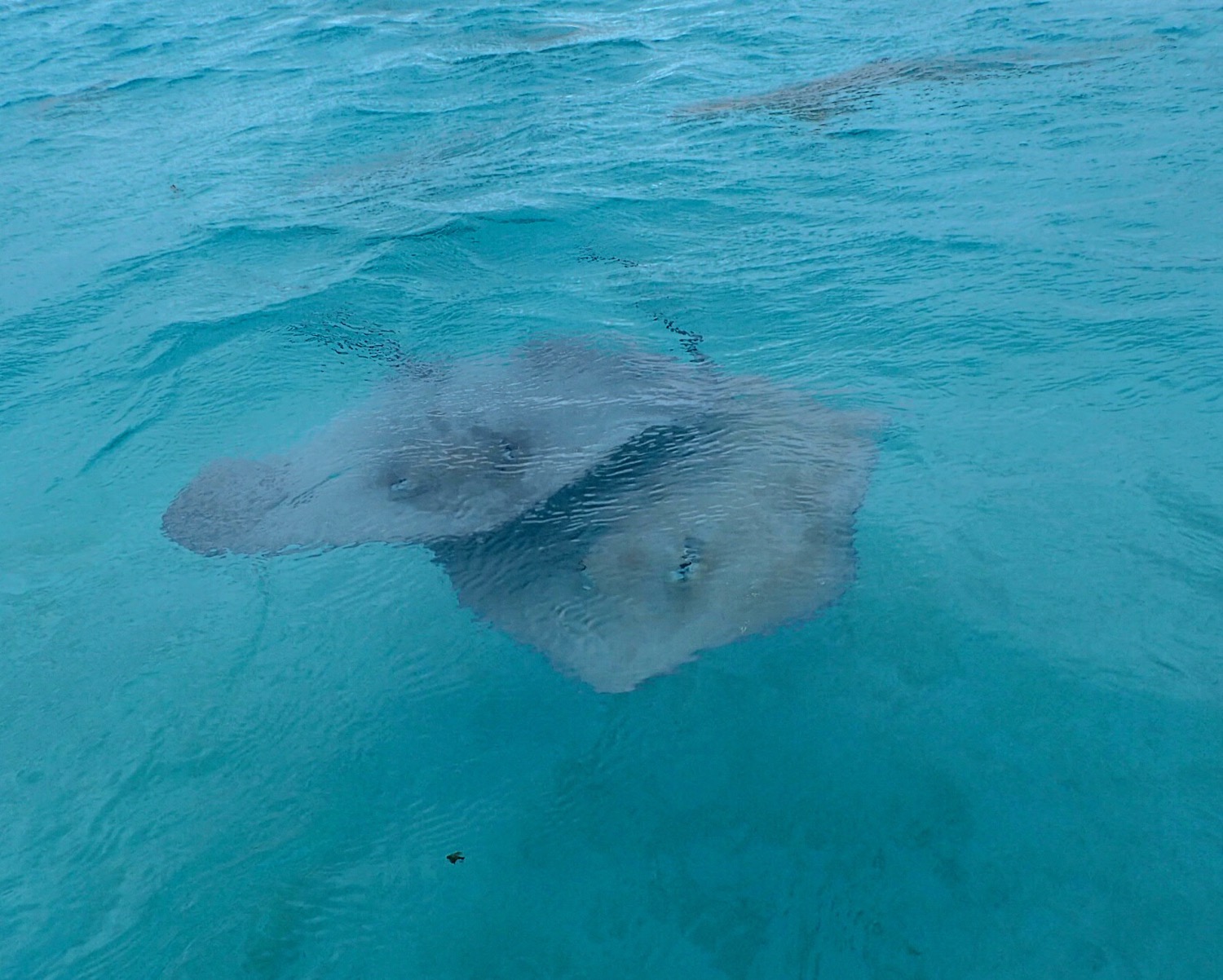
On Saturday the wind began to pick up but the sun still shone, in an attempt to clear my head a little we dingied over to a sting ray feeding area. A patch of shallow sand in the lagoon where the tour boats come armed with tinned sardines to hand feed the large ray’s and inevitably the local black tip shark population. Today there were no tour boats but the sound of our engine was enough to attract attention, we were immediately surrounded by over a dozen or so black tip sharks and four or five large sting rays. We hadn’t bought any food with us but to be honest with sharks outweighing the rays by about four to one the prospect of jumping in the water hands full of sardines seemed rather foolish. We were happy enough to just see them at such close quarters sitting in the dingy.

Sting rays mobbing the dingy


That night the combination of my sneezing, the rain clattering on the hatch and the wind howling through the rigging made for a rather sleepless night. The next day we decided to up anchor and move to the protection inside the bay. The wind still gusted down through the mountains spinning us this way and that but the holding was good and the scenery, when we could make it out through the gloom was fantastic.

By Monday with the weather still not good enough for the crossing to our next island Huahini (pronounced Wuahini, we are told) but unable to make drinking water from the muddy water  around us in the bay, we decided to go off shore for an hour, make water, empty black tanks and then re-anchor in the other deep bay on the north coast of Moorea, two miles to the east, Cooks Bay. 

Cooks Bay is slightly wider and the surrounding mountains less steep giving it a more open feel and it is slightly more built up. Next to our anchorage is the Bali Hai Hotel, yes Moorea is yet another island that claims to be the setting of the movie South Pacific, they have a dingy dock, a bar, restaurant and book exchange, with a small supermarket up the road there was everything we needed.

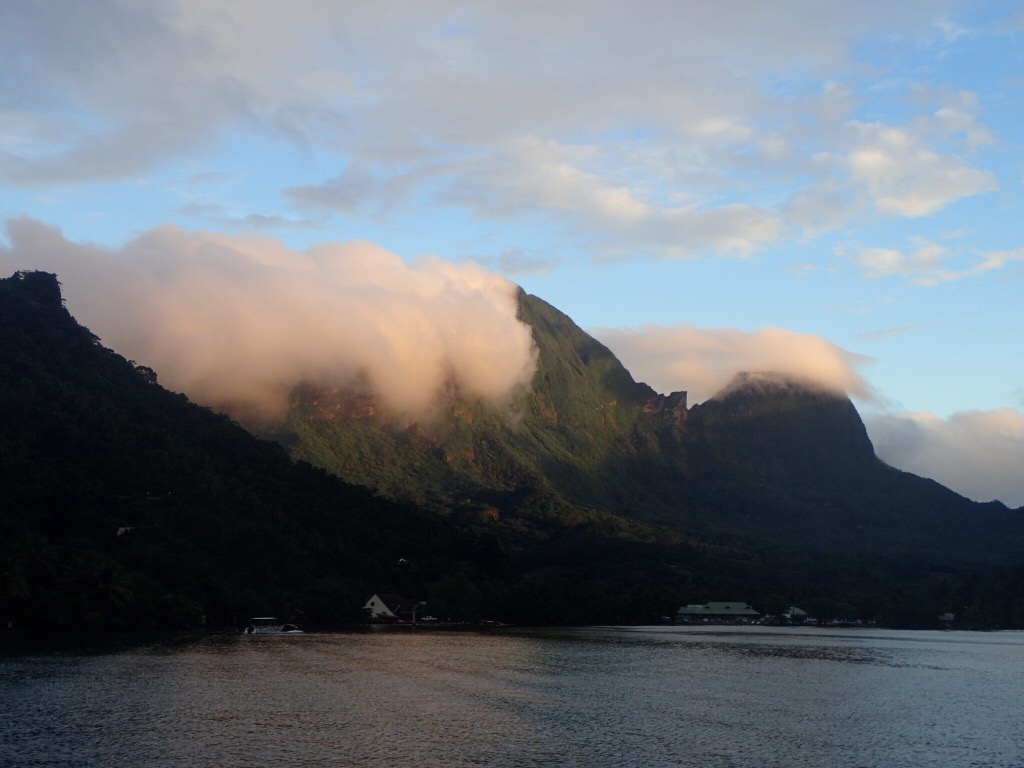
Clouds building over the peaks in Cooks Bay


Thursday 23rd June

The weather broke Wednesday afternoon so we departed for Huahini that evening, we left at ten, the light of the full moon guiding us out of the bay. The crossing was 87nm so we were sailing through the night to arrive to enter the pass in the reef surrounding the island in daylight. There was little wind and the night passed without incidence however as dawn arrived the sky darkened and we had an extremely wet last few hours. We are anchored off the pretty town beach and coincidentally  we have the best internet we have had since the Carribbean, enough in fact to watch the unfolding drama of the UK vote to leave the EU. Blimey that wil take some digesting!

A wet arrival in Fare , Huahini

Variety of Views

Friday 17th June 2016

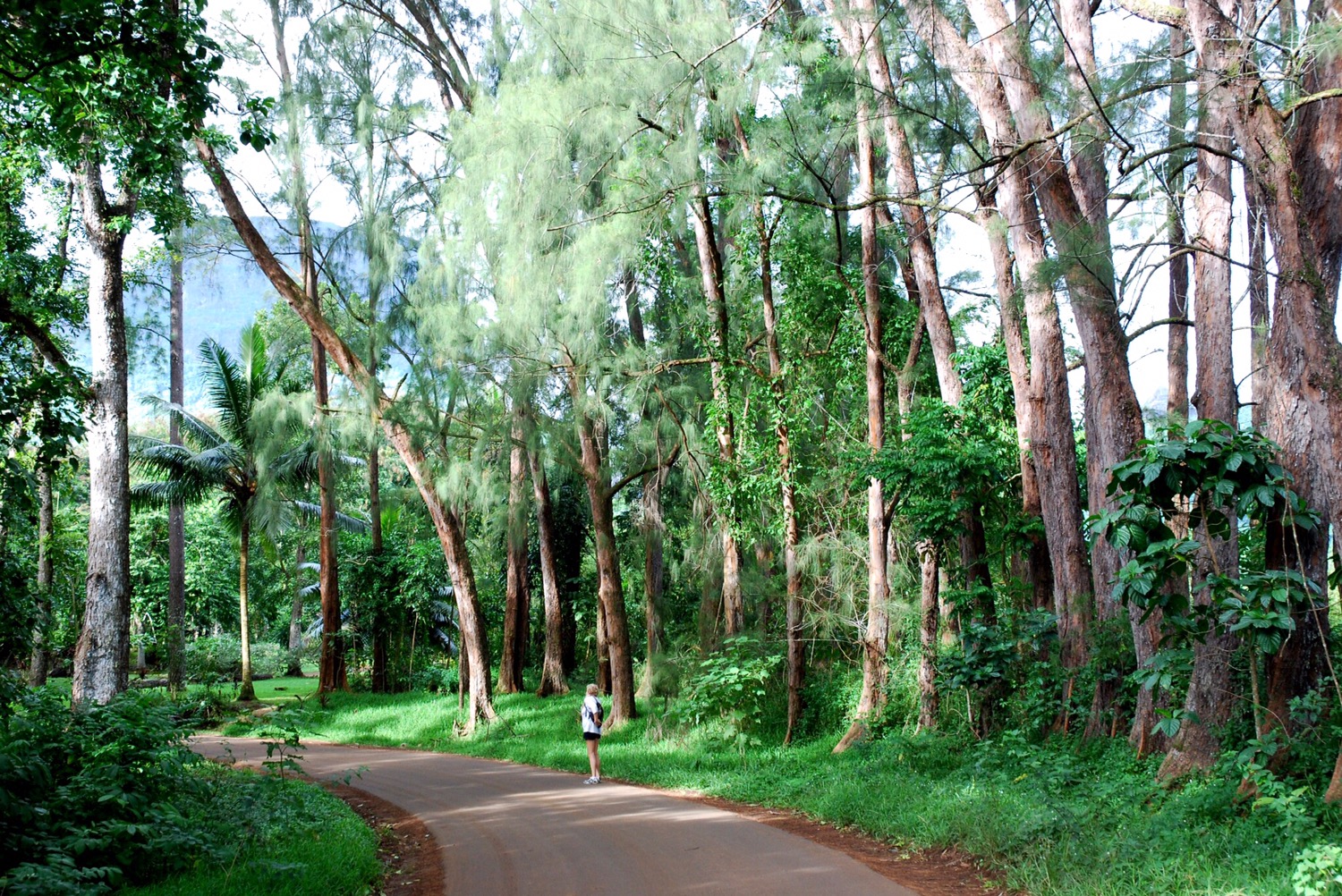
The clue should have been in the guide book title – hike to mountain view point. We are not overly keen walkers especially when the word mountain is in the sentence, so I’m not sure how we found ourselves pounding, in temperatures approaching 30C, the path 5 km up the road to the Moorea Belvedere, with its ‘spectacular views of rare natural beauty’. The road took us initially through gently sloping farm land, cows grazed, meadows lined the route, all was well. Gradually the road got steeper and was bordered with tall firs, fast running streams snaked to and fro, pineapple groves dropped down into the valleys. The final two km rose more sharply zigzagging upwards through jungle. We passed flowers of bright yellow, red and orange, shrubs with leaves the same size as us and others bright green one side, purple the other, large Banyan trees, stately Acacia and 30m high clumps of bamboo. At each bend and between each tree was the ever present dominance of the craggy slabs of rock that form the peaks here. Unfortunately our enjoyment of our surroundings gradually decreased in proportion to the steepness of the road, by the time we arrived puffing and soaked in sweat at the viewing point our ability to appreciate its splendour was seriously reduced.

Tall firs line the road on the lower slopes

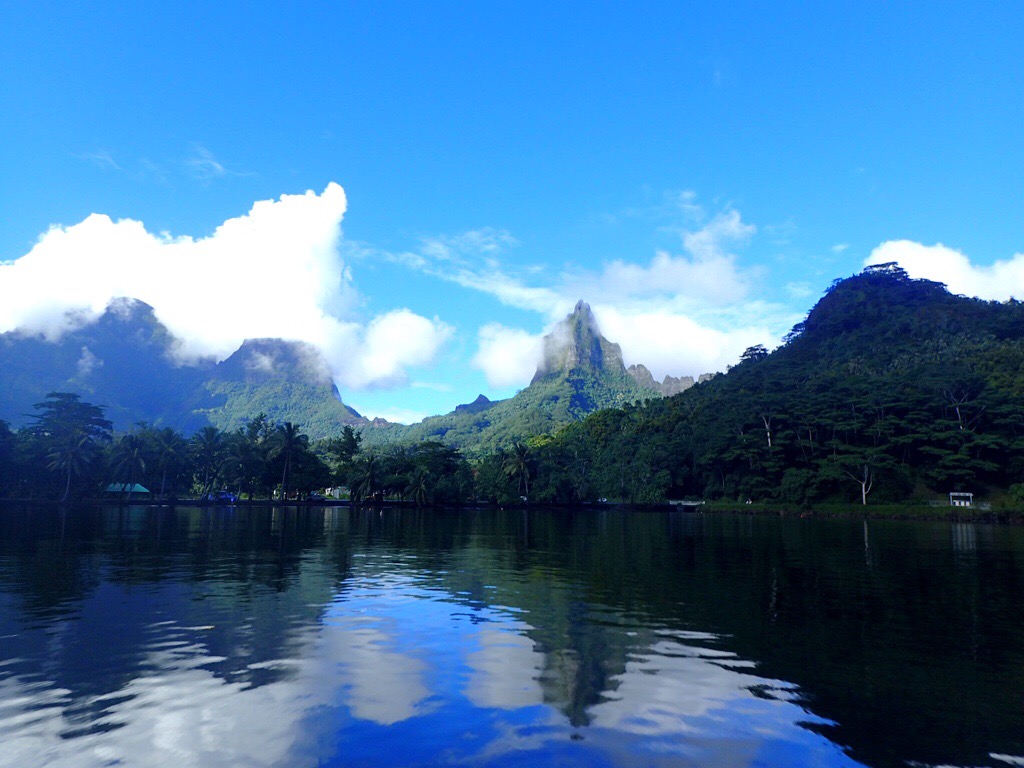
Still we are appreciating the mountains from sea level, the peaks fill our sky line and we have a couple of sleek Superyachts in the foreground to enhance the view. On Wednesday morning we went right into the bay, it is one mile long and quite narrow, the sides are steep and the water is deep, dark and still, the mountains reflect in its surface. Around the edge the undergrowth hangs low over the water, lightoccasionally finds a  gap and highlights points of grass, green leaves and yellow sand, we creep slowly along the coast enjoying the cool, slightly spooky ambiance.

The head of Opunohu Bay


We had taken the dingy to the black sand beach at its head to a shrimp farm to buy the large fresh prawns for supper. The plan was to BBQ them but as seems to happen everywhere in the world the very mention of a BBQ immediately produces rain and we ended up eating below, fried in butter, lemon and garlic they were still delicious.

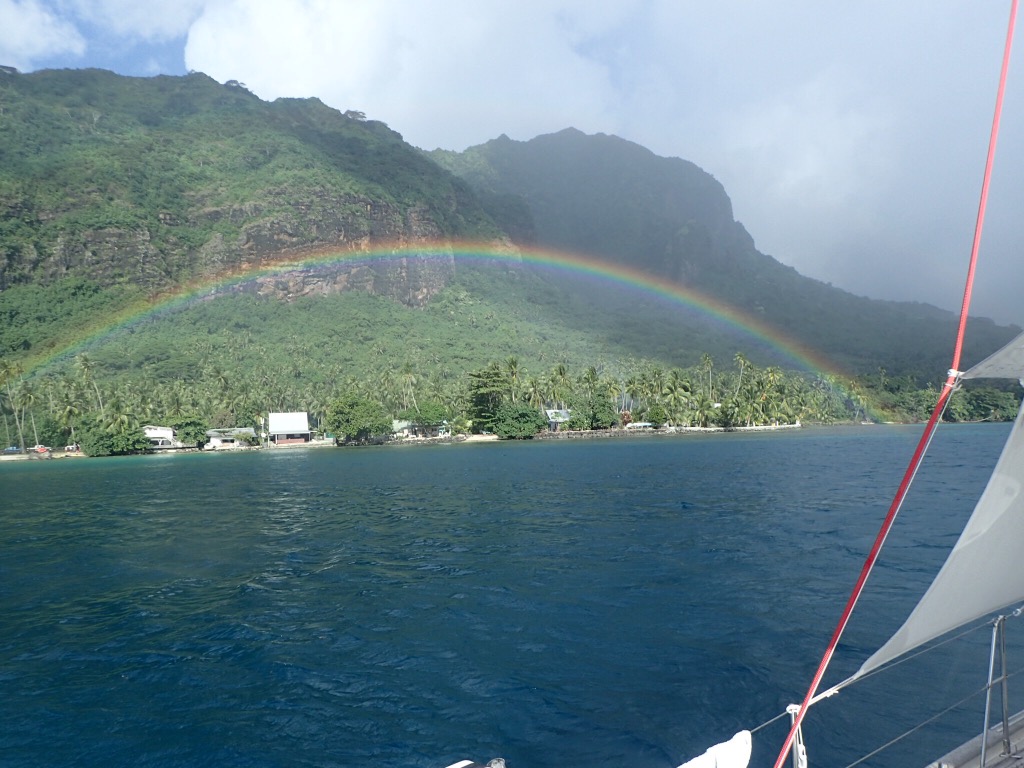
Rainbow proceding the deluge to come


Taking the dingy out along the reef is more hazardous, coral heads lurk just below the surface ready to catch your propeller the moment you lose concentration. Markers have been laid to guide the numerous rental jet skis and tour boats that zoom back and forth to snorkelling areas. But finding your way in and out of the channels is a case of painstakingly winding through the maze of bommies. It took us a good half hour to find a route into the Hilton for lunch, it would have been quicker to walk, aching feet and all!

Enjoying a Mojito at the Hilton

Moorea at last

Tuesday 14th June 2016

As I came up on deck this morning I was struck by a novel feeling – there was a chill in the air. It only lasted about half an hour, as the sun rose higher, by 7.15 I was again seeking out the shade but the cool breeze was sweeping down off the top of the jagged mountains that tower 2000ft above us. We have finally escaped the marina. 

The oceanic swell continued to increase as forecast and by Thursday night Raya was been battered and jolted uncomfortably by not only the incoming waves but their reflections as they bounced off the wall of the dock. As day dawned the next morning, the cost of the night was revealed, we had sustained more damage in those few hours than in last six months of cruising. The port quarter fairlead had been pulled lose (luckily not completely off and lost to the depths of Taina marina), the passeralle although raised for the night had taken a bashing and its attachment point on the swim deck ladder had come apart. Rick determinedly marched around to the marina office and finally a spot large enough for us in the inner marina was found and we spent our final few days in a still if not quite so salubrious spot. 

Not quite the view of superyachts we had had but calm, calm, calm.


In French Polynesia we have found that their balance of work to play definitely comes down on the play side. Lunch break is often from 11am-2pm and the end of the day can be as early as 4.30pm, 11am on Fridays and Saturdays. The chance of us getting materials or manpower before the beginning of the next week was remote. We were itching to get out of the marina and we probably won’t be in one again until New Zealand, so the need for fairleads and pasarelles was minimal. We opted for Rick making temporary fixes.

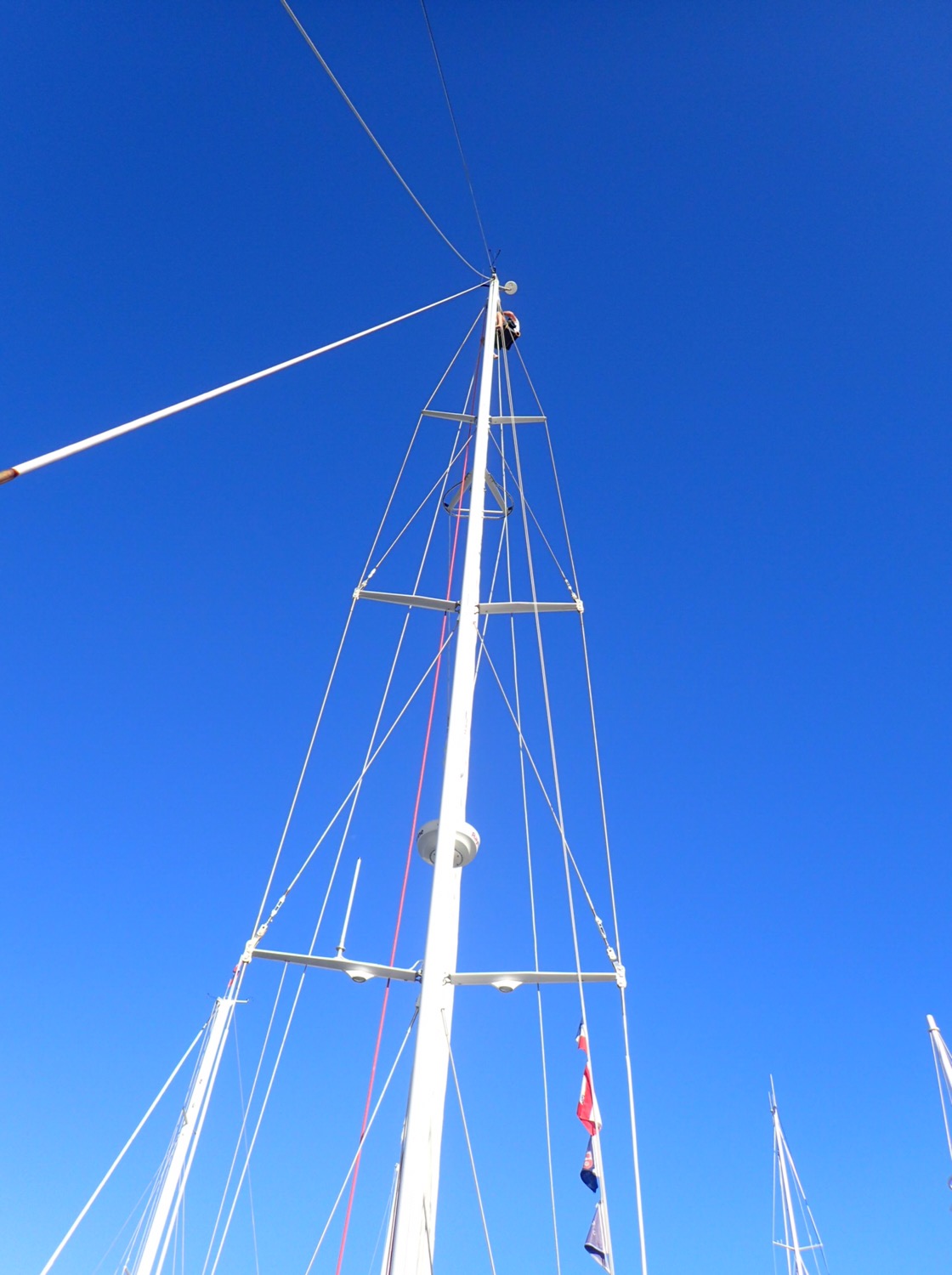
The 4m swells were forecast to decrease to 2m by Monday, we spent the weekend readying to leave. This included me winching Rick up to the top of the mast. Being scared of heights, to the extent of being scared when seeing other people at heights, especially when I’m responsible for that person, make this one of my most nerve racking jobs. All went smoothly thank goodness and the fixtures and fittings aloft were all in good order.

Rick checking out the fittings at the top of the mast

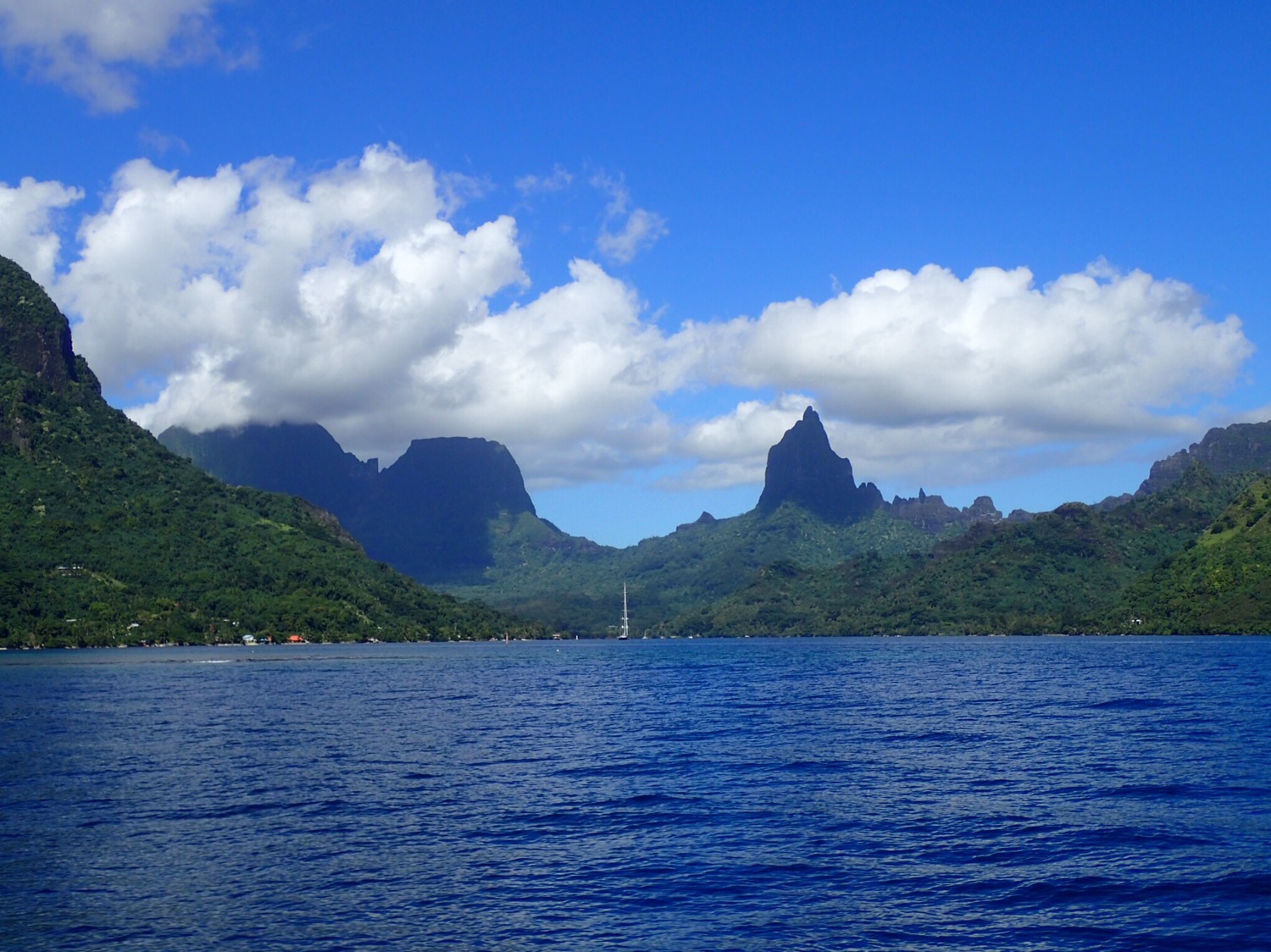
The short crossing to Moorea was lumpy with at one point, off the northern tip of Tahiti, the 2m swell coming at us from two directions at once, but inside the outer protective reef of Baie D’Opunohu is stunning, it is lovely to be back surrounded by dramatic peaks. 

Entering the pass into Opunohu Bay


The geography of French Polynesia is interesting. All the islands were formed by volcanoes. The Marquesas group are relatively young the mighty peaks still soar 4000 ft into the sky, the coastlines are deep and there hasn’t been enough time for reefs to form. The Tuamotu lie at the other extreme, created by much earlier eruptions the volcanoes themselves have been completely eroded and have collapsed leaving just the circular reefs above sea level. The Society Islands, where we sit now, are at an in between stage, the islands are formed of high craggy mountains still a few thousand feet high, but there has been enough time for a surrounding reef to form. Inside these reefs there are beautiful protected lagoons full of clear turquoise water, with the added bonus of great mountain views. Moorea is more developed than the islands we have visited so far, the anchorage can’t be called isolated however this does mean a short dingy tide away is a five star Hilton Hotel. It has required digging deep through the wardrobe for something decent to wear, but we are off now to treat ourselves to lunch.

Still (very) tied up in Tahiti

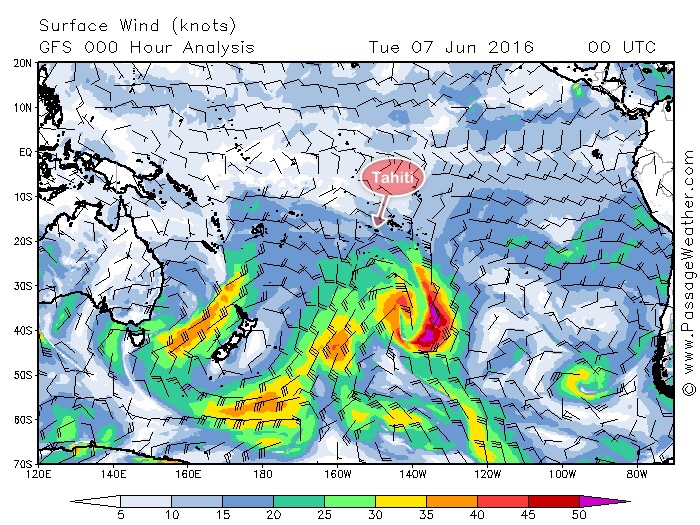
Pacific weather chart for Monday night

Purple is not a colour you want to see on a weather chart, especially when you live on a yacht. The centre of this weather system may be nearly a thousand miles away but repercussions are being felt throughout the South Pacific. We have decided to stay in the marina until its effects have past by.

Not that that means things are comfortable, even in the marina its very bouncy. The waves are crashing over the outer reef that circles Tahiti, creating swell which slams into the dock, jolting us violently. We are stern-to at the dock and trussed up like a turkey. Securing our bows we have two slime lines and our anchor, at the stern we have seven warps in a spiders web to keep us square and try to spread the loads as we rock. Rick has applied washing up liquid liberally to the fairleads and cleats to reduce the graunching that kept us awake last night and our passeralle is suspended high off the ground to stop it hitting the bollards but making it quite hairy to get on and off the boat. There are periods of beautiful sunshine and then intense downpours, our dingy filled with over a foot of rain overnight on Sunday. If we lift the dingy onto the davits then it will drain but we definitely won’t be able to get ashore, so it remains bobbing dramatically at our side.

The super yacht crews diligently continue to tweak their lines, trying to keep the boats perfectly straight, knotted brows of the skippers checking and rechecking. Out in the marina anchorage, the boats look very uncomfortable and mooring buoys are breaking free, the chatter is of night anchor watches and delayed departures. And things are forecast to get worse with more wind, rain and sadly bigger waves over the next couple of days, so we are getting out the scrabble, lining up the books and hunkering down.

Tied up in Tahiti

1st June 2016

Raya appears to have shrunk, we are on the outer wall of Taina Marina, Tahiti and are sandwiched between two superyachts. Both 130ft long, with 180ft masts they dwarf us and with two crews constantly cleaning we feel obliged to keep everything onboard shipshape. Needless to say I think the chances of Rick letting me hang the laundry out are zero. Further along the dock things get even bigger with the three masted, 180ft classic schooner, Atlantic, stealing the show.

Raya dwafted by the superyachts at Taina matina

In contrast, on the inner pontoons it is hard to find a boat over 45ft. We have noticed, beside the collection of Superyachts here, that most of the boats crossing the Pacific are really quite small, we normally feel huge. In fact some boats are really small, generally skippered by lone Frenchmen, they have little in the way of electronic navigation, no autopilot, no refrigeration, no watermaker, I can’t imagine how different thier experience is to ours.
We were pleased to find the guys from Toothless waiting to catch our lines as we pulled in to the dock and then to discover half a dozen boats we know tied up in the Marina, including two boats from the ARC that we hadn’t seen since we left St Lucia in December. Even more bizarrely the crew on one of these boats, Nina, turned out to be from Sissinghurst, had, a few years after we had moved, lived a couple of hundred yards from Ceylon House and whose children had both gone to Cranbrook, their youngest in Matts year. Certainly made plenty to chat about over a happy hour beer.

Although sitting in the Marina is not so lovely as anchoring in a beautiful bay we are enjoying a brief return to civilisation. Much to everyone’s excitement there is a large Carrefour supermarket a mere 200m away. Kids in a sweet shop comes to mind, as cruisers peruse a full fruit and veg counter for the first time in four months. The Internet is mostly good and there are a couple of decent restaurants onsite. Being on the lea of the island we are a bit short of a cooling breeze but the Superyachts protect us from the swell from passing craft and there is very little in the way of tide to worry about. Tahiti sits on an Amphidronic point, a point in the ocean where the tides are small, the tidal range increases as you move outward from these nodes.  It is caused by the the rotation of the earth and in turn the Corolius effect and local land masses, too technical for this blog, so for more information see – https://en.m.wikipedia.org/wiki/Amphidromic_point

Papeete, the capital of Tahiti, was in contrast to the Marina area a bit of a disappointment. Busy, noisy, full of traffic with very few decent shops. There was a pretty little church – the cathedral, a large traditional market and a long boat filled waterfront but the long awaited chandlery was under stocked and tired and the black pearl shops, I’d been looking forward to, were expensive and commercialised. In fact we are finding Tahiti generally underwhelming . Yesterday we hired a car and drove around the island. It struck us as one long string of surburbia, small towns stretching the whole way along the road that circles the island. Of course, had we not just come from the Marquesas and Tuamotu, the high wooded mountains that form the interior of the island would have awed us, the lush colourful gardens of the houses would have enchanted us and the coastline of turquoise sea would have dazzled us – we have been spoilt.

West coast of Tahiti


Tomorrow a rigger is coming to help with the inmast furling system and to have a look at the vang which appears to have seized. We need a few more trips to the supermarket to restock and a couple of maintainance jobs are still outstanding. Then we will be off. The island of Moorea, the next stop on our visit to this final part of French Polynesia, The Society Islands, stands tantalisingly just a sort distance away.

Diving and Departures 

With the midday sun high in a cloudless sky, the colours around us, seemed almost impossible. We had motored Friday afternoon the few miles back east to the beautiful Hirifa bay. The sea was made up of the richest turquoises imaginable, the beach and sand banks shine a pearly white and the coconut palms sway a deep grass green. We were the only boat in the bay it was wonderfully peaceful. On shore I watched a small girl with her dog trailing behind her father as he does his chores.Tucked in amongst the trees lives one small family, each morning the husband jumps in his boat and goes north, presumably to work, returning around two. They laugh, sing and play each afternoon in the water. I know the reality is probably very different but from afar their life seems idyllic.

Turquoise, Harifa Bay

We had returned to this protected bay because the forecast was for the winds to pick up at the weekend and we were keen to lift our anchor chain from its torturous route around the coral heads, before the increase in breeze pulled us tight into knots. During the four days we had been at the anchorage at Fakarava South Pass we had swung back and forth through over 180 degrees, we could see we were completely wrapped around at least one bommie. So Friday afternoon we slowly, slowly teased the chain up, each time it pulled tight we let the boat drift over the top of it until in went slack. It took about twenty minutes but with a little help from the bow thrusters and occasionally the engine, we set it free without straining anything, hopefully without damaging the coral and without Rick having to go into the water to run the gauntlet of our circling shark friends.

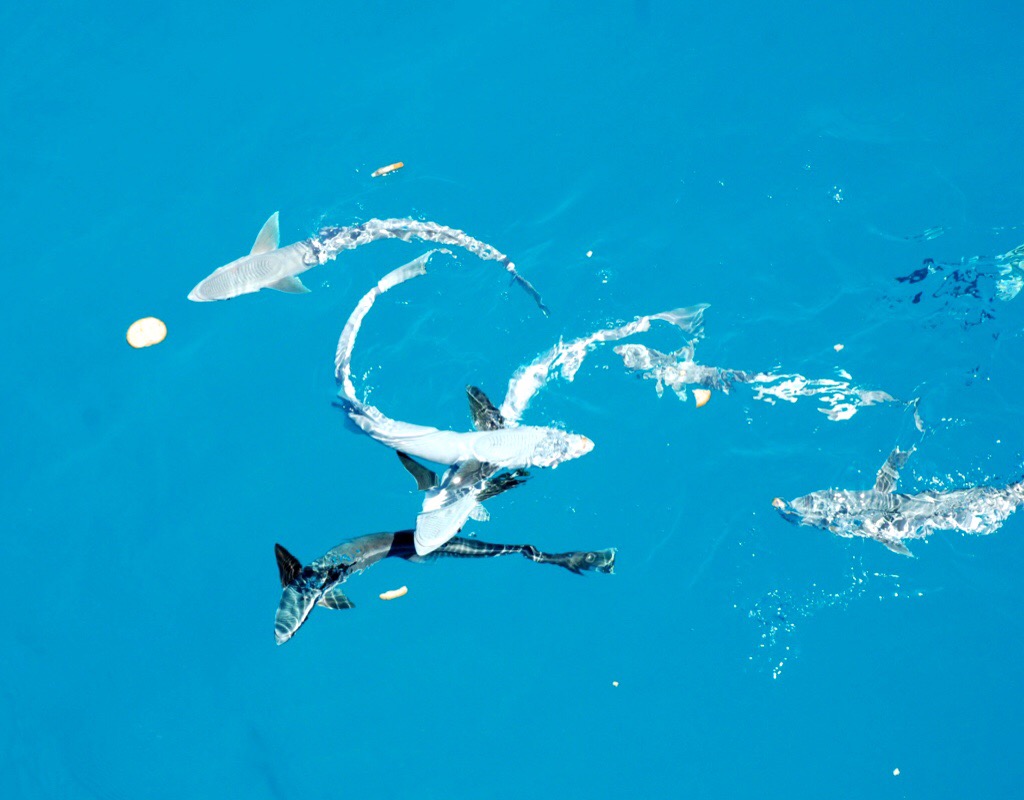
In the morning we had dived the pass, I guess it was always going to be a bit of a disappointment. It was a good dive but it added little to the marvellous snorkelling we had already done. The only difference was, after descending to 28m we were surrounded by hundreds, honestly hundreds, of sharks gathered at the bottom of the pass, quite a sight. My dive was spoilt by a leaking mask that distracted me for most of the time. Rick assured me I hadn’t missed much, besides, a rare, large, but luckily not fully grown, black finned shark and a close encounter with the six foot long Maori Wrasse we had seen the day before. The dive finished with us swimming back into the shallows in front of the dive school. As we paddled across to return our kit, chatting about what we had seen, I suddenly realised this was where, just an hour before, we had seen a mass of black tips been fed from the kitchen. I whispered to Rick we are paddling through a shark pool, we giggle, again we reflect how strange it is that having your scuba kit on changes your perception. 

Feeding time at the dive school kitchen

Our plan was to go to the Rotoava on Sunday in the hope of finding some fresh food on Monday and then sailing a bit further north for a couple of days to visit one more atoll, before crossing over to Tahiti where we have a reservation at the marina for the following Saturday. However on checking the weather it seems the wind will last until Tuesday and then drop for the rest of the week. We make a snap decision to leave Tuamotu tomorrow through the South Pass on slack high tide.
We set off for one more snorkel to a patch of coral under the marker at the head of the bay.  Unfortunately there is quite a wind blowing and we could find nowhere we were happy to anchor the dingy.  I dropped into the water to have a look. The area is covered with incredible tree corals some almost five foot high complete with trunk, very interesting but not worth the risk, losing the dingy half a mile from Raya and land doesn’t bear thinking about.

Once back onboard we prepare for the 250nm passage. After over three weeks protected in the Tuamotu there is quite a lot to do. We rinse and tidy up all the snorkel and dive gear, lift the dingy on to the davits, check and organise the running rigging, make everything shipshape below and from our very depleted supplies rustle up a vegetable curry and bake some bread. 

Sunday afternoon we leave Hirifa to arrive at the pass approximately an hour before the tide turns. With the high winds over the past couple of days waves have been breaking over the encircling reef, filling the lagoon with water. As this water can only leave via the few gaps that form the passes, the pressure of water out of the lagoon can dominate even over the incoming tide, we expect the water in the lagoon to turn the tide early. And so it turned out, we motored out through turbulent water, with two knots behind us, grateful yet again to be onboard our large powerful yacht. 

With the tide times being what they are at the pass, to arrive in Tahiti in daylight means two nights and a day at sea, a tiring combination, the swell, as always on these westward crossing, was on our beam, no fish were caught, drizzle filled the air. Not our best trip but we are now safely tied up in Marina Taina on the west coast of Tahiti. 

Now where’s the Supermarket?

—————————————————————————————————–
We have some internet, hooray! So check out the last couple of blogs as I have added some photographs.

The incredible coral at the South Pass, Fakarava

Stunning South Pass

19th Thursday May 2016

Wow! We have just returned from the most incredible snorkel of our lives and we have had some amazing snorkelling over the years. We can’t wipe the smiles off our faces, the water at the south pass of Fakarava is unimaginably clear, the coral is stunning, the fish varied and plentiful, there are sharks everywhere.

Fakarava’s amazing clear water

Monday morning we set off from our calm anchorage at Hirifa for the southern pass, there were a few dark clouds threatening but looked like they would pass to the north. Almost as soon as we set out the wind started to pick up and backed, by the time we had motored the 3/4hr to our destination the squalls were blowing our way. The anchorage was very rough, the visability was very poor, we could see the torrential rain approaching in the distance. Not the best conditions to anchor in and why we would we want to spend another night bouncing around. We are now in the habit of recording our track on the chart plotter, we turn Raya around and retraced our path through the pouring rain and returned to the flat sea at Hirifa to await for better conditions.

Tuesday we tried again, the water was still choppy but the weather forecast, everybody agrees, is for a calm few days ahead. The anchorage is a mass of coral, there are mooring buoys but they are only specified to thirty tons we are thirty three, if the wind decides to get up again we would rather trust our anchor. I tried to drop it into a patch of sand but we can see through the clear water that it is hocked on to some rock, the chain meanders through the coral heads. Not a great situation, it could easily get wrap around one of the heads, it is holding however and we can at least see it when we need to get it up. As a last resort we can use our scuba gear to dive down and untangle it from the coral, there is one small extra problem however, we are surrounded by sharks. Not little three footers now but fully grown, black tips, white tips and even larger grey reef sharks. It gives a whole new meaning to feeding the fish off the back of the boat.


Sharks swimming around the boat

 
As is often pleasantly the case now, we have friends in the anchorage, the catamaran Yolata is sat on a mooring bouy next to us. They dingy over to say hello and give us the low down of what’s here. Incredible snorkelling on the pass, a dive shop, a collection of resort cabins, a bar where you can get a meal but you have to order it a day in advance and an old deserted town that was before a cyclone came through fifty years ago the capital of Tuamotu. No supplies however, we swap notes on the empty state of our fridges, being Australian and hearing we have only a few beers left, they immediately insist we have a case of theirs. We are again humbled by the generosity of the cruising community.

Wednesday dawned still and fine, without a doubt the best weather we have had since we arrived in Tuamotu, perfect for snorkelling. To snorkel the pass you need to firstly make sure you are doing it on an incoming tide, sweeping you into the lagoon rather than out to the ocean. You dingy to a mark put down in the pass by the dive centre, tie the dingy to your wrist and if the tide is strong enough, drift, if not swim, back towards the lagoon.

The water is so calm and clear, it is like looking through glass, we motor agog at the coral passing by below us. The sight under the water is even more breathtaking. The coral resembles a glorious rock garden, communities of small fish guard their patch on the reef, large shoals of bigger fish swim past, a spotted eagle ray drifts near the sea bed. We raise our heads exchange a glance of incredulity and return on masks to the water.


We must see a couple of dozen sharks, it’s funny when your head is above water they are frightening, I imagine them nibbling my toes as I hang from the dingy but as soon as you put your head in the water they are just part of the back drop. They glide past with an air of indifference, magnificent, powerful but not at all intimidating, Rick is clicking the camera as fast as it will reset, I just watch in amazement.

  
The current starts to pick up as we reach the end of the pass, instead of me dragging the dingy it starts to drag us. We are whisked around the corner towards the anchorage, a bed of beautiful coral whizzes past beneath us, a large barracuda swims by, we hardly notice so caught up are we with exilaration of flying through the water.

We pinch ourselves, same again tomorrow please.

In Short Supply

Monday 16th May 2016

Good weather is still in short supply. The South Pacific Convergence Zone or SPCZ would normally sit just below the equator but since late April has drifted further south and is producing unsettled weather all the way from Fiji to the Marquesas. So it’s a bit of a cat and mouse game anchoring in the atolls, as I’ve mentioned the fetch across the lagoon can bring choppy conditions if you are caught at the wrong end of the atoll for the current wind direction. However with no accurate forecast for the local weather good decision making is more luck then judgement. So we have decided to just carry on with our plans the best we can. Thursday morning we set off for the southern end of Fakarava, being one of the larger and more frequented atolls there is a buoyed channel leading from the north anchorage to the anchorage 25nm away in the south, our plan however, was to join our friends onboard Toothless off the pretty beach at Hirifa in the SE corner, where, they told us it was very calm.


About halfway down the channel we would have to leave it and follow the East coast, this also had buoys on the main obstacles but we had no reports as to how good the charts were here. This route would require, what they call in the cruising guides, eyeball navigation, or ‘looking out’ to you and me. We scanned the sky for dark clouds and deemed the conditions good enough for the sunlight to penetrate the grey, for us to see the dangerous coral heads. Sea with depths of over 15m is blue, below that it turns increasingly to shades of turquoise, the paler the turquoise the shallower the water. I stood on the bows, Rick steered and studied the chart. It was quite a tense hour or so but turned out to be quite straight forward, I was managing to spot the turquoise patches at about half a mile and the Navionics chart was impressively acurate.

We had chosen this spot because it was calm and quiet, with few other boats, Toothless were here so they could relax while their two small boys swam off the boat. The South pass is famous for its shark populations, it is one of the scuba worlds “must do” dives and our next stop. Toothless however had just come from there and after a fantastic few days diving and snorkelling they watched a large tiger shark chase a turtle around their bows and decided it perhaps wasn’t the best place for the boys to swim.

Shark tales fill the VHF and inter boat chatter here almost as much as the weather, so when we took the dingy ashore to do some snorkelling and saw two black tips swim by, we entered the water with some trepidation. They were only three foot long and had no interest in us, we told ourselves to stop being stupid and had a pleasant swim amongst the shallow coral heads. At this stage I would often swim the three or four hundred metres back to the yacht but here, even though I know it’s illogical, somehow I don’t fancy the open water.

We have our now normal clutch of remora under the boat. They are great fun and shoot out for any scraps we throw to them. In the Caribbean a few years ago Stephen and I witnessed them scoop up a small tube of toothpaste ( don’t ask it’s a long story ). Well we have another one with tummy ache, while replacing an anode on the propeller shaft, (an anode is a sacrificial piece of metal that you attach to important metal fittings under the water to divert the degradation caused by electrolysis…phew!). Rick had tied the appropriate alan key to some string hung from his dive jacket, when he came to use it, it was gone. He swore at himself for toying such a weak knot, came back to the surface and I got him another one. With the job finished he noticed that the knot had not come loose, the string had been bitten through!  It definitely discourages you from dangling your toes in the water.

  
Another thing in short supply are our provisions. In the luxury department things are dire, beer is down to six cans, we have no white wine, no gin, no limes or lemons, only four squares of chocolate, no biscuits and the only fruit is one rather tired pamplemousse. The fridge looks very empty, although a fun challenge to start with, it is getting quite tiring each day trying to work out something tasty to eat. It is not that we haven’t got food, we still have lockers full of cans and jars, we are not going hungry, as our waistlines will attest to, its just the lack of fresh food. We haven’t seen  staples such as mince or chicken breasts since Galápagos and fresh fruit and veg have really been a challenge since we left Panama.

Sunday I stood staring into the bare void of the fridge, a couple of carrots and a few potatoes stared back, we had a whole chicken in the freezer, Sunday roast, l thought.


First Year Celebrations

We have just completed our first year at sea, it’s difficult to fathom that we have sailed almost half way around the world. I still feel like we are just practicing but here we are sitting off a palm covered atoll in the middle of the South Pacific Ocean.

We had planned to celebrate with a nice meal at the poshest hotel we could find in Rotoava the main town on the Fatarava Atoll. We had enjoyed a nice lunch there at the beach bar over looking the clear waters of the lagoon. One of the main sources of income for the whole archipelago is pearl farming, the resort farms its own pearls but the display and shop didn’t open until  five so a perfect excuse to return for dinner the next day.


Wednesday started fine and calm, we set off for what is now a normal morning when we reach a bit of civilisation. Firstly find somewhere to get rid of the rubbish, Rotorava turned out, like all the Polynesian towns and villages we have visited so far, to be organised and tidy. There was a platform for rubbish, raised to stop the dogs rifling through the bags, sited conveniently next to the docks.

We walked down the Main Street, well the only street to be honest, through the town. Each house was brightly painted in a different colour and nestled in its own piece of land that was carefully tended and full of flowering plants. Leading from each roof were pipes into large water butts, the islands being just strips of coral have no source of fresh water and so every drop of rain is collected. Between the gaps of the houses and the tall pine trees that lined the road the turquoise sea sparkled invitingly. The town had a relaxed happy feel, people wandered down the street, chatted on corners, or leisurely cycled past, greeting each other and us with a wide smile and a friendly “Bonjour”. Incongruous to the sleepy atmosphere and overpowering the ever present roar of the ocean pounding the outside of the atoll, was the occasional blast of music, strangely everybody here seemed to be listening to rap.

  
We came to the couple of stores, the shelves were mostly empty but they did have thankfully the ubiquitous baguettes, we found potatoes and carrots, biscuits and crisps and ‘glory be’ some grapes. It is common to bump into other cruisers, everybody swaps what knowledge they have. Today it was the chef from a large motor boat, Dorethea, that we have seen in a lot of the anchorages since the Galápagos, he searched in vane for anything decent to cook with, I sent him in the direction of some fresh eggs we had found. Rick had bought the dingy to the nearest point to the store, today’s supermarket car park turned out to be a tiny sandy beach with a single post to tie the dingy up to.

  
A further rather hot quarter of a mile up the road bought us to the Fatarava Yacht Services office, basically just the house of an enterprising French couple, they will try to help with anything you need. They act as a postal address for letters or parcels of spares, they will do your laundry, provide you with small amounts of fuel, hire you a bicycle, book you a restaurant, the list goes on and on. We wanted their free access to the Internet, we bought tea and coffee, sat on the veranda and spent a pleasant hour catching up with the world, I posted a blog and some pictures, Rick downloaded 250 old emails and we checked an alternative weather forecast.

They also had a book exchange, you will find these in most ports of call, with the limited space onboard and restricted access to the Internet to top up on ebooks they are a highly valued commodity. Rick exchanged four books, as he put them into his bag it occurred to me that these books are doing their very own world cruise, hopping from one boat to another. What tales, besides those written in their pages, they must have to tell.

We returned to Raya and in the time it took for us to prepare lunch the hazy sunshine had disappeared and black clouds loomed on the horizon. A storm moved in, it blew around 25-35kts for about five hours. The wind was from the SE and as we were in the NE corner of the atoll we no longer had any protection and with the atoll over 25nm long, there was plenty of room for waves to form . The anchorage of boats was being battered by a short 4ft chop and monsoon levels of rain. We turned the path tracker on, on my iPad to check for any movement and switched the anchor alarm on, on the chart plotter, the anchor was holding firm. The dingy now impossible to raise onto the davits, bounced and bucked like a cork in a washing machine, we attached three lines to it and Rick had to risk life and limb to get onboard and bail it out, twice!

This weather was completely unforecast and by the way the local boats scrambled for home, I think even they were taken by surprise at its ferocity. There was no way we could leave the boat and even if we could have got into the dingy there was no way we could have motored the mile, in the sea conditions, to the hotel dingy dock for dinner. Instead we found ourselves celebrating a year at sea, huddled, damp and cold in the cockpit, anxiously watching the dingy and the yellow squiggle of our track as we swung back and forth, sipping mugs of hot tomato soup.

In fact a scene rather similar to that found during the last few days before we left Southampton. It’s a funny old world.

Living in a Screen Saver

Sunday 8th May 2016
We continue to sit under a veil of cloud, every now and then we see a patch of blue sky but then another squall forms and the rain is back. Despite the weather we are enjoying it here, snuggled in the SE corner of Kauehi Atoll, we are protected from most of the chop and swell, there are a few yachts anchored about a mile away but otherwise we are completely alone.
In front of us we have a string of uninhabited, palm covered motu, areas along the reef that sit above sea level, in this case probably just three meters above sea level, they are extremely pretty. Catching the view through a port light, Rick smiles “it’s like living in a screen saver”. 


Ashore however, with dark clouds gathering and a brisk wind blowing in from the ocean, things look a little different. With no waves it is an easy landing for the dingy at the steep beach, we tie up to a palm and then pull the boat a little way off with the anchor, as the beach turns out not to be made of soft white sand but of a trillion small pieces of sharp broken coral. We put on our sand skipper shoes and walk to the end of the motu and a shallow pass towards the ocean outside. It is low tide, the rocky landscape has just a smattering of struggling shrubs, with a grey sky above and the continuous pounding of waves hitting the reef, the environments feels quite hostile.

As we round the corner, we are suddenly, surrounded by a couple of dozen squawking sooty terns and we realise we must be passing a nesting sight, we keep to the shore line to disturb then the least we can. Rick spots a moray eel wallowing in a rock pool and small fish dart in and out with the waves. We find scores of beautiful shells some empty, some not, a hundred hermit crabs wriggle beneath our feet, the scuttle of tiny shells making the ground appear to move. 


As the tide turns, water begins to rush through the pass into the lagoon, we return to the dingy on the inner reef. We had to weave through a maze of coral heads to reach the beach and so decide to have a quick look beneath the surface. After all the years we have snorkelled and dived I don’t know why we are still always so shocked, despite all clues from the surface, at how incredible it is the moment you put your mask on and look under the water. Here it is exceptional, the visibility even without the bright sunshine is excellent. In the calm, shallow water it looks almost as if someone has put the contents of a large aquarium into a swimming pool.

There is a good mix of coral in a rainbow of colours, clams imbedded in the rock clamp shut as you approach hiding the luminescent blues, turquoises and purples of their fleshy jaws and soft corals nestle brightly in the nooks and crannies. Being so shallow the fish are small but they are plentiful. Angel fish, butterfly fish, small colourful wrasse, parrot fish and a dozen more varieties I don’t recognise.


Onboard, we relish our isolation and the spectacle of the changing weather. 


Snatching the opportunity during a lull, Rick puts on his scuba gear and cleans the hull fittings and checks the anodes. We have two friendly remora or flip flop fish as we nicknamed them in the Caribbean, swimming around the boat. They have a sucker area at the top of their head, shaped a bit like a flip flop and spend their lives hitching a ride, stuck on to the likes of sharks or as Rick discovers, in this case, to the bottom of our hull. We have to think that our antifoul can’t be good for them however they continue to dart out to pick up the scraps we throw them, looking as sprightly as ever. 
The cloudy days do mean it is a little cooler so we also set to with domestic chores below. I decide to tackle the cooker, oven cleaning is my least favourite job, so every now and then I raise my head and look out of the hull port, just to remind myself that I am at least, scrubbing, whilst living in a screen saver.

P.S.

Tuesday 10th April 

We arrived at the small town of  Rotoava in North Fatarava yesterday afternoon. We have found internet, if you look  back you can see the few photos I have managed to insert into the last couple of posts.

Timing the Pass

Wednesday 4th May 2016

As Tuesday night went on the wind gradually dropped, a marvellous sunrise filled Rick’s watch. We mulled over the old rhyme – red sky at night shepherds delight, red sky in the morning shepherds warning, did that only apply to shepherds or was it relevant mid Pacific Ocean?

  
To reach our first destination, the atoll of Kauehi, at 9.30 the next morning and the slack tide to enter through the pass, we would have to average nearly seven knots which would mean motoring through the light winds. We spent an hour studying charts and guides and discussing our options. This is not that easy, unfortunately there is no definitive guide to the Tuamotu Archipelago and so it is a matter of cross referencing from the five or six different sources we have collected. To make things even more difficult we didn’t want to arrive at night or navigate through the inside of the atoll in low light. The lagoons are only roughly charted, coral heads abound, they are best crossed with the sun high in the sky and preferably behind you, when sea floor is most visible.

It quickly became clear that the likelihood of satisfying these optimum conditions was extremely low. Our alternatives were to, try to keep the speeds up and stick to the original plan, hoping we could make it in time and the cloud would lift. Sail pass Kauehi to the next atoll, Fatarava, the second largest in the group with a large northern pass that was apparently OK in almost all conditions and states of tide. We could turn north and go to one of the northern atolls which should have slack tides later in the morning or we could enter Kauehi on slack high tide at about 3pm and risk crossing to our anchorage in fading light. Finally we could slow right up spend another day at sea and aim to arrive Thursday morning.

We decided to stick with plan A, we turned on the engine, optimised the sails as best we could and motor sailed towards Kauehi. The rods were out, the day before we had hooked a tuna that escaped just metres from the boat, we were hopeful in the calm sea that we would have fish for supper. It was not to be, we did catch something but it was much bigger, it quickly snapped the line taking yet another of our diminishing selection of lures. It was a shame the engine was disturbing the peace, Tuesday turned into a fantastic day. The flat sea sparkled a deep blue, frequent fluffy white clouds gave us respite from the sun, all was well with the world.

Wednesday night however proved to be a different matter, during my watch in the early hours of the morning the non existent winds picked up a bit and moved around to the west. We haven’t see winds west of south since we left Las Palmas, I reset the sails and pushed on. When Rick took over the watch the winds had died down again, he noted in the log book for 4am, winds of 1.4 knots. Suddenly the breeze picked up and reverted to the SE, the sails came out, the engine went off. Within ten minutes everything went bonkers, the wind was gusting up to 36kts and the calm sea turned messy. There had been no warning, no rain and no obvious darker clouds, as we sailed on the weather turned squally I guess we had been passing through a front. Luckily it was Rick on watch, he reacted quickly, all was ok.

There was one upside to the change in conditions we were now storming to our destination. As we approached the atoll the weather had improved slightly and we spotted the AIS of another boat about to exit the pass. We watched him carefully and called him on the VHF, he confirmed there was still an outgoing tide and he had been spat out by a 4kt current. Half an hour later and dead on our guesstimated slack tide we motored through the pass in calm water with the help of a half knot from the new incoming tide.

Once inside we had two choices, the well trodden, charted path to the only inhabited part of the atoll or a couple of waypoints that we were assured lead safely to an idyllic, protected anchorage in the deserted SE corner. The sky was cloudy but bright, buoyed by our easy entry through the pass, we decided to take the adventurous path and headed south. We met no obstacles and are now anchored in 10m on sand, clear of coral heads that may snag our chain, off our very own desert island. The conditions have continued to be stormy but the sea is dead flat and Raya is stock still, not such a bad place to wait for a change in the weather.


Moving On

3am Tuesday 3rd May 2016


Goodbye to Marquesas


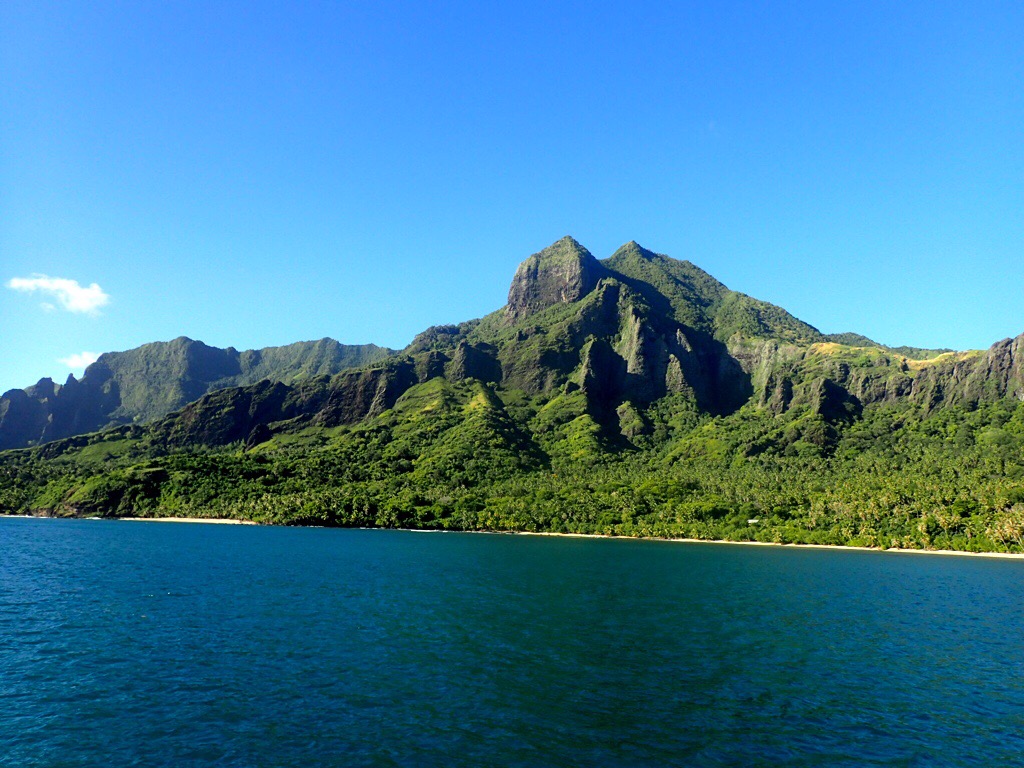
It was with a twinge of sadness we said a final farewell to the Marquesas. Impressing us to the end, the dramatic scenery continued as we sailed past the final island, Oa Pou, with its 3000ft spires of rock thrusting up into the sky it made a magnificent sight on the horizon. The Marquesas has to be one of the most visually stunning places we have ever been to, add to that the friendly cheerful people, the cleanliness and order of the towns and villages and the incredible flora and fauna and the rest of the Pacific has a lot to live up to.

  
Friday we finally left Anaho bay and returned to the main town Taiohae to stock up the cupboards, top up the petrol in the dingy tank and connect to the Internet. The plan was to leave Nuku Hiva early Monday morning, hopefully catching the promise of wind to take us the 520nm to Tuamotu.There was quite a bit of swell in the bay making the anchorage rolly and uncomfortable so we set to getting everything done as quickly as possible so we could move one bay down to Anse Hakatea or Daniels bay which looked more protected for our final couple of days.

The town dingy dock was full, we pushed ourselves between the crowds of other boats to reach the vertical ladder that takes us up the 6ft of concrete above us and the only way ashore. The supply boat had not been for a couple of weeks so the shelves at the shops were quite bare but our expectations are lower now and we felt happy with our purchases. To escape the rolling in the evening we went back ashore to the only restaurant in town, a pizza place, so used am I to spending evenings on one boat or another, as we approached the dock Rick noticed I wasn’t wearing shoes, to return to Raya would be bouncy and difficult, so in true Polynesian style I went to dinner barefoot.

We were up at six the next morning to see what we could find at the market and then went over to the fuel dock. Flush with tomatoes, Marquesian grapefruits, bananas and baguettes we set off. It was yet another beautiful and dramatic location, on one side of the bay the wall of rock rose vertically thousand of feet straight up from the sea. There was another pretty beach and the guide book tells us a 2-3 hr walk up the valley would bring us to a waterfall – the third highest in the world. Hot and tired from our busy few days we decided trekking could wait until tomorrow, turned on the AC and relaxed below.

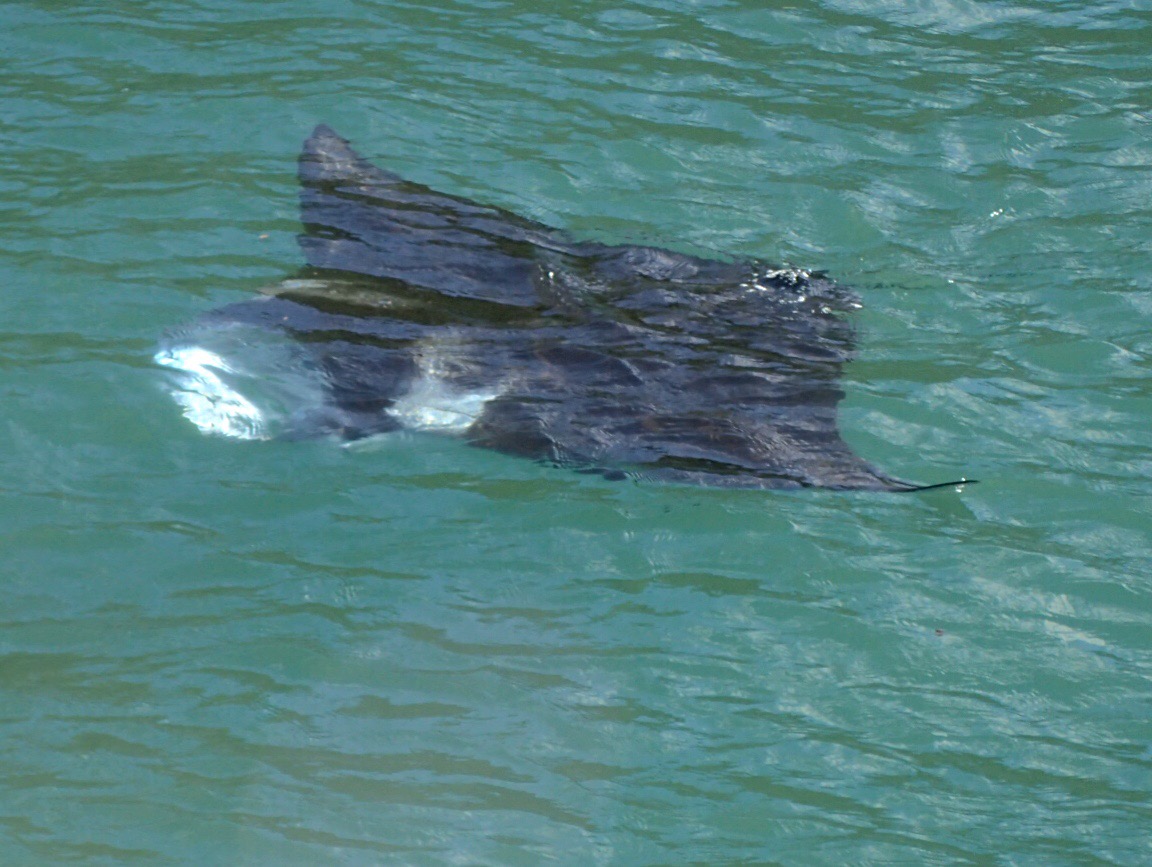
Sunday morning however, found us fighting off a swarm of tiny flies, they were everywhere, in our breakfast, up our noses, covering every surface. Time to leave we decided, so instead of going ashore we readied the boat for departure. A manta ray with a 6ft wing span cruised by a few feet away to wish us farewell and by 10.30 the anchor was up.


It is now 3am on our second night at sea, clouds are building low in the sky making it difficult to identify the horizon, I assume that if another boat appears it lights will be obvious in the blackness. We have seen nothing since leaving Nuku Hiva. We are trying out four hour watches tonight, more difficult for the person on watch but a larger lump of sleep in between might help keep us more rested.

We have had some great sailing with the wind just behind the beam in calm seas. At present we are doing between 7 and 8 kts in sixteen or so kts of wind but with the occasional gust in the middle twenties we have reefed the Genoa. Jupiter our constant bright companion since we entered the Pacific is setting to the west, the moon a wafer thin slither of light is about to rise in the east.

For the past week we have been gathering information and discussing with other cruisers the best time to enter the passes of the coral atolls. The atolls are rings of coral, on top of some areas are sandy islands but mostly the coral barely rises above sea level. Occasionally there is a break in the coral big enough for a boat to pass through. Most of the water that enters into the lagoon also comes in and out of these passes so it is important to go through them at slack tide. We are trying to time our arrival at Kaueli atoll, our first landfall, to between 9 and 11 am on Wednesday morning. With light winds forecast it is going to be touch and go.

Baie d’Anaho

Thursday 28th April

We are finding it hard to drag ourselves away from Anaho Bay, it is calm, peaceful and secure, we are tempted to stay forever.

It has good snorkelling, stunning scenery and a great beach, there has never been more than four boats anchored and most of them are our friends. What more could we want? Well, food, rubbish disposal, a telephone and Internet signal etc….. We can’t put off our departure much longer.

The beach is edged by a reef, so you have to take the dingy in via a pass marked by buoys. The reef is too shallow for swimming but the mile long arch of sand makes for a great walk. As you stroll along the views are fantastic in all directions, out to sea are the yachts gently swaying at anchor in the turquoise water, inland, towering above you, are the striking rugged mountains and through the trees the criss-cross of palm tree trunks and the bright colours of the hibiscus flowers. Coconuts, shells and bits of coral are strewn over the soft sand, large tree roots block your path and small crabs scatter in front of your footsteps.

  
The village is just a smattering of houses, the ubiquitous Catholic church and a building with some construction going on that was apparently once a restaurant. We can’t imagine there ever being enough people to make it worth while, there are only two ways into the bay, by sea via the pass to the beach and a rough track across the hills to the next bay about two miles away.

We have been taking advantage of the calm water to catch up on some jobs. We have scrubbed the waterline, the hull coolers for the refrigeration systems and all the water inlets, again, the green weed grows faster than we can scrape it off. All the raw water filters have been checked, they filter the sea water that is used to cool the fresh water that runs through the pumps, we have six, one for each air conditioning unit, one for the water maker and one each for the generator and engine. We have cleaned the lazerette and its contents and hoovered through below decks and Rick has fashioned a wind scoop for our cabin hatch from the clew of the ripped cruising shute. 


A second life for the clew of the ripped cruising shute

 
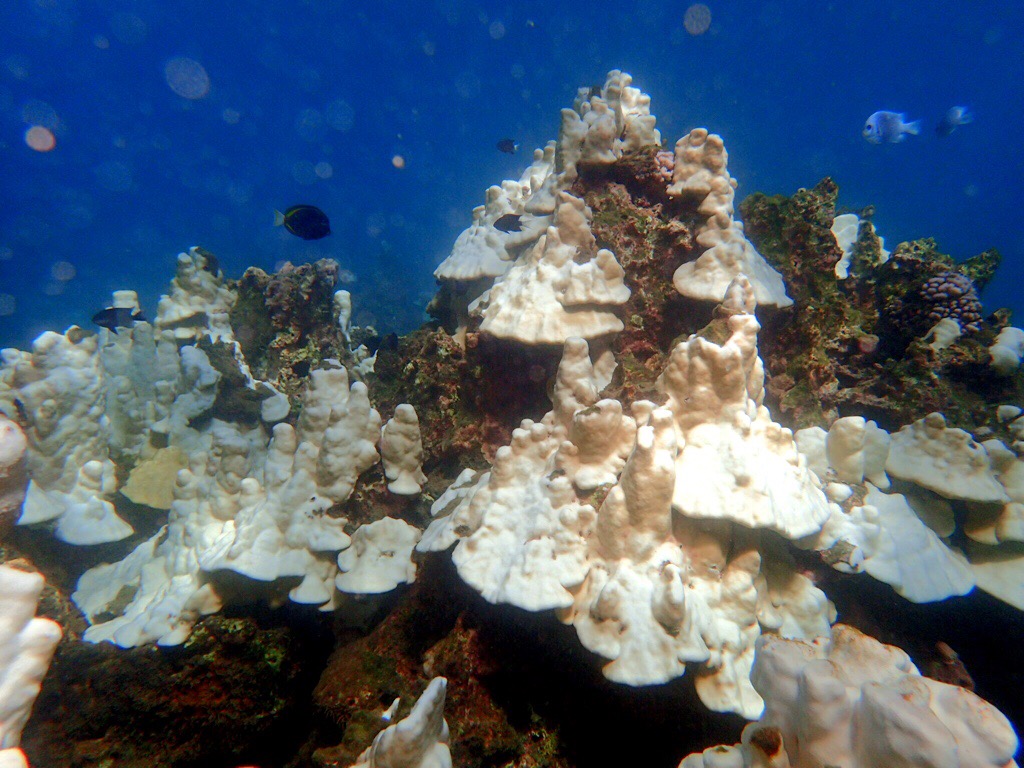
We have also found plenty of time to relax and read and have discovered a really good snorkelling spot. It takes a while to find a patch of sand amongst the coral to drop the dingy anchor, as you carefully weave between the coral heads that protrude almost to the surface, but once you do the dingy holds fast. The heads are covered in a white coral that make them look much like they have been topped with thick icing, in fact it is rather like swimming through Disney’s idea of a winter wonderland with mountains, spires and turrets covered in snow. There are plenty of fish too, unfortunately I have yet to get a Pacific Fish Field Guide so they are all very pretty but new to us and so as yet mostly unidentified.

  
There are, of course, a few draw backs to paradise, along with the fast growing hull weed, the Marquesas if full of biting insects. We are plagued by a large bright yellow wasp, everybody is getting stung. One got inside Rick’s T shirt yesterday giving him a particularly painful sting on his stomach and on the finger he used to swoosh it away. I am covered from head to toe in small itchy bites either from the billions of ants or the tiny No-No midges that fill the air and the sand on the beach.

Still, I think we can bear the pain and stay just one more day.

Wine, worms and waterfalls

Monday 25th April

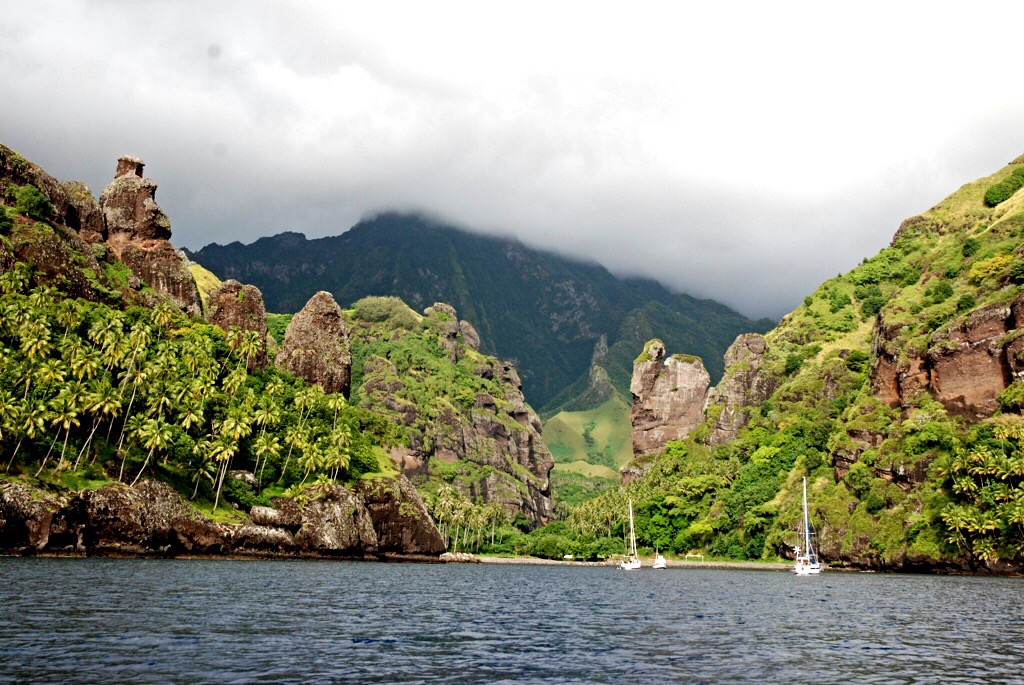
Today we have woken to clear blue skies and a bit of a hangover. We are anchored in what is described in Charlie’s Charts – a guide to anchorages in the Pacific – as the calmest bay in the Marquesas. Baie D’Ahona is narrow and indented about a mile into the northern coast, we are tucked into a cove at its furthest end that is completely protected by a headland from the ocean outside. We are surrounded on all sides by jagged steep mountains, on the shore is a beach of yellow sand, topped by palms and hibiscus trees, a typical Marquesian landscape in fact. A ghost of a moon is setting in the west, the morning sun is already feeling hot.


Entering Anaho Bay

 
Last night, and the reason for the hangover,  Bob and Heather from Crazy Daisy who had sailed up to this bay with us and Scott and Tracy an Australian couple from their Catamaran Yolata who we have been bumping into ever since our arrival in Marquesas, came over  for a sundowner onboard Raya. Bob had spent most of yesterday with his head inside the seat where our freezer compressors are, trying to coax some life into them. He seems to be an expert on all the systems on the boat and we now have one compressor slowly cooling the freezer back down. We managed to repay him, in part, with an oval hinge that had cracked on his freezer that had made it rather dangerous to open. We are finding that cruisers are very generous with their time, expertise and spares.

We had the stern light shining on the swim deck to help people in and out of their dingies, with three dingies bobbing out the back Raya resembled mother duck with her brood of ducklings. When it was time for everyone to leave, gathered in the pool of light off the back of the boat was not just ducklings but a form of life that we had never seen before. Tens of wiggling, huge flattened worm like things, 6-8 inches long and about an inch across they had red and white stripes with sucker type legs. Everybody entered their dingies with extreme care and strangely nobody has gone in for a morning swim yet today.

Friday night, the night before we left Taiohae Bay we had monsoon levels of rain. The guys from Toothless were full of a plan to get up at 4am to track down the rumour of fresh vegetables, a rarity in Marquesas, at an early Saturday morning market stall. Chris persuaded me to join him – it’s all part of experience of being here, he encouraged – but we agreed if it was raining we would leave it. My alarm woke me to the sound of torrential rain crashing down on the deck above us, I got dressed but with no let up in the downpour I retreated back to bed. Chris did go ashore an hour or so later and kindly picked up some stuff for us as well, hooray we have tomatoes!

The rain had had a dramatic effect on the bay, muddy water flooded out from the rivers turning the water brown and carrying flotsam far out to sea . As we returned to the boat armed with fresh baguettes we had to weave the dingy around the coconuts and branches that threatened our outboard. The mountains above us were streaked with a dozen waterfalls, thousands of gallons of water cascading off the the peaks. 


Water cascading down the hillsides

 
To complete the scene, onshore, a crowd had gathered under marquees above the beach to watch the inter island school canoe regatta,  indifferent to the conditions the boys battled hard in a series of races encouraged by the loud cheers from the crowd. Music came from the community hall behind them and women were setting up stalls of food. 

We considered staying another day to join in the fun but our water tanks were nearly empty and we didn’t fancy making water from the now murky bay and we were keen to swim and explore somewhere new, so we set sail in search of cleaner, calmer waters. We sailed out of the bay straight into choppy seas, the wind was good but right on the nose, we motor sailed uncomfortably to the north of the island, wondering if we had made a mistake. 

We haven’t, in Anaho Bay we are still, the water is clean and the view spectacular. And hopefully the wormy creatures of the night before have returned to the depths from which they came.

The Sacred Banyan Tree


The Banyan tree was gigantic, a magnificent one hundred and fifty feet high and forty feet in diameter, the aerial prop roots are so numerous and thick that nobody can find the original trunk but it is estimated to be about six hundred years old. These trees were sacred to the Polynesian people and as with this one were frequently planted near the high priests platform at the highest point of the ritual gathering places. A couple of years ago, during the dry season, one of these huge trees burnt down revealing hundreds of skulls concealed within its tangle of prop roots. It is thought that the head of a person was considered the centre of the body and resting place of the soul, the heads of the enemy were prized bounty (and supper) and when a chief or priest died their head was placed in the sacred Banyan tree to help facilitate their souls reaching the spirit world.


As we walked, crunching below our feet were nuts that when boiled produce the blue black ink that was used for tattooing, rocks can frequently be found with hollows that have been created as ink wells and fragments of sharpened bone and shell have been discovered that acted as the needles. Everyone within the tribe was extensively tattooed it seems to have been a way of story telling and recording ones personal history and achievements.

Then above our heads, high in the canopy, we were treated to a view of the endangered Upe, a large type of dark pigeon that survives only on Nuku Hiva, there is thought to be only about two hundred individuals left on the island, so a rare sight indeed.

The architectural site near Hatiheu Bay is immense and has been partly restored  so local people can again gather for festivals of song and dance and to encourage the current Marquesians to rediscover their ancient culture which was almost completely crushed in the 19C by catholic missionaries. The Marquesians are still 80% Catholic but now in more enlightened times the language is taught in school and traditional crafts, dance and music are being revived.

We discussed with our guide Richard, the future of his country, he said there is a lot of strong feelings as to which direction the country should take – more or less autonomy from French Polynesia, modernisation and increased tourism or an inward looking return to parts of their old culture. At present they are economically dependent on France, the young are leaving through lack of employment opportunities and their subsistence life style is under threat from the desire for a more modern western existence. He would like his children to beable to have a future in their homeland, his hope is that the Marquesas can learn the lessons of other small communities in the world that have tried to balance the old with the new and that they can successfully modernise and attract the tourist industry without losing the uniqueness of this incredible place.

Nuku Hiva is slightly more tamed than Hiva Oa and Fatu Hiva, there are more paved roads and large coconut plantations but still the landscape is mountainous and dramatic and the views as we wound around the steep, tight hairpin bends were remarkable.  

View of Hatiheu bay

We had been invited on the tour by Bob and Heather. When we arrived in Taiohae Bay unusually there was another Oyster 56 anchored, Crazy Daisy, we popped over to say hello and they invited us aboard. This is their second time through the Pacific and they have had Crazy Daisy for ten years, Bob knows his boat inside out. We had a pleasant evening together talking Oysters and South Pacific islands and agreed to help each other refuel, at yet another Marquesian dodgy dock, the next day. It was good for us to do this tricky manoeuvre on somebody else’s boat first and after a hot, high stressed couple of hour all tanks were full. Well almost, the fuel gauge was across the dock so couldn’t be monitored, an airlock formed in the hose as we were filling and so we thought we were full when we in fact still had a few hundred litres to go. Still better an airlock than what happened to the unfortunate boat yesterday whose fuel pipe leaked and filled thier bilges with diesel as they innocently continued to top up from the deck.

We should have plenty of fuel to keep us going, we plan to spend another week or so exploring Marquesas then we will be swapping these dramatic volcanic islands for the low lying coral atolls of the Tuamoto Archipelago.
 

Bay of Virgins

Sunday 17th April

We have just finished the first one night sail we have done for a long time and we are both shattered. The problem with a single night sail is that it takes time to get into the rhythm of the watch system, we both had a sleepless night. We have arrived in Taiohae the main town on the island of Nuku Hiva and the administrative centre of Marquesas. There is promise of minimarts, restaurants and fuel. The anchorage seems calm so we plan to stay a few days, sleep and get a bit sorted out. 

We have spent the last five days anchored in the Baie Hanavave or Bay of Virgins as it is commonly known, on the most southerly island of the group, Fatu Hiva. The bay is surrounded by dramatic columns of rock, it is startlingly beautiful. The water is clean, clear and dark blue over the black volcanic sand and when you look below the surface it as if you are swimming in a huge pot of transparent royal blue ink.


There is again a small village that straggles up the hillside away from the dock. There is a church, a school and a small shop. However the shop has little to sell, the supply ship we are assured will be in on Friday, come back then we are told. It doesn’t really matter with just the two of us onboard we don’t eat much and we have plenty of staples tucked away all over the boat and tons of fruit that we bought from a local boat that came out to the anchorage.

On Wednesday we joined an Australian couple, Margaret and Chris  from their boat Storm Bay, for the one hour trek to a waterfall. It was raining again but the scenery was as always wonderful, as the tall vertical cliffs on the coast gave way to forested hills the track got muddier and muddier. We abandoned all pretence of keeping clean and just splashed on through using the frequent fords we crossed to help wash the worst off our footwear. We had a sketched map that had been passed and copied between cruisers probably for years and when we came across a large digger we realised something was wrong. In fact it was creating a space in the forest for improvements to a hydroelectric plant, our path had been bulldozed, the driver pointed us back down the hill, we tramped on through even more mud, wary of falling coconuts as he cleared a swathe of forest behind us.


Finally we found the final steep path and we clambered over fallen trees, boulders and massive roots, every turn bought another intriguing view through the undergrowth down to a fast flowing stream. Our surroundings could have come straight from the set of Indianna Jones. The smell was fabulous, a mix of, sweetness from the hundreds of hibiscus shrubs that are everywhere, earthy tones from the rich soil and that ‘just mown lawn’ smell that came from the damp undergrowth. We reached the waterfall hot and dripping with sweat and revelled in the cool fresh water of the pool at its base. The diversity of plants was vast and tangled, definitely not the spot to drop your favourite sun glasses, despite a extensive search Rick’s will I suspect be lost forever to the jungle.


The next day we explored the coast line, the only word I can think of to describe the steep mountainsides here is corrugated, sharp ridges alternating with deep valleys created by the seemingly constant rain, the water plummeting down from the peaks above us. As they run down to the sea the valleys often end in small coves and we spent a pleasant hour or so motoring in and out of them admiring the shear faces of the massive cliffs and the trees that cling precariously to them. The trip was made especially memorable however by the large pod of dolphins we came across. Two meter long males right down to tiny babies swam all around us, low in the dingy we could almost touch them. We considered getting in to swim with them but didn’t want to frighten them off, so just floated quietly while they investigated us.

We woke Friday to a hubbub of activity in the normally quiet bay. Preparations were in full swing to welcome the supply boat, the Aranui, which has a second function, doubling up as a cruise boat. At midday it anchored at the entrance to the bay and using what looked like WW2 landing craft disgorged a multitude of boxes and hundreds of visitors. The villagers put out stalls of crafts and performed a traditional dance. We took the dingy into the very busy dock and tired up to some rocks. Mingling with the tourists we joined them to watch the girls of the village do their bit on the playing fields of the school but it seemed incongruous having so many people in what had been such a quiet place, we escaped back to the peace of the boat. 


Saturday it was as if it had all been in our imagination, a couple of locals chatted on the dock, a few chickens pecked at the grassy verge and a lone dog walked up the street. We revisited the shop and here there were changes, we bought onions, eggs, cheese and biscuits just enough to get us to Nuku Hiva.

Trees, Tikis and Torrents of Rain

Saturday 9th April

Puopau is a ceremonial site on the far eastern tip of Hiva Oa, it was last used by the indigenous population in the sixteenth century and is regaled by tales of sacrifice, extreme tattooing, coming of age rituals and cannibalism. The area is terraced and sitting watching over everything is the chief, a large squat stone tiki whom at 8ft tall is apparently the largest in Polynesia. Our guide, Pifa, is of similar dimensions he tells us legends of the “real” men and strong warriors that were important to the people that gathered here. It does feel like a special place but unlike the violent stories that surround it, it feels peaceful and at one with nature. On one side is a huge vertical rock face, the other three sides are formed by large elegant trees with an unusual grey bark that mark the start of the rain forest. The lower terrace is full of  vivid red, yellow and lime coloured shrubs that are planted everywhere on the island. This is only part of the original site, more terracing and other tikis lie amongst the jungle beyond.


The two hour drive to reach Puopau was, however, the really amazing part of the trip. The interior of the island is a mix of high craggy mountains soaring thousands of feet high and deep steep valleys, every inch of ground covered in a miriad of trees. At the lower levels these are mostly fruit trees everything imaginable from guava to lime to avocado, at the highest levels there are huge tall pine trees and mixed between them all are fantastic large specimens of many different species. Anyone of which, would be magnificent standing alone but here they are just part of the forest. 

Wet steaming forest

To add to the atmosphere we drive through torrential rain showers, the water cascades down the hills creating landslides and uprooting trees which block the roads. Nearer the coast the concrete surface runs out and the road turns to a gravel track, the rain rushes down them creating gullies and large puddles as they twist and turn sharply and rise and descend precariously around the hills and pinicals that soar high above us. Luckily Pifa drives this route three or four times a week and knows every bump and precipice. He carries a shovel and machete in the back of the truck to clear the road when necessary.


In complete contrast nestled amongst his tools is his ukulele, when he picked us up we had recognised him as one of the players from the band at the pizza restaurant last week. It seems he plays music, sings and dances at every opportunity. At lunchtime we join a couple of other groups at a restaurant serving “typical” Marquesian food, goat cooked in coconut milk, roasted pork, raw fish in lime and coconut and bananas every way possible. It is all very tasty but I’m fussy about my meat and it s a bit fatty and gristly for me, we politely pick through it. The moment Pifa thinks we have finished eating he suggests a song, his brother and fellow band member is the guide of one of the other groups and they start to sing and play. Before we know it the boys are up doing a Hakka (as in NZ rugby team) and we are all joining in with the guttural sounds that are sung along with them.

We return to the boat via the Gendarmerie where we have to check Ian out for his flight on Monday. What an extrordinary day. 

The boat is anchored in Baie Hanaiapa and we are currently the only boat there, it’s a bit choppy but again we are surrounded by incredible green mountain slopes. The entrance to the bay is guarded by a rock that looks just like the head of an African Queen complete with a greenery crown. There is no where to attach the dingy but a old concrete warf and is a real challenge especially in the swell, I feel grateful Ian is still with us to make the dodgy leap ashore to tie us up. The village, a few hundred metres inland, basically just one road strangling up the hill, is a delight each house having a tidy garden containing beautiful flowering plants and again the brightly coloured shrubs. There is a church and phone signal but no shop. The cooking is going to have to get inventive!

Hanaiapa village

Baie Hanamoenoa

Friday 8th April

Baie Hanamoenoa, we seem to have found the South Pacific we have all this time imagined in our heads. We are anchored in a bay on the North East coast of the island of Tahuata, the only thing that is difficult here is the pronunciation of our location,  it is idyllic and the sea is calm. The sun is just rising above the steep hills, casting it’s magic across the bay, the land turns a lush green and the water a bright turquoise. The swell gently rocks the boat and the only noise are the waves breaking on the beach and crashing on the cliffs that form each side of the bay. A small turtle pops his head above the surface nearby, a pod of dolphins swim past out at sea and a pair of white tailed tropic birds guard their nest in the cliffs.


Dropping the anchor in Hanamoenoa

 
We sailed the short hop from Hiva Oa on Tuesday and after the soil rich water of the anchorage there, it is nice to beable to swim off the boat again. The water is clear and a warm 31 degrees, it envelopes you in a silky caress while being still cool enough to give you respite from the tropical heat. However this is “not a holiday” and before we can rest there are jobs to be done. On arriving in the Marquesas we were shocked to discover that during the crossing we had grown a positive zoo of algae and tiny creatures on our waterline. The three of us, armed with scrapers and brushes, spent a good couple of hours scrubbing the hull to remove, the best we could, of the surprisingly stubborn growth.

With the hull clean the next morning we headed into the beach. The surf pounding onto the sand looked a bit strong to land the dingy so we anchored 100 or so meters off and swam in. The steep beach of golden sand, black rocks and palm trees was picture perfect.

As we walked along the shoreline we discovered there were two shacks nestling in amongst the trees at the back of the beach. The first was a Copra drying shed, Copra is the name for the white meat inside older coconuts, it is laid out to dry in racks and then transported to Tahiti where it is pressed to produce coconut oil. Sale of Copra is the main source of income for the islands and groves of coconut trees can be seen lining the head of every available bay and up amongst the undergrowth covering the coastal hills.

The second was a ramshackle affair belonging to the only resident of the valley, Steven. Steven is a young guy and possibly the most laid back person we have ever met, no hard sell here, just a ka-o-ha (hello) and as you approach, the offer of one of the small sweet bananas they grow here. In a land so abundant he lives on the fruit from his trees and the fish he goes out each night to catch. We sit on the makeshift bench in the shade of the trees, drink the coconut water he offers us and chat. His English is excellent, learnt from cruisers that have gone before us, he must have heard our tale a hundred times before but happily listens anyway and then slowly, he produces items he has for sale. We refuse the offer of a spear fishing trip to catch our supper but buy a pretty string of beads made from coloured seeds and a large bag full of limes, he throws in some green beans and a dozen bananas.

  
Pleased with our purchases it dawns on us that we now have the problem of getting it all back to the dingy. Kicking on my back I manage to hold it above the water and reach the boat with the bag just a little damp, we set about making some lime lemonade.

Ian leaves us on Monday and the plan is, later today, to sail back to Hiva Oa and anchor in a northern cove so he can see a little more of the Marquesas before he goes. Rick and I however may well return to this lovely place as we explore more of the islands.

Landfall 

Tuesday 5th April

We stand in the Gendarmerie in Atuona, Hiva Oa, clinging to the desk looking blankly at the form in front of us, we must look like a group of drunks brought in to sober up. In fact we have all got a bad case of sea legs, the room sways in front of us and we are so dazed the filling in of the customs form is a real intellectual challenge. The Gendarme must be use to such scences, he smiles at us indulgently as he gently coaxes out of us the required information to check into French Polynesia.

How exciting is that, we have reached French Polynesia. Well deserved “got here beers” were enjoyed by all.


The final night had been stormy and the approach to the island quite rough. Our first glimpse of land for seventeen days, far off on the horizon, was of a huge slab of rock clocked in cloud. As we approached the anchorage our hearts dropped the sea didn’t appear to be much calmer and the anchorage was rumoured to be rolly. We craved calm.

Luckily rolly is relative and compared to our last few weeks the bay as we motored past the breakwater was positively tranquil. We looked around us, we were completely enclosed by steep green, green hills. The mountains behind us have dramatic sharp ridges that runs up into the mist. At the head of the bay is, what would be called in a school geography lesson a V shaped valley. Every patch of land is covered by exotic trees and luxurious vegetation. The beach is of black volcanic sand and the sea is brown from the rich soil that has been wash down during the heavy rains of the previous night.

View looking out from the bay

It is steamy hot and heavy downpours are frequent, the undulating road into town from the anchorage is about 2 miles long so we try to time it to pick up a lift with the yachting agent and sorter of all things in Hiva Oa, Sandra. Town is just a couple of roads but there is a bank, a post office and three small supermarkets. This is – French – Polynesia so at a price you can dine on fine wine, cheese and pate all served on crusty baguettes, there is however a distinct lack of fruit and veg. The locals apparently grow so much in their gardens that there is no demand for them in the shops. So for the yachties it is a case of dodgy deals from the backs of vans. 

The Marquesas are famed for thier pamplemousse, these large grapefruits are sweet and delicious and acted as a fitting welcome for our friends on Toothless as they arrived a couple of days after us. As did the squadron of small manta rays that filled the bay that day about eight of them swam around the boats for a couple of hours. It is nice to see familiar faces in far away places and we shared a nice lunch together comparing notes on the crossing.


The Marquesian people seem a contented bunch, smiling and helpful. On our first evening we went to one of the few restaurants in town, a pizza place that had a local band playing. The music was a mix of popular French and Polynesian songs, it was all very casual and unpracticed but they were obviously having such fun, it was infectious, the whole place was full of smiling faces, tapping and singing along to the tunes.

Besides being the welcoming first port of call for tired ocean crossing yachts, Atuona has one more claim to fame, it is the last residence and final resting place of Gaugin. There is a small museum and you can visit his house, unfortunately all his paintings were returned to France when he died, the display is full of copies only but the sumptuous gardens alone were worth the visit. Ian walked up the hill to picturesque grave yard where he is buried.


Today we plan to sail to a bay on an adjacent island about 10nm away, the bay is of rare white sand and the book says one of the prettiest in Polynesia. I think enjoy it here.

Don’t Buy Bananas

Friday 1st April 2016

It is our final night at sea, I’m doing the 3-6 am watch. It’s quite lively, I’m dressed in waterproof trousers as all the seats are wet from a succession of rain squalls, lightening flashes frighteningly in the distance and we are storming along at about 8kts. We have 52nm to go, the island of Hiva Oa is 4000ft high at its peak so we hope to see land soon after dawn. We are looking forward to getting there, this has been rolly trip.

At the end of our second ocean passage I thought I’d note down a few important things we have learnt.

Don’t buy the traditional large bunches of bananas, they arrive full of spiders and cockroaches and their sap stains the teak decks. However green you buy them and however many different places and conditions you find to store them in they all ripen together on day two and have to be chucked, for fear of banana gas poisoning, overboard by day four.

The satellite link is essential, not just for weather forecasts but for the emails we receive from everyone that, in the absence of whales, brighten up our days.

Weather forecasts are almost always wrong – well should be read as trends rather than truths.

Be prepared for copious amounts of facial hair, it seems it is obligatory for most men to grow as much as they can for the duration of the passage.

Have plenty of spectacle mending kit/spare pairs onboard, Raya seems to be a glasses disaster area.

Develop daily routines to give the day structure, like the morning “what shall we eat today?” conversation, the 4.30pm crossword and the boys afternoon cockpit snooze.

Rotate the watch system, everyone deserves to experience the uplift the dawn brings after a dark night watch.

Yes you can sleep in those sheets for a couple more nights, it is shocking how disgusting the bedding can get without any adverse effects.

Don’t rely on the fishing rods to provide dinner, or the freezer to keep things frozen, enjoy the challenge of what can be created with one green pepper, half a carrot and slightly mouldy lump of cheese.

And finally, beware of flying kettles!

Stars, Scalds and Swordfish

Easter Sunday 27th March 2016

08 55.491 S, 126 05.610 W – 760nm  to go

The stars are fantastic this evening, the sky is almost cloudless and the moon has yet to rise, allowing them to to take centre stage. I was going to start this post by saying that this will not go down as one of our favourite passages but instead find myself marvelling at the fact that I’m sitting here being pushed across an ocean by just the wind, we eat, we sleep, we read but Raya just keeps ploughing on. The night breeze is soft on my skin and the only noise is the occasional flap of the sail and the water rushing past our hull. The swell has finally reduced making everything much more comfortable. It seems churlish to complain.

The roll has been the main issue for most of the way and I am suffering because of it. Almost as the last scab flaked off my grazed shins I had another accident, this one potentially much more serious. While making my morning cup of tea on Thursday we were hit by a wave at a particularly awkward angle the boat lurched over, the kettle flew off the counter and its boiling contents splashed onto my side. Luckily my first aid training took over and I was in a cold shower within thirty seconds, I stayed there for ten minutes before Rick applied a cooling burns dressing. Our quick action seems to have contained the damage, it’s a bit messy but the pain is being controlled by codeine and I seem to be healing fine. The careful planning of the first aid supplies came in to their own, we had everything we needed and easily to hand. It certainly brought home, especially to Rick who was having to manage the situation, how vulnerable we are and how extra careful we have to be.

I loved Rachael’s response ” Mum, you sail half way around the world only to be taken out by a kettle, how English”

The lumpy seas have also curtailed our fishing, we did put the rod out one afternoon and it appears the Pacific is full of fish. Within an hour we had hooked a 5ft long sword fish, there was no way we could land him, luckily he broke the line and got away, but not before giving us a fantastic display, leaping from the water, showing off his power and grace. Half an hour later the line screamed again, this time it was a much more manageable 3ft dorado and supper.

The days slip by blending into each other, nothing but mile after mile of sea, great excitement if we see a bird, even more excitement if we can identify it in our Birds of the Pacific book. The visit of a large pod of dolphins kept us entertained for hours, first watching them then looking them up and finally rerunning the videos and photos we have taken of them. A small sailing boat popping up on the AIS or lights on the horizon are greeted with enthusiasm and emails from home bring a smile to our faces and are read aloud to be shared.

The miles to go counter now reads 750nm and the guides to Marquesas are being studied. Hoping for landfall on the afternoon of the first or the morning of the second, apparently  dramatic cliffs, waterfalls and pamplemousse await us.