Ocean High

Monday 10th June 2019

We have finally arrived in Horta in the Azores, after a couple of weeks of very little wind, it has been a slow but comfortable crossing. I, particularly, get range anxiety when we have to do such a lot of motoring but this time even Rick, not confident of the fuel gauge, was measuring the inexorable draining of the fuel tank with the dip stick on a very regular basis. In the end about 50nm out from the marina we picked up some wind and sailed the whole of the last day, approaching the island reefed and doing 8kts, with at least 150 litres of fuel left in the tank.

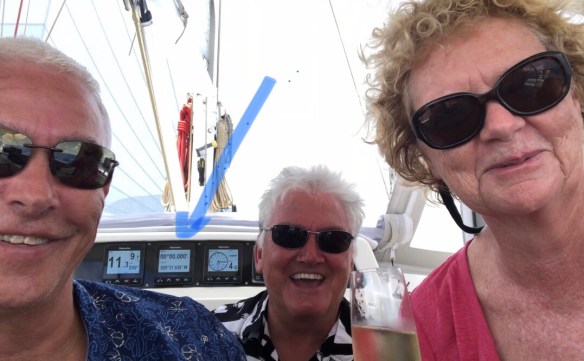
‘Got here beer’ in Horta

Our crossing from the Caribbean might have been the slowest of our ocean passages but stuck in the middle of the Azores high pressure system, it also became the calmest. And calm seas don’t just mean more sleep and a much more comfortable life onboard, it also means our fellow ocean goers are easier to see.

On Wednesday I spotted what I first thought was rubbish, it looked a bit like the end of a child’s clear pencil case decorated with a pink rim. Then I saw another and another. We looked more closely and realised they were a type of jelly fish, a jelly fish with what appeared to be a three dimensional semi circular sail. Enquiries back home to those who have access to Google revealed them to be in the Portuguese Man-o-War family. We learnt that each creature was in fact not a single organism but a colony of much smaller ones, all working together to create a viable unit. And what was also incredible, was that five days and nearly a thousand miles on, they were still passing us by in a steady stream. The whole ocean is full of them.

A clump of a dozen sailing jelly fish

A rarer sight was a pod of whales. In a rougher sea we probably wouldn’t have spotted the telltale blow in the distance, but any thing that breaks the surface in these calm conditions is obvious. Too far away to identify conclusively, their small size suggests they were probably pilot whales. And just when we were beginning to give up on dolphins over the last few days of the passage we saw three or four large pods, They were Atlantic spotted dolphins and they gave us a spectacular show leaping from the water and dancing in our bow waves.

A pod of dolphins charging in to swim at our bows

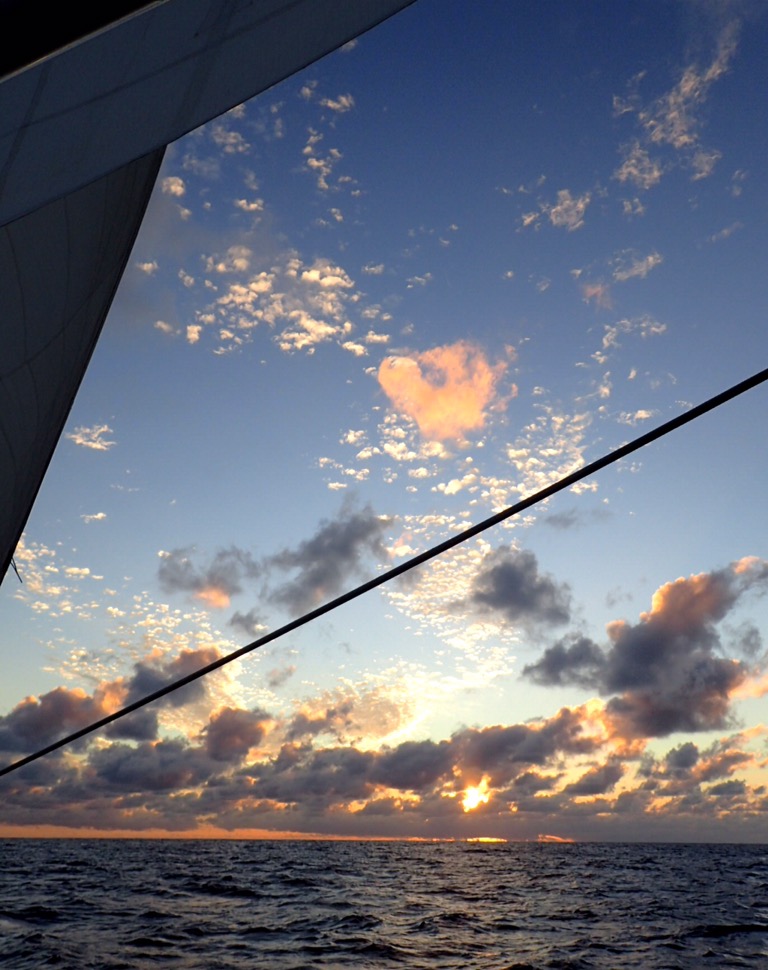
The journey has also been big on the pure grandure of the open ocean, the only ripple to be seen was our wake as we motored over a glassy, inky blue, undulating sea, that stretched out to a huge horizon. We have been treated to dramatic dark orange sunrises and sunsets and one night the ocean was so smooth, I sat mesmerised by a whole sky full of stars reflected in its surface. As always we gaze in wonder and reflect on how honoured we are to witness such things.

Sun rising over a silky sea

While we enjoyed all this we were slowly travelling northward and we were noticing many changes. The temperatures of the sea and the air dropped daily forcing us into more and thicker clothing. The Southern cross that has for so long been our focus in the night sky, a few days ago disappeared below the horizon and after years of pretty much 12 hours of darkness each night, the shorter nights are taking a bit of getting use to. With the sun setting later and later each day, despite our routine changing of the clocks as we travelled through different time zones, we had eventually to push our night watch system back an hour because we were struggling to get to sleep. Even the duration of dawn and dusk is changing, the sudden onset and disappearance of darkness of the tropics is being replaced with the hour long fading and brightening of light of higher latitudes.

We hope to have about a week to enjoy the Azores, we suspect the passage back to the UK may not be so tranquil, so we must be patient and wait for a good weather window.
Goodbye to the Tropics ðŸ˜¢

Sunday 26th May 2019

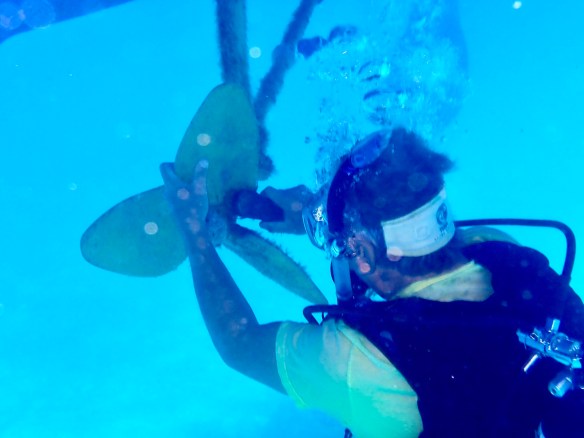
Preparations in full swing, Rick scrubbing a very furry prop

As we lifted the anchor today and headed towards the marina to prepare to leave tomorrow it occurred to me that, rather sadly, this may be the last time we ever anchor Raya. Our next destinations, Horta in the Azores and then the South Coast of England will most likely have us tied up in marinas for the rest of the trip, our trusty anchor unneeded. By strange coincidence, while I play about with the possibility of writing a book of our adventures, I was just yesterday writing down my thoughts about our very first night at anchor, off the coast of Portugal as we sailed towards the Mediterranean.

Where on earth have the last four years gone?

Since our arrival in the Caribbean we have found ourselves trying to absorb the details of everything we love about our tropical watery life, fixing them into our memories to be conjured, at will, to brighten dreary November days.

Stunning tropical colours in the BVI

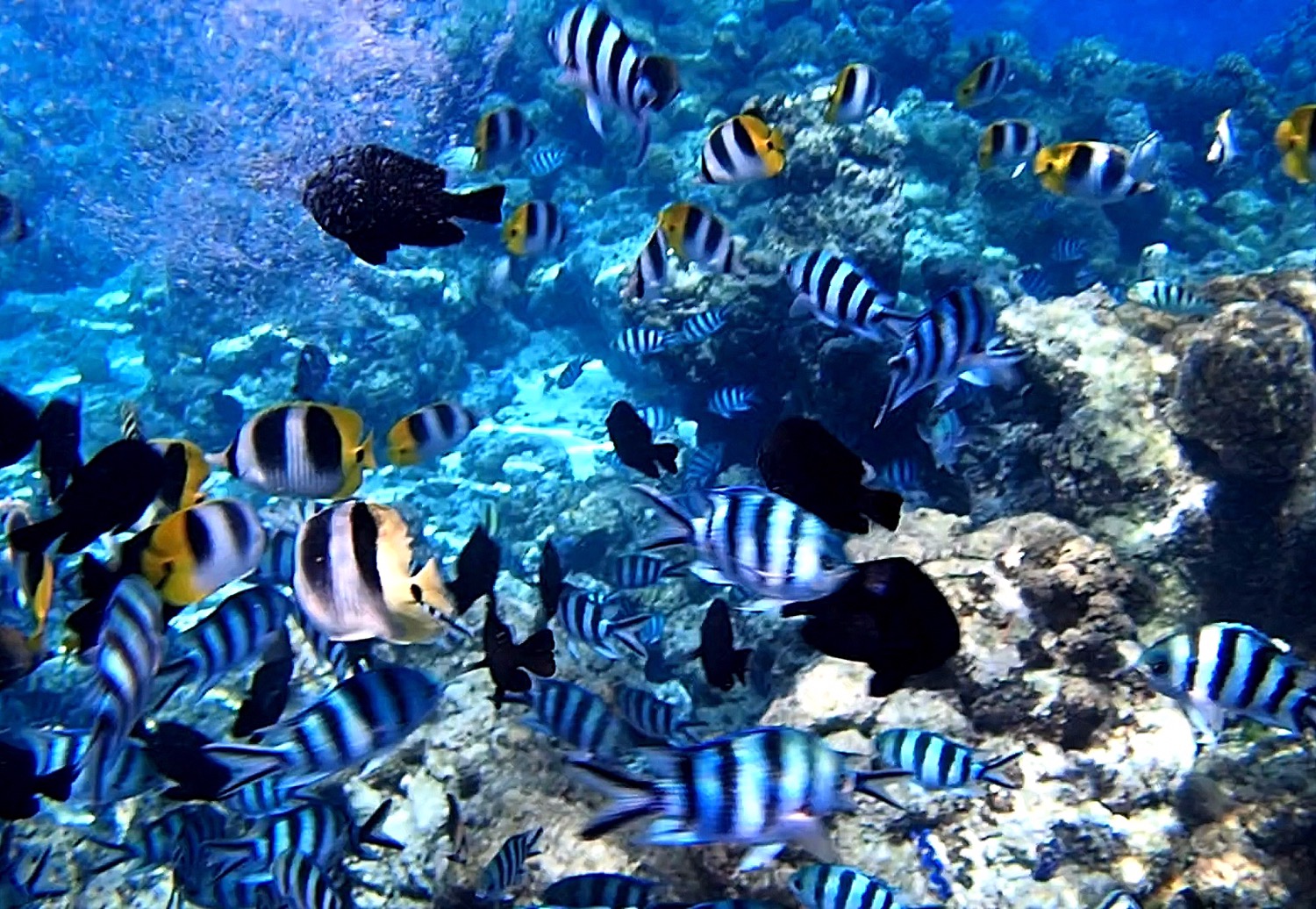
Not just the incredible events we have been honoured to experience but also the small every day things, like the feeling you get when, sweaty and hot, you jump over the side into the water, it’s delicious silky coolness enveloping you. The anticipation of what might be revealed today as you dip your head into the magical underwater world whose sights rarely let you down. Or the spectacular shows of the seabirds as they swoop and dive or dance above your heads. And the kaleidoscope of colours of the fish and the coral, the burnt oranges and baby pinks of the sunsets and the turquoise of shallow seas.

How can I live without that turquoise.

Not sure who this chap is but his home is a colourful mini reef
It’s difficult to imagine living without these things, however, I have recently caught myself contemplating other aspects of our life and thinking how nice it would be to wear perfume rather than insect repellent out to dinner, how great it would be to have a fridge full of green vegetables and what a luxury it would be to be able to flush the toilet paper.

So perhaps this is a good time to be leaving this life while our tolerance of the inconveniences, the price we pay to enjoy these things, is still high.

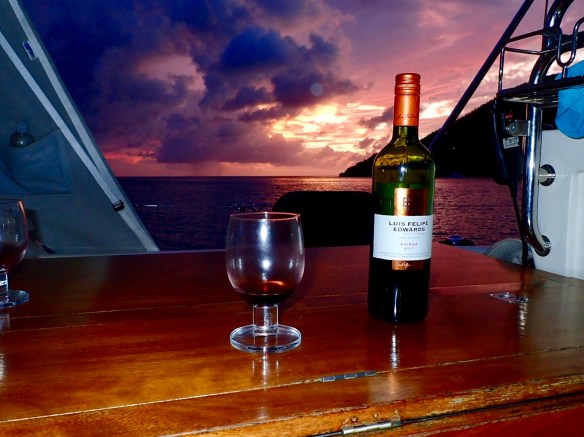
Thursdays sunset

You can track our homebound route through our Yellow Brick tracker, found at http://my.yb.tl/sailrayatracking/

All the Way Round

Thursday 7th March 2019

We are circumnavigators, on Tuesday morning we sailed into Port Louis Marina on the Caribbean Island of Grenada, where 3 years and 45days ago we had set sail for the Panama Canal and the Pacific. We have been swamped by messages of congratulations and have been toasted with champagne but I’m not sure our achievement has really sunk in.

We are being very kindly treated to a week in a luxurious villa, with Jonathan our sail mate, his wife and my sister and husband. Slowly we are unwinding but the last few months of continuous sailing have taken its toll and we feel pretty tired.

The pool at our lovely villa in Grenada

The second half of the passage from Ascension was much windier than the first half. Having cleared the squalls the sea calmed down and for a day or two we enjoyed perfect trade wind sailing. With the sea flatter Jonathan put the rods out and we finally had some fishing success catching a small tuna and a few days later a Mahi Mahi.

Successful fishing day

The days rolled by, sleep, watch, eat, read, eat, sleep, crossword, eat sleep, watch……. We sailed on in our ever changing disc of blue, some days calm others a mess of conflicting waves, the oceans colour varying with the sky from deep ink blue to somber grey. The moon gradually reduced to a slither that rose later and later each night and as the nights grew darker we were treated to skies of a trillion stars.

We were mostly completely alone, the occasional brown booby flew close catching the flying fish we disturbed with our wake and a few AIS targets passed by on the chart plotter but too distant to appear on our horizon. So it was rather a shock when, with our waining vigilance, we spotted a fishing boat less than half a mile away. It had no AIS, in fact, covered in rust, it’s waterline thick with algae, for a moment we thought it may be abandoned but no, tossing wildly in the waves it’s crew valiantly fished on.

Ever since the equator we had been sailing through increasingly large patches of free floating, bright orange Sargassum seaweed. With no engine running it wasn’t a problem for the propellor, but we sat aghast trying to imagine how many acres of ocean it must cover, hoping that it was at least using up lots of carbon dioxide to help the atmosphere.

Masses of Sargassum seaweed covered the ocean

We were sailing fast which meant our eta had us arriving the morning before the arrival of our welcoming committee, who were flying in from the UK Tuesday afternoon. But after 15 days the thought of slowing up and spending an extra night at sea didn’t appeal to us, we pushed on. Until suddenly, and against every chart and source of information we had for this area of water, we encountered a negative current and for 36hrs we stared depressingly as our speed over the ground struggling to reach 7kts. Thankfully about 200nm from Grenada the current firstly went neutral and then positive, at times we screamed along at 10 knots towards the finish line.

The traffic had increased also, not only more fishing boats, with and without AIS but tankers and cargo boats, plying their way between the Americas and Africa or the Far East. The radio sparked into life with a large drilling platform calling up to ask us to leave them a minimum perimeter of two miles as we passed. On our final night we had to call up two cargo boats to ensure they were aware of our presence and as always they were happy to change course to give us plenty of space.

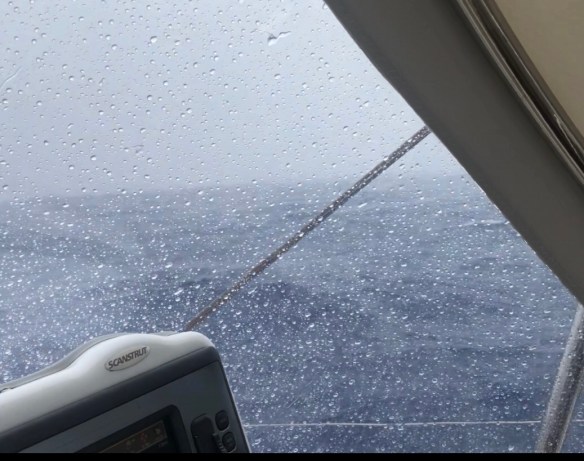
Tuesday morning we arrived off the SE corner of Grenada, land ahoy was excitedly written into the log. But we weren’t quite there yet, blackening skies and high winds built as we approached the island, overfalls tossed us about and we had to slow to let the rain pass so we could prepare the boat for docking. Then we faced the challenge of the complicated mooring system at Port Louis Marina, it was with a sigh of relief we secured the final line.

The ‘got here beer’ tasted good but not as good as the Champagne we shared with our friends that evening. We’d made it, we’d sailed all the way round.

Got here beer Grenada

Back in the Northern Hemisphere

Sunday 24th February 2019

Latitude : 02 12(N). Longitude : 034 54(W)

South Atlantic sunrise

Raya is back in the Northern Hemisphere. We crossed the equator about 400nm off the Brazilian East Coast heading for the Caribbean and celebrated the event with four glasses of bubbly, one each for the three of us and, as tradition dictates, one over the side for Neptune. Strangely it is almost to the day exactly three years since we crossed the equator going southwards in the Pacific.

Capturing the moment

We left Ascension Island under blue skies, with light winds and calm seas. A nice easy start while we settled into the pattern of eating, sleeping and night watches that would be the rhythm of our lives for the next 18 days or so. The going was a bit slow but we were saving our fuel to help us through the Doldrums.

Either side of the equator in the tropics run the trade winds, winds generated by the rotation of the earth that blow from the NE in the northern Hemisphere and SE in the Southern Hemisphere, we have been enjoying their consistency for most of our trip and they are the reason for our westerly circumnavigation. Running around the equator however is the intertropical convergence zone, the ITCZ. Here the winds drop dramatically, historically the doldrums were dreaded by mariners as they could become becalmed for days on end. These days with most yachts equipped with an engine it is more a matter of motoring through them as fast as you can to pick up the winds on the other side.

We motor sailed for a couple of days before the wind picked up a little and we managed to sail for a while. Friday evening however the wind dropped again, but when we turned on our engine, we were assaulted by a loud and worrying banging from the prop. As we crossed the equator we had thought of taking a mid ocean dip but decided there was a bit too much swell, now it looked like Rick would be getting wet after all. We sailed slowly through the night until at first light, equipped with his mask and a knife he went to investigate. For the past few days we had been passing through dense patches of weed, and to our relief it was this that was entangled around our prop and the simple act of stopping the boat freed it up. Rick stayed down to check things were ok before we continued on our way.

Where the trades meet the ITCZ there is often an area of unsettled weather and unfortunately as we sailed through the northern boundary we had 36hrs of squally conditions. Ominous dark clouds would continually build on the horizon and we’d watch as they either scooted past, missing us or relentlessly approached. Each squall brought high winds that backed northwards and torrential rain that fell for about half an hour. With light winds between them the trick to not getting continually soaked was to reef the sails with the wind increasing just before the rain arrived, this was not always that easy. On the upside our decks that were still covered in dirty South African dust have been cleaned beautifully.

Another squall comes through

Thankfully we are now through the squalls and are picking up the northeasterly trades which, with an accompanying current, are whisking us quickly towards Grenada. Just over three years ago we took off form Grenada for the Panama Canal and the Pacific Ocean, as we arrive back we will cross our outward track and unbelievably our circumnavigation will be complete.

For now however we have another week or so of sailing to do. We are pretty low on fresh fruit and veg but have plenty of frozen meals, we are all swapping Kindles to ensure everyone has plenty to read and we are becoming better and better at the four o’clock crossword. Raya as always is preforming well and our spirits are buoyed by a continuous stream of entertaining emails from home. The sight of land however will be very, very welcome.

Passage to St Helena

Wednesday 30th January 2019

As the sun rose my spirits rose with it. Our first three nights out of Cape Town were chilly and the sea rough, the wind making our night watches cool and the rolly seas making sleeping difficult. It’s hard to explain just how nice, when you are cold and tired the coming of daylight is. The skies were full of cloud and glimpses of sunlight rare but still being able to see the waves as well as hear them and feel the small amount of warmth from the hazy sunshine came as a relief from the hours of darkness.

We had timed our departure from Cape Town, last Tuesday, not on the tide but on the earliest opening time of the fuel dock. Designed for much larger vessels we hadn’t quite realised just how high the sides of the dock would be and at low tide this was exaggerated further. The only protection from the barnacle encrusted wall were three huge tyres and the only cleats languished about 10ft above our heads. The surge from the ocean swell entering the outer harbour, pushed us on, off, up and down against the all. All my strength was not enough to throw our heavy warps up to the fuel manager, luckily Rick managed to get one up and I then tied us off on a couple of rusty brackets. Once full of desiel there was then the problem of transferring R8000 (£450) across the watery gap and into the air. We placed the bundle of notes into a zip lock bag and Rick threw as hard as he could, for a moment as Raya lurched it looked like it would go into the ocean but with relief it landed safely on the dock. We didn’t bother with the receipt!

Dodgy fuel dock, Cape Town

We headed out of the harbour into crowded waters, small, local motor boats fishing, huge cargo boats queueing to come into Port, pilot boats ready to guide them, a large fast ferry, flocks of cormorants and dozens of sun bathing seals. The seals lounging on their backs with their flippers in the air seemed uncaring of the passing traffic, quite a few times we came to within a few metres of them they didn’t bat an eyelid.

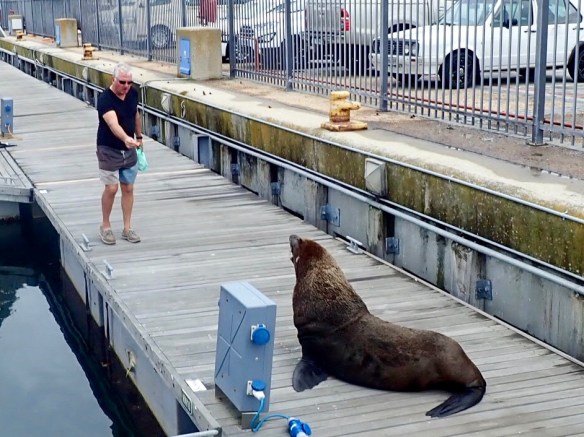
Unlike the huge male that had lorded it over our marina pontoon, one day aggressively barring Ricks access to the boat. Rick had popped out for a selection of nibbles for our lunch, unfortunately seals don’t seem to be keen on vegetable samosas and resisted the temptation to be lured after one into the water. After a 15min stand off, Rick clambered on to a wall at the back of the pontoon and sneaked around the seals back before making a leap for the boat. The seal now very cross stationed itself right next to our step off the boat. A good day for jobs onboard we decided.Pontoon wars

There traffic quickly thinned out once we left the coast of Africa, there have been a few AIS targets on the chart plotter, mostly cargo boats heading to the Far East, but none that actually were close enough to see by eye. There have been no dolphins or whales and few birds, just us, the sea and the sky.

It was a chilly first few days

When not catching up with sleep we have been reading, doing crosswords and fishing, two bites, two got away. A slight leak around a through hull fitting kept Rick busy for a day, but luckily he managed to stem the egress to a slow drip that can wait for our arrival in Grenada. We’ve enjoyed a couple of nice sunsets, well stocked from Cape Town the food has been fresh and we have even toasted the halfway point with a sneaky beer.

And as we have sailed north gradually the temperatures have increased and with clearing of the clouds, by day 5 we were back in shorts and T shirts, unfortunately the fine weather came with light winds and eventually we had to give up sailing and put on the engine. Thankfully the winds have picked up and we are sailing again today and winds are forecast to stay with us all the way into St Helena tomorrow afternoon.

Very much looking forward to getting there.

Finally Durban

Reunion to Durban – part 3

Whales everywhere between Madagascar and Durban
Thursday 15th November 2018

At 3am last Friday, near the top of the tide, we left the dock in Richards Bay and with a good forecast we headed finally for Durban. The multitude of lights within the busy harbour, an incoming cruise liner and 50 or so anchored tankers that were overloading our AIS system, made for a stressful exit. But by first light we had turned south and were being whisked along with help of the Agulhas current, the light winds were directly behind us as we motor sailed, in sunshine and calm seas.

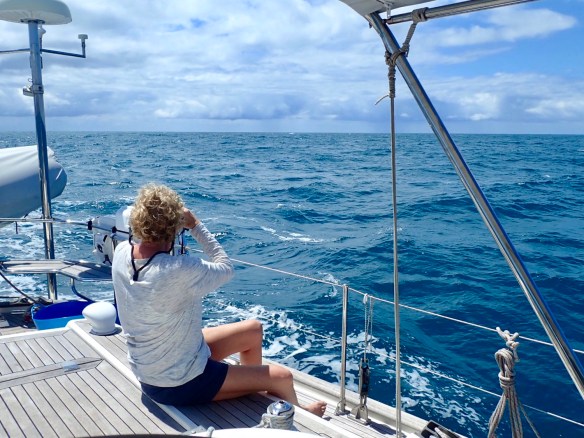
Ever since we arrived off the coast of Madagascar we have seen numerous pods of whales and this trip proved to be no exception. However many times you encounter them, when they are up close to you, it is still shocking how huge they actually are. One surprised us, surfacing just a few hundred meters off our beam, another pod entertained us, breaching and fin slapping as we sailed by.

Whale watching off Madagascar

By 4pm we were tied up on the International dock in Durban Marina. We are a bit close to the noise of the city, with its continuous traffic, a rail track and crowds of people. And the water in this corner of the marina is depressingly strewn with rubbish. We are however more than ready to enjoy having no anchor alarms to worry about, no walls to contend with as the tide rises and falls and an endless supply of power and water.

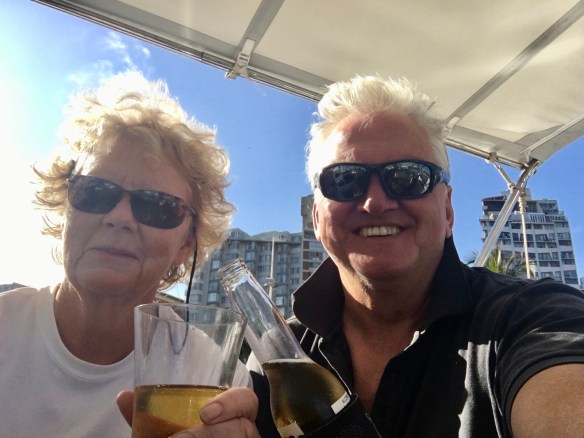
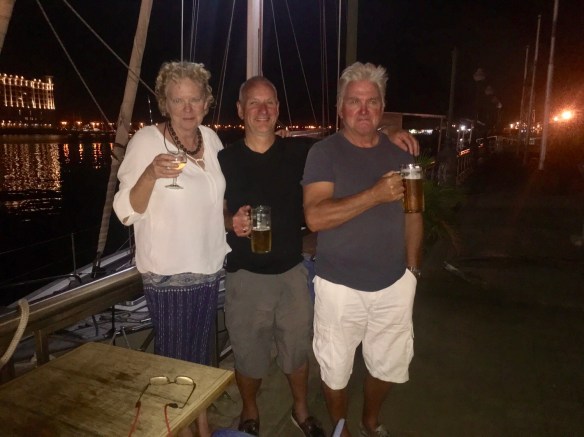
Durban ‘got here’ beers

Just across from us is the Royal Natal Yacht Club, the oldest yacht club in Africa. It’s a well frequented venue and everyone has given generously of their time and local knowledge. Sunday’s they served a carvery so we enjoyed our first roast lunch in 18 months, we have sampled the fine South African wine and been entertained by live music on their lawn. A few hundred meters in the other direction is the Point Yacht Club, who serve a knock out breakfast and have a Thursday night B B Q. Termed Braai here, as well as delicious chicken kebabs, we tried spicy boerewors, a tasty beef sausage and rather tough biltong, a thick cut beef jerky. There are a couple of Oyster rally boats still in the marina, as well as a few other boats we know, so we have plenty of company and as for once Sterling is strong here, to make things even better, everything is extremely cheap.

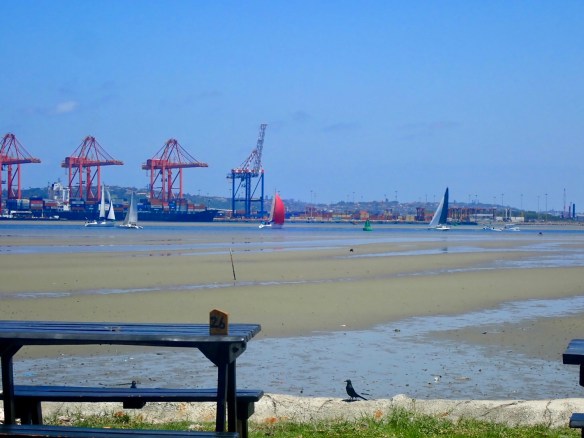
View from the yacht club lawn across Durban Harbour at spring low tide
We do however have lots of work to get through during the next few weeks, a long list of jobs sits staring at us from the table. Luckily with labour cheap and plenty of marine trades around, finding help has been relatively easy so far.

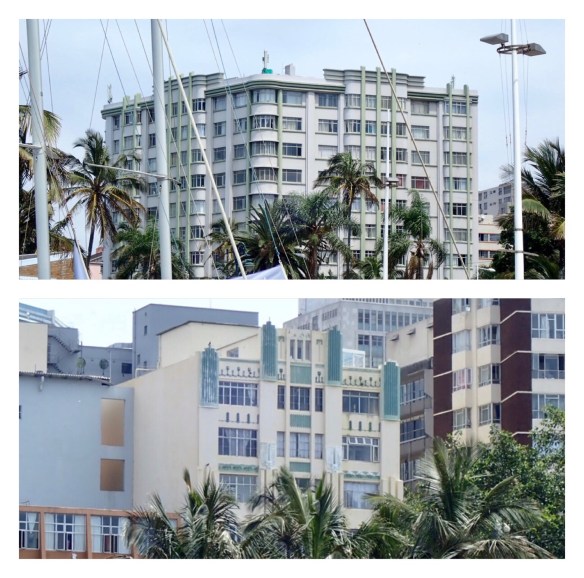
Which is a good job because moving about is a bit of a challenge, the crime level in Durban is high and exploring further than the marina precinct by foot, we are told, is ill advised. Our immediate surroundings, in the worst days of apartheid, was a whites only neighbourhood, upmarket new apartment blocks sat between majestic examples of Art Deco architecture. As politics changed, the wealthy residents moved out of the city centre and now many of the buildings stand empty and derelict, the whole area has become dismally run down and petty crime is rife. Consequently taxis are the order of the day and next week, having ticked off some of our tasks, we will hire a car to explore further a field.

Art Deco architecture overlooking the harbour

Turbulent Indian Ocean

Finally Internet, see two blogs below

Friday 5th October 2018

We have just reached the halfway mark of our sail from Cocos Keeling to Mauritius. The Indian Ocean continues to be lumpy and uncomfortable, tossing Raya back and forth as she speeds onward. Bigger waves roll in every ten minutes or so, looming over us then picking us up, when we reach the crest for a moment we sit perched high above the ocean, before with much spray and noise, we surf downwards to await the next ride.

Waves up to five meters high persisted for most of the passage.
Our friend Richard who joined us in Cocos Keeling has fitted in well with our routines and so we are now all getting a bit more sleep, even with the rolly conditions. The half moon however that lit our way for the first few nights, has waned and with quite a bit of cloud obscuring the stars our night watches are very dark. Sunrise is as always welcome.

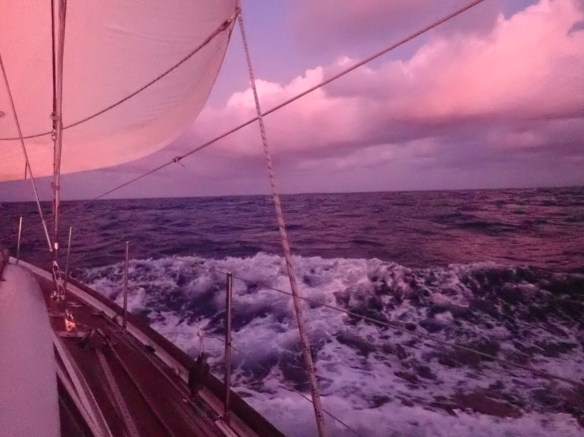
A pink sunrise

We have seen very few other ships, a few tankers have passed us but most only spotted on the chart plotter as AIS targets, just a couple pass close enough to spot on the horizon. Even the dolphins have been keeping their distance it is unusual to be at sea for this long without spotting at least a few.

In contrast there have been plenty of flying fish, one morning Richard cleared 26 that had accumulated on the deck over night. During the day we watched them skimming the waves all around us. On one wave, right next to us, about 50 small fish all took to the air at once. Catching the sun as they leapt, fins beating rapidly, for one magical moment they looked just like a band of fairies appearing from the deep.

So each day goes on, we eat, catch up on sleep, read and gather for the 4pm crossword. We’ve had good winds and we are sailing fast, there is much debate as to whether we can maintain these high speeds and make it to Port Louis the afternoon before our estimated arrival on Friday 12th. The next few days, with a forecast drop in the wind and possible drop in speed, will be the deciding factor. Unfortunately if we lose pace then we will have to slow up for the rest of the voyage to avoid a night time arrival.

——————————————————————————————————————————————–

Thursday 11th October 2018

On day eight calmer weather did arrive, the sea settled, the sun shone and the fishing rod came out. Luckily we still had a reasonable breeze and could keep our speed up. The fish however were disappointedly not biting. A fish supper would not only have been delicious but would have helped our dwindling fresh food supplies. Almost everything I bought in Cocos Keeling has not lasted well, the fridge is looking extremely bare. We have all been fantasising about our first meal ashore, with chips of course and a large glass of wine.

Boys putting out the fishing rod, no bites this trip sadly.

The Indian Ocean hadn’t finished with us yet however, two days out from Mauritius and the winds built again along with the swell. It was back to bracing against the tipping from the waves, each task taking twice as long as it should. We have found this Ocean particularly fickle, winds often gusting from 18 to over 30kts every few minutes and the sea state varying, seemingly randomly, from slight to rough.

For the second half of the passage we saw many more tankers and cargo boats, all thankfully happy, on request on VHF, to let us maintain our course. About 200nm out we began to cross the shipping lane for boats coming up from the Cape of Good Hope heading towards East Asia. A sharp lookout was required.

And then the squalls came. Ominous black clouds would appear on the horizon, the wind would drop and back. The arrival of a downpour would be accompanied by a blast of high winds that only gradually returned to their presquall direction and strength. Each squall required us to reef the sails and frequently change direction, the cockpit and crew were frequently soaked, sleeping off watch almost impossible, if we hadn’t laughed we would have cried.

Squalls rolling in over the Indian Ocean

To add to our woes, a seam on our Genoa started to split, the sails have, like us, done a lot of miles. Luckily they are very strong and held together with a network of spectra, miraculously the sail maintained its integrity and didn’t appear to effect our performance.

A split in the Genoa

But we made it, in more or less one piece and are now tied up to the wall near the customs office in the capital of Mauritius, Port Louis. Although not our favourite crossing it has been our fastest, arriving 12hrs earlier that expected and averaging 7.8kts. The usual ‘ got here beer’ was delayed slightly by the extremely efficient check in procedure. An hour of form filling later, it was three very weary and slightly wobbly sailors that clambered over the railings to the restaurants conveniently located right next to us.

Second ‘got here beer’

Windy Welcome to Oz

Thursday 9th November 2017

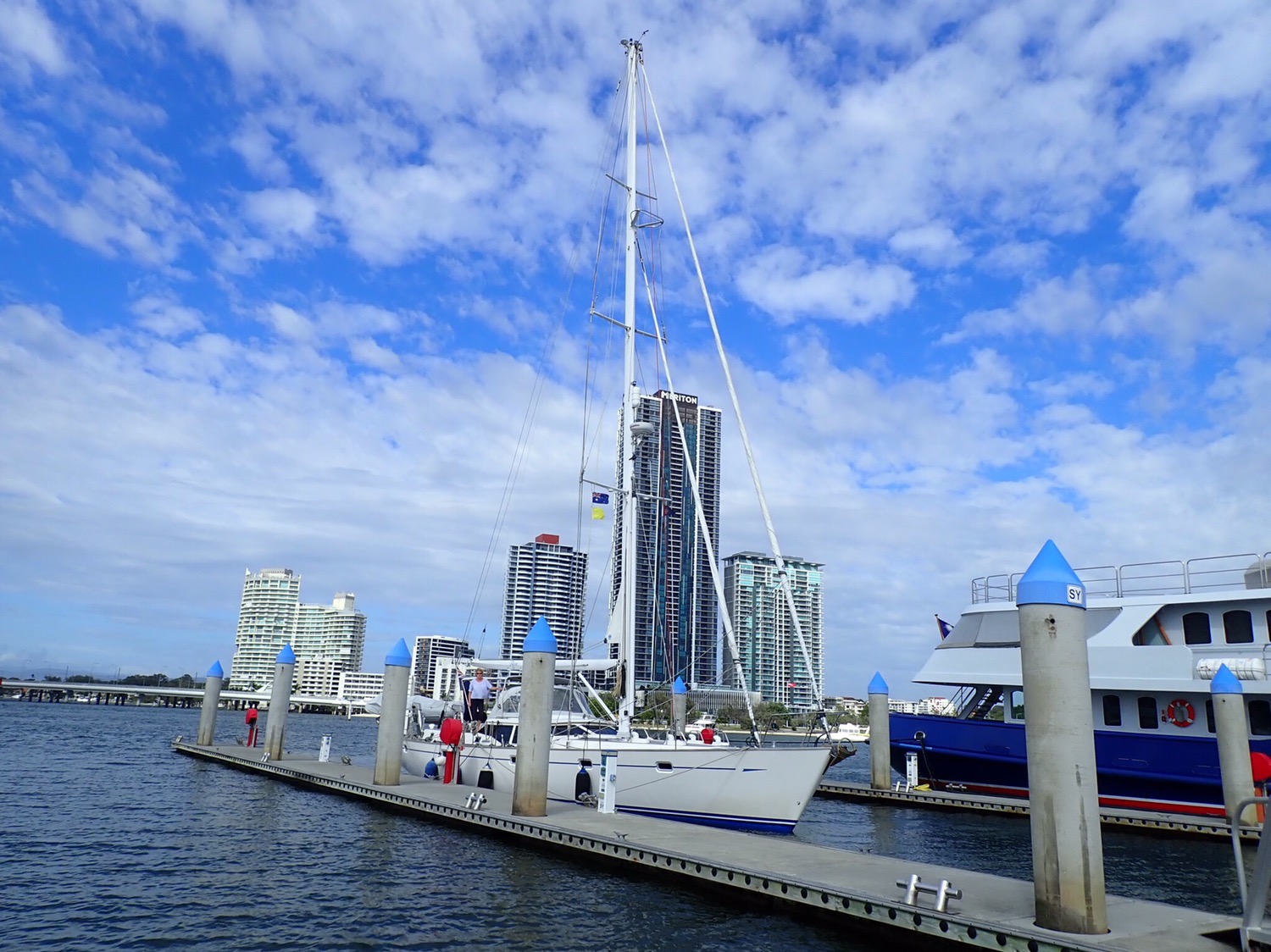
A family, on an early morning walk, have just passed by on the opposite bank from our berth in the Southport Yacht Club Marina. It was a bit of a shock to hear them speak English, I haven’t quite got my head around the fact that we have actually arrived in Australia. In the marina it’s life as usual but when we leave through the gate we are back in the real world and it’s a bit disorientating. There are proper shops, good pavements and decent comms!

Tied up at the custom dock

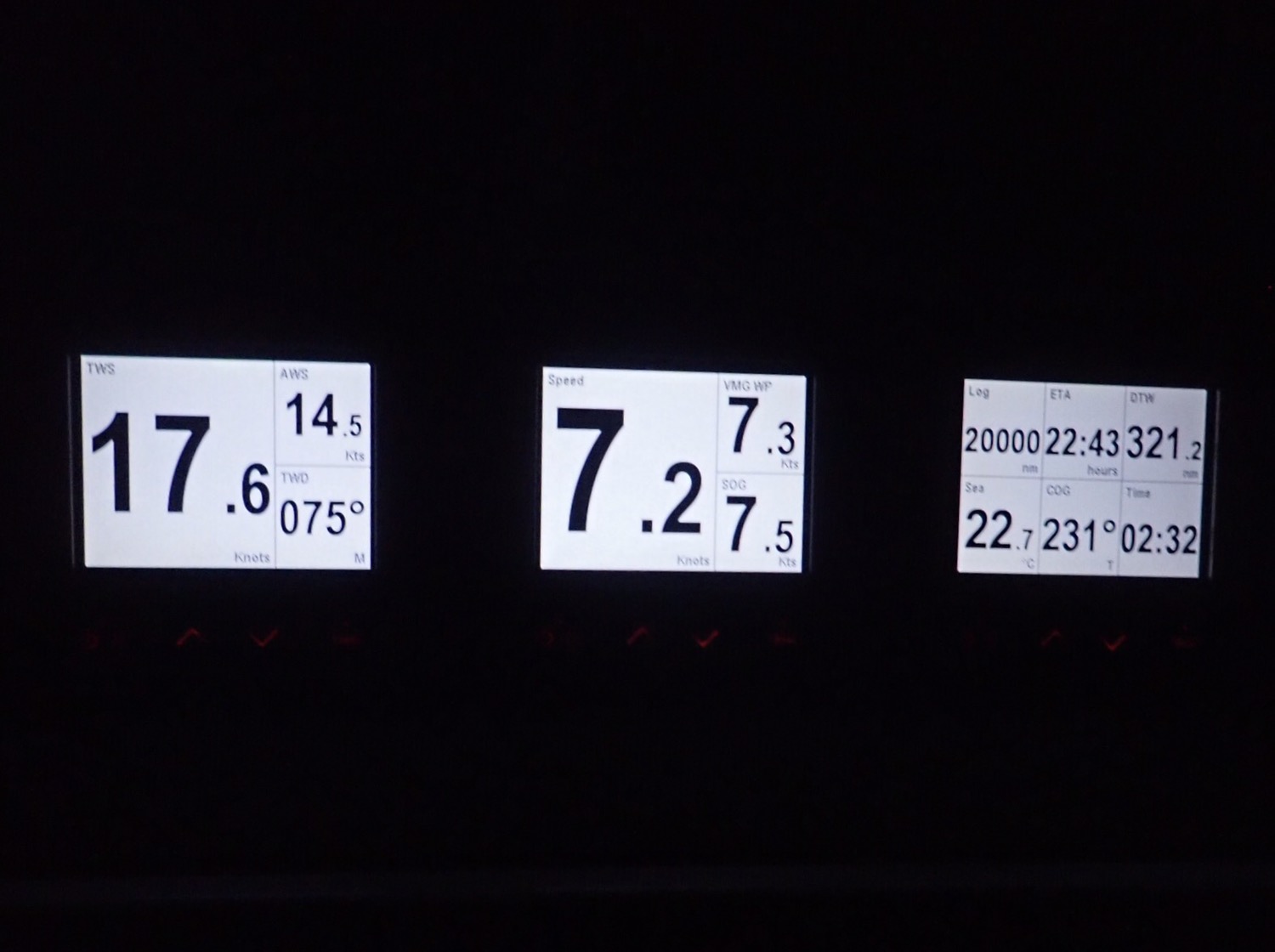
The passage from New Caledonia continued to be smooth and fast, a Tuesday evening arrival was on the cards. We read that to cross an unknown bar was safest four hours after low tide, to ensure that all outgoing flow from the inland water and rivers was complete, we set a target for between 8-10pm. Early Monday morning the log clicked onto 20,000nm, we congratulated each other but in reality we were more concerned with the dwindling wind, by daylight we were motor sailing to keep a Tuesday arrival in our sights.

Early Monday morning the log registered 20,000nm sailed

We had been sailing parallel to another yacht since Saturday, a lone sailor in a small but fast catamaran, he turned south intent on reaching Coffs Harbour, via VHF we wished each other well and soon the AIS screen was empty again. Early on in the trip we had seen a hundred strong pod of dolphins but now there wasn’t even a bird to watch. We read, snoozed and looked out into the vast expanses of sea, however things were about to get lively.

Pulled away from our books, we found ourselves scouring the sea for bubbles, a fishing boat had come on the radio to inform us that they had been laying long lines in our path and to watch out for bubbles. Bubbles? We thought it unlikely that, with a choppy sea and the setting sun in our eyes, we would see bubbles but we searched anyway. Then just off our port side we saw a buoy, then another and another, some just metres away, bubbles we realised translated from Australian to English as buoys. The buoys were marking the hooks and lines that they had set across miles of ocean. The ‘line caught’ label on cans of tuna conjures a vision of a lone fisherman battling the elements with a rod, this experience made the cheapness of these cans make much more sense.

Then a few hours later, on my watch, which ran from 11pm until 2am, the full moon that had been lighting our way each night disappeared behind a bank of cloud, in the distance sheet lightening lit up the horizon. The barometer started to drop, the low pressure trough was arriving a day early. The winds were still light and we had a knot or two of current against us, back on came the engine.

As Tuesday dawned the barometer slowly started to rise again bringing with it increased winds, much increased winds and the sea began to build. The comment in the log for midday Tuesday, about 60nm out from Southport, reads : Bloody horrible. At 1pm : Still bloody horrible. By 3pm we were in full wet weather gear and we were sailing through 50kt gusts and 4m waves. The local marine forecast came on the VHF informing us that the current weather was wind SE15-20kts, swell 11/2-2m, we wondered which bit of ocean they were looking at, certainly not our bit.

Finally an hour later as we approached land things did begin to improve and we radioed Seaway Tower who monitor the bar and entrance to Broadwater the inner seaway that leads down to Southport. It was with some relief that he reported the entrance calm and it was safe to proceed.

Now all we had to do in our rather soggy and tired state was to navigate in the dark through a narrow channel, find the marina and berth the boat in a 2kt current. A slightly tense half hour but by 9.30pm, we were tucked up in bed. Phew!

We have now checked in with customs, had the boat pulled apart by quarantine officers in search of mini beasts and had great fun at the supermarket stocking back up with food. Most of the boat is beginning to look clean and tidy again, except unfortunately for the front cabin. All the water that came over the bows at the end to our passage has proved the small leak we thought we may have solved is still there. The cleaning, drying and fixing of that will have to wait until another day.

Whoops, I may have been a little over enthusiastic as I wiped down one of the water triggered life jackets.

Go, Stay, Gone

.

Saturday 4th November 2017

Friday morning we left New Caledonia in a bit of a rush having just the day before decided that we would have to postpone our passage for another week – the weather forecasts have been tricky.

So far so good, we have calmish seas and a SE wind blowing us along at between 7 and 8kts. The passage plan has us arriving early Wednesday morning for the incoming tide across the bar. Bars are new to us and like passes have fearsome reputations and many of the harbours on the East coast of Australia have them. An area of shallow water lays across the entrance and when combined with the almost permanent large swell that arrives on the shore, can, on an ebbing tide, cause large breaking waves, not something you want to encounter on a sailing yacht.

We had been expecting the light winds we have at present but they are in a perfect direction and with the just a 1m swell we are storming along and can possibly make the earlier tide and possibly give ourselves a better land fall weatherwise if we can keep it up. Time will tell.

Full moon rise 250 miles out at sea

Our last day, ever, anchored in a pretty bay in the Pacific Islands turned out appropriately enough to be Ricks birthday. It was a lovely day, we swam and read, dugongs and turtles joined us and the winds were gentle. Since being on the boat we have pretty much given up on presents, so with our one precious pack of bacon I cooked him a fry up for breakfast and we BBQ lamb chops for supper with a beautiful sunset as a back drop.

Sunset in Baie Papaye

Then it was back to reality. A one hour motor and Sunday found us anchored again in Port Moselle. The day promised to be sunny and calm and the locals were taking advantage of the conditions, it was like being at sea. The whole fleet of motor boats from Noumea was going out to enjoy a day off in the islands leaving rocky water in their wake. We went ashore and did a bit of  essential shopping and had lunch, returning just in time to take another battering from the boats as they all returned to their marina berths.

That evening while enjoying the company of our friends from Atla we noticed the racing catamaran anchored in front of us was getting gradually closer, her anchor must have been dislodged by the turbulent waters, with no one onboard there was little we could do but put out some fenders and hope the anchor would re catch. After a rather sleepless night of continuous checking she luckily kept her distance but we were glad to move and get tied up in the marina to start our preparations to leave.

We shopped, cooked, checked the boat over and obsessed over the weather forecasts. On Monday, Friday was looking good for departure to Coffs Harbour on the Australian east coast. By Wednesday however there was the threat of a small but lively low forming in the Tasman sea.

Rick checking the steering quadrant

Thursday what had looked like a perfect passage now looked horrible for our arrival with not only the low hovering but a front forming. Frustrated, we abandoned our morning plans to visit the three offices required to check out of New Caledonia, had a delightful lunch at the Art Cafe and started considering going back out into the islands for a few days.

Then would you believe it, when Friday dawned the forecast low had fizzled and gone south and if we kept a bit north and entered the country at Southport instead of Coffs, we might miss the worst of the front. Our departure was back on and by midday we had cast off.

Fingers crossed we have made the right decision.

Contrasts

Thursday 5th October 2017

Mirror flat seas followed by 30kt winds, open ocean one day, modern city the next and an introduction to a culture that’s part chic France part Pacific Island charm, the last few days has been full of contrast.

Saturday morning nearly half way between Fiji and New Caledonia the wind began to die and soon the sails were flogging and despite being happy to travel slowly the engine eventually had to come on. Although motoring in calm seas is very easy, we can sleep, cook, shower as if at anchor, it is also noisy and with the wind behind us rather smelly from the exhaust wafting into the cockpit. In addition, after our engine problems on the trip down to New Zealand, we both, apprehensively have ears half cocked for any slight change in engine pitch.

I guess light winds must be a problem for the sea birds also, without the air currents to help them soar and rest, flying must become tiring. That night while on watch I peered forward to check for lights on the horizon and spotted a dark blob on the rail, worried something must had fallen from somewhere I shone a torch forward and revealed a Red Footed Booby, head tucked under his wing, perched on the pulpit. Obviously fast asleep, he was unbothered by the torch light and stayed unmoving until day break, as the sun climbed into the sky he flew off, back the way we had come, hopefully we hadn’t taken him too far in the wrong direction.

Red Footed Booby hitches a ride

Throughout Sunday the wind hardly registered on the gauge, the surface of the sea became like a mirror, the only movement through its silky expanse was the slight undulation of a small ocean swell and the ripples created by our wake. We put out the fishing line and kept a look out for dolphins and whales but for twelve hours there was nothing anywhere but us. The grandeur of this emptiness is difficult to get across, we sat in wonder at our isolation.

Mirror like silky seas

Gradually the winds picked back up and by midnight we were sailing once again. Next morning we have New Caledonia in our sights and we’re glad we had kept our speed low and delayed our arrival, the Canal de la Havannah turned out to be as treacherous as described in the guides. We arrived perfectly timed at supposedly low water but still had to contend with two knots of tide against us and swirling currents that did their best to drag us off the line through the pass. Add into the mix patches of rough overfalls created from the wind blowing against the outgoing water and we were well and truly pleased to enter the lagoon.

The lagoon however was not quite what we imagined, it’s the largest lagoon in the world and with its outer reef nearly twenty miles off the coast this is basically open water. As the afternoon sea breeze added to the already high winds the sea became extremely choppy. Fortunately we had the wind and waves behind us and we made good progress towards the marina. As we rounded the headland south of Noumea we were greeted by the sight of a hundred or so kite surfers, they looked from a distance like flocks of huge colourful birds, at least someone was enjoying the conditions.

To our dismay as we approached Port Moselle the high winds continued, putting out the fenders and lines in preparation for the approach to the marina was hazardous. We took the decision to collect ourselves, we motored to the anchorage outside the marina wall dropped the anchor and sorted everything out at a slower pace. Then with our hearts in our mouths, as gust of over 30kts toyed with us, we entered the marina and only with the help of neighbouring crews made it without incidence into our berth.

The marina office were friendly and efficient and initiated the check in formalities for us. It was all very low key, customs didn’t even bother to visit the boat but the biosecurity lady did come onboard and take away all our fresh produce and meats. The immigration office only opens in the morning and must be visited in town the next day. Quite quickly we were able to settle down with a ‘got here beer’ and then enjoy a good nights sleep.

Got here beer in blowy New Caledonia

It’s a bit of a shock to the system to have a road running past the boat with proper traffic and it feels very odd to be in what on the surface seems like an European town. New Caledonia like French Polynesia is an overseas territory of France, however unlike French Polynesia the population, in Noumea at least, appears to be dominantly European. Gone are the ubiquitous smiles and greetings as you pass smiling strangers who stroll through the streets, “bonjour”, “bula bula”, this is city life, everyone is busy, eyes ahead, intent on reaching their destination.

First impressions are that there are only a few signs around that we are still in the Pacific islands, muddy taro still looms large next the contrasting colourful produce in the excellent fruit and veg market, traditional Melanesian crafts fill the stalls next to the tourist boats and car hire companies and there are plenty of pot holes and uneven pavements to remind you that you are not back in the world of personal injury claims. On the other hand the supermarkets are packed with fantastic French cheeses, cold meats, bread and wine, the dress code is mostly fashionable French and high rise buildings line the shore.

Our first foray into town was a little frustrating but in the end 90% successful. Immigration, once we found the office hidden away unlabelled in a scruffy block, in a side street, was easy, we are still European and can stay here for 3 months without a visa. It took three different ATMs but we finally persuaded one to give us some cash and after taking directions to half a dozen places we eventually found a mobile shop and bought a sim for Ricks phone.

At lunch time back onboard Raya we sat down to tasty salami, proper ham, smelly soft cheese and crunchy French bread, delicious. European towns do have a few upsides.

Farewell Fiji

Crystal clear waters at beautiful Navandra
Saturday 30th September 2017

19 52′ 722 (S) 172 56′ 036 (E)

We sit encircled by the royal blue of deep water, under a cloudless sky, we are caressed by a gentle breeze, the sea is calm, its rippled surface overlaying a lazy ocean swell. There are no other signs of life, no boats or aeroplane tracks, no birds, not even flying fish on the decks. We sail steadily towards our destination, Noumea the capital of New Caledonia, which lies 350nm away. After a quiet night we feel rested and relaxed.

Our last few days in Fiji were spent in Vuda Marina preparing for this passage. At some points they were also relaxed – best day to go is Friday. And at other times a big rush – actually the weather has changed, a Tuesday departure looks perfect, can we be ready in two days?

For this passage not only were we looking at the weather forecast but also the tide times. In Vuda we needed to depart 3hrs either side of high tide to ensure enough water under us at the fuel dock and the sand bar at the exit. Luckily this weeks high tide was in the morning and coincided with the customs people who each morning conveniently come to the marina to check yachts out of the country. Fast forward 3-4 days and we will arrive at Canal de la Havannah the pass through the reef encircling the large South Lagoon at the bottom of New Caledonia. This channel can have currents of up to 4kts, so you are advised to enter on a rising tide, not to mention that the 20kt winds forecast for our arrival are perfect for a wind against tide chop on an outgoing tide. It is then over 40nm inside the lagoon winding around headlands, islands and reefs before you reach Noumea all best done in good light. Timing of our arrival is therefore critical.

So in between, laundry, provisioning, cooking passage meals, standard engine and generator checks, sorting out rigging and clearing the decks there has been much calculating and copious amounts of rubbing out.

In the end we left Thursday, this gave us plenty of time for all our jobs and gave us the opportunity for a bit of an Oyster Owners get together. With five Rally boats in the marina there has been plenty of friendly introductions, a visit from the Rally coordinator and a night at the bar filling a couple of crews in on our favourite spots in the Yasawas.

Abdul the taxi driver (Abdul blue car, he tells us we should call him, to distinguish him from all the other Abdul’s who are also taxi drivers but, presumably, without blue cars) was as helpful as ever, running last minute errands and even appeared at the dock to wave us off. We also had a final fairwell from Clare and Darren from Knockando, our last night dinner together was scuppered by a sudden squall but we did manage a cup of coffee in the morning. Even the restaurant staff waved us off emotionally. Vuda will remain one of our favourite places.

Motoring out of Vuda Marina

Having assured customs we would be leaving immediately, we let go the lines around noon and motored for a couple of hours before slipping, hopefully unnoticed, into Momi Bay on the far southwestern corner of Vitu Levu. Our best time to arrive at the Canal de la Havannah is mid morning on Monday, when the tide turns but giving ourselves plenty of daylight to reach Noumea. This unfortunately means that we need to take our time and have a slow passage. Anchoring meant we left Fiji a few hours later, and meant we could eat lunch, shower and get an afternoon snooze, before setting off at 5pm out of Navula Passage and into open water.

We were expecting that evening to pass through a rain band but the accompanying high winds whipped up the waves creating a very messy sea and turned our first night into an uncomfortable start. Thankfully by sunrise everything had calmed down and we, despite the grogginess bought on by the seasickness pills and lack of sleep, started to get into the rhythm of things. We have now had 24hrs of great sailing, only problem is that despite a number of reefs in the sails, Raya is in her stride and is going too fast. The winds are expected to gradually die so the plan is to adjust our timings during the expected day of motoring we will have to do on Saturday/Sunday. For now we are just enjoying the calm and the blue nothingness all around us.

Sailing into the sunset

Census in Sawa I Lau

Sunday 24th Sept 2017

Our presence in a remote bay in the Yasawas has been recorded officially and for eternity. Last Sunday morning as we sat anchored off the Island of Sawa I Lau, with just one other yacht, a mile or so from any other signs of life we were visited by a local boat. It’s occupant greeted us with the normal wide smile and enthusiastic greeting “Bula Bula” but unusually, for the Islanders, spoke with perfect English. He asked not for the anticipated bunch of cava but if he could take down some information about everybody onboard. It turns out that it was census day in Fiji and our presence remote or not needed to be recorded.

Raya anchored off Sawa I Lau

Our final set of guest has left us, it has been a busy summer and nice as it’s been to have everyone onboard it felt good to have Raya back to ourselves. Sasha and Julia’s visit will be remembered for the fantastic snorkelling we have done, this week we finally got to see the magnificent mantas again, we were also treated to sharks, sea snakes, and a huge titan trigger fish. The last couple of swims were done without Rick who had a bit of an earache and the sight of the three of us after a long tiring snorkel, struggling, ungainly and giggling trying to lift ourselves into the dingy, whilst gradually being swept out to sea, went thankfully, unrecorded but will stick in our minds for quite a while.

Excellent snorkelling off Manta Ray Island Resort

We have played Rummy cube, attempted a game of bridge, drank far too much wine and beer, eaten far too much food and talked and talked. We were actually treated with enough wind during their stay for a couple of sails but for our stay in Fiji we have basically been a motor boat. In fact we have motored so far that on our return to Musket Cove we actually ran out of fuel in the main tank and in, luckily, calm open seas we had to top up from our reserve tank.

Team Raya on the sand bank at Musket Cove
Yesterday we came back into Vuda, ready for the girls early flight this morning. We are getting use to the tight squeeze of yachts here but the space we were presented with this time was the tightest of all. In fact after two tries it was fairly obvious we weren’t going to fit in going stern to, so Rick turned us around and managed to wedge us in with bows to the wall. The normal skilled marina boat boy wasn’t around and his replacement had no understanding of what was going on. Without the efforts of Sasha one side and Julia the other, both armed with large blow up fenders we would never have berthed unscathed.

And we are not the only Oyster squeezed in here, after bumping into only a handful of other Oysters throughout the whole Pacific crossing, suddenly we are inundated with Raya look a likes. In Manta Bay another Oyster 56 had anchored right next to us and at Musket Cove there were three other Oysters including Oyster Blew 56/23 the boat built right after Raya who is 56/22 and here in Vuda there are five other yachts, the Oyster World Rally has arrived in Fiji.
We however are on our way out of Fiji, we have a few days to clear up and prepare then weather permitting it’s on to New Caledonia at the end of the week.

Ricky Puts His Shorts On – Finally

Wednesday 24th May 2017

As I picked myself off the salon floor, made slippery by our sodden boots and lethal by the heavy seas, I felt I had hit, literally and metaphorically, a low point in this passage. We were both very tired, it has been a rough, grey and wet crossing, For a few moments I indulged in a wave of self pity, but it’s just us out here, no other option than to keep going, so we try to smile for each other and get on with whatever has to be done to get us to Fiji.

Rick securing the pole
We finally left New Zealand on Friday. All that week the forecasts swayed from good to bad and back again, each day the decisions onboard each boat swayed too and fro. It started to become apparent to us that there was never going to be a perfect time to leave. We took the decision at the very last minute as we walked to the customs office, swaying from cancelling our appointment, checking out, cancelling our appointment or checking out? We checked out, they are very strict in New Zealand, once you have your exit stamp, that’s it, no turning back.

Now we are hopefully through the worst of the passage it definitely feels like the right decision, the prospect of a Mojito in the Copra Shed Marina Bar in Savusavu, Friday night, encouraging us onward. There were times in the last couple of days  however, when the boredom, indecision and chilly weather of the last few weeks in Opua seemed like a luxury. Almost from the outset we have had messy seas and as the winds built to a steady 30+ knots the waves grew bigger and came round onto our beam. Two or three times a day one would hit us wrongly and crash over into the cockpit. Twice these waves were bid enough to fill the cockpit floor with six inches of water, add in the spray from waves over the bows and frequent showers it has been a very wet and unpleasant few days.


The movement below made life extremely difficult, having to put on and off our heavy wet weather gear, boots and life jackets each time we changed watch was exhausting. The niceties of life, all thoughts of writing a ‘finally left New Zealand’ blog, even trying to read, were quickly put aside. It was all we could do to make sure we ate something and got some sleep. Shares in our seasickness medication of choice, Stugeron, will be sky rocketing.

The hoped for increase in temperatures were also slow in coming, so when we got our first glimpse of sunshine yesterday our spirits rose. This turned out to be premature, the breaks in the clouds did indicate us moving from the NZ high pressure system into the tropical trade winds but it was accompanied by frequent violent wet and extremely gusty squalls. As we watched them track across the horizon our hearts would drop knowing that this ominous blackness was coming our way. In the worst to hit us we registered 60+ kts winds, the last thing we wanted in our bone weary state was to be constantly trimming the sails and fighting the now very rough sea.

Raya of course has, as always, not put a step wrong, she just ploughs on and on, shrugging off the high winds and riding out the large waves. Shame her crew can’t ride out the storms quite so easily.

Now through the front the weather has improved dramatically, the winds are a nice 22kts and with the easterly miles we fought to make early on, we are now sailing comfortably down wind. Rick has his shorts on and it is calm enough finally, for me to write this blog.

Alternative arrival to New Zealand

Tuesday 25th October 2016

Monday lunch time, after a week at sea, we tied up to the customs dock at Opua Marina. Unfortunately this was not the arrival in New Zealand we had imagined, for we arrived curtesy of  the local coastguard. A real trip of extremes, we had calms so still it was difficult to believe we were at sea, a blast from Antartica that bought cold strong winds and then an engine failure just as we thought we were home and dry.

After the two windless days we saw building, on the horizon, a long grey smudge. As we got closer it gradually became more and more ominous, this was the front that we had been expecting, a dramatic and sudden change from the bright sunny weather to a line of cloud bearing heavy rain. The rain didn’t last long but the weather behind the cloud was in complete contrast to the past few days, the wind turned to the south and grew in strength. At first it was a relief to turn off the engine and we turned west as planned to ride out the weather. The winds and the sea gradually built and within a few hours things were uncomfortable, the wind veered to the SW making it impossible to sail even vaguely towards our destination. So back on came the engine, to help us sail as close to the wind as possible.

Ominous front on the horizon


We were both well dosed with seasick pills, a pre-prepared meal sat on the cooker and we hunkered down, every bit of warm clothing we owned layered under our jackets, telling ourselves it was only for 24 hrs. It was a long 24 hrs however, especially the hours of cold night watches and rather depressing to see our VMG (velocity made good – the speed at which we were going towards out final destination) at only 0.7kts. The sea was never really huge just messy, rocking Raya unpredictably as she slammed into the oncoming swell, the chilly wind whipping around the corners of the sprayhood.

Chilly in the cockpit


Gradually through Sunday the wind decreased and the sea calmed and although chilly we began to enjoy the trip once again. We spotted our first albatross, their huge wingspan disproportionately long for their bodies, seemingly never moving as they swooped past the boat and low over the waves. We got out the cruising guides and started to read about the entry into Opua, we even shared a beer sitting out at the back of the boat watching the sun set.

In the early hours of Monday morning with the wind dropping yet again, our engine which had been doing such a sterling job for us on this difficult to sail passage, suddenly stopped. We knew the fuel we had picked up in Tonga was dirty, Rick had been emptying and changing filters for the whole trip. This time however there was also oil leaking from the turbo charger, he began to think maybe it wasn’t a fuel problem, he worked through the night while I managed to get us sailing in the light winds. Finally the engine restarted , we left it running at very low revs to see if it would keep going, no such luck it stopped again after an hour. We sailed slowly onwards until a few miles out from the rocky shore of the Bay of Islands the wind completely died. This far from the coast we were in no danger, but we thought it prudent, with no knowledge of the tides and currents, not to try and enter the Bay until there was a steady enough wind to give us steerage. The wind dropped further, the dial read 2kts, Rick tried a few more things, questions fill our heads, there was some fuel coming through the system but how much fuel was enough fuel, had problems with the turbo shut down the engine as a precaution, if we got the engine running would it fail again in a more enclosed and dangerous space?

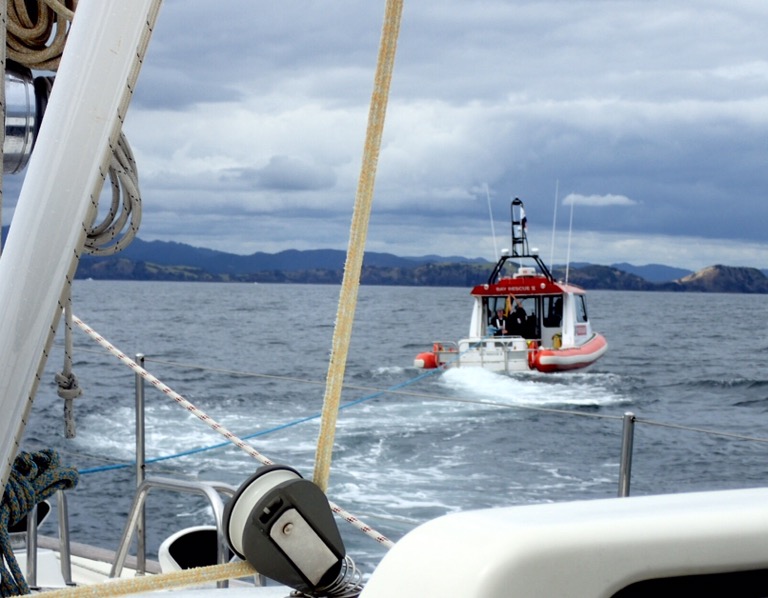
We had a cup of tea to consider our options and at eight in the morning we called the marina to see if they could arrange for some help for us. Typically, it turned out this was a bank holiday in New Zealand and no commercial help was available, an all stations radio call was put out for assistance to no avail, finally it was suggested that they contact the coastguard. So it was we found ourselves being towed at great cost, the coastguard here, unlike in the UK charge for their services, through the Bay and the channel towards the marina.

Preparing to Tow


They dropped us at the customs dock to check in, we thanked them and they rushed off to help someone else. The customs official was waiting for us and the entry procedures started. This includes the requirement to pass a Biosecurity Inspection. You are not allowed to bring in any meat, vegetables, fruit, seeds or dairy into the country, so the contents of our fridge, freezers and many cupboards were thrown into black rubbish sacks. The process was conducted efficiently and with a smile and before long with the help of Bruce from Seapower, a marine engineering company, we were safely tied up in our berth. Finally we toasted ourselves with the traditional ‘ got here beer’, too tired to venture out for food and with little else available, we opened a tin of beans, had a glass of wine and slept for twelve solid hours. 


In the morning Bruce was back with his engineers, the Tongan fuel was the culprit, every filter and pipe was clogged and the injectors blocked, it took a few hours but they got the engine running again. It was a relief that we didn’t have to replace the expensive turbo charger, frustrating that the fuel providers in Tonga could get away with selling such a filthy product but mostly thankful that the engine failed when it did, our situation could have been far worse.

OK, New Zealand here we are, what have you got to offer us for the next few months?

Halfway Around the World

Early this morning we crossed the dateline, we have sailed halfway around the world. Unlike at the equator, however, there was no dramatic 00 00.000 moment on the position read out. Longitude 180 doesn’t really exist so the read out just flipped from 179 59.999 W to 179 59.999 E. We have already lost our day as we entered Tonga, who bend the line to keep themselves at the same time as New Zealand, so it’s only practical significance is that we need to remember to start taking away instead of adding to our longitude as we travel west.

Goodbye Tonga


Monday Raya flew out of Tonga on strong SSE winds, travelling slightly east of the normal doglegged SW course, on Bob the weather mans advice. The sea was lumpy and skies grey but we were happy with the high speeds because we were trying to out run a low pressure system coming down from Fiji. Having achieved that, yesterday we had a perfect days sailing but today having reached the centre of a high pressure all is calm and we have only 4kts of wind so have the motor. Low winds have their upside however, the sea is a huge empty flat disc of blue and the sun shines in a cloudless sky, nothing else anywhere just a few birds and a couple of flying fish. In the whole four days the only boat we have seen has been a single AIS target of a cargo ship over 60nm away. Yesterday we did spot some dolphins, the first pod since Huahini in French Polynesia, disappointedly they didn’t come over to check us out, unlike a whale, which made us jump as he suddenly surfaced with a huge blow just meters away, before, obviously not taken by Raya’s womanly charms, sunk down and disappeared.


The sea and air temperature are decreasing surprisingly quickly and night watches have become rather chilly. Socks, jumpers and jackets that have not seen the light of day since we left NW Portugal a year and a half ago, are being pulled, musty, from beneath berths and wardrobes. The life jacket straps have had to be released to fit over all the clothing.

The early miles going south means accidentally, and as seems to be Raya’s way, we find ourselves on the rhumb line directly into Opua, with just under 500nm to go, that would normally give us an arrival time around Sunday lunch time. Unfortunately we have a front crossing New Zealand, bringing southerly winds to contend with, this will force us to sail west for a day, it will be fairly uncomfortable upwind sailing and add twelve or so hours to our eta, which in turn will mean slowing up so as not to arrive during Sunday night. We are also assuming that the south winds will cause a further drop in temperature and probably bring showers- is that the wet weather gear locker I can here rustling?

So this evening we are trying to enjoy the last of today’s calm sunshine, congratulate ourselves on reaching this far and look forward to the prize of arriving in New Zealand, hopefully Monday morning.

Meteorology at Mama’s

This morning I opened our last pack of Englsh tea bags, what surer sign could there be that it’s time to return to civilisation for a while. Our passports have been stamped, Raya is full of fuel, five passage meals sit in the freezer, it’s now just down to the weather. Tonight there is going to be a BBQ at Big Mama’s Yacht Club for all the waiting cruisers, as if collectively we can will the weather to suit our plans.

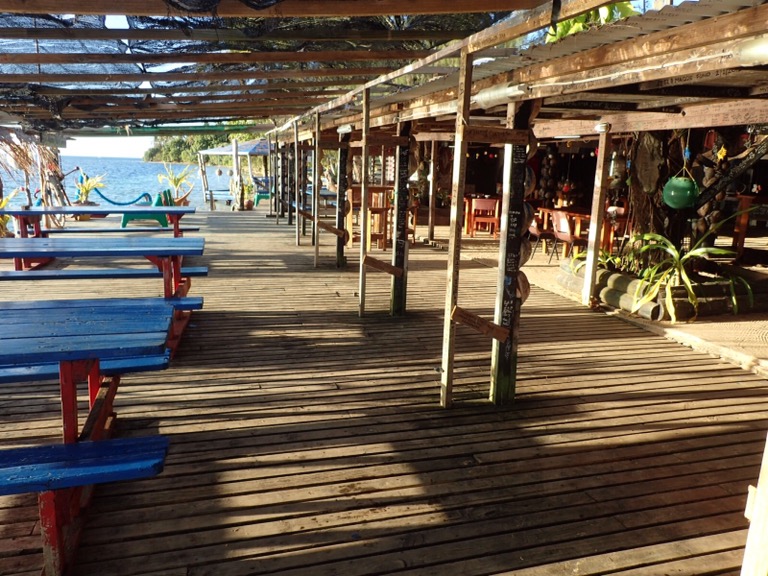
Veranda at Big Mama’s Yacht Club


After a year of relatively stable trade wind sailing, we are venturing back out into less predictable weather. The weather systems that cross over Australia and New Zealand from the Southern Ocean to just below the tropics are on the face of it simple, a high pressure system follows a low pressure system, follows a high pressure, follows a low pressure etc. etc. all travelling west to east. The reality is of course much more complex, firstly we must remember that each system rotates in the opposite direction to those of the northern hemisphere, so for the best departure we wait for the top of a high pressure to bring us SE-E-NE winds to whisk us south west from Tonga. Then the timing becomes crucial because between the high we are using and the following low there is often a trough of high winds and if the systems squash up or travels too quickly you face south winds straight on the nose as you approach your destination. The general advice is to sail a dog leg, going well west of the rhumb line before turning south, the magic waypoint being around 30S 173E. The skill is to know when in the system to leave and then exactly how far west to sail. Add to all that the seemingly infinite other vagaries that affect the weather and the fact that our ‘at sea’ weather forecast app is having a crisis about spanning the dateline, we have decided for the first time, to use the help of a weather router. Bob McDavitt is a weather guru located in New Zealand, he looks at your particular passage requirements – destination, boat type, average passage speed, etc. and with his years of experience analysing the weather patterns he suggests a departure date, best route and updates as necessary along the way. At the moment it is firming up for us to leave on Monday, heading for Opua in Northern New Zealand.

Needless to say the weather is the main topic of conversation in the bar at Big Mama’s Yacht Club, everybody anchored at Pangaimotu, the main stopping off point to take off for New Zealand, is on more or less the same track. However it wasn’t just passage weather that has been the topic of interest, the forecasted low pressure screamed through Tonga last Monday night with gusts in the high thirties and lashings of rain. With plenty of warning everybody had time to prepare and we all sat tight as it past over. 

Stormy morning


By Wednesday all was calm and we could venture out to prepare for our exit. The small boat harbour unfortunately hadn’t weathered the storm as well, the dodgy dock had become completely detached from its link to shore and had lost large sections of its length, the attached small boats sinking and floating out to sea. Getting on to dry land was precarious to say the least. In the heat we then spent 3hrs traipsing between, Nuku’alofa Port Authority, the Customs shed and other official offices in a seemingly random order, filling in numerous forms and collecting countless stamps as we went. The system for checking out has another fundamental problem, to get duty free fuel you need to have custom clearance, to get custom clearance you need a departure time within the next 24hrs. Unfortunately it takes a day to organise the fuel, a day to get it onboard, there is no fuel or custom service at the weekend and the weather windows change almost hourly. We took the decision to check out early and sit hopefully inconspicuously at anchor. 

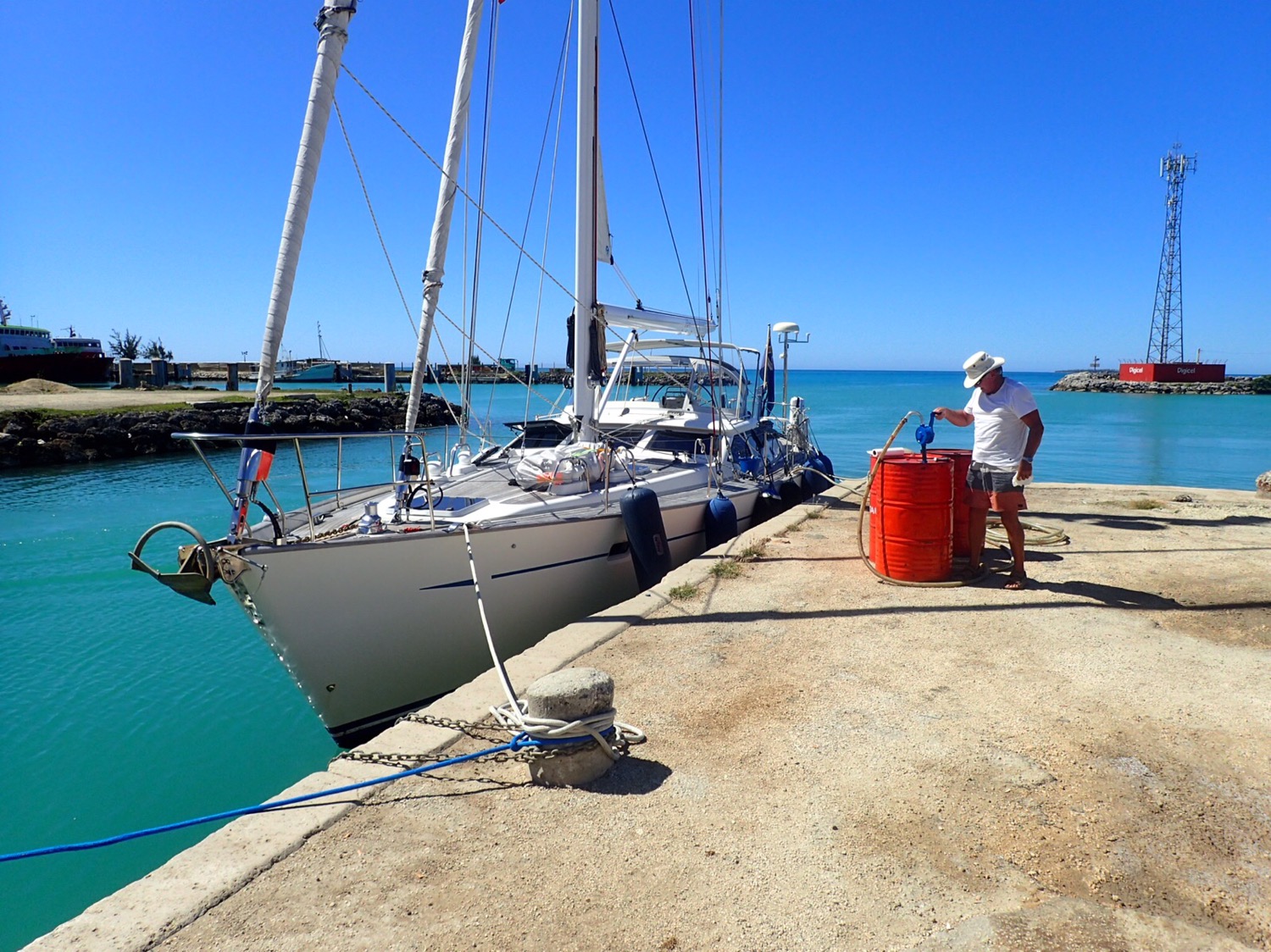
We were quite pleased we did, it took us all day Thursday to fill the fuel tanks. Firstly it took Rick and Russ, from A Train and also filling up, three trips in the dingy over to the harbour to clear a space at the wharf big enough to fit us on. We then had to wait for the tide to come in a little to give us enough depth, while we waited the delivery truck arrived and finding us not there, left and had to be called back, finally we had to pump 600l of diesel from three large drums into our tank by hand, all in the scorching afternoon sun.


It was an exhausting and frustrating couple of days but now we are prepared and looking forward to casting off. New Zealand here we come, please warm up a bit for us, the current Spring temperature in Opua of 18 degrees is going to seem very cold!

Landfall Tonga

Friday 29th July 2016

Our life afloat has many special moments, I suppose in a way that’s what we are doing it all for. This was not a wow special moment however. No sharks circling the boat, no formation boobies diving a few feet away, no magnicant rock formations towering above us, this was a much more subtle and precious moment.

The last couple of days of our passage were quite intense, pushing hard to keep our speed up to ensure a daylight landfall we were half reefed in 25 gusting 35kt winds. The waves had built and as we headed slightly further south came further on to the beam, sleeping was fitful, normal life hard work. 

Pacific swell loomimg over the stern

Still out of sight of land we picked up chatter on VHF Ch26, the radio net that is boosted to cover the whole of the Tongan Vava’u group and the main means of boat to boat and boat to business communication there. After a week at sea it was good to hear familiar boat names even familiar voices over the airwaves. Then through the haze the two hundred meter high flat chunk of rock that is the eastern shore of  Vava’u came into sight. A sense of excited anticipation ran through us. 

Sunset was at 6.20pm so although we knew from the chart that we were going to make it before dark, we still faced the unknown of our arrival. We had picked Vaiutukakau bay as an anchorage from the chart in the NW of the island where we should in theory be sheltered from the SE winds and swell but you can never be really sure until you get there. The chart showed the bay was deep with just a couple of shallow ledges, would they be sand, coral, rock, would they be suitable to anchor in, would the bay be full of other yachts, fishing bouys or other hazards? We had no time for a plan B.

It is difficult to express the feeling of euphoria of rounding a headland after a period at sea being bashed by the wind and waves to find the calm expanse inside a protected bay. And what a spot this turned out to be, the bay was serene as the sun sank below the horizon. There was not a sign of human intervention any where, not a hut, a fence, a radio tower, even a boat insight, the water was flat and crystal clear. The shore was a vertical limestone cliff covered in trees that somehow clung to every crevice, the air was full of tropical bird song and the shore line was dotted with white sand beaches and caves. After a week at sea this was a special moment indeed.

Enjoying my ‘got here beer’, just got in before sunset.

We warmed up a chilli, drank a glass of red wine and then slept like the dead for twelve hours. We would loved to have stayed but we were yet to check into Tonga and so reluctantly at 9 the next morning we started to raise the anchor. As if in protest to my statement earlier accusing Vaiutukakau Bay of lacking the wow factor, a pod of humpback whales appeared a couple of hundred meters away, they treated us to the full show spouting water, slapping fins and fluking. 

Good start Tonga.

Tomorrow Today

Wednesday 27th July 2016

We sat in the cockpit, morning sun on our backs sipping a cup of tea, it was 9am on Monday 25th July, we were two thirds of the way to Tonga. By the time our cups were empty however, it was 8.10am on Tuesday 26th July, Monday had turned into the day that never was. Tonga may only have a longitude of 174W  but the international date line has been bent around it to keep it in a similar time zone to New Zealand. So we had switched our clocks from -11 UTC Tiahiti time to +13 UTC Togan time. Tomorrow was now today.

A day on we have 260 miles to go and we are pushing hard to try to arrive in Tonga during daylight, it’s on the edge. We have tried to slow Raya down so we arrive the next morning but she is just loving the conditions and even reefed right up we are struggling to get her much below seven knots. With not enough sail to keep her stable in the swell, we were rolling about all over the place. So we now have full sails flying and are trying to keep an average speed as near to eight knots as we can, no mean feat over a few days. We have found an anchorage on the North East of Vava’u Island outside the pass, we should be able to safely slip in there tomorrow evening without having to worrying about the low light and just hope customs don’t discover us anchored without being checked in.

The mismatch in our timings is partly due to having decided, to sadly, give Niue a miss. A weather forecast has gone out for an active trough to go through the Tongan area Sunday/Monday. I’m not precisely sure what an active trough will produce in the way of weather but it sounds like something to avoid, certainly not weather, if can you help it, to be sailing in or moored somewhere as unprotected as Niue. Tonga has a multitude of good anchorages some of which are designated hurricane holes, it feels like the best place to be.

We are finding passage making double handed no problem at all, we are coping with the watch system, as well as we ever do, catching up by napping during the day. The Pacific swell has been generally kind to us with the 2m waves most often behind us and despite frequent showers we have had plenty of sunshine and blue skies. The water temperature has been dropping steadily and is now only 25C, this cools the night air and it has been quite chilly up on deck, trousers, jumpers and even socks have been pulled from the bottom of the wardrobe. On the upside the freezer is at -5C the lowest we’ve seen it for months.

However, Sod’s Law dictates, that we can’t have everything working at once and we have had two equipment failures. On the second day out the generator stopped working, luckily Rick diagnosed the problem quickly, an impeller had gone in the raw water system. A spare was found, put in place, the generator was working again within an hour. The next morning a hose for the hydraulic furlers burst, of course Rick has a spare and again fixed it without any problems. Mopping up the oily fluid covering our decks was another thing altogether. We have done the best we can in a rolly ocean, the rain showers have helped too but there is still a large part of the deck that needs work.
And finally, of course we have to have a passage flying fish story. It’s 5am, Rick is asleep below, the sea is calm, we have risked having the aft cabin hatch open. Suddenly he is awoken by a strange flapping noise, he leaps up to discover a 10inch long, smelly, silver flying fish has dived straight through the hatch and is now sharing his bed.

Bye Bye Bora Bora

Good Bye to Bora Bora


Sirus shines brightly and defiantly off our stern, despite the competing silvery light from an almost full moon and the red glow from the rising sun. We are sailing rather north of our rhumb line in a light northeasterly breeze waiting for the move south as the forecasted wind veers and picks up. The calm sea looks dark and viscous in the low light and the ever present Pacific swell rolls us back and forth. It is the end of our second night at sea, headed for Tonga, possibly if the weather is calm, via a stop in Nuie.

Anyone who has taken a look at a map of the Pacific Ocean will notice that it is very blue with just a few black specks which are the islands. It was with some surprise then, when I drew the line from Bora Bora to Niue, that in all that space I discover that it goes straight through an island and an atoll. Our charts, that we are finding accurate to a few feet, make navigation easy for us. The sailing community here are in total awe of how the Polynesians ever managed to cross this vast ocean in small canoes or how Captain Cook managed to map so many of the Islands all just using the stars.

We had not planned to go to Nuie but having talked with people and read up a little and it looks to make an interesting stop. The book says it is a raised coral atoll, basically a very large lump of limestone, it is said to be full of caves, chasms and arches. We are not really prepared for a visit, we have no curtesy flag (the flag of the country whose waters you are in, flown from the spreaders) and no New Zealand dollars, the currency they use. The country is rumoured to have no ATM’s  and just one bank. Our arrival could be interesting, that is if the weather is good enough for us to arrive. There are no protected bays or coves and it is surrounded by very deep water so the main town has laid a mooring field which is only good in the prevailing winds from the east, winds from the west would make the anchorage untenable.

After nearly four months in Fench Polynesia, it was with a heavy heart that we watched the Gendarme’s stamp decend onto our exit papers. We have had the best time here. The contrasting landscapes, from dramatic peaks and ridges to picture perfect atolls, untamed jungle to coconut groves and pretty tended gardens. The stunning warm, clear, turquoise seas full of coral and fish of all sizes and the welcoming happy people we have met on all of the islands.

In fact we had a  good example of the latter on our last day. We needed a final stock up at the supermarket . We could get the dingy quite near by tying up to a wire fence next to a concrete wall tucked between a small beach and industrial buildings just across the road from the Super U Store. As we returned with our trolley full of bags, hanging out at the corner were a couple of young men, caps low over their eyes, head phones on, rolling cigarettes. The lines from thier boat stretched across the path blocking the route of our trolley, not really a problem the dingy was only ten meters away but we couldn’t quite carry all the bags in one go. In London you probably would have nodded a hello, while subconsciously keeping one hand on your purse. In the Carribean where no one will even look you the eye, we would have probably been worried to walk away from the remaining bags in the trolley or been hassled to pay them for the use of the dock. In stark contrast in Bora Bora we get the ubiquitous bright “bonjour” and the boys jump up apologising and with a smile help carry the bags for us to the dingy.

As we sail away, we reflect that this feeling of welcome and the warm politeness you find everywhere, really has enhanced the natural delights of French Polynesia. Tonga is known as the Friendly Islands so there is hope that this situation will continue.

Waiting for our window

Saturday 16th July

The phrase on everybody’s lips is “weather window”. Bora Bora is the principle place to check out of French Polynesia before sailing on towards Tonga. The winds for the passage have not been great for the past few weeks so a bit of a yacht bottle neck is building up. Obviously all the crews here are individuals with an adventurous streak or they wouldn’t be sitting in a small floating home half way across the Pacific, it is strange observation then, that they clump together so. The word will go out that the weather looks good, people stop looking at there own weather forecasts and there will be a mass exodus. It’s the same with anchoring when we arrived in this bay it was empty except for a couple of charter boats out near the reef, we anchored in deeper water and spent a couple of days in splendid isolation. Then a couple of friends arrived and we created a group of three boats, immediately every boat that entered the bay seemed to stop looking at their own charts and instead just anchored nearby us. At one point there were about ten yachts all anchored on top of each other and the rest of the large bay was empty?! 

Tehou Bay


The weather looks quite good to leave in a couple of days but this window of opportunity has caught us napping and it would mean rushing around for two days and we don’t really fancy competing with every one else for a spot at the fuel dock or that last tomato at the supermarket. So we may well stay a bit longer, hardly a hardship.

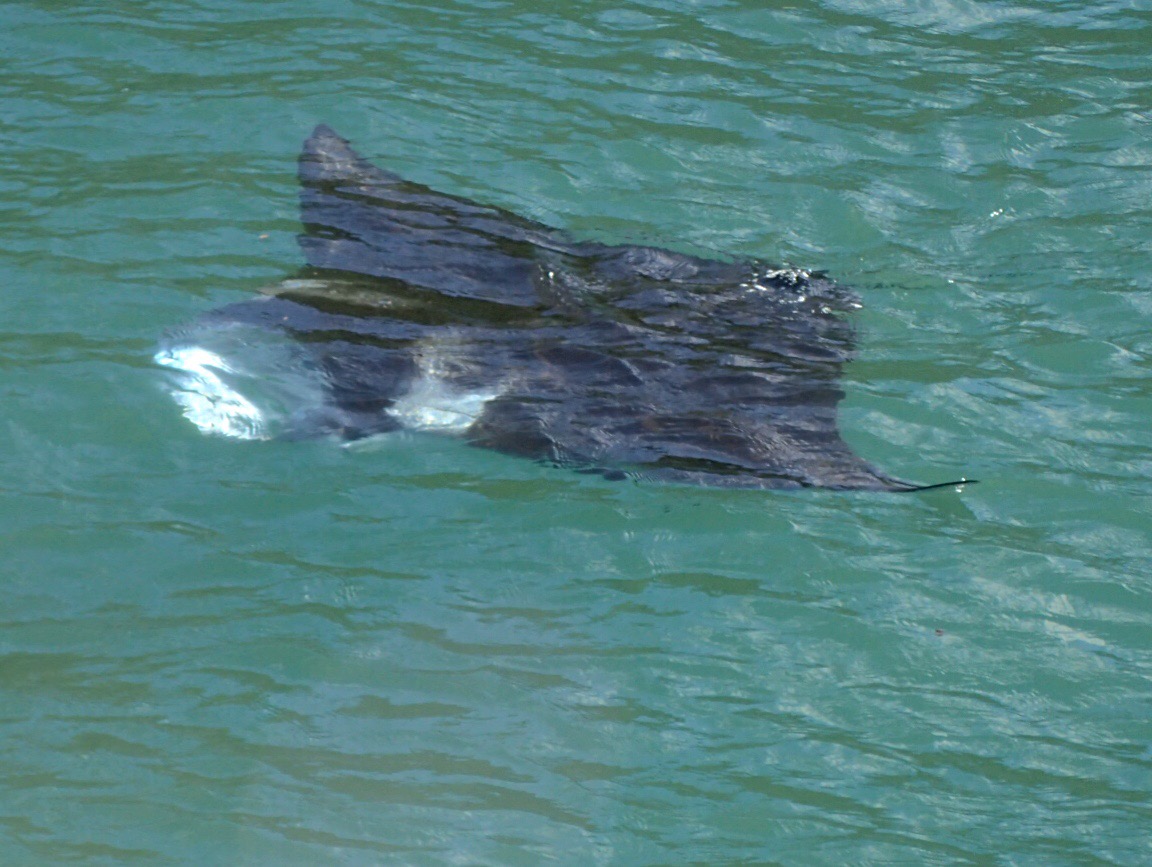
We are anchored in Tehou Bay, in the lea of Toopua Island in the SW corner of the Bora Bora lagoon. We are again in clear turquoise water, with green hills to shore and a dramatic white line of surf out to sea. When we arrived on Tuesday, having dropped the anchor carefully to ensure we weren’t going to snag on any coral heads, we jumped into the water and a school of twelve spotted eagle rays glided slowly past our feet. I love them, they are so graceful and have friendly faces a bit like a dogs. Out on the reef the tourist boats come to feed sting rays and black tips and to the south of us is a line of luxury, over the water, Hilton villas. 

Our only real issue is again lack of Internet, the only place we are finding anything is in the restaurants and with the eleven hour time difference back to the UK it is making communication quite difficult. In Tehou bay we don’t even have much of a phone signal.

Luckily Bora Bora is quite small so we can easily run back in to town. Wednesday night we decided to go back for Happy Hour at the yacht club as the guitarist from last week was to be there again. It was only about 2nm if we cut the corner off the main channel, so we took the iPad and recorded our track winding through the coral heads while it was still light and then followed the track back later that evening in the dark. It was quite exciting whizzing blindly through the night, Rick driving, me directing – right a bit, left a bit, LEFT A BIT MORE!

Thursday night Lili and Steve from Liward and Steve, Linda, Karen and Peter from Nina came onboard armed with meat, salad and beer and we had a BBQ. As the sun went down Steve broke out his guitar and we all, loudly, sang the night away, more enthusiasm than talent on the vocals, maybe that will teach people not to anchor quite so close to us. 

The next morning all a little worse for wear we took the dingies around the south of the island to a snorkelling spot. The day was calm, the water so clear and so blue we could see the coral ten meters down as if it was at the surface. There was quite a strong current running over the buoyed bank of coral, the trick was to swim hard against the flow to one side and then drift back over all the fish and repeat until you are exhausted. It amazes me that having been here for over three months, that we are still seeing new types of fish each time we snorkel, the star today was a roundish fish, about the size of a large serving platter, brown with green stripes and a large green stubby nose? Linda had bought the remains of last nights pasta salad, this was very popular with the smaller reef fish and caused a mini feeding frenzy all around us.

Small reef fish enjoying the pasta salad


Perhaps because of the night before or the strength of the current, we all tired quite quickly and we returned to our dingies and went over for lunch at Bloody Mary’s Restaurant. It is famous on Bora Bora, built in Polynesian style with thatched roof and sand floors, it’s been wowing its customers for over forty years. At the entrance they have two boards listing all their famous visitors, it seems everyone has been from Rod Stewart, to Diana Ross, to Cameron Diaz to Buzz Aldrin. The Bloody Mary’s were spicy, the burgers good and the wash basin in the ladies a waterfall, but no famous faces we could recognise.

Lunch at Bloody Mary’s


Between the fun there are still the routine jobs to do. Today one of our least favourite – cleaning the hull. After the fast growth rate in the Galápagos and Marquesas, the hull in the Tuomotu kept surprisingly clean so we have had a bit of a reprieve but it has been gradually getting worse again as we have sailed west. Close up we saw it had grown a whole eco system over the last couple of weeks.  So I cleaned the thick green slime from the waterline, while Rick put on his scuba gear and tackled the fuzz of weed and barnacles that were making our keel and rudder thier home.

With the hull pristine we should fairly fly to Tonga. Until then, here we sit awaiting the next weather window with our name on it.

Moving On

3am Tuesday 3rd May 2016


Goodbye to Marquesas


It was with a twinge of sadness we said a final farewell to the Marquesas. Impressing us to the end, the dramatic scenery continued as we sailed past the final island, Oa Pou, with its 3000ft spires of rock thrusting up into the sky it made a magnificent sight on the horizon. The Marquesas has to be one of the most visually stunning places we have ever been to, add to that the friendly cheerful people, the cleanliness and order of the towns and villages and the incredible flora and fauna and the rest of the Pacific has a lot to live up to.

  
Friday we finally left Anaho bay and returned to the main town Taiohae to stock up the cupboards, top up the petrol in the dingy tank and connect to the Internet. The plan was to leave Nuku Hiva early Monday morning, hopefully catching the promise of wind to take us the 520nm to Tuamotu.There was quite a bit of swell in the bay making the anchorage rolly and uncomfortable so we set to getting everything done as quickly as possible so we could move one bay down to Anse Hakatea or Daniels bay which looked more protected for our final couple of days.

The town dingy dock was full, we pushed ourselves between the crowds of other boats to reach the vertical ladder that takes us up the 6ft of concrete above us and the only way ashore. The supply boat had not been for a couple of weeks so the shelves at the shops were quite bare but our expectations are lower now and we felt happy with our purchases. To escape the rolling in the evening we went back ashore to the only restaurant in town, a pizza place, so used am I to spending evenings on one boat or another, as we approached the dock Rick noticed I wasn’t wearing shoes, to return to Raya would be bouncy and difficult, so in true Polynesian style I went to dinner barefoot.

We were up at six the next morning to see what we could find at the market and then went over to the fuel dock. Flush with tomatoes, Marquesian grapefruits, bananas and baguettes we set off. It was yet another beautiful and dramatic location, on one side of the bay the wall of rock rose vertically thousand of feet straight up from the sea. There was another pretty beach and the guide book tells us a 2-3 hr walk up the valley would bring us to a waterfall – the third highest in the world. Hot and tired from our busy few days we decided trekking could wait until tomorrow, turned on the AC and relaxed below.

Sunday morning however, found us fighting off a swarm of tiny flies, they were everywhere, in our breakfast, up our noses, covering every surface. Time to leave we decided, so instead of going ashore we readied the boat for departure. A manta ray with a 6ft wing span cruised by a few feet away to wish us farewell and by 10.30 the anchor was up.


It is now 3am on our second night at sea, clouds are building low in the sky making it difficult to identify the horizon, I assume that if another boat appears it lights will be obvious in the blackness. We have seen nothing since leaving Nuku Hiva. We are trying out four hour watches tonight, more difficult for the person on watch but a larger lump of sleep in between might help keep us more rested.

We have had some great sailing with the wind just behind the beam in calm seas. At present we are doing between 7 and 8 kts in sixteen or so kts of wind but with the occasional gust in the middle twenties we have reefed the Genoa. Jupiter our constant bright companion since we entered the Pacific is setting to the west, the moon a wafer thin slither of light is about to rise in the east.

For the past week we have been gathering information and discussing with other cruisers the best time to enter the passes of the coral atolls. The atolls are rings of coral, on top of some areas are sandy islands but mostly the coral barely rises above sea level. Occasionally there is a break in the coral big enough for a boat to pass through. Most of the water that enters into the lagoon also comes in and out of these passes so it is important to go through them at slack tide. We are trying to time our arrival at Kaueli atoll, our first landfall, to between 9 and 11 am on Wednesday morning. With light winds forecast it is going to be touch and go.

Landfall 

Tuesday 5th April

We stand in the Gendarmerie in Atuona, Hiva Oa, clinging to the desk looking blankly at the form in front of us, we must look like a group of drunks brought in to sober up. In fact we have all got a bad case of sea legs, the room sways in front of us and we are so dazed the filling in of the customs form is a real intellectual challenge. The Gendarme must be use to such scences, he smiles at us indulgently as he gently coaxes out of us the required information to check into French Polynesia.

How exciting is that, we have reached French Polynesia. Well deserved “got here beers” were enjoyed by all.


The final night had been stormy and the approach to the island quite rough. Our first glimpse of land for seventeen days, far off on the horizon, was of a huge slab of rock clocked in cloud. As we approached the anchorage our hearts dropped the sea didn’t appear to be much calmer and the anchorage was rumoured to be rolly. We craved calm.

Luckily rolly is relative and compared to our last few weeks the bay as we motored past the breakwater was positively tranquil. We looked around us, we were completely enclosed by steep green, green hills. The mountains behind us have dramatic sharp ridges that runs up into the mist. At the head of the bay is, what would be called in a school geography lesson a V shaped valley. Every patch of land is covered by exotic trees and luxurious vegetation. The beach is of black volcanic sand and the sea is brown from the rich soil that has been wash down during the heavy rains of the previous night.

View looking out from the bay

It is steamy hot and heavy downpours are frequent, the undulating road into town from the anchorage is about 2 miles long so we try to time it to pick up a lift with the yachting agent and sorter of all things in Hiva Oa, Sandra. Town is just a couple of roads but there is a bank, a post office and three small supermarkets. This is – French – Polynesia so at a price you can dine on fine wine, cheese and pate all served on crusty baguettes, there is however a distinct lack of fruit and veg. The locals apparently grow so much in their gardens that there is no demand for them in the shops. So for the yachties it is a case of dodgy deals from the backs of vans. 

The Marquesas are famed for thier pamplemousse, these large grapefruits are sweet and delicious and acted as a fitting welcome for our friends on Toothless as they arrived a couple of days after us. As did the squadron of small manta rays that filled the bay that day about eight of them swam around the boats for a couple of hours. It is nice to see familiar faces in far away places and we shared a nice lunch together comparing notes on the crossing.


The Marquesian people seem a contented bunch, smiling and helpful. On our first evening we went to one of the few restaurants in town, a pizza place that had a local band playing. The music was a mix of popular French and Polynesian songs, it was all very casual and unpracticed but they were obviously having such fun, it was infectious, the whole place was full of smiling faces, tapping and singing along to the tunes.

Besides being the welcoming first port of call for tired ocean crossing yachts, Atuona has one more claim to fame, it is the last residence and final resting place of Gaugin. There is a small museum and you can visit his house, unfortunately all his paintings were returned to France when he died, the display is full of copies only but the sumptuous gardens alone were worth the visit. Ian walked up the hill to picturesque grave yard where he is buried.


Today we plan to sail to a bay on an adjacent island about 10nm away, the bay is of rare white sand and the book says one of the prettiest in Polynesia. I think enjoy it here.

Don’t Buy Bananas

Friday 1st April 2016

It is our final night at sea, I’m doing the 3-6 am watch. It’s quite lively, I’m dressed in waterproof trousers as all the seats are wet from a succession of rain squalls, lightening flashes frighteningly in the distance and we are storming along at about 8kts. We have 52nm to go, the island of Hiva Oa is 4000ft high at its peak so we hope to see land soon after dawn. We are looking forward to getting there, this has been rolly trip.

At the end of our second ocean passage I thought I’d note down a few important things we have learnt.

Don’t buy the traditional large bunches of bananas, they arrive full of spiders and cockroaches and their sap stains the teak decks. However green you buy them and however many different places and conditions you find to store them in they all ripen together on day two and have to be chucked, for fear of banana gas poisoning, overboard by day four.

The satellite link is essential, not just for weather forecasts but for the emails we receive from everyone that, in the absence of whales, brighten up our days.

Weather forecasts are almost always wrong – well should be read as trends rather than truths.

Be prepared for copious amounts of facial hair, it seems it is obligatory for most men to grow as much as they can for the duration of the passage.

Have plenty of spectacle mending kit/spare pairs onboard, Raya seems to be a glasses disaster area.

Develop daily routines to give the day structure, like the morning “what shall we eat today?” conversation, the 4.30pm crossword and the boys afternoon cockpit snooze.

Rotate the watch system, everyone deserves to experience the uplift the dawn brings after a dark night watch.

Yes you can sleep in those sheets for a couple more nights, it is shocking how disgusting the bedding can get without any adverse effects.

Don’t rely on the fishing rods to provide dinner, or the freezer to keep things frozen, enjoy the challenge of what can be created with one green pepper, half a carrot and slightly mouldy lump of cheese.

And finally, beware of flying kettles!

Stars, Scalds and Swordfish

Easter Sunday 27th March 2016

08 55.491 S, 126 05.610 W – 760nm  to go

The stars are fantastic this evening, the sky is almost cloudless and the moon has yet to rise, allowing them to to take centre stage. I was going to start this post by saying that this will not go down as one of our favourite passages but instead find myself marvelling at the fact that I’m sitting here being pushed across an ocean by just the wind, we eat, we sleep, we read but Raya just keeps ploughing on. The night breeze is soft on my skin and the only noise is the occasional flap of the sail and the water rushing past our hull. The swell has finally reduced making everything much more comfortable. It seems churlish to complain.

The roll has been the main issue for most of the way and I am suffering because of it. Almost as the last scab flaked off my grazed shins I had another accident, this one potentially much more serious. While making my morning cup of tea on Thursday we were hit by a wave at a particularly awkward angle the boat lurched over, the kettle flew off the counter and its boiling contents splashed onto my side. Luckily my first aid training took over and I was in a cold shower within thirty seconds, I stayed there for ten minutes before Rick applied a cooling burns dressing. Our quick action seems to have contained the damage, it’s a bit messy but the pain is being controlled by codeine and I seem to be healing fine. The careful planning of the first aid supplies came in to their own, we had everything we needed and easily to hand. It certainly brought home, especially to Rick who was having to manage the situation, how vulnerable we are and how extra careful we have to be.

I loved Rachael’s response ” Mum, you sail half way around the world only to be taken out by a kettle, how English”

The lumpy seas have also curtailed our fishing, we did put the rod out one afternoon and it appears the Pacific is full of fish. Within an hour we had hooked a 5ft long sword fish, there was no way we could land him, luckily he broke the line and got away, but not before giving us a fantastic display, leaping from the water, showing off his power and grace. Half an hour later the line screamed again, this time it was a much more manageable 3ft dorado and supper.

The days slip by blending into each other, nothing but mile after mile of sea, great excitement if we see a bird, even more excitement if we can identify it in our Birds of the Pacific book. The visit of a large pod of dolphins kept us entertained for hours, first watching them then looking them up and finally rerunning the videos and photos we have taken of them. A small sailing boat popping up on the AIS or lights on the horizon are greeted with enthusiasm and emails from home bring a smile to our faces and are read aloud to be shared.

The miles to go counter now reads 750nm and the guides to Marquesas are being studied. Hoping for landfall on the afternoon of the first or the morning of the second, apparently  dramatic cliffs, waterfalls and pamplemousse await us.

Not So Peaceful Pacific

Monday 21st March 2016

Position : 06 46 S, 107 10 W (middle of the Pacific Ocean, a long way from anywhere)

Last night we reached 10,000nm sailed on Raya, almost exactly a year since our first post-refit sail. All that seems a very long time ago now, a lot of water has past under our keel since then. We still get things wrong sometimes but we are gradually moving towards the accolade of Salty Old Sea Dogs. Actually the Salty and Old bits seemed to have come rather too easily, the Sea Dog status is more of a challenge.

It’s been a relatively eventful trip so far. We were given a fitting farewell to the Galapagos by a clutch of penguins dodging and diving, fishing around the boat. This helped to cheer me up as I painfully applied antiseptic to a large graze I had acquired, tripping up a high pavement, returning to the boat with last minute supplies.

As we sailed away we glimpsed a whale and were treated to a final formation fly-past by a flock of blue footed boobies. Alas, down below things were not so good, Rick was up to his elbows in diesel unblocking a fuel pipe to the generator. From the evidence of the filters and now this blockage, it looks like the fuel we picked up in either Panama or Galapagos wasn’t that clean.

The sailing was great however with flattish seas and F4 winds, we made good progress. To top it off on day two we finally properly saw our first whale, a couple of short finned pilot whales swimming with a pod of dolphins.

But the status quo doesn’t last long at sea and we were soon becalmed and the motor was on. The drop in the wind was expected and one of the reason we were sailing south west rather than directly west out of Galapagos. The southeast trade winds were forecast at below about 4 degrees south, the decision was how much to motor using our precious fuel knowing we had nearly 2500nm still to go, to get us down to them. Our patience, especially mine, is not great but after about nine hours of motoring we managed to coax the sails into taking us along at 6kts.

We now, six days in, have good winds and are sailing fast straight for Marquesas, if we keep these sorts of speeds up it should make for a quick trip. We are paying for it however with a 3m swell on our beam, making life, especially below, rather uncomfortable. The skies have been grey for the past few days, with a scattering of showers making the nights dark. On the upside the watch system with three of us on board is working well, after a couple of nights pairing with Rick, Ian is now happy doing a watch on his own which means we are doing 3hrs on, 6hrs off. Six hours of sleep seems like luxury on passage and we are all relatively rested despite the conditions.

The flying fish are again doing their thing and landing on the boat throughout the night. As well as the normal scattering on the deck, we have had one baked in the morning sun stuck to the large salon windows,  a squid (how does a squid fly?…) on the coach roof, one that flew right up onto the Bimini roof and bounced back into the sea and one that like a guided missile came out of the water and hit Rick straight in the eye!
Surprisingly we have seen quite a few boats, yesterday we were checked out by a navy vessel, they didn’t come close enough for me to ascertain their nationality but in away it is comforting to see them around and about and a large tanker slid by on the horizon enroute to South America. More difficult were the five or so vessels from a Japaneese fishing fleet we came across during the night. As they are following the fish, turning this way and that their route it is difficult to judge, especially the one boat that didn’t have AIS. Luckily they were not hard to see being nearly 200ft long and lit up like Christmas trees.
A few days ago getting into the rhythm of the sea we relaxed and were enjoying the ride. Relaxed a bit too much maybe, the winds were freshening and we decided to put a reef in the main before darkness fell. Disaster, a lapse of concentration and a gust of wind popped our super sensitive inmast furling system again. Rick has reefed the mainsail by hand to about two thirds which should be ok for the whole passage but does mean when we get to Hiva Oa the first island we visit in the Marquesas group, we will have to find somewhere safe to detach the boom – probably at anchor?!?

Add to that the fact that I have, fighting with the swell, just managed to tip the omelette egg mix on to the galley flour not once but twice! You see this Sea Dog stuff is not as easy as it sounds.